
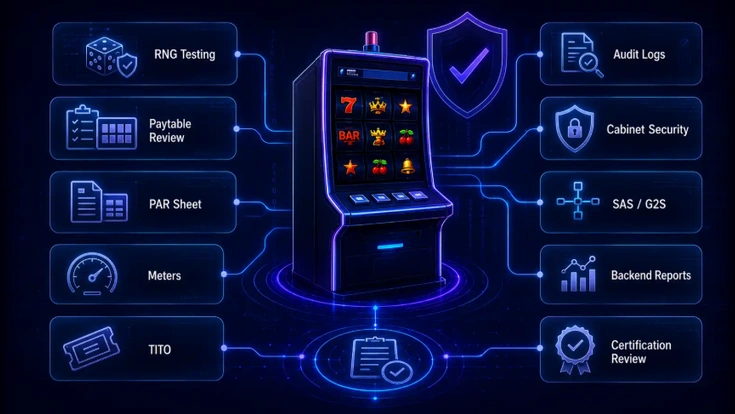
EGM compliance testing checks whether a gaming machine works correctly and meets regulatory rules before launch. The review covers game software, RNG, payouts, security, meters, tickets, reports, audit logs, and system connections.
Requirements vary by jurisdiction, machine type, lab process, and submitted configuration. In this guide, operators can review the main areas that matter before testing, certification, and deployment.
Quick Summary of EGM Compliance Testing
Plain-English takeaway: Compliance testing checks the machine, its records, and its connected systems as one controlled product.
| Area | What It Means |
|---|---|
| Main purpose | Review whether an EGM operates, records, recovers, and reports correctly |
| Testing scope | RNG, paytables, meters, TITO, audit logs, cabinet controls, protocols, and reports |
| Certification | A formal result of review, based on applicable rules and submitted configuration |
| Jurisdiction | Rules and technical requirements may differ by market |
| Main users | Operators, labs, regulators, manufacturers, technical teams, audit teams |
| Operator value | Clearer machine review, fewer launch issues, better records, safer change control |
Evidence and Submission Planning Benchmarks
Plain-English takeaway: A complete submission package prevents more delays than last-minute retesting.
What Public Standards Confirm
GLI states that it supports regulators, suppliers, and operators across more than 710 jurisdictions. This scale shows why certification cannot be treated as one universal approval process.
Jurisdictions served by GLI, showing the range of market-specific requirements.
A certification normally applies to the submitted software version and configuration, not every future release.
Common submission problems fall into math, meters, event records, and system communication.
Submission example: A meter-mapping mismatch can stop the machine record from matching the host report. The product team must then correct the mapping, rebuild the submission package, and repeat the affected tests before certification can continue. There is no universal certification timeline. The lab sets the schedule after reviewing the jurisdiction, product scope, documentation, machine configuration, and testing issues.
What Is EGM Compliance Testing?
Plain-English takeaway: The lab checks whether the machine behaves exactly as its documents and approved configuration describe. EGM compliance testing is a technical review of a gaming machine against applicable standards, rules, and submitted behavior.
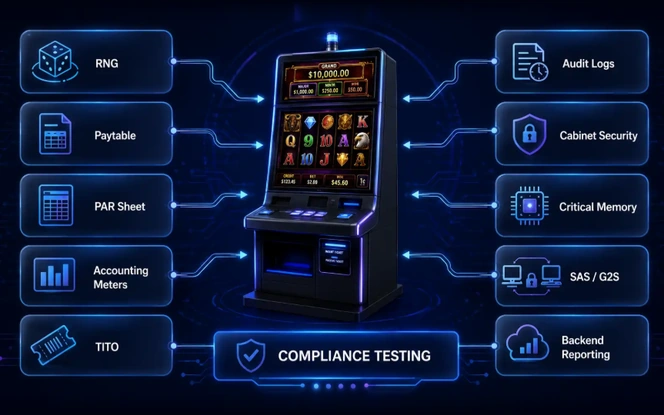
The review checks how the machine selects outcomes, evaluates prizes, stores records, handles tickets, and reports meters. It also covers critical-area protection, recovery after interruptions, and host-system communication. GLI's standards library includes GLI-11 for gaming devices and other standards that may apply depending on the device, system, or feature being reviewed.
In practical terms, compliance testing asks whether the machine can be trusted as a controlled gaming device in its target market.
What Testing May Confirm
Testing confirms whether:
- The RNG behaves correctly
- The paytable awards the correct prizes
- The PAR sheet matches the expected math
- Accounting meters update correctly
- Ticket records are created correctly
- Audit logs capture important events
- Cabinet access is recorded
- Critical memory preserves key data
- Software versions are identifiable
- SAS/G2S messages are handled correctly
- Backend records match machine records
- Recovery behavior is reviewable
Compliance Testing vs Certification vs Approval
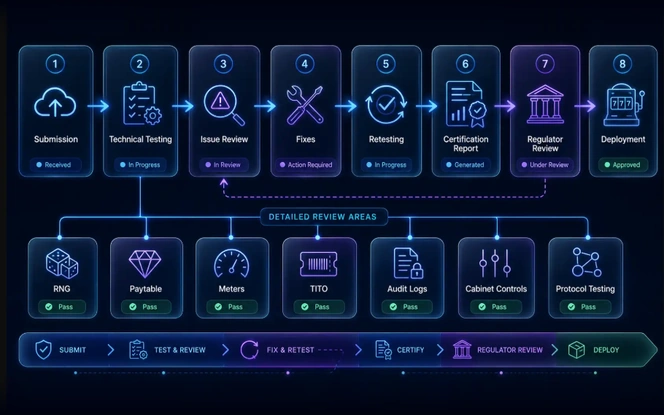
Plain-English takeaway: Testing finds issues, certification records the result, and the regulator decides whether the product can enter the market. Although compliance testing, certification, and approval are related, they are not the same.
| Area | Meaning | Important Note |
|---|---|---|
| Compliance testing | Technical review against standards, rules, and submitted behavior | Testing scope depends on the machine and jurisdiction |
| Certification | Formal documentation or lab output after review | It usually applies to a specific version and configuration |
| Regulatory approval | Permission or acceptance from the applicable authority | Approval rules vary by market and regulator |
| Operator acceptance | Operator-side review before floor deployment | It checks readiness in the live operating environment |
An EGM can pass one review stage and still need more work before floor deployment. Therefore, operators should confirm the exact path with the lab, regulator, and internal compliance team.
Why Jurisdiction Matters
EGM requirements are not universal. Each jurisdiction may define its own technical standards, submission process, reporting rules, lab requirements, approval steps, and deployment controls. Singapore is a useful example, but it should not be treated as the only reference point.
Regulated EGM markets such as the United States, Great Britain, Australia, and Singapore may apply different review approaches. A machine reviewed for one market is not automatically accepted in another, because the regulator, technical standard, lab process, machine type, software version, and submitted configuration all matter.
| Jurisdiction Example | What It Shows | Operator Note |
|---|---|---|
| Nevada, USA | Nevada Technical Standard 1 covers technical standards for gaming devices and associated equipment, including areas such as control programs, RNG, communications, and metering. | Nevada is a strong reference for land-based casino gaming device review in the United States. |
| New Jersey, USA | New Jersey Chapter 69E covers gaming equipment rules under the Division of Gaming Enforcement framework. | New Jersey shows that U.S. state-level gaming equipment rules can differ from Nevada and should be checked separately. |
| Great Britain | The Gambling Commission gaming machine technical standards cover requirements around game features, display notices, general machine operation, and metering. | Great Britain uses its own machine technical standards and testing approach for licensed gambling environments. |
| New South Wales, Australia | NSW gaming machine technical standards reference the Gaming Machine National Standard for gaming machines, game software, and related equipment. | Australian states and territories may apply technical standards and approval requirements through local regulators. |
| Singapore | Singapore's Gambling Regulatory Authority states that EGMs deployed in Singapore must be secure, reliable, and auditable. | Singapore is useful for showing the importance of security, reliability, and auditability in EGM review. |
What Testing Labs Usually Review
Plain-English takeaway: Labs inspect the complete machine flow, not only the visible game screen. Testing labs review multiple machine layers rather than only the visible game screen.
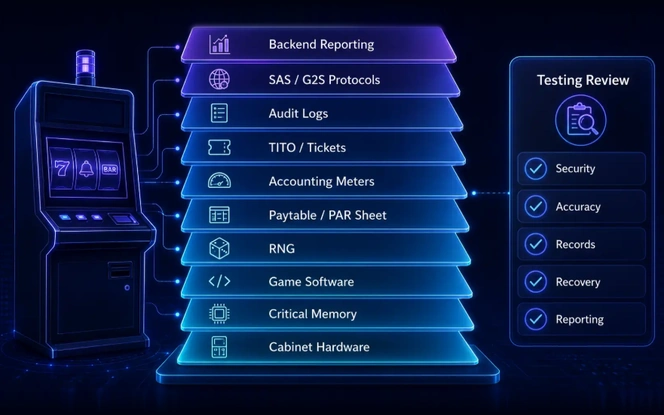
GLI-11 covers requirements for gaming devices, and its scope helps show why a gaming machine review can include game behavior, cabinet controls, records, meters, communications, and recovery behavior. Labs review these layers:
- Cabinet hardware
- Game software
- Critical memory
- RNG behavior
- Game outcome logic
- Paytables and PAR sheets
- Bonus features
- Accounting meters
- TITO and ticket handling
- Audit logs and event records
- Cabinet access events
- Protocol communication
- Backend reporting
- Recovery after interruption
Overall, the goal is to review the full machine flow from wager to result, result to record, and machine record to reporting layer.
RNG and Game Outcome Testing
Plain-English takeaway: A valid random number is useful only when mapping, display, prizes, recall, and records are also correct. RNG and outcome review checks whether the machine selects, maps, displays, evaluates, records, and reports results correctly. EGM RNG and game outcome testing follows the result from generation to final record. Labs review seeding, random selection, reel or symbol mapping, bonus triggers, jackpot triggers, game recall, prize evaluation, meter updates, and audit records.
| Review Stage | What the Lab Confirms |
|---|---|
| Random selection | The RNG produces outcomes without predictable patterns. |
| Outcome mapping | The selected value maps to the correct reel, symbol, card, or bonus result. |
| Prize evaluation | The paytable awards the correct prize for the displayed result. |
| Recall and records | Game recall, meters, and audit logs preserve the same outcome. |
For example, a valid RNG result can still fail review when the mapping table displays the wrong symbol combination or records the wrong prize.
Paytables, PAR Sheets, RTP, and Math Review
Plain-English takeaway: The displayed prizes and game settings must match the submitted math model. Game math review confirms whether the configuration and expected performance match the submitted model. EGM paytables and PAR sheets are reviewed for:
- Prize values
- Winning combinations
- Symbol mapping
- Reel strips
- RTP
- Volatility
- Hit frequency
- Bonus contribution
- Progressive contribution
- Bet-level rules
- Denomination settings
- Configuration consistency
A paytable issue can create incorrect prizes even when the RNG and display work correctly. For this reason, paytable evaluation, PAR sheet review, and outcome testing should be reviewed together.
Accounting Meters and Financial Records
Plain-English takeaway: Meters must show the same value movement on the machine, host system, and financial reports. Accounting meters are central to EGM review because they show how value moves through the machine. EGM accounting meters include records for:
- Credits bet
- Credits won
- Games played
- Bill-in value
- Ticket-in value
- Ticket-out value
- Handpay value
- Jackpot value
- Cancelled credits
- Promotional credits, where supported
- Game-specific meters
- Denomination-level values
Meter testing may review whether local machine values, host values, backend reports, ticket records, and cashier records stay aligned.
TITO, Voucher, and Ticket Testing
Plain-English takeaway: Every ticket must be created, validated, recorded, and redeemed without breaking reconciliation. TITO testing checks whether ticket-in, ticket-out, validation, printing, meter updates, and redemption records work together correctly. TITO in slot machines follows a clear lifecycle. The machine reads the barcode, validates the voucher, transfers the value, updates the ticket-in meter, and stores the transaction.
| Ticket Stage | Required Result |
|---|---|
| Ticket in | The barcode is read once, validated, and added to machine credit. |
| Cashout | The machine creates one valid voucher and updates the ticket-out meter. |
| Fault handling | Printer, barcode, network, and duplicate-ticket errors create clear records. |
| Redemption | The cashier or kiosk record matches the original machine transaction. |
A failure at any stage affects player support and financial reconciliation. For example, a printed voucher without the matching host record may require manual investigation before payment.
Cabinet Security, Door Events, and Critical Memory
Plain-English takeaway: Physical access and power recovery must not hide or change important machine records. In addition, EGM review covers the physical and protected areas of the machine. EGM cabinet components include a bill validator, ticket printer, cash box, door sensors, logic board, critical memory, display, button panel, and communication module. Testing reviews whether:
- Cabinet doors are detected correctly
- Logic area access is recorded
- Cash box access is recorded
- Critical memory preserves data
- Program storage is protected
- Secure compartments behave correctly
- Faults create reviewable records
- Power loss recovery works correctly
- Game state is preserved where required
- Credits and meters recover correctly
- Access events are timestamped
- Machine status is clear after recovery
Cabinet security and critical memory matter because physical access, storage, and recovery behavior can affect trust in the machine record.
Audit Logs and Significant Event Records
Plain-English takeaway: A reviewer should be able to reconstruct important machine activity from the event log. Audit logs help explain what happened before, during, and after important machine activity. EGM audit logs and event records include:
- Door open and close events
- Logic access events
- Power resets
- Printer faults
- Bill validator errors
- Handpay conditions
- Jackpot events
- Configuration changes
- Paytable changes
- Communication failures
- Critical memory errors
- Recovery events
During testing, reviewers may check whether important events are recorded with the right timing, sequence, and machine context.
SAS/G2S Protocol and Backend Reporting Review
Plain-English takeaway: The machine and host system must report the same meters, events, tickets, and status. EGMs usually communicate with host, ticketing, monitoring, player-tracking, or backend reporting systems. SAS and G2S protocols support communication for:
- Meter reporting
- Event reporting
- Ticket records
- Handpay records
- Machine status
- Fault alerts
- Player tracking
- Bonusing
- Cashless features, where supported
- Backend reports
- Communication failures
- Reconciliation records
Therefore, protocol testing checks whether the machine record and backend system record tell the same story.
Software Versioning, Configuration, and Change Control
Plain-English takeaway: Certification follows a controlled version, so every later change needs a documented review. Compliance review usually depends on a specific machine version, game version, configuration, and document set. Change control records the game version, program storage, configuration, paytable, denomination, protocol version, peripheral firmware, hashes, signatures, release notes, and approval history.
| Change | Typical Review Impact |
|---|---|
| Text-only correction | The team documents the change and confirms that game behavior is unchanged. |
| Paytable or math change | The affected game math, prize evaluation, meters, and records require retesting. |
| Protocol or firmware change | Communication, event reporting, fault handling, and backend records require review. |
| Major software release | The lab reassesses the full affected scope under the target jurisdiction. |
Even a small configuration change can expand the review scope. Teams should connect every release to its approved files, hashes, test results, and deployment record.
Operator Acceptance Testing
Plain-English takeaway: The operator confirms that the approved machine also works correctly on the live floor. Lab testing and certification are not the only review steps. Operators may also run acceptance testing before floor deployment. Operator acceptance testing checks:
- Machine startup
- Game selection
- Bet levels
- Paytable display
- Ticket insertion
- Ticket cashout
- Printer behavior
- Meter reporting
- Host communication
- Floor alerts
- Handpay workflows
- Player tracking
- Backend reports
- Support procedures
Finally, this step confirms that the approved setup also works correctly in the operator's real environment.
Common Compliance Mistakes
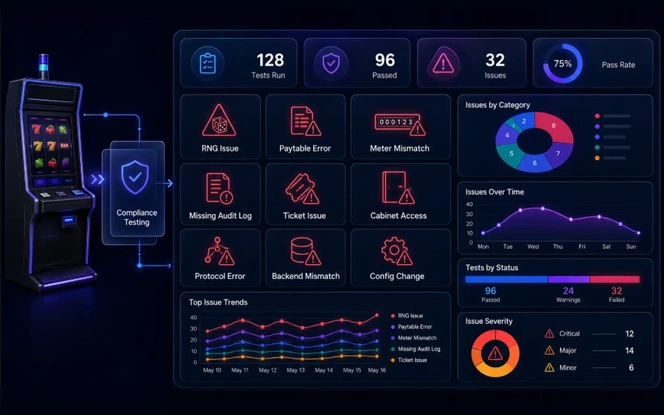
Plain-English takeaway: Most failures happen when game behavior, configuration, records, and backend reporting do not match. Many EGM review issues come from gaps between machine behavior, records, configuration, and backend reporting. As a result, teams should test the full machine-to-system flow rather than isolated parts.
RNG Reviewed in Isolation
The RNG may work, but mapping, display, paytable evaluation, meters, and records still need review.
Paytable and PAR Sheet Mismatch
The displayed paytable, game configuration, and submitted math model should stay aligned.
Meter Mapping Errors
Incorrect meter mapping can create reconciliation issues even when the game outcome is correct.
Missing Audit Events
Door events, power resets, handpays, faults, and configuration changes should be reviewable where required.
Ticket Flow Gaps
TITO issues can affect player support, cashier records, meter values, and backend reconciliation.
Protocol Reporting Mismatch
Machine records and backend records should match, especially for meters, tickets, events, and handpays.
Operator Checklist for EGM Compliance Testing
Plain-English takeaway: A structured checklist catches submission gaps before they become lab findings. Before submission, operators and product teams should review the following areas:
- Applicable jurisdiction
- Machine type
- Game software version
- Configuration settings
- RNG behavior
- Outcome mapping
- Game recall
- Paytable evaluation
- PAR sheet alignment
- RTP and volatility model
- Bonus feature behavior
- Jackpot feature behavior
- Accounting meter updates
- Ticket-in records
- Ticket-out records
- Handpay records
- Audit log coverage
- Door event logging
- Critical memory recovery
- Printer faults
- Bill validator faults
- SAS/G2S communication
- Backend reporting
- Software hashes or signatures
- Change control records
- Operator acceptance testing
- Retesting triggers
- Deployment readiness
Overall, this checklist helps operators review the EGM as a full system rather than only a cabinet or game screen.
Ready to Prepare Your EGM for Compliance Review?
Reduce testing delays with clearer documentation, stronger machine records, controlled configurations, and reliable backend reporting.
Talk to Our Compliance ExpertsFAQs About EGM Compliance Testing and Certification
Plain-English takeaway: These answers explain the main business, testing, cost, and approval questions in simple terms.
EGM compliance testing is the technical review of an electronic gaming machine against applicable standards, jurisdictional rules, submitted configuration, and expected machine behavior.
No. Testing is the technical review process. Certification is the formal document or result that may follow testing. Regulatory approval may still be required.
Testing labs review RNG behavior, paytables, PAR sheets, accounting meters, TITO, audit logs, cabinet controls, critical memory, communication protocols, backend reporting, and recovery behavior.
Each jurisdiction may have different technical standards, submission rules, testing requirements, reporting needs, and approval steps. Requirements should always be checked for the target market.
RNG testing checks whether random outcomes are generated and processed correctly. It is usually reviewed with outcome mapping, paytable evaluation, meter updates, and game records.
Compliance testing helps ensure your product follows industry rules, works safely, and is ready for certification.
You may face legal issues, fines, product rejection, launch delays, or loss of customer trust.
The cost depends on your product, industry, testing scope, jurisdiction, and certification requirements. A testing provider can review your needs and give you an exact estimate.
Usually no. Certification and approval depend on the jurisdiction, submitted configuration, lab process, regulator, machine type, software version, and required technical standards.
Final Thoughts
Plain-English takeaway: Treat the EGM as one machine-to-system record from wager through final report.
EGM compliance testing and certification review connect every major layer of the machine. The review may include RNG behavior, game outcome logic, paytables, PAR sheets, meters, TITO, cabinet security, critical memory, audit logs, SAS/G2S communication, backend reporting, software versions, and operator acceptance testing. For operators, the safest approach is to treat an EGM as a full machine-to-system environment. The game result, machine record, ticket record, event log, and backend report should all support the same story. Clear records, controlled configurations, tested recovery behavior, and jurisdiction-specific review make EGM deployment easier to audit and easier to operate.