An NGO evaluating ERP for operations in Germany should examine how records are created, corrected, retained and retrieved. A visible audit log is useful, but it does not by itself establish that the whole recordkeeping process meets the organisation's applicable obligations.
GoBD is the German abbreviation for principles concerning proper electronic bookkeeping, record retention and data access: Grundsätze zur ordnungsmäßigen Führung und Aufbewahrung von Büchern, Aufzeichnungen und Unterlagen in elektronischer Form sowie zum Datenzugriff. Determine applicability with the responsible German accounting or tax adviser, then translate the relevant requirements into documented processes and testable system controls.
Which records fall within the german review?
Identify the entity, activities, accounting arrangements and systems involved. Include upstream applications, document capture, interfaces and archives where they affect the records. A review limited to the ERP's final report can miss important parts of the process.
The Federal Ministry of Finance published a GoBD amendment dated 14 July 2025. Check the applicable underlying guidance and subsequent changes with your adviser; an amendment notice is not a complete implementation checklist.
Record the assessed requirements in the compliance register, including source, applicability, responsible owner and review date. Avoid treating an “NGO” label or a vendor's general compliance statement as a substitute for the entity-specific assessment.
Corrections must leave an explainable history
For the approved process, define how a record can be followed from source evidence to entry, correction and report. Stable references should connect the transaction with its documents and approvals. A filename or free-text note is often insufficient for reliable retrieval.
The country-specific configuration design should preserve effective mappings and historical versions. The security requirements should identify who may create, approve or correct records and how those actions remain reviewable.
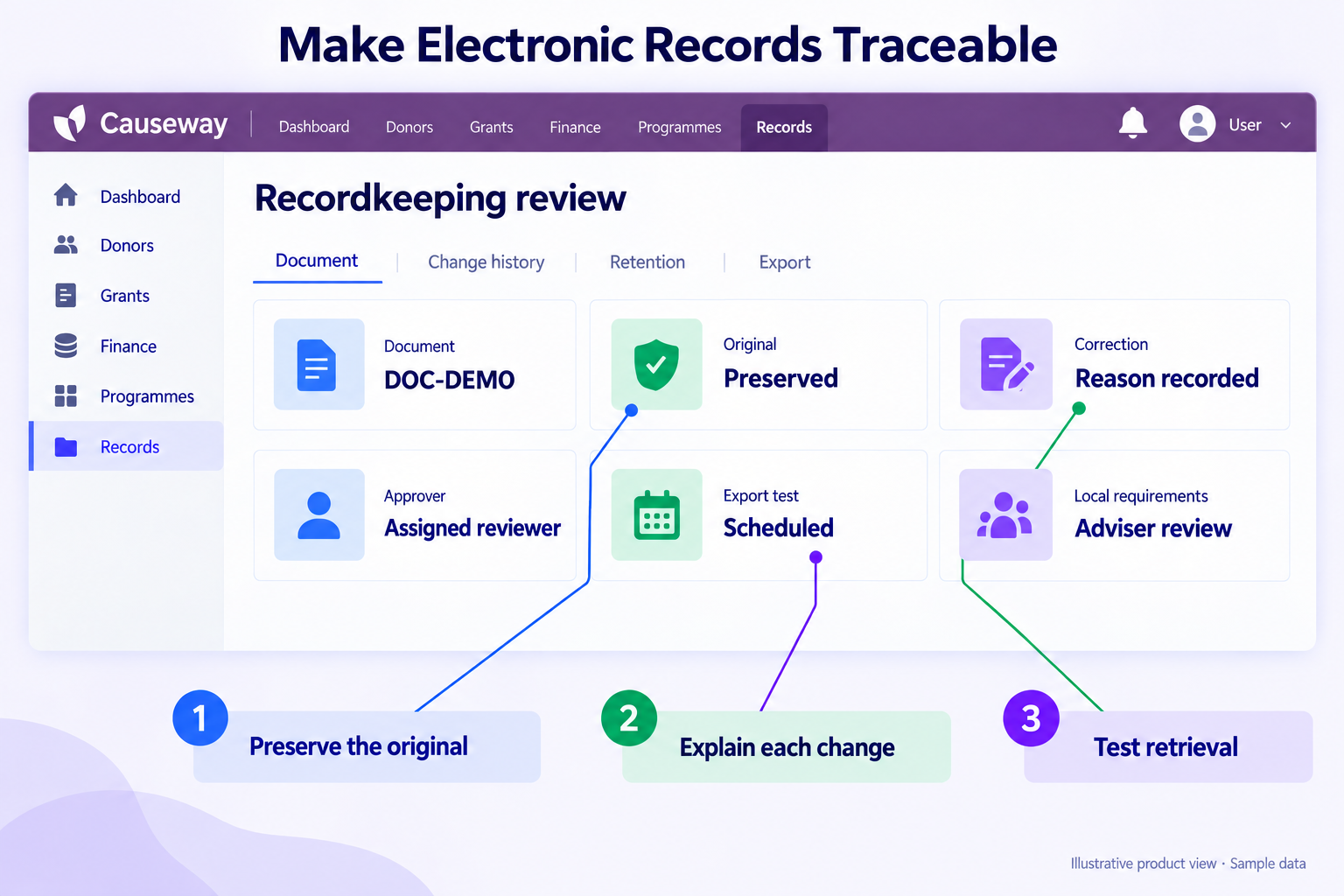
To test the correction process, enter an invoice against the wrong project, identify the error and perform the approved correction. Ask an independent reviewer to reconstruct the original entry, reason for change and final treatment. Use the correction procedure approved for that record type and retain its supporting evidence.
Process documentation describes actual operation
Prepare process documentation that reflects actual operation. Describe the applications involved, record flows, responsibilities, controls, exceptions and relevant changes. Assign ownership so the documentation remains current after staff or system changes.
| Process Area | Question To Document |
|---|---|
| Capture | How does the source document enter the controlled record? |
| Validation | Who checks completeness and classification? |
| Correction | What authority and evidence govern changes? |
| Interface | How are failed or duplicate transfers resolved? |
| Retrieval | How can authorised reviewers obtain the required evidence? |
Distinguish product documentation from the NGO's own procedure. A manual may explain how a feature works without describing who uses it, which checks are performed or how exceptions are resolved in your organisation.
Review an ordinary transaction and an exception with the people who perform the work. If the documented procedure requires a step that nobody actually takes, resolve the gap rather than assuming the written process is sufficient evidence.
Test retrieval, exports and retention
Define the record categories, retention decisions and retrieval needs confirmed by your adviser. Test representative older records as well as recent ones. Include attachments, relationships and relevant history, not only the current value in a database field.
The integration design should explain what happens to records entering from other systems and how transfer exceptions are reconciled. If evidence remains outside ERP, the retrieval procedure needs to reach it reliably.
Test an export using the agreed scope and format. Confirm that identifiers, dates, currencies and relationships retain their meaning. An export that opens successfully may still be incomplete or difficult to interpret without its mappings and documentation.
Avoid a universal retention setting applied to every record. Keep the basis, category, trigger and owner of each retention decision clear, including any holds or other obligations that affect disposal.
Local requirements become acceptance criteria
Ask the accounting or tax adviser to validate the relevant process and evidence requirements before they become software acceptance criteria. Then require the supplier to show how the proposed configuration supports them and where external procedures remain necessary.
Keep vendor assertions precise. A statement that a feature supports traceability is different from a guarantee about the organisation's entire compliance position. Ask for the scope and evidence behind any assurance language rather than accepting a broad certification claim without context.
Reassess the design when interfaces, document formats, responsibilities or applicable requirements change. Preserve review records and unresolved actions. The goal is an operating process that can be explained and tested over time, not a one-time checklist completed during implementation.
Rehearse an export with its process documentation
Choose a transaction that includes an original document, approval, correction and final posting. Export the records with identifiers that preserve their relationships. Check that dates, account mappings, tax-relevant classifications and change history remain intelligible outside the application.
The accompanying process documentation should explain capture, validation, authorisation, corrections, retention, access and system changes. Identify which steps belong to the NGO, the software provider and any scanning or archive service. A file export without that context can leave an authorised reviewer unable to reconstruct the process.
Use the BMF's GoBD amendment notice as part of checking the current source material with a German adviser. Have the adviser assess the exported records and process documentation against the applicable requirements. A usable export alone does not establish that the recordkeeping process satisfies them.
An audit trail a reviewer can follow
In a worked record, invoice INV-01 is entered against Project A, then corrected to Project B under approval COR-01. Retain the original classification, correction method, actor, timestamp, reason, reviewer and final posting reference. The history should show the approved procedure; it should not make the original entry disappear.
The process-documentation checklist covers source capture, application ownership, validation, authorisation, correction, failed interfaces, retention, access, export interpretation and change control. Assign a version and owner to the procedure. Test a transaction against the documented steps and record any difference between the procedure and actual operation.
Map each obligation to its control, evidence and reviewer in the Global Compliance Controls Matrix. Focus recordkeeping acceptance on traceability, process documentation, retained evidence and usable exports.
Conclusion
Focus acceptance testing on traceability, process documentation, retained evidence and exportability. Follow one corrected transaction from its original entry through approval and reporting, then retrieve it with the process documentation that applied. The local review determines which records and requirements are in scope. A successful export is useful only if a reviewer can interpret it and reconstruct the relevant history without relying on undocumented staff knowledge.
Review your recordkeeping requirements
Causeway supports configurable finance, reporting, approval and recordkeeping controls within a global NGO operating platform. Evaluate those controls against your reviewed requirements for German recordkeeping, corrections, process documentation and audit exports. Use a corrected transaction and an audit-export request to evaluate the recordkeeping workflow. The demonstration should preserve the original entry, explain the correction and retrieve the process documentation that applied at the time.
Frequently asked questions
Does an audit log alone satisfy recordkeeping duties?
No single feature establishes the organisation's full position. Assess the applicable requirements across capture, processing, correction, retention and access. Test the audit evidence as part of that wider process and have the relevant adviser review the result.
Can a vendor guarantee compliance for every organisation?
Treat such a broad statement cautiously. Applicability and operating procedures depend on the organisation's circumstances. Request precise scope and evidence for the supported controls, while retaining appropriate local accounting or tax review.
What process documentation should be reviewed?
Review the actual record flow, applications, responsibilities, validations, corrections, interfaces, retention and retrieval procedures. Include exceptions and changes. Product manuals can support this work but do not replace documentation of how the NGO operates the system.