
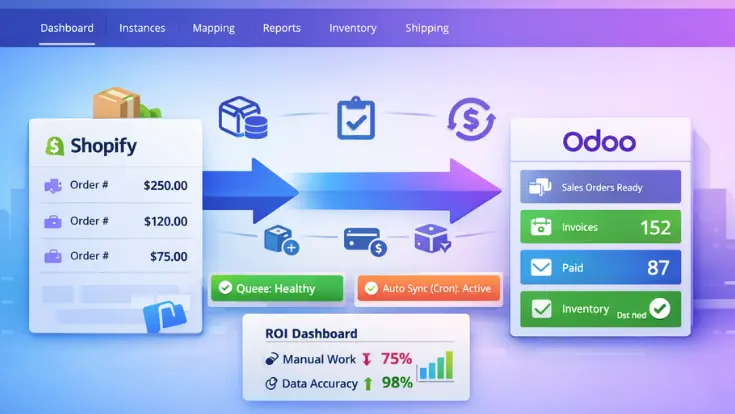
SDLC Corp today announced the release of its new Odoo–Shopify Connector, a production-focused integration that helps eCommerce teams keep Shopify storefront data and Odoo ERP records aligned across catalog, customers, orders, and stock.
Shopify and Odoo solve different parts of commerce operations. However, teams lose time when data drifts between systems. For example, mismatched SKUs can create duplicate products. Then inventory updates land late, and oversells follow. As a result, finance and fulfillment teams spend hours reconciling records that should already match.
SDLC Corp built the connector for those day-to-day realities. Instead of treating “sync” as one button, the product focuses on mapping control, audit-ready logs, and recovery workflows that teams can run without guesswork. In addition, the connector supports structured configuration so teams can match sync behavior to their internal process.
A connector built for real operations
In many implementations, the first sync succeeds, and the second sync fails. Therefore, SDLC Corp designed the connector around repeatable operations, not a one-time setup. Teams can set defaults, tune schedules, and keep a clear trail of what happened. Then they can fix problems fast when an exception appears.
The connector supports multi-store and multi-instance setups, so teams can connect more than one Shopify store to Odoo when needed. In addition, it supports multi-company setups in Odoo, so teams can route transactions to the right company and warehouse configuration. This matters when brands run separate legal entities, separate warehouses, or separate tax rules.
What the connector synchronizes
The SDLC Corp Odoo–Shopify Connector supports the core objects that drive daily operations:
- Products and variants, including key fields such as title, SKU, price, weight, images, and options.
- Inventory updates, so stock stays consistent across storefront and warehouse records.
- Customers and addresses, so CRM, invoicing, and delivery details use the same profile.
- Orders from Shopify to Odoo, including configurable states that match the team’s process.
- Collections and category-style groupings, when teams use them for navigation and reporting.
Teams can also map taxes, currencies, shipping methods, and fiscal positions based on business rules. Therefore, order lines can land in Odoo with the right accounting and tax context. Moreover, teams can avoid the common “same cart, different totals” problem during invoice creation.
Order sync that matches how teams work
Teams do not all process orders the same way. So the connector supports configuration that matches the workflow instead of forcing one pattern.
Teams can sync Shopify orders into Odoo as draft quotations when they want a review step. Then the team can confirm the order inside Odoo when stock, pricing, or payment checks require approval. This helps teams that run stricter checks for high-value orders.
Teams can also choose whether the connector creates invoices automatically. In addition, teams can choose whether Odoo should mark invoices as paid when a mapped Shopify payment method confirms payment. This keeps the handoff clean for finance teams that need consistent status rules.
The connector can sync shipment details to Odoo as well. So fulfillment can see shipment context without switching systems. In the same way, teams can sync order tags and note attributes into Odoo for operational labeling, routing, and reporting. This is useful when teams rely on tags for priority handling, courier selection, or internal notes.
Because discounts and taxes create the most confusion, SDLC Corp includes options for how the connector applies tax to discount lines. Also, teams can choose a setup that fits tax-included versus tax-excluded pricing. Therefore, the Odoo invoice and the Shopify order stay aligned more often.
Bidirectional controls for select workflows
Many teams want Shopify to remain the customer-facing truth. However, teams also want Odoo to drive certain statuses in warehouse-led operations. So SDLC Corp designed the connector with controlled bidirectional options.
Teams can choose to push fulfillment updates from Odoo to Shopify on a schedule. Therefore, customers see accurate order status without manual updates. At the same time, teams can decide which side remains the source of truth. This helps prevent the “two systems fighting” problem.
Teams can also choose to update “paid” status from Odoo back to Shopify in specific workflows. In that case, teams should set a single direction for payment truth. Then the connector can follow that choice consistently.
Inventory sync can run on schedules or on events. For example, teams can run inventory updates several times per day to smooth API usage. In addition, teams can trigger inventory updates based on events where the Odoo side pushes updates as stock moves. This supports faster stock accuracy during peak periods.
Event-driven inventory updates for faster stock accuracy
Inventory changes need speed, especially during peak sales windows. Therefore, the connector supports event-driven inventory sync patterns where Odoo can trigger updates when stock moves. This reduces the “shop shows stock, warehouse says zero” gap.
From Odoo 18 onward, teams can use native webhook support to send change events. In addition, teams can use automation rules in Odoo (such as base automation rules) to trigger events in a controlled way. This keeps control with the operations team, while still improving speed.
Teams can also run inventory pushes on defined schedules. For example, many teams run scheduled updates multiple times a day to reduce bursts and stay within API limits. This hybrid approach balances speed and stability. As a result, teams avoid both stale stock and API spikes.
Technical approach: mapping, validation, and safe recovery
Integration failures usually come from predictable causes. For example, API rate limits hit during traffic spikes. Then a timeout breaks a batch job. Also, a missing mapping field blocks a create call. So SDLC Corp built the connector around three core controls: mapping, validation, and recovery.
1) Mapping that prevents duplicates and broken orders – The connector supports product mapping so teams can connect Shopify SKUs and variants to the right Odoo products. This reduces duplicates, and it prevents “unmapped line item” errors during order creation. In addition, teams can choose a mapping approach that fits their catalog size and change rate.
2) Validation that fails early and clearly – The connector validates required fields before it creates or updates records. Therefore, teams see early warnings instead of silent failures. This helps when a product lacks a required value, or when shipping data does not meet expected rules.
3) Recovery that teams can run with context – Teams need “retry with context,” not blind retries. So the connector supports reprocessing for failed records, with logs that explain what failed and why. In practice, teams can resync orders that fail on the first attempt, including same-day orders that need quick recovery.
Use cases the connector supports
Different teams buy connectors for different reasons. So SDLC Corp designed the connector to support several common operator needs.
For eCommerce operations teams, the connector reduces manual copy work between Shopify and Odoo. In addition, it helps keep orders and stock aligned so teams can fulfill faster.
For warehouse-led teams, the connector supports warehouse-driven status control. Therefore, teams can keep customers informed while Odoo drives fulfillment logic.
For finance teams, the connector supports invoice creation rules and payment mapping. So accounting views stay consistent across systems, and reconciliation becomes simpler.
For multi-store brands, the connector supports multiple instances. Therefore, teams can manage more than one Shopify store while keeping one ERP control layer.
Quote
“Commerce teams do not struggle because they lack dashboards,” said a spokesperson at SDLC Corp. “Instead, they struggle when stock, orders, and payments do not match across systems. So we built this connector with mapping control, recovery workflows, and logs teams can act on.”
Availability
The SDLC Corp Odoo–Shopify Connector is available now. SDLC Corp offers implementation support, workflow tuning, and integration hardening for teams with complex catalogs, multi-warehouse operations, or multi-store setups. In addition, SDLC Corp supports phased rollouts so teams can reduce risk at go-live.
About SDLC Corp
SDLC Corp builds and integrates business systems for commerce and operations teams. The company delivers Odoo development services, Odoo integration services, and automation with a focus on stable releases, clear runbooks, and measurable operational outcomes. Therefore, teams get systems that work under real load, not only in demos.