
Robotic process automationSOC 2 Type II
RPA Development Services for Bots That Run in Production
SDLC Corp provides RPA development services for repetitive, rules-based work in desktop, web and legacy apps. We find the right processes, then build, test and run software bots with clear exception handling. For API-first flows and approvals, see our workflow automation services.
- SOC 2 Type II
- ISO 27001 Certified
- ISO 9001 Certified
- INV-2041INV-2044bot-01Unattended
- PO-7718PO-7721bot-02Unattended
- INV-2046INV-2047bot-03Attended
09:41:02 bot-01 INV-2041 posted to ERP
09:41:05 bot-03 BusinessRuleException: PO missing
09:41:05 routed to reviewer queue
- Projects delivered
- 3,400+
- Global engineers
- 1,200+
- Countries served
- 30+
- Years of delivery
- 10+
Trusted by teams at








Where RPA fits
What Our RPA Development Services Actually Cover
Robotic process automation uses software bots that work through the same screens your team uses. A bot logs in, reads a value, types it into another app and saves the record. So RPA suits stable, high-volume tasks that jump between systems with no clean API.
Our RPA development services start with that fit test. If a process has a good API, we will tell you, because an API integration is often cheaper to run. If it needs judgment, we design a human step for it. As a result, bots take the repeatable bulk while people handle the cases that need a decision.
- We check process fit and ROI before we build any bot
- Attended, unattended and hybrid bots on your chosen platform
- Exception queues, audit logs and vault-held credentials as standard
Capabilities
RPA Development Services From Discovery to Daily Runs
Start with a single process or a full program. Either way, our RPA development services cover the full bot lifecycle, from the first process map to the support desk.
Process Discovery and Assessment
We map each task step by step, then score it on volume, rules, stability and value. You get a ranked list of what to automate first.
Bot Design and Development
Next, we write the process and solution design documents. Then we build modular bots with reusable components and clear logging.
Attended and Unattended Bots
Attended bots help staff at their desks on demand. Unattended bots run on servers from a schedule or a queue, with no one watching.
Orchestration and Bot Monitoring
Queues, schedules, retries and alerts live in the orchestrator. So your team can see what every bot did, and when.
Exception Handling and Human-in-the-Loop
Business and system exceptions follow separate paths. Any case that needs judgment goes to a person with full context.
Intelligent Document Processing
OCR and machine learning read invoices, forms and PDFs. Then confidence scores decide which fields a person should check.
Data AI NinjaAI-Assisted Automation
Language models can classify emails, pull out intent or draft replies inside a bot flow. A person still approves the risky steps.
Agentic AI developmentBot Support and Maintenance
Apps change, and bots must keep up. We fix selectors, patch flows after updates and tune bots as volumes grow.
Inside a production bot
How We Build Bots That Keep Running
A demo bot is easy. However, a bot that runs every day for years needs queues, exception paths, vaults and owners. So our RPA development services plan for all four. For a vendor view of desktop flows, see the Microsoft Learn path on RPA with Power Automate.
Process discovery and assessment
- The common problem
- Teams often pick the loudest process, not the best one. Then the bot breaks on edge cases nobody wrote down.
- How we build it
- We watch the work, record each step and count the variants. After that, we score fit and value, and agree a short list with your process owners.
UiPath, Automation Anywhere or Power Automate
- The common problem
- Each platform has its own licensing, runtime and skills. A poor match adds cost every year.
- How we build it
- We build on UiPath, Automation Anywhere and Microsoft Power Automate. If you already own licences, we use them. If not, we compare options against your apps, hosting and team skills.
Queues, schedules and monitoring
- The common problem
- Bots that run from a desktop shortcut are hard to scale, track or recover after a failure.
- How we build it
- We run bots from the platform orchestrator with work queues, schedules and retries. In addition, dashboards and alerts show queue depth, failures and run history.
Exception handling and human-in-the-loop
- The common problem
- A missing field or a slow screen can stop a bot. Worse, it can post bad data without telling anyone.
- How we build it
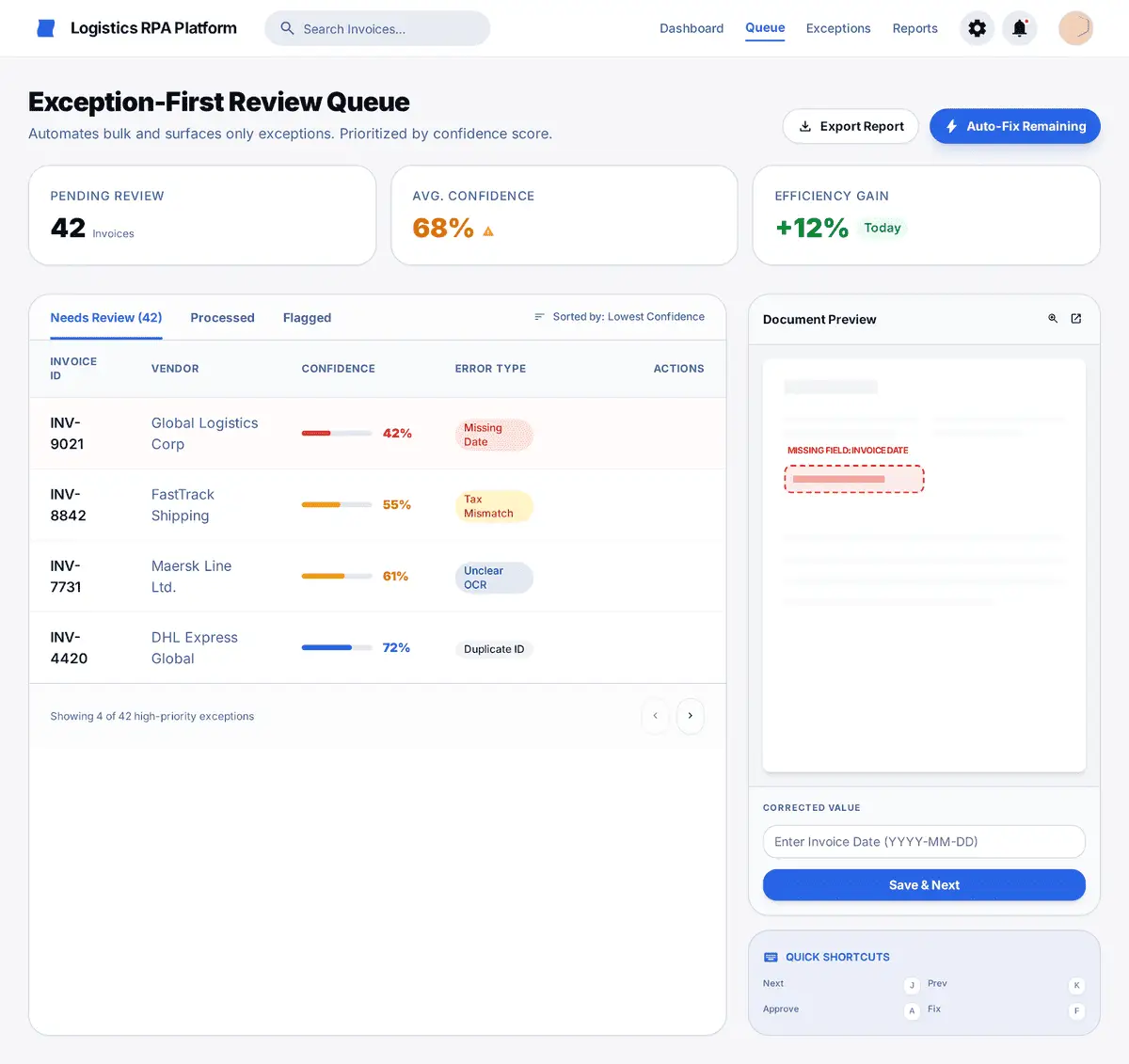
- We split business exceptions from system exceptions. System errors retry on their own, while business cases go to a reviewer queue with the source data attached.
Intelligent document processing
- The common problem
- Invoices, claims and forms arrive in many layouts. So simple templates fail as soon as a supplier changes a format.
- How we build it
- We pair OCR with machine learning models that find fields and tables. Each field gets a confidence score, and low scores go to a person before the bot posts the data.
Bot security and credential vaults
- The common problem
- Shared logins and passwords inside scripts are a common audit finding in RPA programs.
- How we build it
- Each bot gets its own least-privilege account. Credentials sit in a vault such as CyberArk, Azure Key Vault or the platform store, and every run writes an audit log.
Governance and a Center of Excellence
- The common problem
- Without shared rules, teams build bots in different ways. Soon nobody knows who owns which bot.
- How we build it
- We help you set up a light Center of Excellence. It covers intake, design standards, code review, release steps and a bot register with named owners.
Platforms and tools we build on
RPA platforms
- UiPath Studio
- UiPath Orchestrator
- Automation Anywhere Automation 360
- Power Automate desktop flows
Documents and AI
- OCR
- UiPath Document Understanding
- AI Builder
- Azure AI Document Intelligence
- LLM classifiers
Scripting
- Python
- C# and .NET
- PowerShell
- JavaScript
- SQL
Apps bots work in
- SAP GUI
- Citrix and VDI
- Excel
- Outlook
- web portals
- legacy desktop apps
Security
- CyberArk
- Azure Key Vault
- HashiCorp Vault
- role-based access
Run and monitor
- Work queues
- schedules
- alerts in Teams or email
- run logs
- dashboards
Platform names belong to their owners. We build on the platform you license and do not resell licences.
Why SDLC Corp
Why Choose SDLC Corp for RPA Development Services
Many RPA programs stall after the first few bots. Ours keep going because we plan for change, failure and ownership from day one.
Honest fit checks
Some tasks need an API, a form fix or nothing at all. We say so before you spend money on bots.
Engineers, not just bot builders
Our teams also build APIs, ERP modules and AI models. So a bot is never the only tool we can offer.
Exceptions designed in
Every bot ships with exception paths, retry rules and a reviewer queue, rather than a silent failure.
Secure by default
We work under SOC 2 Type II, ISO 27001 and ISO 9001 certified processes. Bots use vault-held, least-privilege accounts.
You own the bots
Source files, design documents and runbooks sit in your repository and your orchestrator, not ours.
Support after go-live
Apps update and screens change. Our support team watches failures and patches bots before queues back up.
Have a process that eats hours every week?
Walk us through it on a call. We will tell you if RPA fits, what to automate first and how to measure the return.
Process
How Our RPA Development Services Work
Each bot follows the same six steps. As a result, you see progress early and know exactly what goes live.
- 01
Discover and assess
We map the process, count volumes and variants, and score fit and value with your team.
- 02
Design the bot
Next, we write the process and solution design documents, including every exception path.
- 03
Build and unit test
Developers build modular bots in short sprints. After each sprint, you review a working demo.
- 04
Test with real data
Then we run user acceptance tests on real samples, so edge cases show up before go-live.
- 05
Deploy and hand over
Bots move to the orchestrator with queues, schedules, alerts and vault credentials.
- 06
Run and improve
Finally, we watch runs, fix failures and tune bots. Each quarter, we review the next processes.
Engagement
Ways to Work With Our RPA Team
Buy our RPA development services as a pilot, a full program or one developer on your team. Then change models as your program grows.
Assessment and pilot
Good fit for: Teams new to RPA
We assess your processes, then build one pilot bot to prove value on real work before you commit to more.
Discuss this model- Most chosen
Build and run program
Good fit for: Firms with several processes to automate
One team runs discovery, builds bots in waves, sets up governance and supports them in production.
Discuss this model Dedicated RPA developer
Good fit for: Teams that already run a CoE
Add a developer to your own team for bot builds, fixes and upkeep, under your process and tools.
Hire an RPA developer
Proof
Automation Case Studies
A few of the bots and document workflows our teams have shipped. Each one shows how our RPA development services keep a person in the loop where data needs a check.
- Logistics
Transworld Logistics
An RPA document processing platform for invoices in changing layouts. It pairs OCR and confidence checks with a human review queue. Per the case study, processing time fell from 48 hours to 4 hours.
- OCR
- Human-in-the-loop
- ERP sync
- Workflow automation
Email Invoice Processing
A bot scans an inbox every 15 minutes, reads the SKU on each invoice and routes it to the right team. Failed items go to a retry queue.
- Inbox scan
- SKU routing
- Retry queue
- Finance
Data AI Ninja
A finance team moved from manual entry to AI extraction with confidence scores, human review and exports to JSON, CSV, Excel, API and webhooks.
- AI OCR
- Confidence scoring
- Exports
More document work: see our intelligent document processing case studies.
Client feedback
What Our Clients Say
Verified reviews from Clutch and feedback from SDLC Corp clients, shown as published.
They've quickly understood our business context, moved fast, and brought recommendations rather than questions.
BKBrandy KuentzelCo-Founder & CEO, Ease Pet Vet
Verified review on ClutchAI Development for Veterinary Care Company
Overall, we were very satisfied with the engagement.
RURajesh U GaikwadFounder, Quantus-Technik
Verified review on ClutchERP Development for Engineering Solutions Company
The team understood my requirement, agreed to multiple change requests, and delivered a very likable product.
ADAarti DohareyCEO, Algo Harmonic
Verified review on ClutchCustom Software Dev for Pattern Scanner Company
Industries
Where RPA Fits by Industry
Bots pay off where rules are clear, volumes are high and systems do not talk to each other. These are the use cases our RPA development services handle most often.
Banking and finance
KYC document checks, loan file intake, reconciliations and report runs across core systems.
Insurance
Claims intake, policy servicing updates and data moves between broker portals and core apps.
Healthcare
Eligibility checks, claim status lookups and patient registration, with access rules set by your compliance team.
Logistics
Freight invoices, shipment status updates and customs paperwork across carrier portals.
Retail and ecommerce
Order exceptions, returns, price and stock updates across marketplaces and ERP.
Manufacturing
Purchase orders, inventory sync and quality reports between ERP, MES and supplier portals.
Accounting
Accounts payable, bank reconciliation and month-end close tasks.
RPA for accountingProperty management
Lease data entry, rent reconciliation and tenant requests across systems.
RPA for property management
Buying guide
RPA Development Services Cost: What Drives the Budget
No fair flat price exists for RPA, because no two processes are alike. Instead, scope depends on these six factors. So compare how vendors plan exceptions and support, not just the build fee.
- 1
Number of processes
First, each process adds discovery, design, build and test time.
- 2
Process complexity
More steps, rules and variants mean more exception paths to build and test.
- 3
Apps and access
Citrix, VDI, SAP GUI or old desktop apps need extra care to automate reliably.
- 4
Documents
Invoices or forms in many layouts add OCR, model tuning and review screens.
- 5
Run model
Unattended bots need runner machines, schedules and monitoring. Attended bots need rollout to desks.
- 6
Platform licences
Finally, you buy licences from the vendor. We size them with you, apart from our build fee.
FAQs
RPA Development Services FAQs
Straight answers to the questions operations and IT leaders ask us most about fit, platforms, security and cost.
Ask Your Own QuestionWhat do RPA development services include?
Our RPA development services cover process discovery, ROI assessment, bot design, development, testing and deployment. They also cover orchestration, exception handling, document processing, security setup and support. You can hire us for one stage or the full lifecycle.
How is RPA different from workflow automation or API integration?
RPA works through the user interface, like a person would. API integration and workflow tools connect systems directly, so they are usually faster and sturdier. We use RPA when no suitable API exists, and our workflow automation services when one does.
What is the difference between attended and unattended bots?
An attended bot runs on a staff member's desktop when that person starts it. An unattended bot runs on its own from a schedule or a queue, on a server or virtual machine. Many programs use both, plus hybrid flows that hand off between them.
Which RPA platform should we use?
We build on UiPath, Automation Anywhere and Microsoft Power Automate. If you already have licences, we usually start there. Otherwise, we compare platforms against your apps, hosting, budget and in-house skills.
How do your bots handle exceptions?
We split exceptions into two types. System exceptions, such as a slow screen, trigger retries and alerts. Business exceptions, such as a missing PO number, go to a reviewer queue with the source data, so a person can decide.
How do you keep bots and data secure?
Each bot uses its own least-privilege account. Credentials live in a vault, not in scripts, and every run writes an audit log. We also work under SOC 2 Type II, ISO 27001 and ISO 9001 certified processes.
Can RPA work with AI and documents?
Yes. OCR and machine learning models read invoices, forms and emails, and confidence scores send unclear fields to a person. Language models can also classify or summarize text inside a bot flow, with human approval on risky steps.
How long does an RPA project take?
It depends on the number of processes, their complexity and the apps involved. Most clients start with an assessment and one pilot bot. After that, we plan the rest in waves, so you see value early.
Who owns the bots after delivery?
You do. Bot source files, design documents and runbooks stay in your repository and your orchestrator. If you later move support in-house, your team has everything it needs.
Start with one process
Ready to Automate a Process Your Team Repeats Every Day?
Tell us about the task. After one short call, you will know if RPA fits, what a pilot looks like and how we would measure the return.
- Free assessment call
- NDA on request
- Clear pilot plan
Contact Us
Share a few details about your project, and we’ll get back to you soon.
Let's Talk About Your Project
- Free Consultation
- Support options based on your engagement
- Agreed delivery milestones
- sales@sdlccorp.com
- +1(510-630-6507)