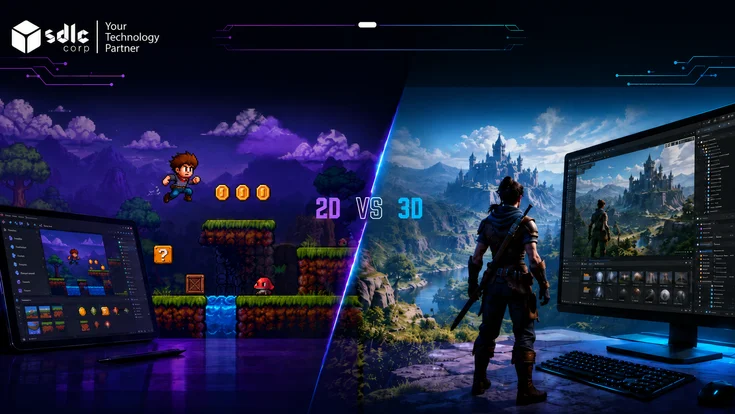
The choice between 2D and 3D is one of the first decisions in any game project - and one of the most consequential. It affects art pipeline cost, engine selection, team size, performance targets, timeline, and what the game can and cannot do.
Neither approach is inherently better. The right choice depends on the game's genre, target platform, budget, and the experience you want to create.
2D games are typically faster and cheaper to produce - better suited to mobile, casual, card, puzzle, and side-scrolling genres. 3D games cost more but unlock spatial gameplay, realistic environments, and immersive worlds. Budget, genre, and target platform are the three deciding factors.
2D vs 3D Game Development Cost
The cost gap between 2D and 3D widens with project complexity. At the simple end, 3D often costs around 2–3× more than 2D. At the complex end, the gap can become much wider depending on asset volume, animation depth, multiplayer scope, and platform targets.
2D Games
3D Games
These are planning ranges. Final cost depends on art style, asset count, engine choice, team location, platform targets, and feature complexity. See the game development cost guide for broader budgeting factors across game genres, platforms, team models, and production stages.
What Drives the Cost Difference?
The gap between 2D and 3D budgets is almost entirely explained by art production and technical complexity. A 2D game can reuse sprite sheets across many scenes; a 3D game requires modeled assets, textures, rigging, animation, lighting, and physics for every character, prop, and environment.
| Cost factor | 2D | 3D |
|---|---|---|
| Art production | Sprites, backgrounds, UI - faster to iterate | 3D modeling, UV unwrapping, texturing, rigging - significantly more asset hours |
| Animation | Sprite-sheet or skeletal 2D - lighter pipeline | Skeletal 3D, blend trees, motion capture option - heavier pipeline and QA surface |
| Lighting and shading | Baked or flat - minimal real-time cost | Dynamic lighting, PBR materials, shadow maps - significant render and optimization work |
| Physics | Simple 2D colliders - fast to implement | 3D rigid body, cloth, vehicle, or character physics - many more edge cases |
| Environment creation | Tiled backgrounds or illustrated scenes | 3D level design, terrain, occlusion culling, LOD setup |
| Performance optimization | Lower overhead - runs on most devices | Draw calls, poly count, GPU memory - requires dedicated optimization phase |
| QA surface | Narrower - fewer visual edge cases | Camera clipping, asset pop-in, physics glitches - wider QA scope |
When 2D Is the Right Choice
2D is not a compromise - for many game types it is the optimal technical choice. The art pipeline is faster, the device compatibility range is wider, and the development cycle is shorter. See the 2D game development page for delivery and scope options.
2D works best for
- Mobile casual and hyper-casual games
- Card, casino, and table games
- Puzzle and match-3 games
- Side-scrollers and platformers
- Turn-based strategy and tactics
- Visual novels and narrative games
- Top-down RPGs and dungeon crawlers
- Retro and pixel-art aesthetic games
- Educational and children's games
- Board game digital adaptations
2D advantages
- Lower art production cost and time
- Faster iteration on level design
- Runs well on low-spec Android and iOS devices
- Smaller file size - lower download friction
- Easier to achieve visual consistency
- Shorter QA cycles
- Established tooling in Unity 2D and Godot
- Accessible to smaller teams and tighter budgets
Casino games, card games, and board game adaptations usually work best in 2D - the game logic and player experience do not benefit from spatial depth. Adding 3D to a card game increases cost without meaningfully improving the play experience for most player segments.
When 3D Is the Right Choice
3D becomes the right choice when spatial gameplay, environmental immersion, or first/third-person perspective are core to the experience. See the 3D game development page for platform-specific scope and delivery options.
3D works best for
- First-person shooters and action games
- Open-world and exploration games
- Racing and simulation games
- Sports games with realistic physics
- 3D platformers
- Multiplayer battle arenas (MOBA, BR)
- AR/VR experiences
- Live dealer casino environments
- Real-time strategy with 3D terrain
- Fighting games with 3D arenas
3D advantages
- Full 3D spatial navigation and camera freedom
- Realistic character and environment detail
- Dynamic camera systems
- Physics-driven interactions
- Better foundation for VR/AR, though XR still requires dedicated input, stereo rendering, and performance work
- Higher perceived production value on PC/console
- Scalable to larger open worlds
2D vs 3D Scope Estimator
Answer four questions to get a planning cost range and identify the decisions that carry the most budget weight.
2D vs 3D Game Scope Estimator
Four questions — about 60 seconds
Which approach are you considering?
What is the project scale?
Which platforms are targeted?
Is online multiplayer required?
Features That Shift the Budget
| Feature | 2D impact | 3D impact |
|---|---|---|
| Character animation | Medium - sprite sheets or skeletal 2D | High - 3D rig, blend trees, motion capture option |
| Online multiplayer | High - same regardless of art dimension | High - same regardless of art dimension |
| Custom art style | Medium - illustration, pixel, or vector | High - stylized or realistic 3D can both become expensive depending on asset count, rigging, shaders, animation quality, and polish level |
| Procedural generation | Medium - tile-based, map generation | High - 3D terrain, asset scatter, LOD management |
| Physics simulation | Low–Medium - 2D collision and rigid body | High - 3D physics, cloth, vehicle, destruction |
| VR/AR support | Not typical - 2D used for UI/HUD only | High - stereo rendering, 6DoF input, performance targets, XR SDK integration |
| Particle effects / VFX | Low - sprite-based particles | High - shader-based, GPU particle systems |
| UI/UX system | Medium - similar complexity | Medium - similar complexity; 3D spatial audio adds scope in first-person games |
For complex 3D projects, optimization should be planned early. The Unreal Engine testing and optimization guide explains how teams can test and tune game content for performance.
Development Timeline by Project Scale
| Project scale | 2D timeline | 3D timeline |
|---|---|---|
| Simple / MVP / casual | 4 – 10 weeks | 8 – 18 weeks |
| Mid-tier - polished commercial game | 12 – 24 weeks | 20 – 40 weeks |
| Complex - deep systems or open world | 24 – 52 weeks | 40 – 80+ weeks |
| Casino / card / table game | 8 – 22 weeks | 16 – 36 weeks |
| VR / AR experience | Not typical | 20 – 52+ weeks |
Art production is often the longest phase in 3D projects. A 3D game with a 40-week timeline may spend 16–20 of those weeks in asset creation and optimization alone. 2D art pipelines are faster to iterate and easier to replace when design direction changes mid-development.
Best Use Cases by Game Genre
| Genre | Recommended | Reason |
|---|---|---|
| Card / casino / table games | 2D | Game logic and player experience do not benefit from spatial depth. Faster to produce and easier to maintain across variants. |
| Mobile casual / hyper-casual | 2D | Download size, load time, and device compatibility favor 2D. Better performance on low-spec Android devices. |
| Puzzle / match-3 | 2D | Grid-based layouts read more clearly in 2D. 3D adds visual noise without gameplay benefit. |
| Side-scrolling platformer | 2D | Genre is defined by 2D movement. 2.5D is an option for visual flair without full 3D complexity. |
| Top-down RPG / strategy | 2D or isometric | 2D top-down and isometric views work well for turn-based and tactical games. |
| FPS / TPS action | 3D | First and third-person perspective requires spatial depth. 2D cannot replicate the core experience. |
| Open-world / exploration | 3D | Environmental traversal, scale, and discovery all require three-dimensional space. |
| Racing / simulation | 3D | Vehicle physics, track geometry, and environmental detail require full 3D pipelines. |
| Battle royale / MOBA | 3D | Spatial awareness, cover systems, and map scale benefit from 3D environments. |
| Visual novel / narrative | 2D | Illustrated character portraits and painted backgrounds are cheaper, faster, and genre-consistent. |
| VR / AR experience | 3D | Most immersive VR/AR environments require 3D geometry. 2D elements are still commonly used for menus, HUDs, overlays, flat panels, and UI interactions. |
| Board game adaptation | 2D | Physical board game logic maps cleanly to 2D digital. 3D environments add cost without improving digital gameplay clarity. |
Common Mistakes When Choosing Between 2D and 3D
For mobile games, performance testing should start early. The Android game performance guide covers how to analyze and optimize games for smoother gameplay on Android devices.
Choosing 3D to increase perceived value, not because the game needs it. 3D is not inherently more impressive - a beautifully executed 2D game outperforms a mediocre 3D game on every metric. The dimension should serve the gameplay, not signal production ambition.
Underestimating the 3D art pipeline. Teams routinely underestimate how long modeling, texturing, rigging, and optimization take. A character that takes one day as a 2D sprite sheet may take one to two weeks as a fully rigged, animated 3D model with LODs.
Starting with a 3D scope and cutting to 2D mid-project. Switching dimensions mid-development wastes design, tooling, and partial art work. The 2D vs 3D decision should be locked before the first asset is created.
Ignoring mobile performance targets when choosing 3D. A 3D game that performs well on a high-end iPhone may run poorly on mid-range and low-spec Android devices. Since Android represents the majority of global mobile OS share, 3D mobile games should be tested across a broad Android device matrix from the start.
Using 3D for casino or card games without a specific reason. 3D table environments add art and engine cost without improving the betting, dealing, or payout experience. The additional cost should be justified by a specific player-experience goal.
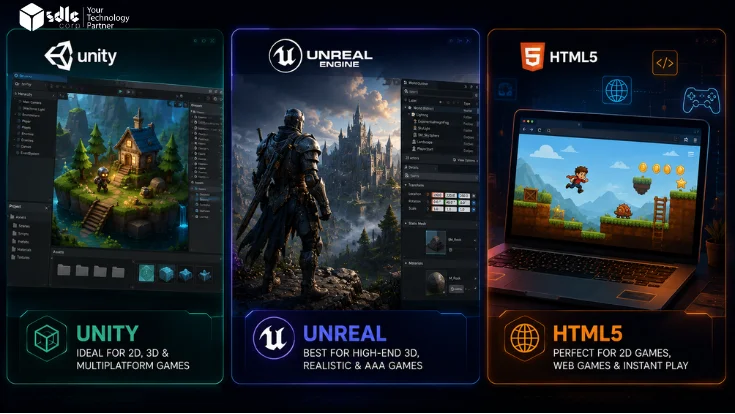
Choosing the wrong engine for the selected dimension. Unity, Godot, and GameMaker are common choices for 2D production. Unreal Engine can support 2D through Paper 2D, but it is usually chosen for high-fidelity 3D, PC, console, and cinematic projects.
For most teams, Unreal is not the default choice for a simple 2D mobile game, and GameMaker is not a practical default for a large 3D open-world game. Engine selection should follow the dimension and platform decision, not precede it.
Questions to Answer Before Committing to 2D or 3D
These decisions shape every downstream choice - art pipeline, engine selection, team composition, and launch path.
- What genre is the game, and does that genre have a strong 2D or 3D convention?
- Does the core mechanic require spatial depth or first/third-person perspective?
- What is the primary target platform - mobile, PC, console, or VR?
- What is the total art budget, and can it support a 3D asset pipeline?
- What is the target device range, including minimum-spec Android?
- Is the art style realistic, stylized, pixel, illustrated, or low-poly?
- Does the team have 3D modeling, rigging, and optimization experience?
- What is the development timeline, and can it accommodate a 3D art pipeline?
- Is VR or AR in scope now or in a future version?
- Has the core loop been prototyped to confirm the dimension choice feels right?
- What is the expected content volume - levels, characters, environments, animations, and skins?
- Will the game need live operations, seasonal content, or frequent asset updates after launch?
If Android is a target platform, review the Android games guide before finalizing engine, performance, and distribution plans.
Book a ConsultationLast reviewed and references
Last reviewed: May 2026
Scope: Cost and timeline ranges are planning estimates. They exclude art licensing, third-party middleware, platform fees, QA lab costs, and post-launch support. Ranges vary by team location, art style, and engine.
Frequently Asked Questions
Is 2D or 3D cheaper to develop?
2D is almost always cheaper, primarily because art production costs less. A simple 2D mobile game may cost $8K–$30K; an equivalent 3D project typically starts at $25K–$70K.
The gap widens significantly for complex or content-heavy games - a large 3D open world can cost five to ten times a comparable 2D game.
What is a 2.5D game and when should I use it?
2.5D uses 3D assets rendered with a fixed camera perspective that simulates a 2D view - isometric, side-scrolling, or top-down. It costs more than pure 2D but less than fully interactive 3D. Use it when you want visual depth without full camera freedom or spatial gameplay complexity.
Which engine should I use for 2D vs 3D?
For 2D: Unity 2D, Godot, and GameMaker are the most common choices. Godot is lightweight and free; GameMaker is fast for prototyping; Unity has the widest ecosystem.
For 3D: Unity and Unreal Engine are the main options. Unreal is better suited to high-fidelity 3D on PC and console; Unity is more flexible for mobile 3D. Engine selection should follow the genre and platform target.
Do 2D games perform better on mobile than 3D games?
Usually, yes. Well-optimized 2D games usually have a smaller GPU footprint, simpler assets, and smaller download sizes than comparable 3D games. Android represents the majority of global mobile OS share, so 3D mobile games should be tested across mid-range and low-spec Android devices, not only high-end iPhones.
Should casino or card games use 2D or 3D?
2D is the standard for casino and card games. The betting logic, dealing mechanics, and player experience do not benefit from three-dimensional space. 3D table environments are occasionally used for premium live-dealer-style presentations but add significant art cost without improving core game clarity. See the casino game development page for platform-specific options.
How long does it take to develop a 3D game vs a 2D game?
A simple 2D casual game takes 4–10 weeks. A comparable 3D game takes 8–18 weeks. A mid-tier 2D game runs 12–24 weeks while the 3D equivalent runs 20–40 weeks. The art pipeline is the primary driver - 3D asset creation, rigging, and optimization take significantly longer than 2D sprite and background production.