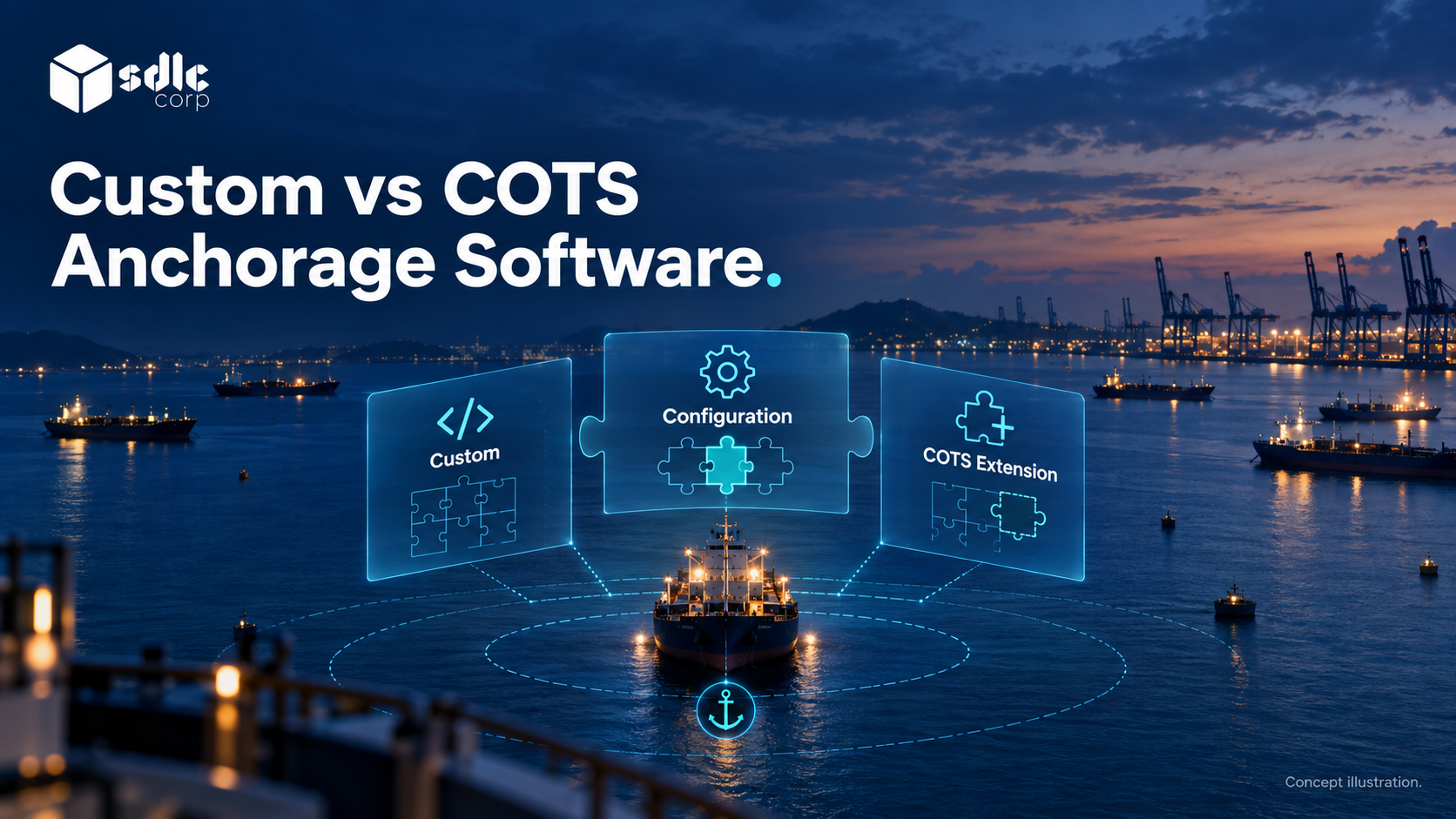
In custom vs COTS anchorage management software, the deciding question is mechanism: can each local rule be met by configuration, a supported extension or only a core change, and who maintains it after an upgrade?
Commercial off-the-shelf (COTS) products meet requirements in those three different ways, and each has different consequences for upgrades, testing and support.
Before accepting that a product is customizable, ask which mechanism is proposed for the actual workflow, and see it demonstrated on the version being offered.
Find the Configuration Boundary Early
Test Where Configuration Ends and Development Begins
Every product has a line beyond which a requirement becomes a change request. Document that boundary for every mandatory requirement during evaluation.
Take three of your least standard rules and ask how each would be implemented. The useful answer names the mechanism: a configurable rule, an extension point, a supplier release, or not supported.
"We can handle that" without a mechanism is a deferred cost. Record the mechanism beside each capability in Which Anchorage Management System Features Belong in the First Release?
Use a fit-gap record to compare mechanisms rather than feature names. For each requirement, record native behavior, supported configuration, supported extension, custom development, roadmap or not supported.
Then name who builds it, who supports it, which releases can affect it and how the buyer will accept it.
| Requirement | Delivery Mechanism to Verify | Evidence to Retain |
|---|---|---|
| Local approval rule | Native, configured, extended or custom | Scenario result and rule owner |
| Incumbent interface | Existing connector or new adapter | Contract, access and recovery tests |
| New report or field | Configuration or release change | Change route and upgrade test |
| Exit and continuity | Contractual rights and supported export | Sample export and support obligations |
Example: A Rule Changes After Launch
Suppose the port needs a new approval condition after launch. Ask who can change it, how the change is tested and whether it survives an upgrade.
A configurable screen may still hide a development dependency in the rule underneath. Following one change from request to release shows the real boundary better than any customization claim.
Also ask whether port staff can make that change themselves or must raise a supplier ticket. Questions to Ask an Anchorage Management Vendor covers who implements and supports future changes.
Custom vs COTS Anchorage Management Software: Delivery, Upgrades and Exit
| Characteristic | Commercial Off-the-Shelf | Custom |
|---|---|---|
| First working release | Assess available fit and configuration effort | Assess delivery scope and reusable components |
| Fit to local rules | Demonstrate configuration and extension limits | Demonstrate specified rules and exception paths |
| Ongoing maintenance | Confirm license and support obligations | Confirm internal or contracted ownership |
| Upgrade path | Verify support term, release policy and compatibility obligations | Plan and fund with the delivery owner |
| Integration flexibility | Verify supported extension mechanisms | Verify interface access, design feasibility and funded scope |
| Cost profile | Check license, configuration, changes and exit | Check delivery, maintenance, changes and exit |
| Exit position | Verify export rights, configuration export and transition assistance | Verify code, data and intellectual property rights |
For COTS, ask how many releases back the supplier supports. If an extension breaks and the port stays on an old release, know when that release stops receiving fixes.
Ask too whether configuration (rules, reason lists, roles) can be exported as data, not only records. That matters at exit and when rebuilding a test environment.
Build vs Buy an Anchorage Management System: How to Decide compares long-term ownership of each route against the same mandatory requirements.
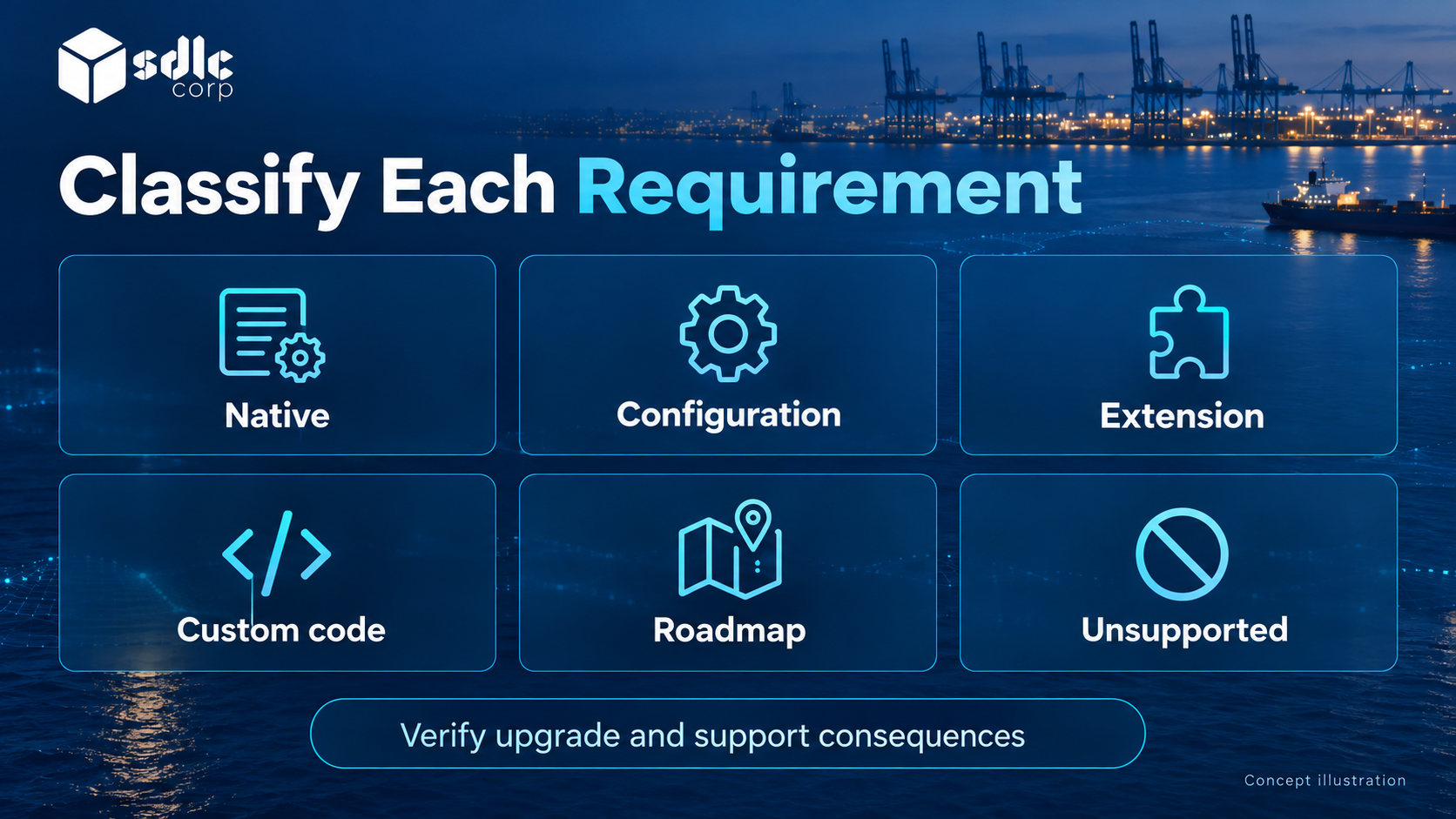
Three Ways to Implement a Local Rule
Illustrative example
Require the supplier to demonstrate the proposed mechanism on the version being offered.
| Requirement | Mechanism | What Happens During an Upgrade? |
|---|---|---|
| Add an approval reason from an allowed list | Supported configuration | Export and import or migration preserves values; regression test confirms them |
| Send approved allocations to another system | Supported extension using a published interface | Check interface compatibility and retest the adapter |
| Change an internal allocation algorithm with no extension point | Core modification | Supplier must merge, support and retest the altered core |
| Required rule with no permitted configuration or supported change route | Not supported in the proposed scope | Rescope or reject the fit gap; do not treat a roadmap statement as delivery evidence |
Follow a Change from Release 1 to Release 2
Suppose approval reason "zone restriction" is configured in release 1, and an adapter expects an allocation_id field. Release 2 preserves the reason list but changes the adapter contract.
Under Semantic Versioning, a breaking interface change like this should arrive as a major version. Ask whether the supplier follows that convention, so the port can see breaking changes coming.
| Upgrade Test | Passing Evidence | Failure Response |
|---|---|---|
| Existing records retain approval reasons | Sample old and new records agree | Hold migration or repair before cutover |
| Adapter processes new contract | Accepted event and reconciliation result | Update adapter; do not mark integration complete |
| Customized core still enforces mandatory limits | Rule regression tests pass | Remain on supported old release or resolve the change |
A configurable screen does not prove every rule beneath it is configurable. Name the mechanism, change owner, supported versions and acceptance test for each local requirement.
Run the proposed mechanism through the Anchorage Management Demo and Proof-of-Concept Checklist, including an upgrade or contract-change test, not only the first working release.
Weigh Local and Regulatory Requirements
Requirements imposed by an authority or regulation deserve different treatment from operational preferences. They are non-negotiable and change on a schedule the port does not control.
Mark both types separately in the Anchorage Management System Scope of Work.
Ask how a product absorbs a regulatory change: configuration the port can apply, a supplier release, or a bespoke change.
If it is a supplier release, ask for the commitment and notice period. That is a contractual question, not a technical one.
Assess Integration and Extension Realistically
Integration effort depends on existing connectors, data model fit, extension rights and testing obligations in the actual proposal.
- Documented extension points, or only the supplier's own development.
- Whether the port's own team can build an integration against the product.
- How customizations survive an upgrade, and who tests that.
- Whether integration code is owned by the port or by the supplier.
An unclear extension model leaves change ownership and upgrade effort unresolved. The Anchorage Management Integration Checklist helps settle those responsibilities before scoring.
Apply the same deployment, identity, encryption, audit, recovery and residency requirements to both proposals, with evidence from the actual service boundary.
Neither a custom build nor an off-the-shelf label establishes security or compliance. A Vessel Traffic Management and Information System (VTMIS) connection still needs a supported adapter, a recovery contract and source-owner work in the fit-gap assessment.
Compare User Experience and Change Capacity
Operators judge a system by whether it fits the shape of their shift. A product brings a designed interface that may not match local practice; a custom build must prove fit through design and operator testing.
Ask how quickly a screen or field can change in each case, and who decides. A port expecting continuous refinement should weight this heavily; one that wants stability should not.
Price Changes and Upgrades as Well as Initial Fit
Include later costs without assuming the two cost profiles necessarily cross.
- Off-the-shelf: subscription growth, user or volume tiers, change requests, upgrade effort and integration maintenance.
- Custom: maintenance retainer, security patching, platform upgrades, staff continuity and documentation upkeep.
- Both: hosting or infrastructure, support hours and training as staff change.
Anchorage Management System Cost provides the structure. Ask each supplier for cost drivers rather than one figure, and model a scope change to see which profile absorbs it better.
Test a Product Core with Custom Interfaces and Reports
A hybrid option combines a configured product for the operational core with custom integration and reporting around it.
It may combine reusable product capability with local extensions, but verify maturity, extension rights, upgrade compatibility and ownership rather than assuming those benefits.
Compare the demonstrated change process alongside initial fit. The preferred option should have a supportable path for the changes the port can reasonably anticipate.
Test a representative extension through a product upgrade before accepting the proposed boundary. Record which interface or configuration contract it uses, what breaks if that contract changes and who pays for retesting.
Confirm that the supported export includes the custom records as well as the product core.
Finish with a fit-gap decision for each mandatory requirement: demonstrated, conditionally deliverable with evidence due, or unsupported.
A hybrid proposal is ready to compare only when component ownership, upgrade duties and acceptance responsibilities are explicit. The word "hybrid" does not resolve an unsupported gap by itself.
Conclusion
Settle custom vs COTS anchorage management software by mechanism: classify every adaptation as configuration, supported extension or core modification, test it on the proposed release, then test it through an upgrade.
Accept product fit only with clear ownership and costs for the continuing work. A customization that works today is incomplete evidence if its future compatibility and support remain unresolved.
Assess Product Fit with SDLC Corp
Evaluate the configuration limits of our Anchorage Management Software, including any proposed Custom Software Development Services. Bring requirements that challenge the normal workflow.
We will respond mechanism by mechanism, with upgrade, regression and support evidence for any extension or core change, and state unsupported needs clearly.
Frequently Asked Questions
When Is Configuration Sufficient?
When supported settings meet the workflow, permissions and exception requirements on the proposed version. Demonstrate that behavior before adding development simply because the product offers an extension mechanism.
How Does an Extension Differ from a Core Modification?
An extension adds behavior through a supported boundary; a core modification changes the product itself. Confirm the supplier's actual support policy, because the labels alone do not establish upgrade compatibility.
Who Maintains Custom Work After an Upgrade?
Assign that responsibility explicitly, including compatibility testing, fixes, supported versions and cost. Verify the upgrade process with representative custom behavior rather than assuming support is included.
Can Port Staff Change Configuration Without the Supplier?
It depends on the product. Ask for a demonstration of port staff changing a rule, a reason list and a role, and confirm which changes still need a supplier ticket.
How Many Releases Back Does the Supplier Support?
Ask for the written support policy. If an extension breaks on upgrade and the port stays on an older release, you need to know when that release stops receiving fixes.
Can We Export Our Configuration at Exit?
Ask whether rules, reason lists and roles export as data alongside operational records. Without that, rebuilding in another system or a test environment means recreating configuration by hand.