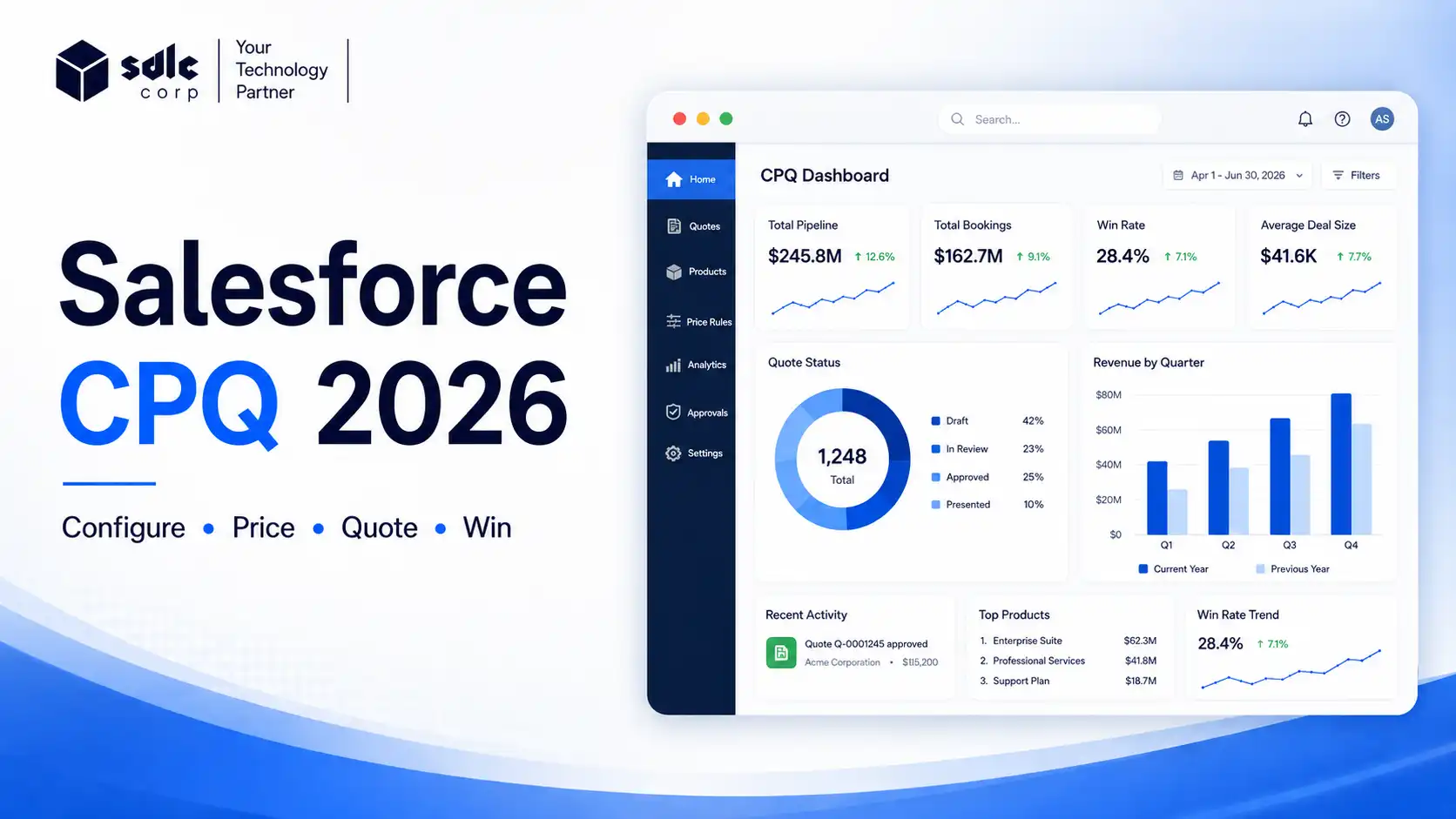
Salesforce CPQ implementation in 2026 is no longer only about configuring products and generating quotes. Organizations are evaluating Revenue Cloud, optimizing existing CPQ environments, reducing technical debt, and building long-term quote-to-cash strategies.
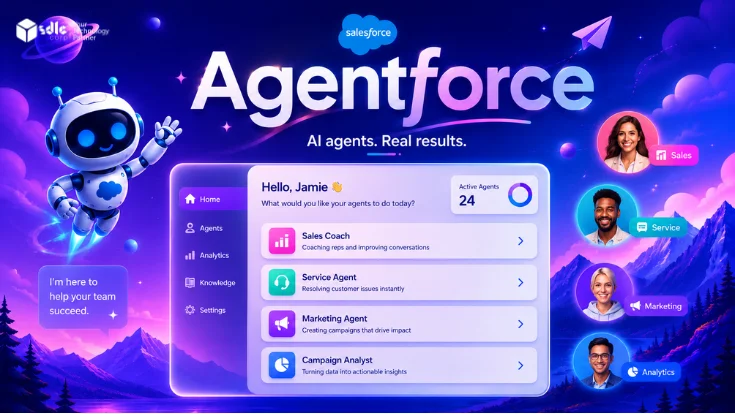
Salesforce CPQ implementation helps businesses manage product configuration, pricing, discounting, and quote creation directly within Salesforce. It remains one of the most widely adopted quote-to-cash solutions for organizations selling complex products and services. However, Salesforce CPQ discussions are changing. Some organizations are evaluating quote-to-cash platforms for the first time, while others are optimizing mature CPQ environments or exploring Revenue Cloud migration opportunities. Teams also review Salesforce Agentforce use cases when planning AI-assisted sales support and service handoffs.
This guide covers Salesforce CPQ implementation, readiness assessment, governance, optimization, technical debt management, and Revenue Cloud migration planning to help organizations choose the right path in 2026.
Key Takeaways
- New buyers should evaluate Revenue Cloud and quote-to-cash requirements. Before selecting a platform.
- Successful CPQ implementation depends on business readiness. Including product catalog structure, pricing strategy, governance, and user adoption.
- Existing CPQ customers should focus on optimization, governance, and technical debt reduction. To maintain scalability.
- Manual workarounds and undocumented processes are warning signs. That the CPQ environment requires attention.
- Revenue Cloud migration requires assessment and planning. Rather than a rushed transition.
- Organizations should evaluate, optimize, or migrate. Based on their current business goals and Salesforce roadmap.
Why Salesforce CPQ Implementation Looks Different in 2026
Salesforce CPQ implementation conversations have evolved significantly. Organizations are no longer focused only on implementation. Businesses are evaluating governance, scalability, Revenue Cloud readiness, technical debt, and broader quote-to-cash modernization initiatives.
Salesforce CPQ Readiness Assessment: Which Path Fits Your Organization?
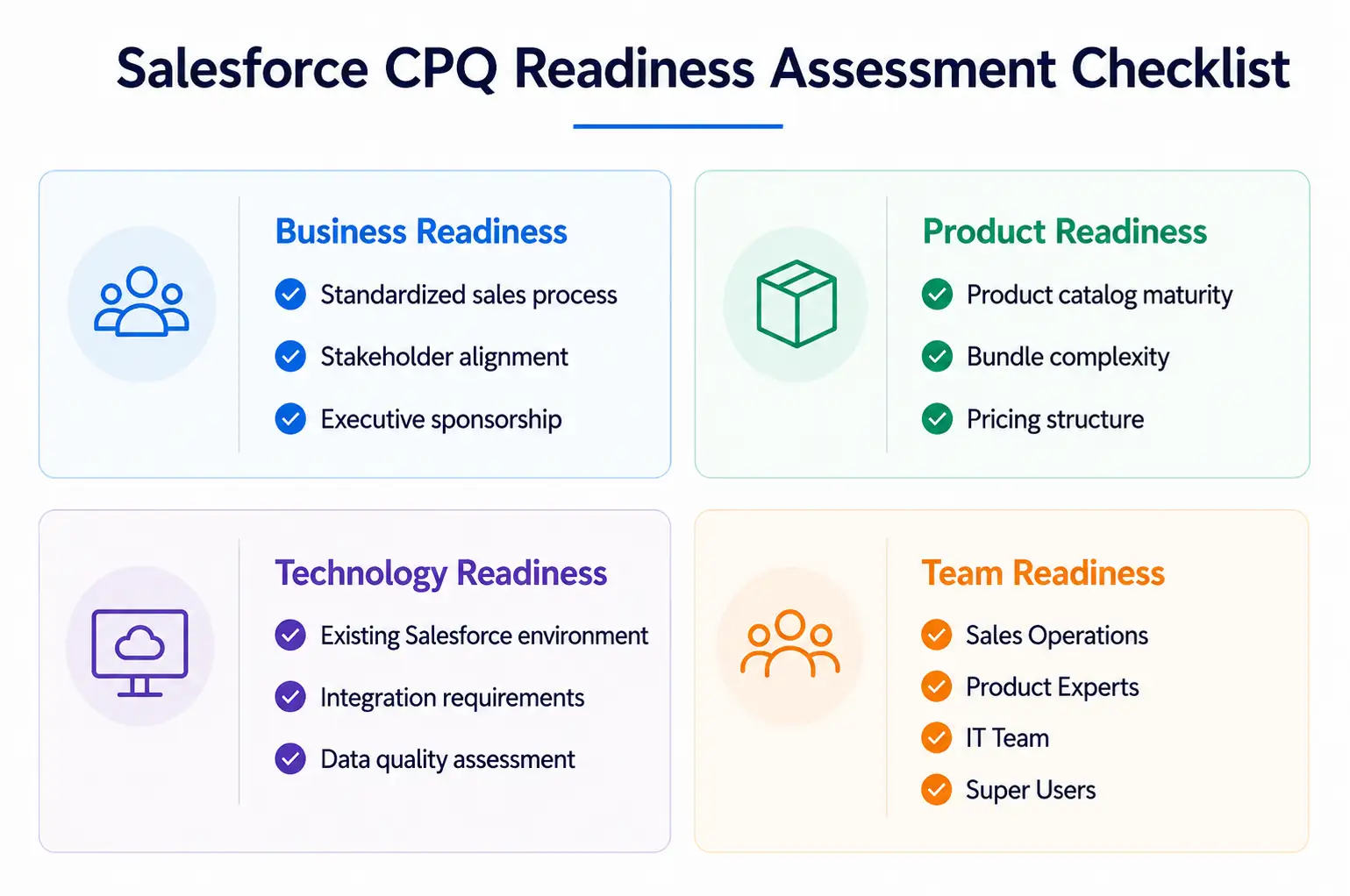
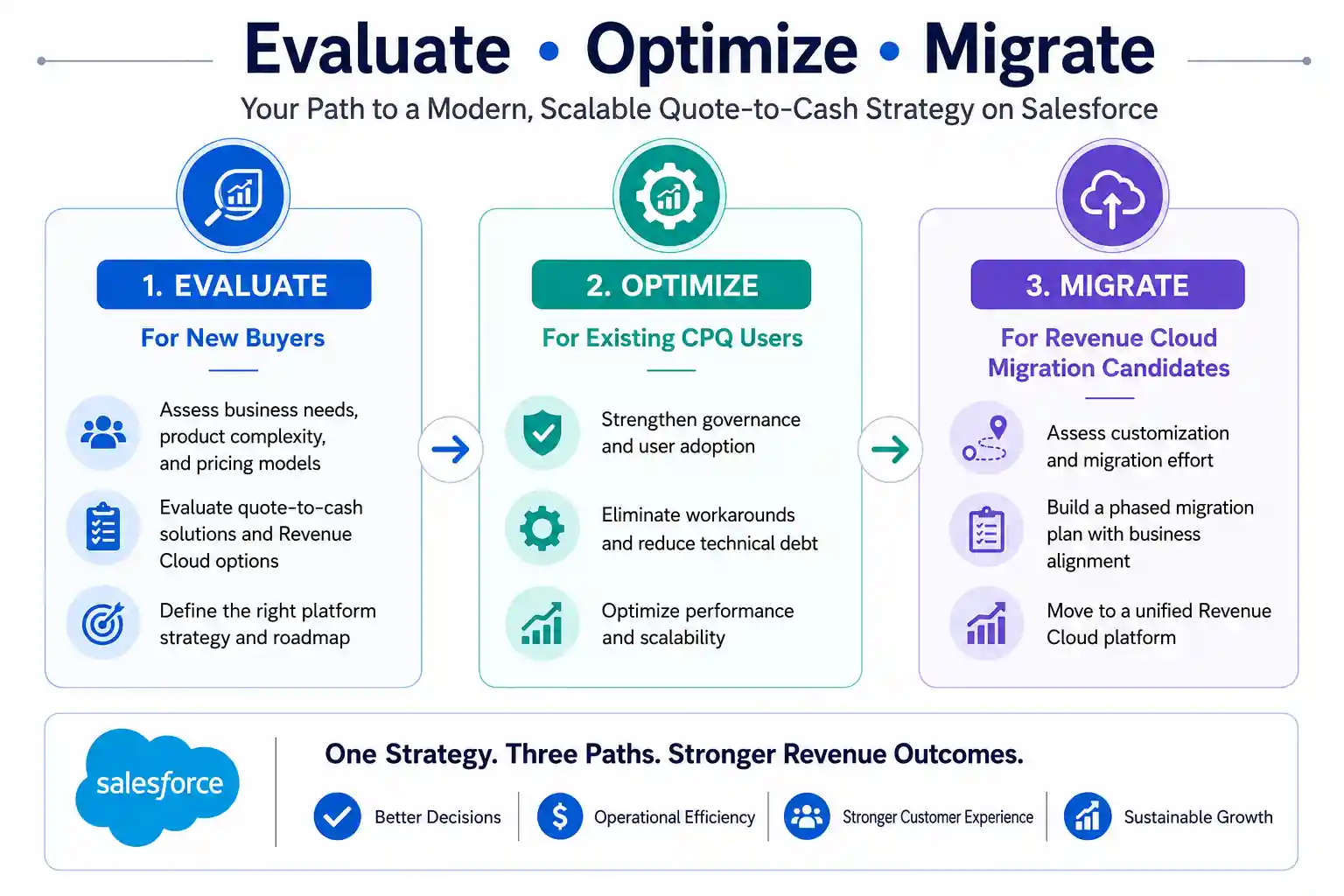
Most organizations evaluating Salesforce revenue solutions fall into one of three categories. Identifying the correct path helps determine the most effective strategy moving forward.
| Path | Organization Type | Primary Objective |
|---|---|---|
| Path 1 | New Buyer | Evaluate Salesforce quote-to-cash solutions, assess readiness, and define a long-term platform roadmap. |
| Path 2 | Existing CPQ User | Improve governance, user adoption, technical debt management, and platform optimization. |
| Path 3 | Advanced Revenue Cloud Migration Candidate | Assess migration readiness, customization impact, and phased migration planning. |
For planning, a standard Salesforce CPQ implementation often takes around 3 to 6 months. Enterprise projects with complex product rules, approvals, renewals, and integrations may extend to 6 to 12 months.
Salesforce Revenue Readiness Assessment for New Buyers in 2026
Organizations evaluating Salesforce CPQ should assess both current requirements and long-term business goals before selecting a quote-to-cash platform. Regardless of platform choice, pricing, discounting, product bundling, quoting, ordering, and billing remain core automated quote-to-cash processes capabilities that must align with business requirements
Successful CPQ projects begin with a clear understanding of:
- Business requirements
- Sales process maturity
- Pricing complexity
- Product complexity
- Product catalog structure
- Long-term Salesforce strategy
Key Insight: A typical Salesforce CPQ implementation takes between 3 and 6 months for mid-sized organizations, while highly complex environments with extensive integrations and custom pricing models may require 9 to 12 months.
Quote-to-Cash Implementation Planning: Key Success Factors
Many organizations focus on technology first when planning a Salesforce CPQ implementation. In reality, successful projects are usually driven by business readiness, stakeholder alignment, governance, and adoption rather than technology alone.
Before selecting an implementation approach, organizations should evaluate the following areas:
Customer Maturity
- Existing Salesforce experience
- Sales process maturity
- Current quote-to-cash capabilities
- Internal platform knowledge
Executive Sponsorship
- Leadership support
- Project ownership
- Change management commitment
- Cross-functional alignment
Product Complexity
- Product catalog size
- Bundles and configurations
- Pricing models
- Discount structures
User Adoption Goals
- Training requirements
- Process standardization
- Long-term adoption
- Continuous improvement
Key Insight: Organizations often choose implementation models based only on budget or timelines. However, long-term success is more closely tied to stakeholder alignment, executive sponsorship, change management, and business readiness.
Salesforce CPQ Best Practices for a Scalable Foundation
For organizations already using Salesforce CPQ, long-term success depends on maintaining a strong foundation built around product catalog management, pricing strategy, governance, and user adoption.
The most successful CPQ implementations focus on building a strong core before introducing advanced functionality.
Introduce Advanced Features in Phases
Once the core CPQ foundation is established, organizations can gradually implement more advanced capabilities.
An incremental implementation approach significantly reduces risk and improves user adoption compared to large-scale deployments.
Optimize the Product Catalog
The structure of the product catalog has a direct impact on user experience, quote accuracy, and long-term maintainability.
Recommended Practices
- Simplify product structures
- Reduce unnecessary SKUs
- Standardize naming conventions
- Create logical product categories
- Improve product discoverability
Expected Benefits
- Faster quote creation
- Improved user adoption
- Reduced maintenance effort
- Better reporting accuracy
- Greater scalability
Build Solution-Based Product Bundles
Instead of selling individual products separately, organizations should structure offerings around business solutions.
Solution-based bundles simplify the buying experience while improving quote accuracy and sales productivity.
Create a Scalable Pricing Strategy
Pricing automation and approval workflows should serve different purposes.
| Area | Purpose |
|---|---|
| Pricing Automation | Automatically determine pricing based on predefined business rules. |
| Approval Workflows | Handle pricing exceptions and governance controls. |
Common pricing models include:
- Margin-Based Pricing
- Customer-Specific Pricing
- Tiered Pricing
- Volume-Based Pricing
- Subscription Pricing
A well-designed pricing strategy improves sales efficiency while maintaining governance and profitability.
Security and Permission Governance
Security should be considered from the beginning of every Salesforce CPQ implementation. A strong permission model protects sensitive configurations while allowing users to perform their responsibilities efficiently.
Community Insight: Practitioner discussions within the Salesforce ecosystem often recommend an admin-only installation approach combined with permission sets to improve governance and access control.
Salesforce CPQ Governance Framework for Existing Users
A successful Salesforce CPQ implementation does not end after go-live. As business requirements evolve, organizations must establish governance processes that maintain platform stability, scalability, and user adoption.
Without governance, even well-designed CPQ environments can become difficult to manage over time.
Continuous Optimization
Organizations should regularly review the performance of their CPQ environment to ensure it continues supporting business goals.
Salesforce CPQ Health Check Framework
A structured health assessment helps organizations identify technical debt, governance risks, documentation gaps, and scalability concerns before they become larger business problems.
Assessment Areas
- Technical debt review
- Documentation quality
- Configuration complexity
- Governance maturity
- User adoption analysis
- Support issue trends
Expected Outcomes
- Improved maintainability
- Reduced operational risk
- Better governance visibility
- Higher user adoption
- Faster issue resolution
- Long-term scalability
Salesforce CPQ Challenges: The Technical Debt Problem Most Organizations Ignore
Many organizations focus heavily on implementation but underestimate long-term maintenance. As business requirements evolve, technical debt often accumulates and makes CPQ environments increasingly difficult to manage.
What Creates CPQ Technical Debt?
Technical debt usually develops gradually through short-term fixes and undocumented customizations.
Workarounds
- Manual process fixes
- Spreadsheet dependencies
- Temporary business solutions
Custom Scripts
- Legacy code
- Unsupported customizations
- Complex maintenance requirements
Quick Fixes
- Unplanned configuration changes
- Process shortcuts
- Short-term problem solving
Documentation Gaps
- Hidden business logic
- Knowledge silos
- Governance challenges
Human Intervention Is a Warning Sign
The more users rely on manual corrections and workarounds, the more likely it is that deeper process or configuration issues exist within the CPQ environment.
- Frequent quote rework
- Inconsistent pricing outcomes
- Manual approval handling
- Spreadsheet-based processes
- Dependence on a small group of experts
Business Complexity Drives Customization
Every organization has unique business requirements that often increase customization complexity over time.
Root Cause Analysis Before Making Changes
Before introducing additional customizations, organizations should identify the root cause of recurring issues.
- Reproduce the problem.
- Document when it occurs.
- Identify recurring patterns.
- Escalate to the appropriate team.
- Determine whether governance or configuration is responsible.
How to Identify Salesforce CPQ Challenges Before They Impact Growth
Many CPQ challenges develop gradually and remain unnoticed until they begin affecting operational efficiency and scalability.
Example: Salesforce community discussions have highlighted situations where approved quotes remained stuck in review because users bypassed standard approval processes. The issue was not configuration-related but a governance and process problem.
Salesforce CPQ vs Revenue Cloud: Which Path Makes Sense in 2026?
| Factor | Salesforce CPQ | Revenue Cloud |
|---|---|---|
| Best For | Organizations with existing CPQ environments | Organizations planning long-term Salesforce innovation |
| Current Status | End-of-Sale but supported for existing customers | Salesforce's strategic quote-to-cash platform |
| Migration Effort | No migration required | Requires assessment, planning, and migration effort |
| Customizations | Existing customizations remain intact | May require redesign and reconfiguration |
| Technical Debt | Managed through optimization and governance | Should be addressed before migration |
| Pricing Logic | Existing pricing rules continue to work | Pricing models should be reviewed during migration |
| Recommended When | Stable environment with strong adoption | Future-ready revenue management strategy is required |
Revenue Cloud Migration Challenges Organizations Should Prepare For
CPQ-to-Revenue Cloud migrations typically take 4 to 9 months, depending on product complexity, customizations, integrations, and data readiness. Highly customized environments can extend beyond 12 months.
-
Challenge #1: High CPQ Customizations
Most Salesforce CPQ environments contain years of pricing logic, approval workflows, custom scripts, and business-specific functionality. Revenue Cloud uses a different architecture, meaning customizations often require redesign rather than direct migration.
-
Challenge #2: Product and Bundle Rebuild Requirements
Although product data and price books may be migrated, many bundles, configuration models, and pricing structures require re-architecture to align with Revenue Cloud capabilities.
-
Challenge #3: Different Customization Models
Revenue Cloud introduces new pricing engines, pricing procedures, and configuration approaches. Existing Quote Calculator Plugins (QCPs), price rules, and CPQ-specific customizations should be reassessed rather than copied directly.
-
Challenge #4: Technical Debt Migration
Legacy workarounds, undocumented business processes, and outdated customizations do not disappear during migration. Organizations should eliminate technical debt before moving to Revenue Cloud.
A CPQ-to-Revenue Cloud migration should usually be planned as a 4 to 6 month program for moderate complexity. Highly customized CPQ environments with advanced pricing rules, legacy bundles, custom approvals, and billing dependencies may require 6 to 12 months.
Revenue Cloud Migration Strategy: A Controlled Roadmap for Existing CPQ Users
Migration should be approached as a business transformation initiative rather than a platform replacement project. A phased strategy helps minimize risk and improve long-term success.
If your Salesforce setup still uses older Classic pages, legacy layouts, or outdated user flows, review your Salesforce Lightning migration services plan before starting CPQ or Revenue Cloud migration work.
- Phase 1: Audit Existing CPQ Environment Review product catalog, pricing rules, approval processes, customizations, Salesforce integration services needs, and adoption metrics.
- Phase 2: Reduce Technical Debt Remove legacy workarounds, undocumented logic, redundant configurations, and unsupported customizations.
- Phase 3: Establish Governance Define ownership across executive sponsors, sales operations, IT teams, product teams, and platform administrators.
- Phase 4: Revenue Cloud Readiness Assessment Evaluate business requirements, pricing complexity, product structure, migration dependencies, and available resources.
- Phase 5: Controlled Migration Execution Implement high-value business processes first, conduct testing, train users, and monitor adoption continuously.
Salesforce CPQ Decision Matrix: Evaluate, Optimize, or Migrate in 2026
| Organization Situation | Recommended Path |
|---|---|
| Evaluating Salesforce Revenue Solutions | Conduct Readiness Assessment |
| Stable CPQ Environment | Optimize & Govern |
| Low User Adoption | Optimize Processes |
| Governance Gaps | Strengthen Governance |
| High Technical Debt | Re-Architect Before Scaling |
| Heavy Customizations | Assess Before Migrating |
| Revenue Cloud Evaluation | Conduct Readiness Assessment |
| Revenue Cloud Roadmap | Migrate Gradually |
| Complex Product Catalog | Rationalize First |
| Legacy Workarounds | Reduce Technical Debt |
| Pricing Complexity Growth | Review Pricing Strategy |
| Long-Term Salesforce Modernization | Revenue Cloud Migration |
How SDLC Corp Helps Organizations Navigate Salesforce Revenue Decisions
Whether your organization is evaluating Salesforce revenue solutions, optimizing an existing Salesforce CPQ implementation, or planning a Revenue Cloud migration, as a certified Salesforce development company, SDLC Corp helps you make informed decisions through structured assessments and strategic planning.
In Salesforce CPQ optimization engagements supported by SDLC Corp, user adoption has improved from 60% to 85% within 3 months after simplifying product rules, quote flows, approval steps, and sales-user training.
Implement, Optimize, or Migrate? Let's Find the Right Salesforce Revenue Path.
There is no one-size-fits-all CPQ strategy. The right decision depends on your business processes, technical landscape, governance maturity, and future Salesforce roadmap.
Conclusion
Salesforce CPQ decisions in 2026 look very different from previous years. Organizations evaluating Salesforce revenue solutions should begin with a readiness assessment and a clear understanding of their quote-to-cash requirements.
Existing CPQ customers should focus on governance, optimization, and technical debt management before considering migration options. Businesses evaluating Revenue Cloud should adopt a phased strategy that minimizes risk and supports long-term scalability.
There is no universal approach. The right path depends on your current environment, business objectives, and future Salesforce strategy. Whether you choose to implement, optimize, or migrate, understanding your current state and planning for future growth remains essential.
Frequently Asked Questions
What should new buyers evaluate before choosing a Salesforce quote-to-cash solution?
Organizations should assess business requirements, product complexity, pricing models, governance needs, and long-term Salesforce strategy before selecting a platform.
What is the biggest challenge in a Salesforce CPQ implementation?
The most common challenges involve product catalog complexity, pricing strategy, stakeholder alignment, governance, and user adoption.
When should organizations optimize instead of migrate?
Organizations with stable CPQ environments, strong adoption, and manageable technical debt should prioritize optimization before considering migration.
Does Revenue Cloud replace Salesforce CPQ?
Revenue Cloud is Salesforce's strategic quote-to-cash platform, while existing Salesforce CPQ customers can continue using and renewing their licenses.
What should organizations do before starting a Revenue Cloud migration?
Organizations should assess technical debt, review customizations, establish governance, and conduct a Revenue Cloud readiness assessment before migration planning begins.
How long does a typical Salesforce CPQ to Revenue Cloud migration take?
Most migrations take 4 to 9 months. A clean CPQ setup can move faster. If pricing rules, bundles, approvals, or billing flows are heavily customized, plan for 6 to 12 months.
What's the cost difference between Salesforce CPQ and Revenue Cloud?
CPQ cost depends on your current Salesforce contract. Revenue Cloud has separate licensing and migration costs. Compare license fees, setup work, integrations, testing, training, and support before deciding.
Can existing CPQ customizations be ported to Revenue Cloud?
Some items can move, such as products, price books, and basic rules. Complex CPQ customizations usually need redesign. QCPs, custom scripts, advanced pricing, and approval logic should be reviewed before migration.
What is the Salesforce CPQ end-of-life timeline?
Salesforce has not shared a final end-of-life date for existing CPQ customers. Existing customers can still plan renewals, but Revenue Cloud is the newer quote-to-cash direction. Review your contract and roadmap early.
Should we migrate now or wait until 2027?
Do not wait only for 2027. Start with a CPQ health check now. If CPQ is stable, optimize it first. If it has debt, low adoption, or renewal pressure, start Revenue Cloud planning now.