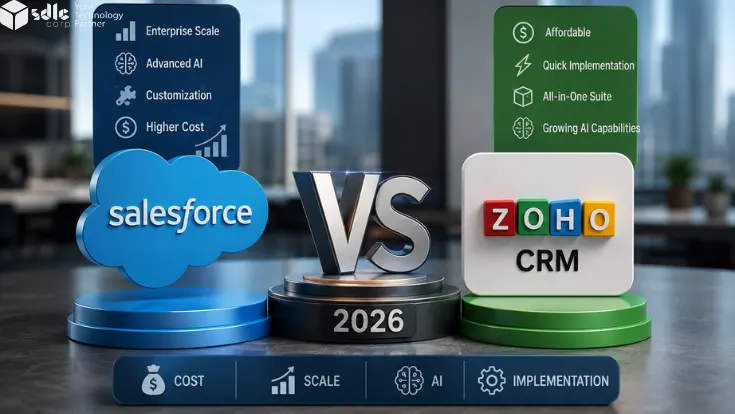
Salesforce and Zoho CRM help businesses manage sales, customers, automation, and reports. The right choice depends on more than price.
Zoho CRM is a good fit for teams that want lower cost, quick setup, and simple use. Salesforce is better for businesses that need advanced workflows, deep integrations, strong reporting, and AI automation.
This guide compares pricing, features, AI, setup, scalability, manufacturing use cases, and long-term value.
Choosing the wrong CRM can increase costs and slow growth. Compare Salesforce and Zoho CRM based on pricing, scalability, AI readiness, and long-term business value.
Talk to CRM ExpertsKey Takeaways
- Zoho CRM excels in affordability: It delivers lower ownership costs, faster implementation, and easier administration for SMBs and mid-market businesses.
- Salesforce leads in enterprise capabilities: Advanced forecasting, AI automation, governance, manufacturing tools, and scalability make it attractive for larger organizations.
- Total ownership cost matters more than licensing: Implementation, integrations, administration, training, and support often influence CRM ROI more than subscription pricing.
- AI strategy is becoming a key differentiator: Salesforce Agentforce and Einstein provide stronger enterprise AI capabilities, while Zoho Zia focuses on practical automation and productivity.
- The best CRM depends on business complexity: Organizations should evaluate implementation reality, scale requirements, and long-term growth objectives rather than features alone.
Salesforce vs Zoho CRM: Our Research Framework & Executive Summary
Deciding between Salesforce and Zoho CRM requires more than comparing pricing plans or feature lists. For this Salesforce vs Zoho CRM comparison, we reviewed official vendor documentation, CRM pricing structures, implementation experiences, migration trends, manufacturing CRM requirements, user discussions, and CRM adoption patterns.
Rather than evaluating platforms based solely on functionality, we analyzed both systems across four practical business realities:
- Cost Reality: What businesses actually spend after licensing, implementation, training, administration, and integrations.
- Scale Reality: How effectively the CRM supports growth, governance, reporting complexity, and enterprise operations.
- AI Reality: Whether AI capabilities improve forecasting, automation, decision-making, and productivity.
- Implementation Reality: The effort required to deploy, adopt, maintain, and optimize the CRM successfully.
Executive Summary: Which CRM Wins in Key Business Areas?
| Evaluation Area | Best Choice | Reason |
|---|---|---|
| Total Cost of Ownership | Zoho CRM | Lower implementation, administration, and ownership costs. |
| Implementation Speed | Zoho CRM | Faster deployment and easier onboarding. |
| Enterprise AI & Forecasting | Salesforce | Agentforce and Einstein deliver stronger AI capabilities and forecasting. |
| Enterprise Scalability | Salesforce | Built for governance, customization, and large-scale operations. |
| Manufacturing Operations | Salesforce | Manufacturing Cloud, forecasting, and account planning capabilities. |
| SMB & Mid-Market Fit | Zoho CRM | Strong functionality with lower operational overhead. |
| Ease of Administration | Zoho CRM | Requires less ongoing management effort. |
| Enterprise Integrations | Salesforce | AppExchange, API integration strategy , and enterprise integrations |
| Long-Term SMB ROI | Zoho CRM | Lower ownership costs improve ROI for smaller businesses. |
| Complex Workflows | Salesforce | Greater customization and automation flexibility. |
Select Salesforce CRM when your organization requires advanced forecasting, AI-driven automation, manufacturing workflows, enterprise integrations, governance, and long-term scalability.
Select Zoho CRM when affordability, faster deployment, lower administrative effort, and operational simplicity are your primary priorities.
Salesforce vs Zoho CRM: Executive Comparison at a Glance
Zoho also publishes its own Salesforce comparison page , including differences in pricing, editions, and CRM capabilities. This helps readers compare both platforms using official product sources.
| Category | Salesforce | Zoho CRM |
|---|---|---|
| Best For | Enterprises | SMBs & Mid-Market |
| Pricing | Higher Cost | Lower Cost |
| Implementation | Longer Setup | Faster Setup |
| Ease of Use | Steeper Learning Curve | Easier to Use |
| AI | Agentforce + Einstein AI | Zia AI |
| Customization | Advanced | Low-Code Flexibility |
| Scalability | Enterprise Governance & Scale | Moderate Complexity Scaling |
| Integrations | AppExchange + APIs | Zoho Ecosystem + Integrations |
| Administration | Higher Effort | Lower Effort |
| Manufacturing Support | Manufacturing Cloud & Forecasting | Basic to Moderate Support |
Why Businesses Compare Salesforce and Zoho CRM in 2026
Organizations evaluating CRM platforms are increasingly focused on business outcomes rather than software features alone. Modern CRM systems influence forecasting accuracy, automation maturity, customer visibility, reporting consistency, AI readiness, and revenue operations.
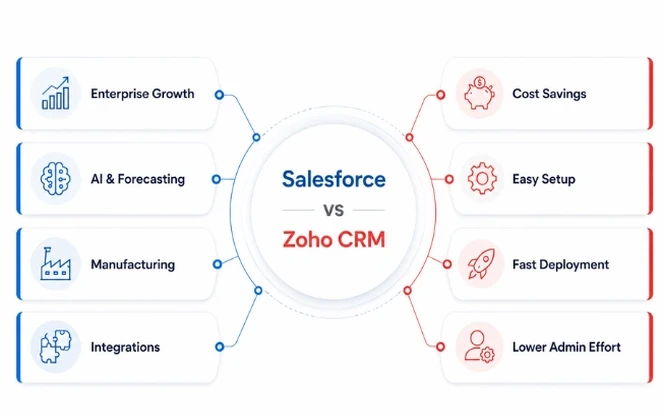
While Zoho CRM often appeals to businesses prioritizing cost-efficiency and simplicity, Salesforce is commonly selected by organizations that require advanced process control, enterprise integrations, manufacturing capabilities, and scalable CRM governance.
The decision should be based on long-term operational fit rather than short-term licensing costs.
The Real Cost of Salesforce vs Zoho CRM: Pricing, Ownership Costs & ROI
When comparing Salesforce vs Zoho pricing, many organizations focus primarily on monthly subscription costs. In reality, licensing represents only one component of total CRM investment.
Zoho CRM offers a free plan for up to 3 users and paid plans based on edition and billing cycle. This makes it easier for small and mid-sized teams to start with CRM at a lower entry cost.
Implementation services, user training, integrations, customization, administration, support, and AI adoption can significantly impact long-term ownership costs and overall return on investment.
Zoho’s total cost depends on licenses, users, add-ons, storage, support, and setup needs. It is usually easier to control for smaller teams because the starting plans are lower than Salesforce.
| Pricing Factor | Salesforce CRM | Zoho CRM |
|---|---|---|
| Entry-Level Availability | Starter Suite begins at $25/user/month | Free edition available for up to 3 users |
| Mid-Tier Adoption | Professional and Enterprise plans | Standard, Professional, and Enterprise editions |
| Advanced Features | Often require higher plans and add-ons | Depend on edition level |
| Real Cost Drivers | Implementation, admins, AI, integrations, training | Licensing, customization, migration, training |
Zoho CRM editions include different limits and feature access for automation, analytics, customization, AI, support, and administration. So the right plan depends on team size and CRM needs.
Salesforce Costs
Salesforce is widely used by growing businesses and enterprises that require advanced customization, workflow automation , extensive integrations, and long-term scalability. Its flexibility allows organizations to adapt the platform to evolving business and operational requirements.
Key cost considerations include:
- User license fees
- CRM consulting and implementation partners
- Salesforce administrators
- Third-party AppExchange apps
- AI solutions and add-ons
- Onboarding and training
- Development work
- Cloud storage and API usage
Zoho CRM Costs
Zoho CRM is less costly to implement and support. It is suitable for SMBs looking for an effective and efficient CRM solution.
Key cost considerations include:
- Affordable licensing prices
- Integration with the Zoho ecosystem
- Quick implementation and onboarding
- Lower administration effort
- Reduced need for dedicated CRM administrators
- Lower customization overhead
According to our research, Salesforce often involves additional investments beyond licensing, including implementation, administration, integrations, AI capabilities, training, and customization.
Zoho CRM is generally easier to deploy, less expensive to maintain, and simpler to administer. However, Salesforce frequently delivers stronger value for organizations that require advanced forecasting, enterprise reporting, governance, manufacturing functionality, AI automation, and large-scale integrations.
Still Deciding Between Salesforce and Zoho CRM?
Compare implementation effort, AI readiness, scalability, and total cost of ownership before making a CRM investment.
Get expert guidance tailored to your business goals.
Salesforce vs Zoho Features: Where Each CRM Wins
Both Salesforce and Zoho CRM provide lead management, automation, reporting, and customer relationship management capabilities. The differences become more visible when evaluating customization, AI capabilities, governance, scalability, and manufacturing support.
Zoho CRM includes sales automation, lead management, workflow automation, reporting, analytics, and customer communication tools. Some advanced features depend on the selected Zoho CRM edition.
| Feature Area | Salesforce CRM | Zoho CRM | Better Fit |
|---|---|---|---|
| Lead & Deal Management | Advanced and highly configurable | Strong and easier to manage | Depends on complexity |
| Workflow Automation | Deep automation and customization | Easier automation for common use cases | Business dependent |
| Reporting & Dashboards | Enterprise-grade reporting and analytics | Strong reporting for SMBs and mid-market teams | Salesforce |
| AI Capabilities | Agentforce + Einstein AI | Zia AI | Salesforce |
| Integrations | AppExchange ecosystem and APIs | Zoho ecosystem and third-party integrations | Salesforce |
| Manufacturing Support | Manufacturing Cloud, forecasting, and account planning | Basic to moderate manufacturing support | Salesforce |
| Administration | Requires governance and ownership | Simpler day-to-day management | Zoho CRM |
| Customization | Extensive customization and scalability | Flexible low-code customization | Salesforce |
Salesforce offers stronger customization, AI capabilities, reporting depth, manufacturing functionality, integrations, and enterprise scalability.
Zoho CRM focuses on usability, affordability, lower administrative effort, and faster deployment. Businesses with simpler requirements often find Zoho sufficient, while organizations with more complex processes frequently benefit from Salesforce.
Scale Reality: Salesforce vs Zoho CRM Scalability for Growing Businesses
Many people assume Zoho CRM is only for small businesses and Salesforce is exclusively for enterprises. In reality, scalability depends on business complexity rather than user count alone.
Public Perception
- Zoho CRM = CRM for small businesses
- Salesforce = CRM for enterprises
What Our Research Revealed
Several organizations have successfully deployed Zoho CRM for hundreds of users. However, true scalability involves governance, reporting structures, workflow complexity, approval processes, integrations, and compliance requirements.
Salesforce is frequently selected by organizations requiring enterprise integrations, multi-department workflows, global operations, advanced reporting, and governance controls.
The real scalability question is not whether Zoho CRM can support more users. The better question is whether the platform can support complex reporting layers, approval workflows, integrations, governance requirements, and operational growth.
For organizations with increasing complexity, Salesforce generally provides stronger long-term scalability.
Salesforce Agentforce + Einstein vs Zoho Zia: Which AI Actually Improves CRM Performance?
Artificial intelligence has become a major factor in CRM selection. Organizations are increasingly looking for platforms that can improve forecasting accuracy, automate repetitive work, surface insights, and help teams make faster decisions.
Salesforce Einstein AI
- Salesforce Agentforce for AI agents
- Einstein predictive analytics
- Lead and opportunity scoring
- Revenue forecasting
- AI-generated content and recommendations
- Workflow automation and decision support
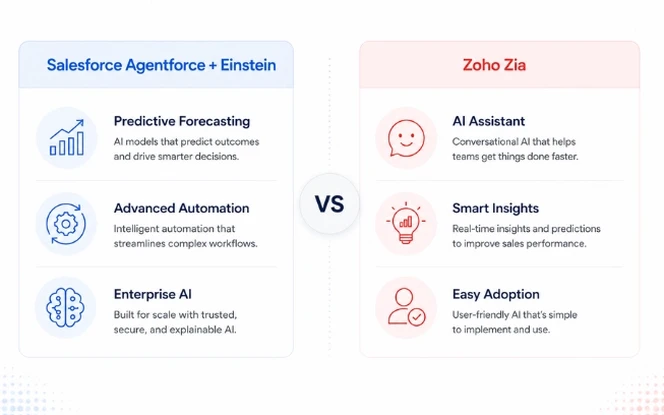
Salesforce has built a broader enterprise AI strategy through Agentforce and Einstein. The platform combines CRM data, automation, forecasting, and AI-powered decision-making into a connected ecosystem.
Zoho Zia AI
- AI conversational assistant
- Sales prediction capabilities
- Workflow recommendations
- Contextual search
- Built-in automation suggestions
- Business productivity enhancements
Zoho Zia focuses on practical AI capabilities that are easier to adopt and manage. For many businesses, it delivers useful automation without the complexity often associated with enterprise AI deployments.
| AI Capability | Salesforce Einstein | Zoho Zia |
|---|---|---|
| Predictive Analytics | Advanced forecasting and scoring | Basic to moderate predictions |
| Revenue Forecasting | Enterprise-grade forecasting | Limited forecasting capabilities |
| Automation | Complex workflow automation | Business-friendly automation |
| AI Assistants | Agentforce AI Agents | Zia Assistant |
| Enterprise Readiness | High | Moderate |
Salesforce provides stronger forecasting, analytics, automation, and enterprise AI capabilities through Einstein and Agentforce.
Zoho Zia offers easier-to-adopt AI functionality that works well for organizations prioritizing productivity, simplicity, and lower operational complexity.
Implementation Reality: Salesforce vs Zoho CRM
Implementation success depends on deployment effort, user adoption, administration requirements, governance, and long-term maintenance. The table below highlights the practical differences between Salesforce and Zoho CRM implementation.
| Implementation Area | Salesforce CRM | Zoho CRM |
|---|---|---|
| Deployment Timeline | Longer implementation cycles | Faster deployment and onboarding |
| Customization | Extensive customization capabilities | Flexible low-code customization |
| Administration | Often requires dedicated CRM ownership | Easier day-to-day administration |
| Consultant Dependency | Higher reliance on implementation partners | Lower dependency on external consultants |
| Governance | Strong governance and compliance controls | Lighter governance requirements |
| User Adoption | Steeper learning curve | Simpler user adoption |
| Maintenance Effort | Higher ongoing management effort | Lower maintenance requirements |
| Time-to-Value | Longer but scalable | Faster business value realization |
Zoho CRM is generally easier and faster to deploy, making it attractive for businesses seeking quicker adoption and lower operational overhead.
Salesforce requires greater planning, governance, and implementation effort but provides stronger scalability, customization, and enterprise-level process control.
CRM implementation often fails when organizations treat CRM as a software deployment rather than a business transformation initiative.
Successful adoption requires process design, governance, reporting frameworks, automation planning, user training, and executive ownership regardless of the platform selected.
Get Expert Guidance on CRM Setup, Automation, Integrations, and Adoption
Whether you're evaluating Salesforce or Zoho CRM, our specialists can help assess implementation effort, integration requirements, scalability, and expected ROI.
Salesforce vs Zoho for Manufacturing: Which CRM Supports Long-Term Growth?
Manufacturing companies often require more than traditional CRM functionality. Forecasting, dealer management, account planning, demand visibility, and ERP integration frequently become critical requirements.
| Manufacturing Need | Salesforce Fit | Zoho Fit |
|---|---|---|
| Dealer Account Planning | Strong | Basic to Moderate |
| Demand Forecasting | Strong | Limited |
| Sales Agreements | Strong | Limited |
| CPQ Complexity | Strong | Moderate |
| Customer Tracking | Good | Good |
| Lower-Cost Deployment | Moderate | Strong |
Where Salesforce Manufacturing Cloud Creates Additional Value
Salesforce provides specialized manufacturing capabilities through Manufacturing Cloud, including sales agreements, account forecasting, demand visibility, and stronger alignment between sales and operational planning.
Zoho CRM remains a practical option for manufacturers with simpler sales processes and tighter budget requirements, but Salesforce typically offers stronger long-term support for manufacturing growth.
User Reviews and Migration Trends: Why Businesses Switch Between Salesforce and Zoho CRM
CRM migration decisions are rarely driven by features alone. Most businesses switch platforms because of changing operational needs, growth requirements, ownership costs, reporting expectations, or scalability concerns.
| Migration Direction | Common Reason |
|---|---|
| Salesforce → Zoho CRM | Reduce licensing costs, simplify administration, and improve ease of use. |
| Zoho CRM → Salesforce | Need stronger customization, forecasting, AI capabilities, governance, and enterprise scalability. |
| Stay on Salesforce | Organizations benefiting from advanced workflows, integrations, and enterprise reporting. |
| Stay on Zoho CRM | Businesses prioritizing affordability, simplicity, and lower operational overhead. |
Most CRM migrations occur because business complexity changes over time. The platform that fits today may not be the best fit three to five years from now.
Which CRM Is Right for Your Business?
The right CRM depends on your organization's growth strategy, operational complexity, reporting requirements, AI ambitions, and budget considerations.
| If Your Priority Is... | Recommended CRM |
|---|---|
| Lower ownership costs | Zoho CRM |
| Fast deployment | Zoho CRM |
| Enterprise scalability | Salesforce |
| Advanced AI capabilities | Salesforce |
| Manufacturing operations | Salesforce |
| Ease of administration | Zoho CRM |
| Advanced customization | Salesforce |
| Reporting and forecasting | Salesforce |
| SMB affordability | Zoho CRM |
When Salesforce Becomes Worth the Higher Cost
Salesforce often becomes the better investment when organizations require enterprise-grade reporting, advanced forecasting, AI-driven automation, governance controls, complex integrations, and long-term scalability.
Although Salesforce typically involves higher implementation and administration costs, many growing organizations find that its flexibility and enterprise capabilities justify the investment.
Organizations That Typically Benefit Most from Salesforce
- Manufacturing companies with forecasting requirements
- Multi-department organizations with complex workflows
- Businesses planning significant growth
- Organizations requiring advanced reporting and analytics
- Companies investing heavily in AI-driven automation
- Enterprises requiring strong governance and compliance controls
Planning a Salesforce CRM Implementation or Optimization?
The Salesforce solution may become highly valuable if it is deployed using a suitable CRM architecture, automation logic, reporting model, and integration path. In its absence, firms are likely to experience low adoption rates, unclear reporting models, workflow duplication, and increased administrative overheads.
SDLC Corp offers Salesforce software development services for companies that require CRM implementation, customization, integration, migration, automation, and further optimization. We work together with our clients to assess Salesforce readiness, develop efficient workflows, integrate Salesforce into enterprise applications, and boost CRM adoption.
List of Services
- Salesforce CRM consulting & strategy
- Salesforce implementation and customization
- Sales Cloud automation
- Salesforce integration with ERP, finance, marketing, and support applications
- Salesforce Manufacturing Cloud consulting
- CRM migration & modernization
- Salesforce reporting and dashboards
- Salesforce AI preparedness for Agentforce & Einstein
If you are evaluating Salesforce as a long-term CRM platform, SDLC Corp can help you assess the implementation effort, technical requirements, integration scope, and expected business impact before you invest.
Need Help Choosing Between Salesforce and Zoho CRM?
Our CRM specialists can evaluate your business requirements, implementation needs, AI readiness, integrations, and long-term growth plans to help identify the best CRM platform.
Final Thoughts
Salesforce and Zoho CRM are both capable CRM platforms, but they serve different business needs.
Zoho CRM provides excellent value for businesses seeking affordability, ease of use, and faster implementation. Salesforce delivers stronger enterprise capabilities, deeper customization, advanced AI functionality, and long-term scalability.
The best choice depends on where your organization is today and where it plans to be in the future.
Businesses with relatively simple CRM requirements may find Zoho CRM sufficient. Organizations expecting significant growth, advanced automation needs, manufacturing requirements, or enterprise-level governance often gain greater long-term value from Salesforce.
FAQs
Yes. Zoho CRM is a good option for small teams that want a simple CRM at a lower cost. Salesforce is better when the business needs more control, deeper reports, and complex workflows.
Zoho CRM is usually cheaper. Its plans are easier to start with, and setup costs are often lower. Salesforce can cost more because it may need more setup, training, apps, and admin support.
Salesforce usually costs more than Zoho CRM. The final price depends on the number of users, plan, setup work, integrations, reports, and support needs.
Salesforce has more advanced features for sales, reports, automation, AI, and integrations. Zoho CRM has the main CRM features most small and mid-size teams need.
Salesforce is better for manufacturing companies with dealers, forecasts, quotes, service teams, and complex sales processes. Zoho CRM can work for smaller manufacturers with simple sales tracking.
Zoho CRM is easier to set up. It works well for teams that want to start fast. Salesforce takes more time because it often needs planning, data migration, custom fields, workflows, and training.
Salesforce has stronger AI features for large teams. It can help with forecasting, lead scoring, recommendations, and automation. Zoho Zia is useful, but it is simpler.
Salesforce is worth it when your business needs advanced reports, strong automation, many integrations, and better control over sales operations. For simple CRM needs, Zoho CRM may be enough.
Yes. You can move from Zoho CRM to Salesforce. The process includes cleaning data, mapping fields, moving contacts and deals, setting up reports, and training users.
Move to Salesforce when Zoho starts limiting your sales team. This usually happens when reporting, automation, integrations, approvals, or team processes become harder to manage.