
Enterprise resource planning investment is growing, but outcomes remain uneven. For example, Gartner reports that the ERP software market reached $66 billion in 2024, up 11.3% from $59 billion in 2023. Meanwhile, cloud ERP remains central to modernization, while AI moves into platform capabilities.
In addition, Gartner forecasts that AI enabled solutions will represent 62% of cloud ERP spending by 2027, up from 14% in 2024. However, over 70% of ERP initiatives may fail to meet their business case goals by 2027.
Readers who need a foundation can first review what ERP is and how it works. Moreover, the ERP industry statistics presented in this guide combine analyst research, implementation studies, and vendor data to help enterprise leaders benchmark market trends, investment priorities, and implementation outcomes.
Quick answer: ERP investment continues to grow, with the market reaching $66 billion in 2024 and projected at $106.22 billion in 2026.
However, AI could represent 62% of cloud ERP spending by 2027, while budget overruns and implementation risks mean these benchmarks should guide planning rather than guarantee results.
Key takeaways
- The ERP software market grew 11.3% to $66 billion in 2024, showing that ERP remains a long term modernization priority rather than a short term technology cycle.
- However, market expansion has not removed delivery risk: more than one quarter of ERP projects exceeded budget, and over 70% may miss their business case goals by 2027.
- Meanwhile, AI is moving from feature to foundation, rising from 14% of cloud ERP spending in 2024 to a forecast 62% by 2027.
- However, published ROI figures are directional, not guaranteed. Therefore, validate them against your own data maturity, governance, and adoption readiness.
Top 10 ERP statistics every enterprise leader should know in 2026
Overall, the following ERP statistics summarise where enterprise investment is heading, how implementations are actually performing, and where AI is beginning to change measurable business outcomes. In addition, each figure is paired with the practical implication for ERP planning teams.
ERP software market grew 11.3% to $66 billion in 2024
Specifically, the global ERP software market grew 11.3% to $66 billion in 2024.
Consequently, steady market expansion indicates that ERP remains a long term enterprise modernization priority rather than a short term technology cycle.
Cloud ERP adoption increased 7% year over year
Meanwhile, cloud ERP adoption increased 7% year over year.
As a result, organizations continue shifting toward cloud deployments to improve scalability, resilience, and operational flexibility.
More than one quarter of implementations exceeded budget
By contrast, more than one quarter of ERP implementations exceeded their original budgets.
In particular, additional technology requirements and scope expansion remain leading causes of project overruns.
Over 70% of initiatives may miss business case goals by 2027
Moreover, more than 70% of ERP initiatives are forecast to fall short of their original business case goals by 2027.
Therefore, enterprise success depends on governance, data readiness, and user adoption, not software selection alone.
Implementations typically take 6 to 18 months
Generally, ERP implementations take between 6 and 18 months, depending on organizational size and project complexity.
Accordingly, realistic implementation timelines help reduce delivery risk and improve change management planning.
SAP Cloud ERP Suite revenue rose 23% in Q1 2026
Meanwhile, SAP Cloud ERP Suite revenue increased 23% year over year in Q1 2026, extending the cloud growth momentum reported in SAP's FY2025 financial results.
However, because these figures reflect vendor reported financial performance, they indicate continued enterprise demand for SAP's cloud ERP portfolio rather than growth across the overall ERP market.
100%+ ROI with a 16 month payback for Dynamics 365 ERP
For example, a Microsoft sponsored Forrester Total Economic Impact study reported a 100%+ ROI with a 16 month payback period for Dynamics 365 ERP.
Although vendor sponsored, the study demonstrates the measurable business value achievable through well executed cloud ERP implementations.
30% improvement in ERP user efficiency
Similarly, an SAP sponsored Forrester Consulting study reported measurable operational benefits from cloud ERP modernization, including a 30% improvement in ERP user efficiency.
Furthermore, ROI and financial outcomes from the same study are discussed later in this guide.
AI to reach 62% of cloud ERP spending by 2027
Meanwhile, AI enabled solutions are forecast to account for 62% of cloud ERP spending by 2027, up from 14% in 2024.
As a result, AI is rapidly evolving into a core capability for automation, analytics, and enterprise decision support.
30% faster financial close with embedded AI by 2028
Specifically, finance organizations using cloud ERP with embedded AI assistants are predicted to achieve a 30% faster financial close by 2028.
Therefore, this forecast highlights how AI adoption is increasingly linked to measurable operational performance rather than experimental innovation.
The ERP statistics enterprises should benchmark against
Overall, these ERP software statistics provide a balanced view of market growth, cloud adoption, implementation performance, business value, and AI adoption to support enterprise planning.
Moreover, enterprise cloud ERP statistics deliver the most value when used as strategic planning benchmarks rather than isolated figures.
As a result, the benchmarks below provide a balanced view of market growth, cloud adoption, implementation performance, business value, and AI adoption to help enterprise leaders make more informed ERP decisions.
ERP market growth and enterprise adoption
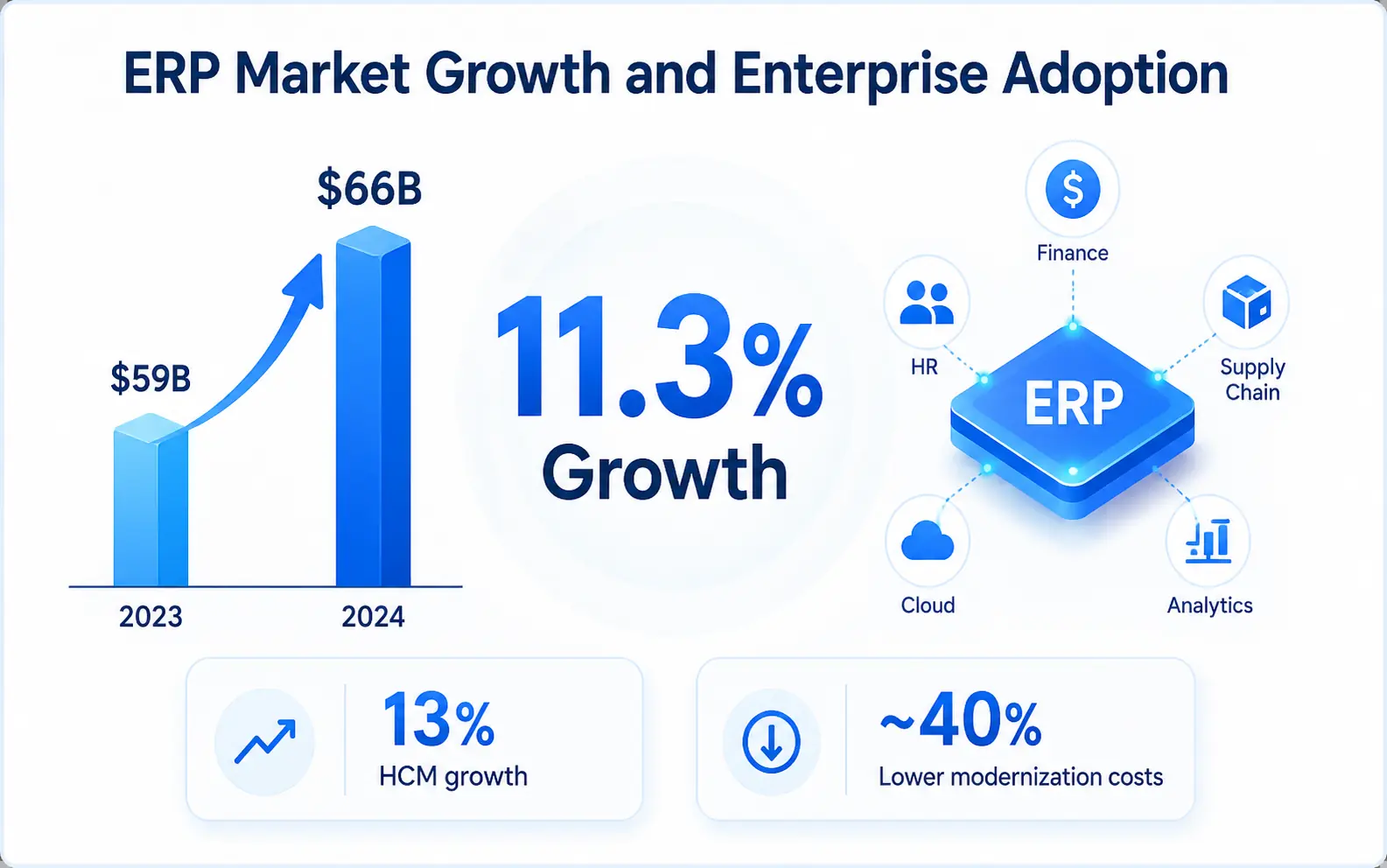
In 2024, the global ERP market size (ERP software market) grew 11.3% to reach $66 billion, up from $59 billion in 2023.
Overall, the sustained growth suggests ERP remains a strategic modernization priority despite tighter enterprise technology budgets.
| Market benchmark | Figure | What it means for enterprise planning |
|---|---|---|
Global ERP software market | $66B in 2024 | Grew 11.3% from $59 billion in 2023, indicating ERP remains a long term modernization priority rather than a short term technology cycle. |
Fastest growing ERP segment (HCM) | +13.0% in 2024 | Human Capital Management (HCM) was the fastest growing ERP segment, expanding 13.0% in 2024. As a result, workforce transformation continues to attract higher investment as organizations modernize talent management alongside core ERP modules such as finance and operations. |
Selection decisions shaped by vendor marketplaces | One third by 2030 | Gartner predicts that by 2030, one third of ERP selection decisions will be influenced by vendors' application marketplaces rather than core platform functionality alone. Consequently, enterprise evaluations are increasingly extending beyond feature comparisons to include ecosystem maturity, partner solutions, and extensibility. |
AI assisted modernization cost reduction | ~40% by 2030 | Gartner also forecasts that AI assisted modernization tools could reduce ERP modernization costs by approximately 40% by 2030. In turn, AI is evolving into a practical accelerator for migration, testing, configuration, and code conversion rather than simply adding new application features. |
Although this guide focuses on market growth rather than vendor ERP market share, enterprise buyers should follow a structured ERP selection process that evaluates vendor ecosystems, industry specialization, and long term product strategy alongside market leadership.
Cloud ERP and deployment trends
Meanwhile, these ERP adoption statistics show how organizations are accelerating cloud deployments while comparing ERP system types and deployment models, AI capabilities, ecosystem maturity, and long term scalability.
- According to SAP FY2025 financial results, Cloud ERP Suite revenue grew 28%. For the full FY2025 fiscal year, cloud backlog increased 22% to $77.29 billion. Together with SAP's Q1 2026 results, these figures indicate sustained enterprise demand across successive reporting periods. As vendor reported financial results, these figures reflect continued customer adoption of SAP's cloud ERP portfolio.
- Business AI was included in two thirds of SAP's Q4 2025 cloud order entry. While specific to SAP, the results indicate that embedded AI capabilities are becoming an increasingly important evaluation criterion for enterprise buyers.
However, vendor reported growth confirms demand direction, but it should be read as evidence of one portfolio's momentum rather than as a measure of the overall ERP software market.
ERP implementation performance
More than one quarter of ERP (Enterprise Resource Planning) projects exceeded their original implementation budgets.
In particular, scope expansion, additional technology requirements, and evolving business needs remain more common causes of cost overruns than software limitations.
For example, Gartner forecasts that more than 70% of recently implemented ERP initiatives will not fully achieve their original business case goals by 2027.
Therefore, governance, executive sponsorship, business alignment, and change management consistently have a greater influence on implementation success than platform selection.
Rather than relying on a single ERP success rate, organizations should evaluate implementation performance through governance, executive sponsorship, user adoption, and measurable business outcomes.
What consistently improves outcomes
- Governance and decision ownership
- Executive sponsorship
- Business alignment
- Change management
- Data readiness
- User adoption
- Measurable business outcomes
What most often causes overruns
- Scope expansion
- Additional technology requirements
- Evolving business needs
- Implementation cost pressure
- Transformation complexity
- Weak change management
- Platform first selection thinking
Deloitte's analysis of more than 400 public companies' 10 K filings identified predominantly negative to neutral sentiment toward ERP investments.
However, the findings reflect executive concern over implementation costs and transformation complexity rather than a measured implementation success rate.
ERP business value and AI optimization
According to the same SAP sponsored Forrester Consulting study, organizations achieved 155% ROI over three years, approximately $630,000 in infrastructure savings, and a 30% improvement in ERP user efficiency.
Although based on a composite customer model, the findings provide directional evidence of the financial and operational benefits organizations may achieve through successful cloud ERP modernization.
Similarly, a Microsoft sponsored Forrester Total Economic Impact™ study found 100%+ ROI with a 16 month payback for Microsoft Dynamics 365 ERP.
Therefore, the findings demonstrate how implementation quality, organizational scale, and user adoption directly influence long term ERP value realization.
Reported ERP value benchmarks
However, figures below come from vendor sponsored studies and should be read as directional evidence rather than guaranteed outcomes.
AI share of cloud ERP spending
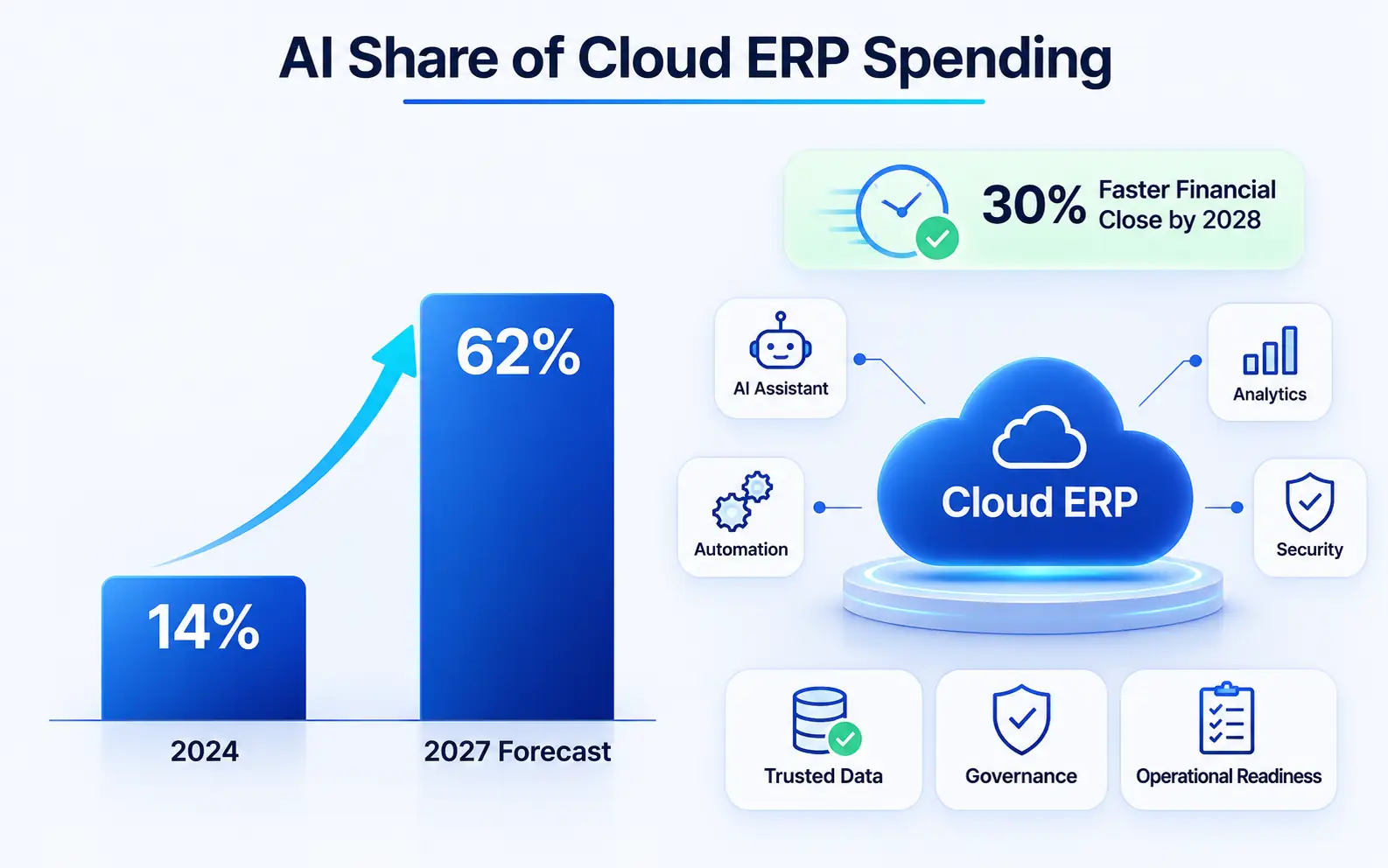
For example, Gartner forecasts that AI enabled solutions will account for 62% of cloud ERP spending by 2027, up from 14% in 2024.
In addition, Gartner predicts that finance organizations using cloud ERP applications with embedded AI assistants could achieve a 30% faster financial close by 2028.
Therefore, ERP strategy is shifting from simply adopting AI features to ensuring organizations have the data quality, AI governance and risk management, and operational readiness needed to realize measurable business outcomes.
How ERP benchmarks differ by organization size
By comparison, these ERP usage statistics demonstrate that implementation priorities, governance requirements, and deployment models vary significantly between small and midsize businesses and large enterprises.
| Organization tier | Annual revenue | What ERP planning typically involves |
|---|---|---|
| Lower Tier II organizations | $10M to $250M | For example, Panorama classifies these organizations as typically operating within a single legal entity and industry, with cloud ERP adoption remaining stable year over year. As a result, the consistent adoption trend indicates cloud ERP continues to be a widely adopted deployment model for organizations in this segment, helping simplify infrastructure management while providing access to modern ERP capabilities. |
| Tier I enterprises | More than $750M | By contrast, Tier I organizations typically manage multiple business units, legal entities, and complex operational processes. Therefore, ERP initiatives at this scale generally require multi entity governance, ERP and CRM integration, standardized business processes, phased implementation planning, and long term scalability to support enterprise wide transformation. |
Turning ERP statistics into enterprise decisions
Overall, ERP statistics are most valuable when they help validate decisions rather than replace business judgment.
Therefore, use the benchmarks above to compare your organization's plans against industry evidence while recognizing that implementation outcomes vary by business objectives, operational complexity, and organizational readiness.
- Budget planning: Use Panorama's budget overrun benchmarks to estimate realistic ERP implementation costs, but avoid assuming published averages will match your project.
- Vendor evaluation: Balance Gartner market insights with vendor reported capabilities to evaluate the platform's long term fit rather than ERP selection solely because of market leadership.
- Implementation planning: Apply Panorama's implementation and governance findings to build realistic project plans, recognizing that successful outcomes depend on process alignment and change management, not just software deployment.
- ROI & risk assessment: Use ROI studies and Gartner's AI readiness benchmarks as directional indicators, not guarantees, and validate expected returns against your organization's data maturity, governance, and adoption readiness.
Translating ERP benchmarks into an implementation roadmap
Similarly, ERP benchmarks are most valuable when they inform implementation decisions rather than serve as fixed project targets.
Accordingly, the statistics and research presented throughout this guide should help organizations validate planning assumptions, identify potential risks, and prioritize implementation activities based on their operational complexity, business objectives, and organizational readiness.
Business process assessment
Firstly, use implementation benchmarks to validate existing workflows and identify process gaps before defining ERP requirements or selecting a platform.
Requirements & platform evaluation
Next, compare business needs against platform capabilities, deployment trends, and ecosystem maturity to identify the ERP solution best aligned with long term operational goals.
Data readiness & governance
Then, apply implementation and AI readiness findings to assess data quality, migration readiness, governance, and integration requirements before deployment begins.
Change management & implementation planning
Afterward, use governance, adoption, and implementation benchmarks to build realistic rollout plans, strengthen executive sponsorship, and improve user adoption throughout the ERP implementation process.
Implementation & continuous optimization
Finally, SDLC Corp supports organizations through ERP consulting services, platform assessment, implementation, modernization, system integration, data migration, user training, and post go live optimization across leading ERP platforms, including SAP, Microsoft Dynamics 365, Oracle, Odoo, and NetSuite.
Research methodology
Click to read how these statistics were selected
Research methodology
Overall, this guide prioritizes 2025 to 2026 analyst research, ERP implementation studies, and publicly documented vendor data.
In addition, each statistic was evaluated for publication date, geographic relevance, sample scope, methodology, and measurement definition.
However, older research is included only where no credible recent equivalent exists, while forecasts are clearly distinguished from observed market and implementation results.
Because ERP implementations differ by industry, geography, deployment model, and organizational maturity, no single statistic should be interpreted as universally applicable.
Therefore, vendor sponsored research, analyst forecasts, and implementation surveys should be evaluated alongside each organization's business objectives, operational complexity, and project scope.
Conclusion
In conclusion, the ERP trends and statistics presented throughout this guide provide valuable context for enterprise planning, but they are most effective when used as benchmarks rather than predictions.
Therefore, organizations should interpret market evidence alongside their own operational complexity, data readiness, governance maturity, implementation capacity, and long term business objectives.
Ultimately, the most successful ERP decisions are driven not by the largest market figures or the most popular platform, but by selecting an approach that aligns with measurable business outcomes and sustainable organizational growth.
FAQs
What are the latest ERP statistics for enterprise adoption in 2026?
Overall, enterprise ERP adoption continues to grow, driven by cloud deployments, AI capabilities, and digital transformation initiatives.
As a result, organizations increasingly prioritize scalability, automation, and long term business value when investing in ERP.
What do ERP implementation statistics say about project success rates?
Specifically, ERP implementation statistics show that project success depends more on governance, executive sponsorship, data readiness, and user adoption than on software selection alone.
How is the ERP software market expected to grow in the coming years?
Meanwhile, the ERP software market is projected to continue expanding as enterprises invest in cloud ERP, AI powered automation, and modern business platforms to improve operational efficiency.
Why are cloud ERP statistics important for enterprise decision making?
Therefore, cloud ERP statistics help organizations evaluate adoption trends, deployment models, scalability, and technology investments before selecting or modernizing an ERP platform.
How can businesses use ERP market statistics to plan ERP investments?
Finally, businesses should use ERP market statistics as planning benchmarks to estimate budgets, assess implementation risks, compare platforms, and support long term ERP investment decisions.