RAG Engineering Enterprise Ready

RAG
Development Services

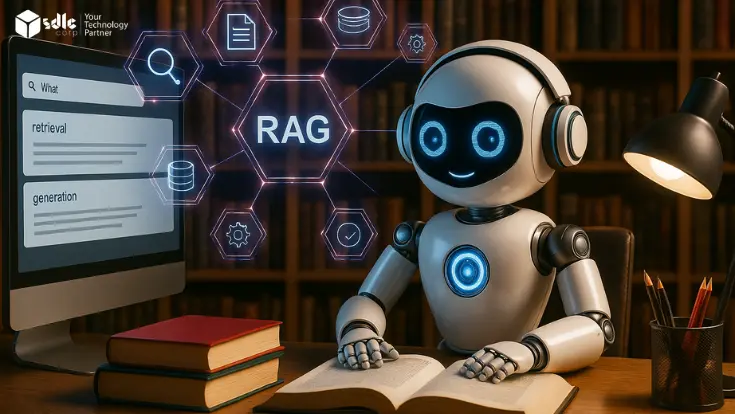
Build RAG applications that connect language models with your business data and deliver accurate, grounded answers.

Our RAG development services cover data ingestion, document processing, vector search, hybrid retrieval, reranking, enterprise integrations, evaluation and production deployment.

Proven AI Delivery

50+Enterprise Clients
400+AI Specialists
98%On Time Delivery
10+ Yearsof Experience

Trusted by Fortune Global 500 leaders, governments & top universities across 30+ countries

Powered by leading cloud & AI platforms

AWS
Google Cloud
Microsoft Azure
NVIDIA
OpenAI
Anthropic
Gemini
Grok
Perplexity
Google AI
AWS
Google Cloud
Microsoft Azure
NVIDIA
OpenAI
Anthropic
Gemini
Grok
Perplexity
Google AI

Recognized by leading industry reviewers

Awards & industry recognition

Top AI Development Company by Selected FirmsTop IT Consulting, SI & Managed Services Company by ITRateTop Web Development Company by Selected FirmsTop Service Provider 2025 by RightFirmsTop App Development Company by AppDevelopmentCompaniesTop Software Development Company by Selected FirmsBest Support Company 2025 by SoftwareSuggestTop AI App Developers by C2C Reviews
RAG Development

RAG Development
Services

Build Retrieval Augmented Generation systems around your business data, workflows and existing applications.

Build

Custom RAG Development

Build custom RAG solutions that retrieve relevant information from documents, databases and enterprise systems before generating a response.

Applications

RAG Application Development

Develop knowledge assistants, enterprise search systems, document intelligence applications and business specific question answering platforms.

Integration

Enterprise RAG Integration

Connect RAG applications with CRM, ERP, knowledge platforms, databases, APIs and existing enterprise applications.

Interfaces

RAG API Development

Expose retrieval and generation capabilities through APIs for existing applications, platforms and workflows.

Tuning

RAG Optimization

Improve chunking, embeddings, retrieval, ranking, context construction, citations, response quality and latency in existing RAG systems.

Testing

RAG Evaluation

Measure whether the system retrieves the right evidence and whether generated responses remain grounded in that evidence.

For broader language model engineering, explore our LLM Development Services.

Use Cases

RAG Solutions
We Build

Production RAG applications shaped around how your teams actually search, read and act on business information.

Employees

Knowledge Assistants

Give employees natural language access to policies, manuals, procedures, product documentation and internal knowledge.

Discovery

Enterprise Search

Search business information using natural language while combining semantic retrieval with exact keyword matching.

Documents

Document Intelligence

Search, compare, summarize and extract information from contracts, reports, manuals and large document collections.

Service

Support Copilots

Help support teams retrieve product information, procedures and previous resolutions while handling customer requests.

Analysis

Research Assistants

Search approved sources, compare documents and summarize findings with references to supporting information.

Departments

Knowledge Portals

Create searchable internal knowledge environments while maintaining user permissions and source access controls.

Outcomes

What RAG
Can Improve

Retrieval changes what the model has in front of it at the moment it answers, which is where most of the quality in a production assistant comes from.

Speed

Faster Knowledge Access

Help users find relevant information across documents and business systems without manually searching multiple repositories.

Accuracy

Grounded Responses

Give language models relevant business information before they generate an answer.

Verification

Source Traceability

Connect responses with supporting documents or source pages when users need to verify information.

Freshness

Current Knowledge

Update the retrieval layer as business information changes without retraining the language model each time.

Data Connectivity

Connect
Business Data

Build RAG systems around the information your organization already uses.

Files

Documents

PDFs, Word files, spreadsheets, reports, policies and manuals.

Structured

Databases

Relational databases, NoSQL systems and structured business information.

Platforms

Enterprise Platforms

CRM, ERP, support systems and operational applications.

Knowledge

Knowledge Sources

Wikis, documentation portals and internal knowledge repositories.

Services

APIs

Internal services and approved third party data sources.

Sources

Web Content

Selected public or private web content where appropriate.

For broader artificial intelligence capabilities, explore our AI Development Services.

Architecture

RAG
Architecture

A reliable RAG system needs more than a language model and vector database.

Stage 01

Data Ingestion

Collect information from approved business sources and keep the knowledge layer synchronized.

Stage 02

Document Processing

Clean, structure and divide content into useful retrieval units while preserving metadata and source information.

Stage 03

Embeddings

Convert content into representations that support semantic retrieval.

Stage 04

Vector Search

Retrieve information based on meaning and context.

Stage 05

Hybrid Search

Combine semantic retrieval, keyword search and metadata filters when exact terms also matter.

Stage 06

Reranking

Prioritize the strongest retrieved evidence before passing context to the language model.

Stage 07

Context Building

Provide the model with the information required to answer without adding unnecessary content.

Stage 08

Grounded Responses

Generate responses using retrieved evidence and include supporting source references where required.

Learn more in our Retrieval Augmented Generation guide.

Evaluation

Evaluate
RAG Quality

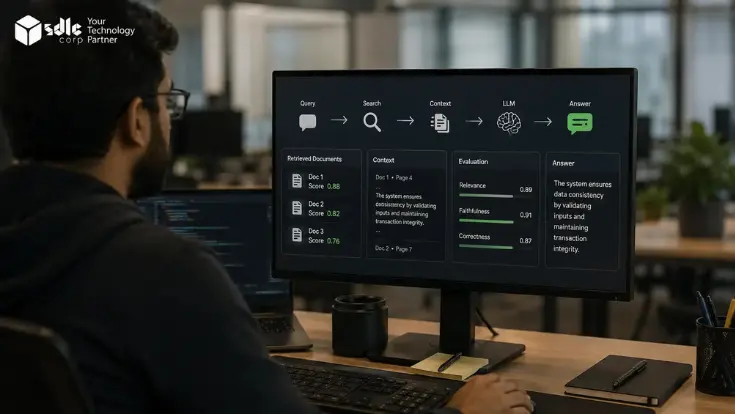
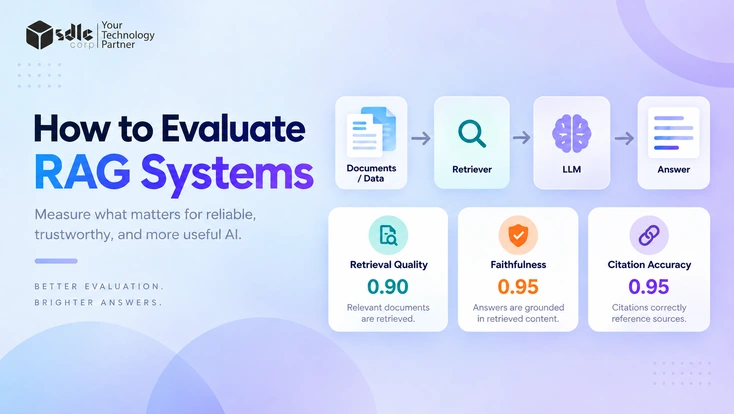
A fluent answer does not automatically mean a RAG system works correctly. We evaluate retrieval and generation separately.

Retrieval

Retrieval Quality

Check whether the system finds the information required to answer the question.

Grounding

Response Grounding

Measure whether generated claims are supported by retrieved information.

Citations

Citation Accuracy

Verify whether citations support the statements connected to them.

Usefulness

Answer Quality

Evaluate relevance, completeness and usefulness.

Restraint

No Answer Handling

Test whether the system avoids unsupported responses when reliable information is unavailable.

Regression

Regression Testing

Compare performance after changes to models, embeddings, prompts, retrieval settings or knowledge sources.

Explore our RAG Evaluation Framework for a deeper approach to retrieval and response evaluation.

Security

Secure
RAG Systems

Enterprise RAG applications need to protect the information behind every response.

Permissions

Role Based Access

Restrict information according to users, groups and application roles.

Governance

Source Permissions

Apply source access rules before retrieved content reaches the language model.

Separation

Data Isolation

Keep customer, department, project or business information separated where required.

Traceability

Audit Logging

Record relevant application, retrieval and administrative activity.

Hosting

Private Deployment

Deploy RAG applications within suitable cloud, private or hybrid environments based on business requirements.

Industries

RAG Solutions
by Industry

The retrieval layer changes shape with the regulations, document types and access rules of each sector.

Regulated

Healthcare

Search approved policies, operational information, research and documentation with controlled information access.

Controlled

Financial Services

Connect teams with policies, procedures, product information and controlled internal knowledge.

Documents

Legal

Search contracts, policies, precedents and large document collections with supporting source references.

Operations

Logistics

Retrieve procedures, shipment documentation, operating manuals and internal knowledge through natural language search.

Technical

Manufacturing

Make technical documentation, maintenance information and standard operating procedures easier to retrieve.

Cross functional

Enterprise Operations

Connect employees with approved knowledge across departments, applications and business systems.

Technology

RAG Technology
Stack

We work with established technologies across the retrieval and application stack.

Language Models

Commercial and open models selected per workload

OpenAIClaudeGemini LlamaMistral
RAG Frameworks

Retrieval orchestration built on proven frameworks

LangChainLlamaIndex Custom Orchestration
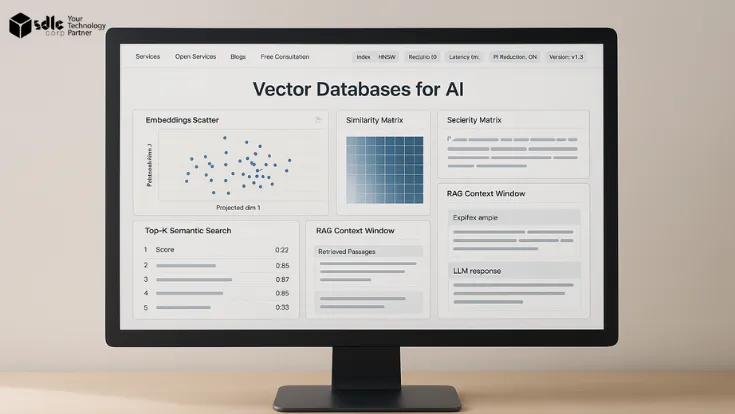
Vector Databases

Embedding storage and similarity retrieval

PineconeQdrantWeaviate Milvuspgvector
Search Platforms

Keyword, filtered and hybrid retrieval

ElasticsearchSemantic SearchHybrid Search
Engineering

Application, service and integration layers

PythonNode.js APIsMicroservices
Infrastructure

Cloud, container and orchestration platforms

AWSAzureGoogle Cloud DockerKubernetes
Products & systems

Retrieval Systems,
Shipped to Production.

Five SDLC Corp products and engagements where retrieval decides the answer. Scroll to deal each card onto the table.

5 cases · scroll to reveal
01 / 05 Case Study
Veterinary Care Ease Pet Vet
0 hallucinations
in review

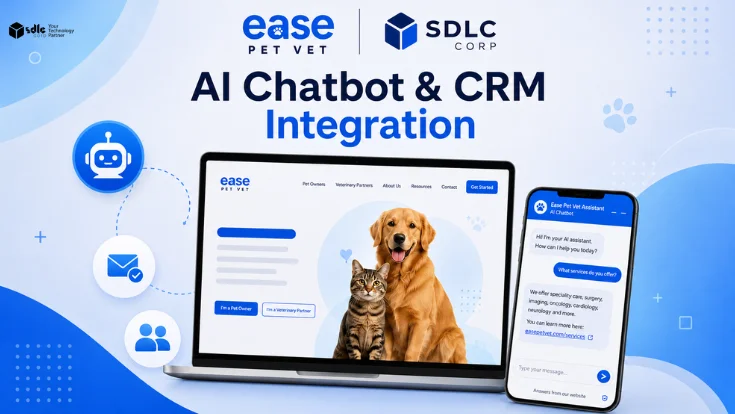
Website Grounded RAG Assistant

A retrieval assistant answering only from approved easepetvet.com content. OpenAI embeddings, PostgreSQL with pgvector and semantic retrieval ground every response in source material, with the index refreshed as the site changes.

  • Site-grounded answers
  • pgvector retrieval
  • 100% emails verified
  • 10–12 week build
View Full Case Study
Ease Pet Vet website-grounded RAG chatbot developed by SDLC Corp

Website-grounded RAG assistant using approved Ease Pet Vet content

02 / 05 Case Study
Enterprise RAG Platform Convera
L4 governed RAG in the
trust pipeline

Governed Retrieval for Regulated Environments

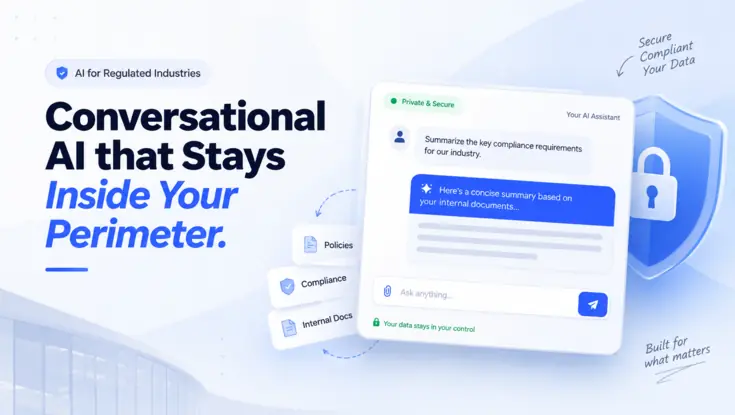
Convera runs governed RAG over your own document set inside a six-stage trust pipeline, then checks citations before the answer leaves the boundary. Deployable on premise, in sovereign cloud or fully air gapped, with open weight models running offline.

  • Sovereign knowledge base
  • Citation check stage
  • 50+ languages
  • On premise, sovereign cloud, air gapped
Explore Convera
Convera enterprise RAG platform answering from governed internal policies and private documents

Convera returns cited answers from governed enterprise knowledge

03 / 05 Case Study
Internal Support Enterprise Knowledge Assistant
68% employee queries
resolved autonomously

RAG Over Internal Documentation

A generative AI assistant integrated with internal documentation, CRM and the ticketing system. GPT-4o with Retrieval Augmented Generation resolved 68% of employee queries autonomously and reduced support costs by 50%.

  • GPT-4o
  • Pinecone
  • LangChain
  • Guardrails.ai
  • −50% support cost
Discuss a Similar Knowledge Assistant
Enterprise knowledge assistant using RAG for internal documentation and support

Enterprise knowledge assistant connected with internal documentation and support systems

04 / 05 Case Study
Logistics Global Logistics Knowledge Assistant
82% internal support
tickets automated

Retrieval Across ServiceNow, Slack and the Knowledge Base

A GPT-4o enterprise assistant built with LangChain and connected to ServiceNow, Slack and the internal knowledge base through RAG architecture, handling IT queries, HR policy questions and system access requests.

  • 45 min → 4 sec response
  • GPT-4o
  • LangChain
  • ServiceNow
  • Slack
Discuss a Similar Enterprise RAG System
Enterprise RAG knowledge assistant for logistics support workflows
05 / 05 Case Study
Voice Knowledge Retrieval Pulastya
KB approved documents
only

Retrieval Inside a Live Phone Call

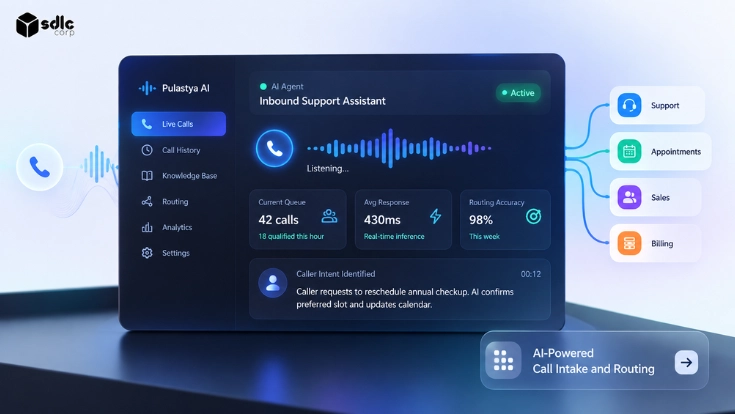
A voice agent that understands callers in natural speech, classifies each call by intent and answers from the client's approved knowledge base. Anything it should not answer is routed on with the transcript and summary attached.

  • Approved documents only
  • Intent classification
  • Transcript + summary on transfer
  • Keeps your existing number
Explore Pulastya
Pulastya semantic knowledge retrieval during AI voice conversations
Client Stories

Real Stories.
Real Impact.

Founders, CEOs, and operating leaders share what it's like to build with SDLC Corp.

Client story

Eric Leist

CEO, Edgerton Strategies

Client story

Doug Schmidt

CEO, Roofaid USA

Client story

Reyzal Razmi

All Star Influencers

What clients say
01 / 05
They approached our Salesforce discovery with real technical depth, uncovered structural gaps others missed, and delivered a solution that worked exactly as promised.
SDLC CORP built a mobile application that met our strategic requirements with strong technical execution. The solution performs reliably and has become an important operational asset.
They saw inefficiencies in our Salesforce workflow and redesigned our entire quote-to-cash system. We now operate faster, cleaner, and with better accuracy.
From planning to post-launch, SDLC Corp guided us every step of the way. Their support makes them more than a vendor. They're a trusted partner.
The SDLC Corp team scaled our platform with impressive technical expertise, ensuring it's secure, robust, and ready for future growth.
What clients say
01 / 05
The SDLC Corp team scaled our platform with impressive technical expertise, ensuring it's secure, robust, and ready for future growth.
From planning to post-launch, SDLC Corp guided us every step of the way. Their support makes them more than a vendor. They're a trusted partner.
They saw inefficiencies in our Salesforce workflow and redesigned our entire quote-to-cash system. We now operate faster, cleaner, and with better accuracy.
SDLC CORP built a mobile application that met our strategic requirements with strong technical execution. The solution performs reliably and has become an important operational asset.
They approached our Salesforce discovery with real technical depth, uncovered structural gaps others missed, and delivered a solution that worked exactly as promised.
By the numbers

10+ Years of
Experience.

Ten chapters from inside SDLC Corp, engineered by 1,200+ engineers across six continents.

Drag to spin
3,400+
Projects Delivered
across 12 industries
400+
AI Specialists
Top 1% global talent
10+
Years of Experience
shipping at enterprise scale
40+
Web3 Projects
regulated, global, real-time
200+
Odoo Implementations
Gold Partner since 2018
120+
Agentforce Launches
Salesforce Summit Partner
1,200+
Global Engineers
across 6 continents
30+
Countries Served
global regulatory regimes
50+
Enterprise Clients
Fortune 500 to challengers
99.99%
Platform Uptime
production SLAs we keep
Delivery

Our RAG
Process

Five stages from use case definition to a measured RAG application running in production.

01

Discover

Define users, business questions, information sources, integrations and expected outcomes.

02

Design

Create the ingestion, retrieval, generation, security and application architecture.

03

Build

Develop data pipelines, retrieval services, application interfaces and system integrations.

04

Evaluate

Test retrieval quality, grounding, citations, latency and representative business scenarios.

05

Deploy

Launch the RAG application in the required environment and monitor production performance.

RAG Audit

Improve
Existing RAG

Already have a RAG system that does not perform as expected? We evaluate the complete retrieval pipeline to identify where quality is being lost.

Common RAG Issues

Where retrieval quality is usually lost

Poor document chunking
Weak retrieval
Irrelevant context
Missing metadata
Poor embedding selection
Incorrect filtering
Weak reranking
Unsupported answers
Incorrect citations
Slow response times
High model costs

We identify the underlying problem before replacing components.

Read How to Evaluate RAG Systems

Why SDLC Corp

Why Choose
SDLC Corp

One engineering partner for the full RAG lifecycle, from the retrieval layer through production operation.

End to End

Complete RAG Engineering

Build the full system from information ingestion and retrieval through generation, integration and deployment.

Systems

Enterprise Integration

Connect RAG applications with existing databases, APIs, business applications and enterprise platforms.

Retrieval First

Retrieval First Approach

Focus on the quality of information reaching the model instead of relying only on prompt changes.

Model Choice

Flexible Model Support

Use suitable commercial or open language models based on quality, privacy, latency and infrastructure requirements.

Measured

Built In Evaluation

Measure retrieval, grounding and response quality throughout development.

50+Enterprise Clients
400+AI Specialists
98%On Time Delivery
Get Started

Build Your
RAG Solution

Connect your documents, enterprise systems and business knowledge with a RAG application built for real users and production workflows.

From enterprise search and knowledge assistants to document intelligence and custom retrieval systems, our RAG development team can take your project from architecture through deployment.

Contact Us

Share a few details about your project, and we’ll get back to you soon.

Let's Talk About Your Project

FAQ

Frequently Asked
Questions.

The questions teams ask most often before starting a RAG engagement.

RAG development services cover the design, development, integration and deployment of Retrieval Augmented Generation applications.

A RAG solution can include data ingestion, document processing, embeddings, semantic search, hybrid retrieval, reranking, generation, citations, evaluation and enterprise integration.

Retrieval Augmented Generation combines information retrieval with a language model.

When a user asks a question, the system retrieves relevant information from approved sources and gives that context to the model before generating a response.

RAG is useful when an application needs proprietary, frequently changing or domain specific information that the language model cannot reliably provide on its own.

Yes. RAG applications can connect with documents, databases, APIs, CRM systems, ERP platforms, knowledge repositories and other approved business sources.

Not always.

RAG systems can use dedicated vector databases, relational databases with vector support, search platforms or hybrid retrieval architectures.


The right option depends on data volume, retrieval requirements, metadata, latency and infrastructure.

RAG can reduce unsupported responses by grounding the language model in retrieved information.

It does not guarantee that every response will be correct, so retrieval and generation still need evaluation.

RAG provides external information to a model when a request is made.

Fine tuning changes model behavior by training it on additional examples.

RAG is generally better suited to proprietary or changing knowledge. Fine tuning can help with specialized behavior or repeatable tasks.

Yes.

We can evaluate existing RAG systems across document processing, chunking, embeddings, retrieval, metadata, filtering, reranking, context construction, generation, citations and latency.

RAG evaluation should test retrieval and generation separately.

Common measures include retrieval relevance, context recall, grounding, faithfulness, citation accuracy, answer relevance and correct handling of questions that cannot be answered from the available information.