
What Is Generative AI in Fintech?
Banks, fintech platforms, and insurers use generative AI to review transactions, summarize documents, and support compliance teams. It can also personalize customer interactions and improve risk analysis with less manual work.
Traditional AI predicts or classifies existing data. Generative AI creates new outputs, such as reports, recommendations, synthetic data, and natural-language responses.
| Area | What Generative AI Handles |
|---|---|
| Customer support | Conversational AI, query routing, after-hours support workflows |
| Fraud detection | Anomaly detection, behavioral analysis, alert triage |
| Document processing | KYC, AML, contract review, regulatory filing |
| Credit and risk | Alternative data scoring, explainable risk models |
| Compliance automation | Policy search, audit preparation, regulatory Q&A |
| Report generation | Financial summaries, portfolio updates, internal briefings |
Core Technologies in Fintech AI
| Technology | Role in Fintech AI |
|---|---|
| LLMs (Large Language Models) | Customer support, document review, report generation, policy Q&A |
| RAG (Retrieval-Augmented Generation) | Grounded answers from approved financial data sources, helping reduce hallucination risk |
| Multimodal AI | Document, voice, image, and structured data processing together |
| AI Agents | Multi-step workflow support with human checkpoints for regulated decisions |
Where Generative AI Fits in Fintech — and Where to Be Careful
Generative AI works well for supporting analysis, automating documentation, and retrieving knowledge. It needs strong controls when outputs affect regulated decisions.
| Use generative AI when… | Be careful when… |
|---|---|
| ✓ You need document summarization, KYC review, support automation, or knowledge retrieval | ⚠ The decision is fully regulated and cannot tolerate hallucinated outputs |
| ✓ You have clean data, access controls, and compliance review in place | ⚠ Your data is scattered, incomplete, or lacks governance |
| ✓ Human teams need faster analysis support, not full workflow replacement | ⚠ You expect the model to make final credit, trading, or compliance decisions alone |
| ✓ Outputs can be reviewed, logged, and audited | ⚠ There is no approval workflow, audit trail, or human review checkpoint |
Best First Use Cases for Banks, Fintechs, and Insurers
Start with a bounded workflow that has clear inputs, measurable outputs, and human review. These use cases are easier to measure and review before wider rollout.
| Use Case | Why It Is a Good Starting Point |
|---|---|
| Customer support summaries | Lower-risk workflow, measurable impact, improves response speed with human review |
| KYC document extraction | Clear input/output workflow, easy to review, useful for reducing manual effort |
| Compliance knowledge search | Useful for internal teams, can be grounded with RAG to reduce hallucination |
| Fraud alert triage | Supports analysts without replacing final human review |
| Internal report generation | Speeds up repeatable reporting with low regulatory risk |
Applications of Generative AI in Fintech
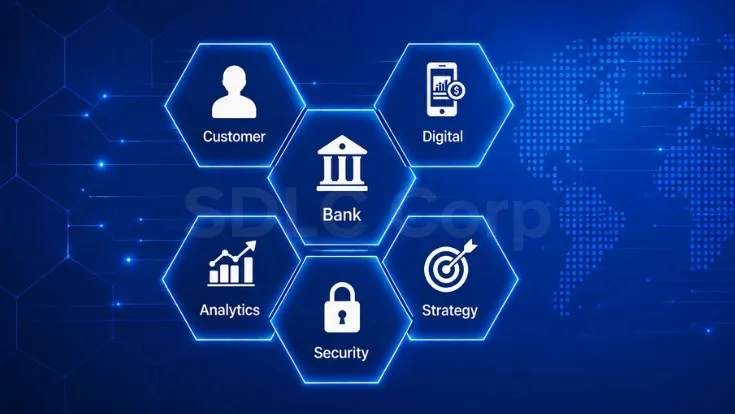
Banks, fintech companies, and insurers use generative AI across customer service, compliance, risk, operations, and reporting. Each use case requires its own governance and review framework.
Customer Support and Chatbots
Conversational agents handle queries, account management, and escalations with context-aware responses. Human agents handle complex or sensitive cases.
Fraud Detection and Prevention
Adaptive anomaly detection and behavioral analysis can help identify suspicious transactions and reduce false positives when models are properly tuned and validated.
Document Processing and KYC
KYC, AML, and identity verification workflows can be scaled with AI-assisted document extraction and validation. High-risk cases should go through human approval.
Personalized Financial Services
Customer data supports tailored product recommendations, spending insights, and proactive guidance across the full account lifecycle.
Algorithmic Trading Support
AI models process structured and alternative data to support trading signal generation and portfolio analysis. Human oversight is required for execution decisions.
Credit Scoring and Risk Assessment
Alternative datasets — including behavioral signals and transaction patterns — can be integrated into credit models. Explainability controls are required for regulated markets.
Financial Modeling and Decision Support
AI generates scenario analysis, stress tests, and market summaries to support strategic planning. Outputs are used to inform, not replace, analyst judgment.
Retrieval-Augmented Generation in Financial Services
Retrieval-Augmented Generation (RAG) combines generative AI with real-time data retrieval. Instead of relying on training data that can become outdated, RAG systems fetch current information before generating a response. This can help reduce hallucination risk by grounding outputs in approved, retrievable sources, but regulated outputs still need review. See our detailed guide on Retrieval-Augmented Generation.
| Use Case | What RAG Delivers |
|---|---|
| Real-Time Market Intelligence | Integrates live stock feeds, economic indicators, and news to produce current financial briefings — not outdated training data. |
| Regulatory Knowledge Search | Retrieves current compliance rules and jurisdiction-specific requirements to answer specific policy queries with cited sources. |
| Risk Documentation | Pulls relevant policy documents and precedents to support risk assessment and audit preparation. |
| Client Advisory Support | Fetches account history, product information, and market data to generate personalized guidance with traceable sources. |
Multimodal AI in Financial Technology
Multimodal AI systems process text, images, audio, and structured data together. In finance, a single model can analyze a scanned contract, cross-reference terms with live market data, and generate a risk summary. See the full scope in our guide on Multimodal AI Technologies.
Visual Document Processing
Computer vision can extract data from contracts, invoices, forms, and ID documents, helping teams verify records with less manual entry.
Voice-Enabled Banking
Natural-language voice interfaces handle account queries and payment authorization with real-time speech recognition.
Integrated Data Analysis
Text, images, audio, and market data are processed together to deliver unified insights for trading, underwriting, and risk profiling.
Generative AI Implementation Cost and Timeline
Cost depends on use case scope, data complexity, regulatory requirements, integration depth, and whether models are pre-trained or built from scratch.
| Solution | Timeline | Cost Range | Primary Use Case |
|---|---|---|---|
| AI-powered chatbot | 3–6 months | $50K–$200K | Customer support, FAQ handling, account queries |
| Fraud detection system | 4–8 months | $150K–$500K | Real-time transaction monitoring and alerts |
| KYC/AML automation | 4–9 months | $100K–$400K | Document processing and identity verification |
| Credit scoring model | 5–10 months | $200K–$600K | Alternative data integration and scoring |
| RAG knowledge system | 3–6 months | $80K–$300K | Regulatory and advisory knowledge retrieval |
| Enterprise AI platform | 9–18 months | $500K–$2M+ | Multi-module integration across operations |
Benefits of Generative AI in Fintech
Generative AI delivers measurable value across operations, customer experience, risk management, and competitive positioning — when implemented with appropriate governance.
Operational Efficiency
AI automates document processing, compliance checks, and reporting — reducing manual workload across operations teams.
Customer Experience
Personalized recommendations, after-hours support workflows, faster onboarding, and proactive guidance can improve customer experience and retention.
Risk Management
Predictive analytics, anomaly detection, and AI-assisted compliance monitoring can help reduce fraud risk and regulatory exposure when models are tested and monitored.
Competitive Advantage
Institutions that deploy AI carefully can scale selected workflows faster and give smaller teams better operational coverage.
Generative AI vs Traditional AI in Fintech
Traditional AI and generative AI are complementary. Most financial institutions use both — traditional AI for structured prediction tasks and generative AI for reasoning, content generation, and automation.
| Criteria | Traditional AI | Generative AI |
|---|---|---|
| Primary function | Predicts, classifies, or detects patterns | Creates content, generates text, code, and synthetic data |
| Output type | Scores, labels, predictions | Reports, summaries, recommendations, code |
| Training data | Requires labeled datasets | Learns from large unlabeled corpora via self-supervision |
| Adaptability | Retrained for each new task | Fine-tuned or prompted for new tasks without full retraining |
| Use in fintech | Credit scoring, fraud detection, forecasting | Advisory bots, document automation, scenario generation |
| Explainability | Generally more interpretable | Requires explainability layers for regulated use |
| Compute requirement | Lower | Higher — especially for large language models |
Implementation Challenges and Best Practices
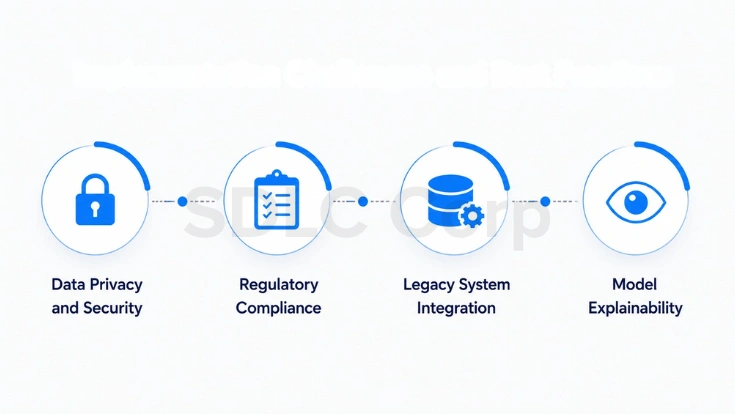
Deploying generative AI in finance requires planning around data, compliance, infrastructure, security, and team skills. A clear roadmap should define the use case, data sources, review process, and risk controls before development starts. Generative AI consulting services can support that planning.
Data Privacy and Security
Federated learning, differential privacy, and encryption help protect sensitive financial data while helping reduce exposure — without replacing the need for strong access controls.
Regulatory Compliance
Depending on use case and jurisdiction, systems may need to comply with GDPR, PCI DSS, Basel III, DORA, or MiFID II. Build governance frameworks with audit trails and review checkpoints.
Legacy System Integration
API-first integration layers and middleware enable AI to connect with existing core banking infrastructure without full system replacement.
Model Explainability
Regulated credit and risk use cases usually require explainability, audit trails, bias testing, and human review. Implement XAI tools that surface model reasoning in a format compliance teams can review and document.
Talent and Training
Hybrid teams that include ML engineers, financial experts, and compliance-aware designers can reduce rollout risk and speed up delivery.
Best Practices for Implementation
Start with specific, measurable objectives. Prioritize use cases by ROI potential and data readiness — not by technical ambition.
Audit data pipelines, establish lineage tracking, and review data for privacy and accuracy before training or fine-tuning any model.
ML engineers, compliance officers, domain experts, and product managers should collaborate from the start — not after the model is built.
Build retraining triggers, monitoring, and performance review cycles in from the start. Financial markets and regulations change constantly.
Future Trends in Generative AI for Fintech
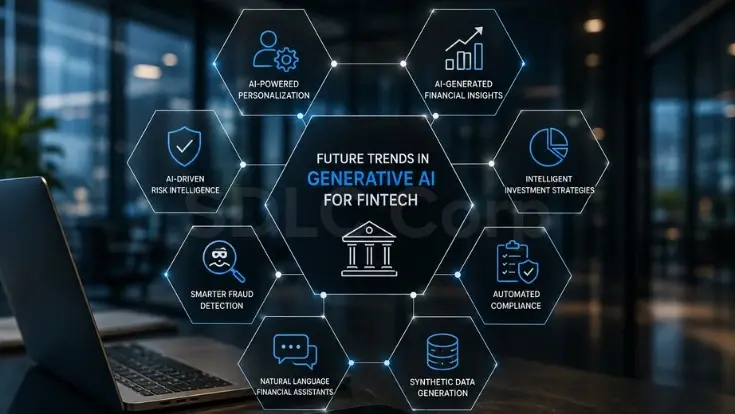
The next phase of financial AI moves from task-specific automation toward systems that handle multi-step workflows. Human checkpoints for regulated decisions remain essential.
| Trend | Financial Implication |
|---|---|
| Autonomous AI Agents | AI systems that handle multi-step financial workflows with human checkpoints for regulated decisions |
| Quantum-Enhanced AI | Quantum computing accelerates optimization for complex portfolio and risk problems |
| Embedded Finance Intelligence | AI embedded in transaction flows enabling real-time decisioning at the point of payment or lending |
| Federated Learning at Scale | Institutions train models collaboratively without sharing raw customer data |
| Agentic RAG Systems | Next-generation retrieval systems that autonomously identify and synthesize relevant financial data |
Measuring Generative AI Success
Track these KPIs to assess whether your generative AI investment is delivering operational, customer, and business value.
| Metric | Category | What It Measures |
|---|---|---|
| Processing time reduction | Operational | Automation efficiency |
| Fraud detection accuracy | Operational | Model performance |
| Customer satisfaction score | Customer | CX and retention |
| First-contact resolution | Customer | Support quality |
| Revenue from AI products | Business | Commercial impact |
| Compliance incident rate | Business | Regulatory exposure |
| Model retraining frequency | Technical | System adaptability |
Security and Compliance for Fintech AI
Generative AI introduces AI-specific vulnerabilities alongside traditional cybersecurity risks — including prompt injection, model inversion, and hallucinated outputs in regulated contexts.
Key Regulatory Frameworks
| Regulation | AI Relevance |
|---|---|
| GDPR | Data protection and right to explanation for AI decisions |
| PCI DSS | Payment data security in AI processing pipelines |
| Basel III | Risk model governance and capital adequacy |
| MiFID II | Algorithmic trading oversight and transparency |
| DORA | Digital operational resilience for EU financial entities |

Build Generative AI Solutions for Financial Services
SDLC Corp designs and delivers generative AI systems for fintech, banking, insurance, and investment platforms — from scoped proof-of-concept to production deployment. For broader fintech product engineering, explore our Fintech Software Development Services.