Agentic AI Development
Services
Build AI agents that move beyond answering questions to planning work, using tools and completing tasks across your business systems.
Our Agentic AI development services cover custom AI agents, agentic workflows, multi-agent orchestration, tool integration, memory and state, human approvals, evaluation, governance and production deployment.
Proven Agentic AI Delivery
Trusted by Fortune Global 500 leaders, governments & top universities across 30+ countries












Powered by leading cloud & AI platforms
Awards & industry recognition


Agentic AI Development
Services
Build AI agents around real responsibilities, business systems and clearly defined operating boundaries.
Build
Custom AI Agent Development
Build purpose specific agents that interpret goals, decide the next step, use approved tools and complete defined tasks, designed around a business function rather than behaving as general purpose assistants.
Process
Agentic Workflow Development
Turn multi step business processes into agent driven workflows where AI can decide which approved action should happen next based on the current situation.
Coordination
Multi-Agent System Development
Coordinate specialized agents that handle different responsibilities such as planning, research, execution, validation and escalation.
Actions
Tool and API Integration
Connect agents with the systems they need to perform useful work, including CRM, ERP, databases, APIs, calendars, service platforms and internal applications.
Oversight
Human-in-the-Loop Agent Design
Define when an agent may act independently and when a person must review, approve, modify or reject a proposed action.
Measured
Agent Evaluation and Optimization
Test whether agents choose the correct actions, use the right tools, follow business rules and successfully complete representative workflows.
Need the underlying language model application rather than an action taking agent? Explore LLM Development Services.
Agentic AI Solutions
We Build
Agentic systems are most useful when responsibility can be bounded around a real business outcome.
Operations
Operations Agents
Coordinate repetitive operational work across multiple systems, check the current state and execute approved next steps.
Service
Customer Service Agents
Retrieve account or case context, complete supported service actions and transfer exceptions to people with the relevant history attached.
Revenue
Sales and RevOps Agents
Qualify enquiries, update CRM records, schedule follow ups, prepare account information and route opportunities according to defined business rules.
IT
IT and Service Agents
Handle supported service requests, create or update tickets, retrieve system information and escalate exceptions to the appropriate team.
Analysis
Research and Analysis Agents
Plan research tasks, gather information from approved tools, analyze results and produce structured outputs for review.
Decisions
Decision Support Agents
Evaluate defined options, prepare recommendations and execute approved downstream actions when the decision policy allows it.
What Agentic AI
Can Improve
Agentic AI is useful when a process needs more than one model response.
Completion
Multi-Step Execution
Allow an agent to break a goal into steps and progress through the workflow until the defined outcome is reached.
Reach
Cross-System Work
Coordinate tasks across applications instead of requiring employees to copy information between systems manually.
Continuity
Faster Handoffs
Pass context, completed work and outstanding actions between AI agents, workflows and human teams.
Control
Controlled Autonomy
Automate routine decisions while maintaining approval gates around higher impact actions.
Connect Agents
With Your Systems
An agent becomes useful when it can safely interact with the applications where work actually happens.
Customers
CRM Platforms
Read and update approved customer, lead, opportunity and service information.
Operations
ERP Systems
Access operational data and prepare or execute approved business transactions.
Support
Service Platforms
Create, update, classify and route service or support requests.
Data
Databases
Query structured information through controlled application services.
Tools
Business APIs
Use internal and third party APIs as approved tools within an agent workflow.
Workplace
Productivity Systems
Connect calendars, email, collaboration applications and other business tools where appropriate.
For broader enterprise artificial intelligence development, explore our AI Development Services.
Agentic AI
Architecture
A production agent needs more than a language model and a prompt.
Stage 01
Goal and Trigger
The workflow begins with a user request, system event, scheduled task or other approved trigger.
Stage 02
Agent Orchestrator
The orchestration layer determines which agent, tool or workflow should handle the next stage.
Stage 03
Planning and State
The agent maintains the information needed to understand what has already happened and what still needs to be completed.
Stage 04
Tool Selection
The agent chooses from an approved set of actions rather than having unrestricted system access.
Stage 05
Tool Execution
The selected API, database service or enterprise application performs the requested operation.
Stage 06
Validation
Application rules validate proposed actions and outputs before they affect another system.
Stage 07
Human Approval
Higher impact actions can pause for review before execution.
Stage 08
Action and Result
The workflow completes the approved action and records what happened for downstream steps, audit and evaluation.
Single-Agent and
Multi-Agent Systems
Not every workflow requires multiple agents. We select the architecture according to the actual responsibility being automated.
Use one agent when a bounded workflow can be completed reliably using one set of instructions, tools and business rules.
Use multiple specialized agents when separating responsibilities improves reliability, control or throughput.
Coordinates
Supervisor Agent
Coordinates the workflow and delegates work.
Gathers
Research Agent
Collects required information.
Acts
Execution Agent
Calls approved tools and performs operational steps.
Checks
Validation Agent
Checks outputs or proposed actions.
Escalates
Escalation Agent
Routes exceptions or high risk scenarios to people.
Multi-agent architecture should be introduced only when it improves the system, not simply because additional agents are technically possible.
Tool-Using
AI Agents
The defining capability of many agentic systems is the ability to take action through approved tools.
Invocation
Function Calling
Allow the agent to select and invoke defined functions using structured parameters.
Services
API Actions
Connect the agent to supported REST, GraphQL or enterprise service APIs.
Data
Database Tools
Let agents request controlled information through application services instead of unrestricted database access.
Applications
Business Application Actions
Create tickets, update records, schedule events or initiate approved workflows.
Standards
MCP-Compatible Tooling
Where appropriate, expose tools and governed business context through Model Context Protocol compatible interfaces.
Boundaries

Tool Permissions
Define exactly which tools an agent can use and what each tool is allowed to change.
Agent Memory
and State
Agents need state when a task spans multiple steps or interactions.
Active
Working State
Track the current goal, completed steps, pending actions and temporary values required by the active workflow.
Session
Conversation State
Maintain relevant context across an interaction without treating every message as a new request.
Process
Workflow State
Store deterministic information such as approval status, current stage, assigned agent and previous actions.
Persistent
Long-Term Memory
Persist selected information when the application genuinely benefits from remembering previous interactions or preferences.
Authoritative
Business Records
Use CRM, ERP or other systems of record for information that should remain authoritative.
If an agent needs extensive retrieval from proprietary documents or knowledge bases, use a dedicated retrieval layer. Explore RAG Development Services.
Human Approval
and Autonomy
Production agents should have clearly defined authority. The goal is not maximum autonomy. The goal is the right autonomy for the workflow.
Allowed
Autonomous Actions
Allow agents to complete low risk, reversible actions within predefined limits.
Gated
Approval Required Actions
Pause actions that change important business records, create financial impact or require organizational authority.
Exceptions
Escalation Rules
Send unsupported, ambiguous or higher risk situations to the appropriate person.
Policy
Confidence and Policy Gates
Use application rules and evaluation thresholds to determine whether the agent may continue.
Recovery
Reversible Operations
Design workflows so actions can be reviewed and, where technically possible, reversed.
Agent
Evaluation
An agent should be evaluated on whether it completes work correctly, not merely whether its messages sound intelligent.
Outcome
Task Completion
Measure whether the agent reaches the intended business outcome.
Choice
Tool Selection
Check whether the correct tool was selected for the situation.
Inputs
Tool Arguments
Validate the information sent to APIs and business systems.
Reasoning
Plan Quality
Test whether the steps chosen by the agent are appropriate and efficient.
Boundaries

Policy Compliance
Confirm that the agent stays within its permissions and workflow boundaries.
Escalation
Handoff Quality
Check whether escalations include the context a person needs to continue the work.
Change
Regression Testing
Retest representative workflows whenever models, tools, prompts or orchestration logic change.
Agent
Observability
Agentic applications need deeper monitoring than ordinary model applications because one request can create many decisions and tool calls.
Trace
Execution Traces

Record the steps an agent took during a workflow.

Calls
Tool Call Monitoring
Track tools called, parameters supplied, responses received and failures.
Progress
Agent State
Inspect workflow progress and outstanding actions.
Diagnosis
Failure Analysis
Identify whether a failure originated in reasoning, integration, business rules or an external system.
Economics
Cost Monitoring
Measure model and infrastructure usage per completed task rather than only per API request.
Business
Outcome Metrics
Track whether the workflow produced the expected business result.
Secure
Agentic AI Systems
An agent that can take action requires stronger controls than a system that only generates text.
Identity
Identity and Authentication
Identify users, services and agents before allowing access to business systems.
Scope
Least-Privilege Tools
Give each agent access only to the tools and actions required for its responsibility.
Permissions
Authorization
Apply business permissions before an agent retrieves information or performs an action.
Credentials
Secrets Management
Keep API credentials and system secrets outside prompts and agent visible application state.
Validation
Action Validation
Validate proposed actions before committing important changes.
Traceability
Audit Logging
Record agent decisions, tool calls, approvals and significant system changes.
Agentic AI
by Industry
The same engineering pattern, bounded by the permissions, approvals and regulations of each sector.
Controlled
Financial Services
Support controlled service workflows, investigation preparation, operations, compliance review and approval driven processes.
Regulated
Healthcare
Assist administrative workflows, scheduling, documentation and approved operational processes while maintaining human authority over sensitive decisions.
Operations
Logistics
Coordinate shipment workflows, exceptions, service requests, scheduling and operational information across connected systems.
Technical
Manufacturing
Support maintenance workflows, technical operations, service requests, procurement and production related coordination.
Commerce
Retail and E-commerce
Handle service actions, order workflows, inventory queries, customer follow up and commerce operations.
Cross functional
Enterprise Operations
Automate bounded processes across IT, HR, finance, sales, service and internal business applications.
Agentic AI
Technology Stack
We select agent technologies according to the workflow, integrations and operating environment.
Reasoning engines selected per workflow
Orchestration, planning and multi-agent coordination
How an agent reaches the systems that do the work
Workflow state, memory and systems of record
Application services and workflow layers
Cloud, container and orchestration platforms
Agentic AI
Products & Systems
Real SDLC Corp platforms and delivery experience showing how agents, actions and governed workflows can operate in production.
Enterprise Agentic Workflows
Agentic workflows coordinate specialized AI capabilities around business data, tools and operational rules.
SDLC Corp currently reports more than 120 agents running in production across its AI engineering work.
Best proof forGoal-driven execution · tool use · multi-agent orchestration · governance
- Goal-driven execution
- Tool use
- Multi-agent orchestration
- Enterprise integrations
- Evaluation
- Continuous monitoring
- Governance controls
- Human oversight
CRM-Native Autonomous Agents
Salesforce Agentforce allows agents to work with live CRM and Data Cloud context, choose approved actions and execute supported customer, sales and operational workflows.
SDLC Corp's Salesforce practice includes Agentforce implementation and operational support across service, sales, IT and finance workflows.
Best proof forCRM context · service actions · guardrails · human escalation
- CRM context
- Service actions
- Lead qualification
- Case handling
- Record updates
- Salesforce Flow
- MuleSoft and API integrations
- Human escalation
- Guardrails
- Agent monitoring
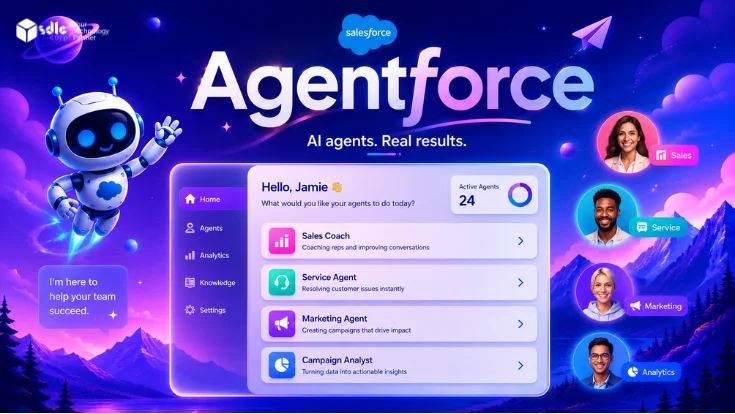
Agentforce agents act on live CRM context through approved Salesforce actions
Action-Oriented Voice Agent
Pulastya demonstrates how an AI agent can combine natural conversation with operational actions rather than stopping after generating an answer.
The platform supports inbound and outbound call workflows for appointment scheduling, customer support and business operations, answering from the organization's own documents.
Best proof forIntent understanding · conversation state · workflow integration · human handoff
- Intent understanding
- Conversation state
- Business rules
- Knowledge access
- Appointment workflows
- Call classification
- Routing
- Human handoff
- Context transfer
- Workflow integrations
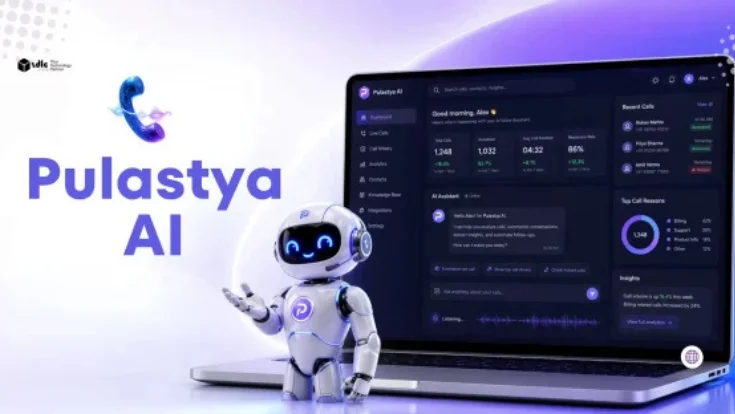
Voice AI remains a dedicated Pulastya capability; it appears here only as proof of action-oriented agent architecture
Governed Tool Access
Foresite provides a governed analytics environment designed to expose trusted business metrics to AI applications.
It ships with a native MCP server, function call schemas and on premise inference options, so assistants and agents reach certified metrics through controlled interfaces rather than unrestricted system connectivity.
Best proof forNative MCP server · function-call schemas · governed metrics · auditability
- Native MCP server
- Function-call schemas
- Governed business metrics
- Auditability
- On-premise inference options
- Enterprise integrations
- Controlled data access
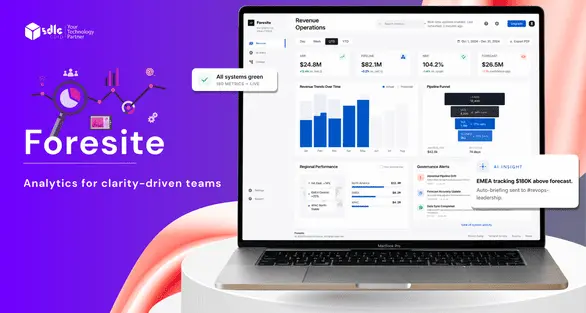
Foresite exposes certified metrics to agents through a native MCP server
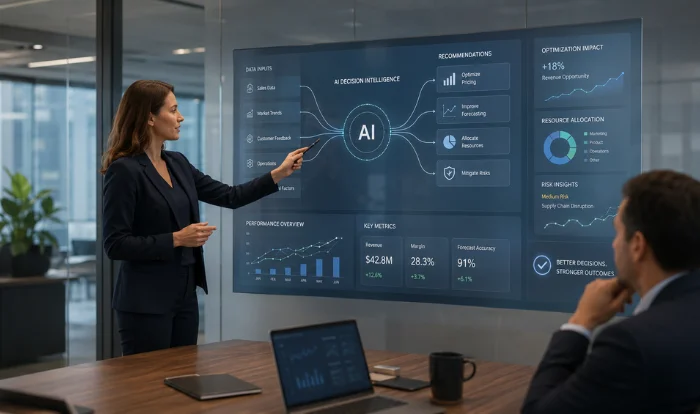
Agentic Decision Intelligence
Agentic systems can also support workflows where AI evaluates options and prepares or performs approved actions.
SDLC Corp's Decision Intelligence practice includes governed AI agents that evaluate options and execute approved tasks across enterprise systems under human oversight.
Best proof forRecommendations before actions · approvals · confidence thresholds · audit trails
- Recommendations before actions
- Human approval where required
- Confidence thresholds
- Explainable decision context
- Reversible actions
- Audit trails
Real Stories.
Real Impact.
Founders, CEOs, and operating leaders share what it's like to build with SDLC Corp.
Eric Leist
CEO, Edgerton Strategies

Doug Schmidt
CEO, Roofaid USA

Reyzal Razmi
All Star Influencers



They approached our Salesforce discovery with real technical depth, uncovered structural gaps others missed, and delivered a solution that worked exactly as promised.
SDLC CORP built a mobile application that met our strategic requirements with strong technical execution. The solution performs reliably and has become an important operational asset.
They saw inefficiencies in our Salesforce workflow and redesigned our entire quote-to-cash system. We now operate faster, cleaner, and with better accuracy.
From planning to post-launch, SDLC Corp guided us every step of the way. Their support makes them more than a vendor. They're a trusted partner.
The SDLC Corp team scaled our platform with impressive technical expertise, ensuring it's secure, robust, and ready for future growth.


The SDLC Corp team scaled our platform with impressive technical expertise, ensuring it's secure, robust, and ready for future growth.
From planning to post-launch, SDLC Corp guided us every step of the way. Their support makes them more than a vendor. They're a trusted partner.
They saw inefficiencies in our Salesforce workflow and redesigned our entire quote-to-cash system. We now operate faster, cleaner, and with better accuracy.
SDLC CORP built a mobile application that met our strategic requirements with strong technical execution. The solution performs reliably and has become an important operational asset.
They approached our Salesforce discovery with real technical depth, uncovered structural gaps others missed, and delivered a solution that worked exactly as promised.
10+ Years of
Experience.
Enterprise engineering experience behind AI systems that need to integrate, execute and operate reliably in production.
Our Agentic AI
Development Process
Five stages from workflow definition to an agent operating under bounded permissions in production.
Discover
Identify the workflow, business outcome, users, systems and decisions involved, and define which parts genuinely benefit from agentic behavior rather than ordinary automation.
Design
Define agent responsibilities, tools, permissions, system integrations, state, approval points, escalation rules and success criteria.
Build
Develop the agents, orchestration layer, business integrations, tool interfaces and human review workflows.
Evaluate
Test representative scenarios including normal execution, tool failures, ambiguous inputs, unauthorized actions and escalation conditions.
Deploy
Launch with bounded permissions, monitoring and defined operational ownership, expanding autonomy only when production evidence supports it.
Improve
Existing AI Agents
Already have an agent prototype that works in demonstrations but struggles in production? We can review the complete agent workflow.
Where agent workflows usually break
The objective is to identify where the workflow fails before changing models or adding more agents.
Why Choose
SDLC Corp
One engineering partner for the full agent lifecycle, from tool permissions through production operation.
End to End
Production Agent Engineering
Build agents as complete software systems rather than isolated model demonstrations.
Systems
Enterprise Integration
Connect agents with the applications where real work is already happening.
Control
Bounded Autonomy
Define exactly what an agent may do, when it must stop and when a person must approve.
Architecture
Multi-Agent Experience
Use specialized agent architectures when they improve reliability and workflow separation.
Measured
Evaluation and Observability
Measure agent behavior, tool calls and task completion throughout development and operation.
Related
AI Services
Adjacent engineering practices that often run alongside an Agentic AI engagement.
LLM
LLM Development Services
Build and integrate the language model layer used for reasoning, generation, structured outputs and application intelligence.
Explore LLM Development ServicesRAG
RAG Development Services
Connect agents and applications with proprietary documents and enterprise knowledge through retrieval architecture.
Explore RAG Development ServicesAI
AI Development Services
Build broader machine learning, artificial intelligence and enterprise AI applications.
Explore AI Development ServicesDecisions
AI Decision Intelligence
Build systems that combine data, AI recommendations, business rules and governed decisions.
Explore Decision IntelligenceDeterministic
Workflow Automation Services
Use deterministic workflows, RPA and business rules where dynamic agent reasoning is unnecessary.
Explore Workflow Automation ServicesAgentic AI
Resources
Deeper reading on agents, tool use, task design and connecting AI with the systems where work happens.
ExplainerWhat Is Agentic AI?
Understand how Agentic AI differs from traditional AI and how autonomous systems perceive, decide and act toward defined goals.
Read What Is Agentic AI
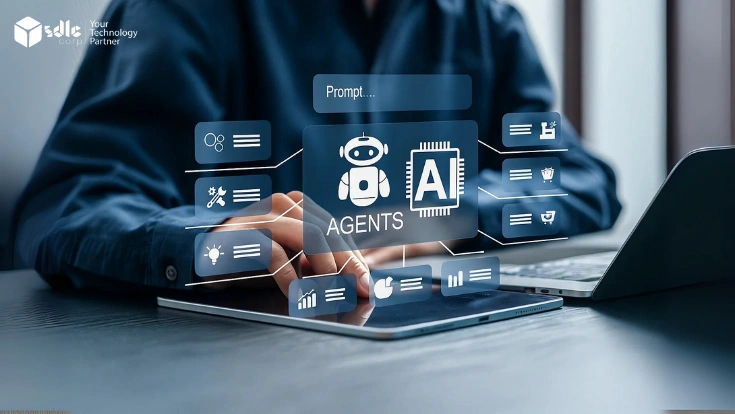
FundamentalsAgentic AI Fundamentals
Explore the foundations of AI agents, including goals, memory, reasoning, tool use and multi-agent systems.
Read Agentic AI Fundamentals
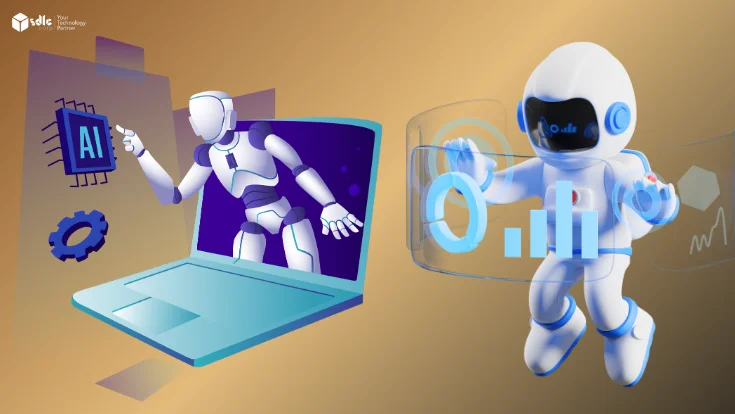
DesignTask-Oriented AI Agents
Understand how agents can be designed around specific goals and structured business workflows.
Read About Task-Oriented AI Agents
GuideIntegrating AI Into Enterprise Systems
Learn how to connect AI with enterprise applications while maintaining approvals, permissions and transaction controls.
Read the Enterprise AI Integration GuideBuild Your
Agentic AI System
Move from AI that only responds to AI that can complete controlled work across your business systems.
From focused task agents and tool using assistants to multi-agent orchestration and enterprise workflow agents, our engineering team can take your Agentic AI project from architecture through production deployment.
Contact Us
Share a few details about your project, and we’ll get back to you soon.
Let's Talk About Your Project
- Free Consultation
- 24/7 Experts Support
- On-Time Delivery
- sales@sdlccorp.com
- +1(510-630-6507)