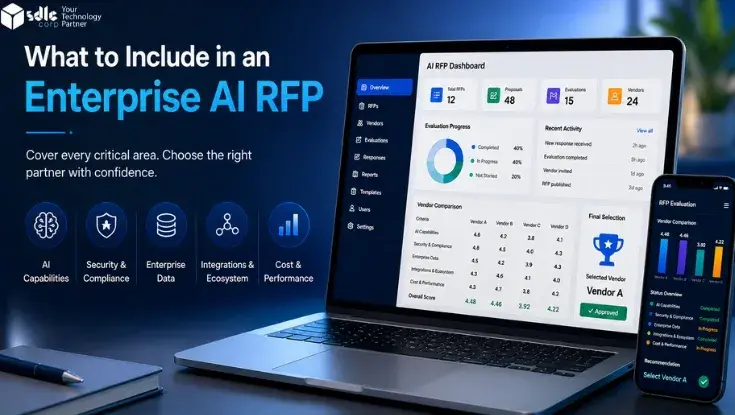
An enterprise AI RFP should define what the business needs, what the AI must do, how enterprise data will be handled, and how vendors will be evaluated. Beyond that, the document covers architecture, security, AI quality, implementation, total cost, support, contract terms, and exit requirements.
Unlike a standard software RFP, AI procurement adds questions about foundation models, RAG, AI agents, hallucinations, third-party providers, governance, monitoring, and variable usage costs. Therefore, a strong RFP should guide buyers from business need to requirements, evidence, testing, scoring, and contract.
Two companion guides sit either side of this one. Work through the AI RFP requirements checklist before you draft the document, then apply the AI vendor risk assessment once responses arrive.
Business need to requirements, evidence, testing, scoring and contract.
Key Takeaways
A strong enterprise AI RFP should:
- Start with the business problem and measurable outcome.
- Separate mandatory requirements from scored criteria.
- Require vendors to explain models, RAG, agents, integrations, and data flows.
- Address security, privacy, governance, and AI-specific risks.
- Define AI evaluation metrics before testing begins.
- Require evidence for important vendor claims.
- Test shortlisted vendors through a buyer-controlled PoC.
- Compare total cost, not only licensing fees.
- Turn critical vendor commitments into contract terms.
- Define portability and exit requirements before signing.
These points turn an AI RFP checklist into a practical vendor-selection process rather than a long list of questions.
Define the Business Problem and Success Criteria
Start with the business problem the AI needs to solve. Do not begin with a preferred LLM, RAG framework, or AI platform unless the technology is already a fixed requirement.
Describe the current workflow, target users, existing problem, and expected outcome. For example, instead of requesting “a RAG chatbot,” explain that employees need faster access to accurate, permission-aware information from approved company sources.
Your RFP should clearly state the business problem, current baseline, users, AI use case, and expected result. It should also define how success will be measured.
For an internal knowledge assistant, useful measures might include:
This business-first approach gives every vendor the same outcome to solve, even when their technical approaches differ.
Set the AI Project Scope and Must-Have Requirements
Next, define exactly what the project includes. Vendors should understand the required capabilities, enterprise systems, deployment constraints, expected scale, and project boundaries before proposing a solution.
Separate critical requirements from optional features. Some requirements should act as pass/fail gates rather than receive points in a weighted score.
For example, mandatory requirements may include:
- Required data residency
- Enterprise SSO
- No unauthorized use of company data for model training
- Required cloud, VPC, hybrid, or on-premises deployment
- Minimum availability requirements
- Data export when the contract ends
Also standardize how vendors respond. Ask them to mark each requirement as Supported, Partially Supported, Roadmap, or Not Supported and attach evidence where needed.
This approach makes an enterprise AI RFP template easier to evaluate. More importantly, a vendor cannot offset a serious security or data gap with strong scores in unrelated categories.
Evaluate AI Architecture, Models, RAG, and Agents
Require vendors to explain the architecture that affects security, cost, performance, and long-term flexibility. Buyers do not need every implementation detail, but they should know which technologies and external providers the solution depends on.
Ask which foundation models the platform uses and whether they are proprietary, open, fine-tuned, or supplied by third parties. Also determine whether your organization can change models if pricing, quality, availability, or policy requirements change.
Understand RAG and Enterprise Knowledge
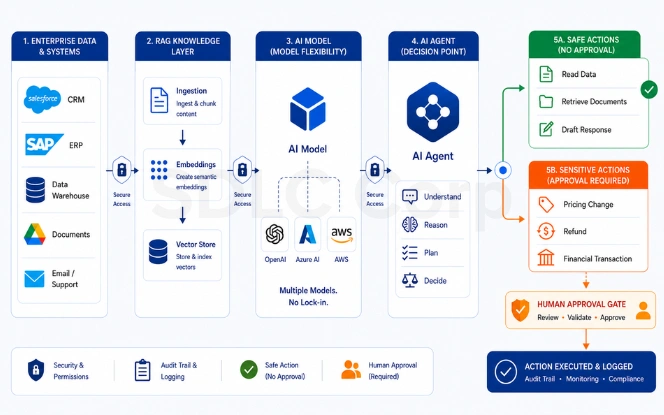
If the solution uses retrieval-augmented generation, ask how it ingests, indexes, retrieves, and refreshes enterprise content. Existing permissions should continue to apply during retrieval.
A user should not receive information from a restricted document simply because the vector database can find it. Therefore, authorization controls must apply throughout the retrieval and response process.
Define AI Agent Permissions
For AI agents, identify which systems and tools they can access. Then separate actions they can perform automatically from actions that require human approval.
- Reads a CRM record
- Retrieves approved documents
- Drafts a reply for review
- Changes pricing
- Issues refunds
- Posts financial transactions
An agent that reads a CRM record creates a different risk from one that changes pricing or issues refunds. The RFP should therefore define permission limits, approval steps, audit logs, and rollback controls.
Questions to include
- Which models and model providers do you use?
- Can we change the underlying model later?
- How does RAG enforce document permissions?
- Which enterprise systems and APIs can the AI access?
- What actions can AI agents perform?
- Which actions require human approval?
- What happens if an underlying provider becomes unavailable?
These questions also help expose AI vendor lock-in before implementation begins.
Map Enterprise Data and Third-Party Access
Require the vendor to show where enterprise information moves during an AI request. Data may pass through more systems than the application interface suggests.
Buyers need visibility into that complete data path.
Ask vendors to explain what enterprise data they access, where they process it, where they store it, and how long they retain prompts, outputs, and logs. They should also identify every subprocessor or third-party provider that can receive company data.
Training use is especially important. This is where generative AI consulting services often uncover hidden data exposure. Ask whether prompts, documents, outputs, feedback, embeddings, or logs can be used to train or improve shared models.
Do not accept “your data is private” as sufficient evidence. Require the vendor to explain how the policy is enforced technically and how the same commitment appears in the contract.
Also define how data is exported and deleted. This becomes important if the organization later changes vendors or model providers.
Verify Security, Privacy, and AI Governance
An AI vendor RFP should assess both traditional enterprise security and AI-specific risk. Instead of asking whether a platform is secure, ask vendors to show how their controls work.
- Encryption and SSO
- RBAC and tenant isolation
- Audit logging and secrets management
- Vulnerability management
- Incident response and data residency
- Prompt injection
- Sensitive information disclosure
- Unsafe output handling
- Excessive agent permissions
- Third-party model and retrieval weaknesses
Useful AI vendor security questions include:
- How do you test for prompt injection?
- Which controls detect or block sensitive outputs?
- How are agent permissions restricted?
- What assessment applies to third-party model providers?
- Which AI actions are logged?
- How do you respond to AI-related security incidents?
Frameworks such as NIST AI RMF and OWASP GenAI can help shape these questions. Still, the exact requirements should depend on the use case, data sensitivity, industry, and location.
Define Governance and Human Oversight
The RFP should identify who can approve, monitor, change, or disable the AI system. Assign these responsibilities in line with your wider responsible AI development policy. High-impact actions may require human approval even when the technology can perform them automatically.
Shortlisted vendors should then go through a full AI vendor risk assessment covering data practices, supply chain, and cybersecurity.
Also ask how the vendor handles model updates. New versions should be evaluated before production when they could change quality, safety, security, or business behavior.
Set AI Evaluation Metrics and Acceptance Criteria
Do not choose an AI vendor because its demo looks impressive. The same discipline applies to machine learning projects. Define how the system will be measured before testing begins.
A statement such as “95% accurate” is incomplete without the dataset, testing method, success definition, and conditions behind the number. Therefore, AI acceptance criteria should match the actual use case.
Each enterprise should set thresholds based on its own risk. A customer-facing financial workflow may require stricter controls than an internal knowledge assistant.
For generative AI, include difficult cases where information is missing, outdated, conflicting, or restricted. These tests show whether the system handles uncertainty safely instead of producing unsupported answers.
Include Production Monitoring
Evaluation should continue after deployment. Ask vendors how they monitor output quality, hallucinations, latency, failures, model changes, security events, and AI usage costs, the way an experienced task-oriented AI agent deployment is monitored in production.
Also define who receives alerts and how incidents are escalated. This helps determine whether the system can operate reliably after the PoC ends.
Require Evidence for Vendor Claims
Strong AI vendor evaluation separates marketing language from evidence. Terms such as “secure,” “scalable,” “private,” and “model-agnostic” mean little unless the vendor can prove them.
Use a simple claim, evidence, and test process.
“Our AI is highly accurate.”
- Evaluation method
- Dataset details
- Results
- Test important scenarios using your own data
“Our platform is enterprise secure.”
- Security architecture
- Control documentation
- Relevant testing evidence
- Verify important controls during technical review
“There is no vendor lock-in.”
- Supported export formats
- Migration steps
- Model portability options
- Review termination procedures and export your data
“The platform scales.”
- Load-testing evidence
- Production performance data
- Workloads similar to yours
- Run peak-load conditions during the PoC
Written documentation may support early screening, while shortlisted vendors should prove critical claims during the PoC.
Evidence should become stronger as vendors move through the selection process.
Evidence Matrix by RFP Section
Use this matrix to state, inside the RFP itself, what each answer must be supported by.
| RFP Section | Vendor Question | Required Evidence |
|---|---|---|
| Architecture and Models | Which models and providers does the solution depend on? | Architecture diagram and named providers per component |
| Enterprise Data | Where is data processed, stored, and retained? | Data-flow map, retention periods, subprocessor list |
| Security | How are prompt injection and unsafe output handled? | Control documentation and testing results |
| AI Quality | How is accuracy measured? | Evaluation method, dataset description, published results |
| Agent Permissions | Which actions run without approval? | Permission model, approval steps, audit log sample |
| Portability | What can we export at contract end? | Export formats, migration steps, termination terms |
| Commercial | How does cost change as usage grows? | Pricing assumptions and a worked scaling example |
Test Shortlisted Vendors With a PoC

Vendor demos only show what the vendor chooses to demonstrate. A buyer-controlled AI proof of concept (PoC) tests whether the solution works under conditions that matter to your organization.
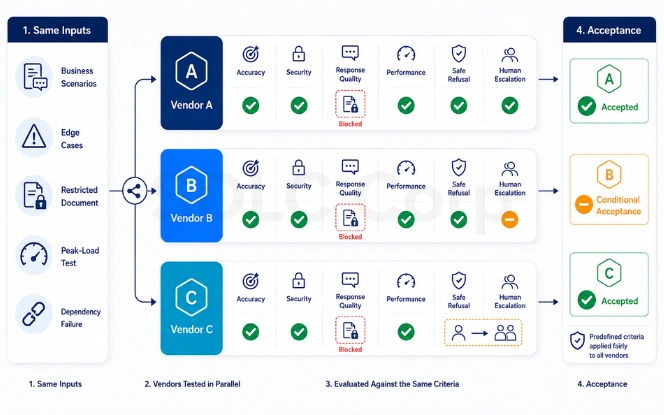
Use the same data, scenarios, metrics, and targets for each shortlisted vendor. This makes the comparison fair and reduces subjective scoring.
Your PoC should cover:
- Normal business scenarios and difficult cases
- Edge cases and security tests
- Peak-load conditions and dependency failures
- Human escalation, and for AI agents, actions that exceed permitted access
For RAG systems, include missing, conflicting, outdated, and permission-restricted documents. Then check whether the system answers correctly, refuses safely, or escalates when necessary.
Set AI PoC acceptance criteria before testing starts. Otherwise, teams may unintentionally change the definition of success after seeing vendor results.
PoC Design Table
Agree each row with the vendor before testing begins.
| Scenario | Success Criterion | Data Source |
|---|---|---|
| Standard Request | Grounded answer with a correct citation | Approved production documents |
| Missing Information | System refuses or escalates instead of guessing | Curated gap set |
| Conflicting Sources | Conflict surfaced rather than silently resolved | Two contradicting document versions |
| Restricted Document | No content returned to an unauthorised user | Permission-controlled sample |
| Prompt Injection | Injected instruction ignored and logged | Security test corpus |
| Peak Load | Latency and error rate stay inside target | Replayed production volume |
| Agent Beyond Permission | Action blocked and routed for approval | Sandbox system with audit logging |
PoC Duration and Effort Ranges
Ranges below are planning figures for scoping a timeline, not quotes. Confirm every line against vendor assumptions.
| Item | Typical Range | Basis |
|---|---|---|
| PoC Duration | 4 to 8 weeks | Data access, two or three evaluation cycles, security review |
| Buyer-Side Effort | 15 to 40 person-days | Test data preparation, scenario writing, scoring, sign-off |
| Vendor-Side Effort | 10 to 30 person-days | Environment setup, integration, tuning, results reporting |
| PoC Cost | 2 to 8 percent of first-year contract value | Vendor solution engineering plus internal time |
| Implementation After Selection | 8 to 20 weeks | Integrations, evaluation setup, deployment, monitoring |
The PoC should answer one practical question: can this solution meet our requirements under conditions that resemble production?
Score Vendors and Compare Total Cost
After vendors clear mandatory requirements and technical testing, compare them using an AI vendor scorecard. The score should reflect evidence from the RFP response, security review, technical evaluation, and PoC.
Example scores only. Every score should trace back to documented evidence.
| Evaluation Area | Example Weight |
|---|---|
| Business and Use-Case Fit | 15% |
| AI Quality | 15% |
| Architecture and Integration | 15% |
| Data, Privacy, and Security | 15% |
| Governance and Risk | 10% |
| Production Readiness | 10% |
| Vendor Capability and Support | 10% |
| Total Cost of Ownership | 10% |
These weights are examples rather than universal targets. A regulated or high-impact use case may place more weight on security, governance, or human oversight.
Compare AI Total Cost of Ownership
Do not compare license fees alone. AI total cost of ownership may include implementation, integrations, model or API usage, cloud or GPU infrastructure, data services, monitoring, support, scaling, and migration.
A solution that appears inexpensive during a small PoC may become much more costly at enterprise scale.
Ask vendors to explain their pricing assumptions and how costs change as usage grows.
TCO Component Table
Ask every vendor to price each component separately, then compare the totals rather than the licence line.
| Component | Typical Share of 3-Year Cost | Basis |
|---|---|---|
| Licence or Subscription | 25 to 40 percent | Seats, tenants, or platform tier |
| Implementation | 10 to 25 percent | One-time build, integration, and rollout |
| Model or API Usage | 10 to 35 percent | Token volume, retrieval calls, agent steps |
| Cloud or GPU Infrastructure | 5 to 20 percent | Deployment model and workload profile |
| Data Services | 3 to 10 percent | Pipelines, storage, vector index refresh |
| Monitoring and Support | 8 to 18 percent | SLA tier, incident volume, evaluation runs |
| Scaling and Migration | 3 to 12 percent | Growth in usage plus any exit or model change |
Shares are illustrative planning ranges. Replace them with vendor figures during commercial review.
Check Vendor Delivery Capability
Technical fit is only part of the decision. An independent AI consulting review can help here. Review the proposed implementation team, relevant production experience, project timeline, support model, and division of responsibilities.
Clarify who handles data preparation, integrations, evaluation, deployment, monitoring, incidents, and future model changes. Clear ownership reduces implementation delays and production support gaps.
Put Critical Requirements Into the Contract
Vendor selection should not end the RFP process. Teams that hire generative AI developers for implementation should hold them to the same commitments. Important commitments made during the proposal, security review, and PoC should become contractual obligations.
Define terms for data ownership, permitted training use, retention, deletion, subprocessors, audit rights, incident reporting, SLAs, and support. Also define how the vendor must communicate material changes to models, model providers, or other important AI components.
Clarify ownership and permitted use of enterprise data, prompts, system instructions, configurations, evaluation datasets, outputs, custom integrations, and fine-tuned assets. Standard software terms may not cover every AI-specific ownership question.
Plan for Vendor Exit and Portability
Define the exit before signing. The contract should explain how the enterprise retrieves data, moves configurations, receives migration support, verifies deletion, and handles termination costs.
Also ask what happens if you want to change the foundation-model provider.
What data, configurations, integrations, and technical work would we need to move this solution to another vendor or model provider?
That answer can reveal dependencies that were not obvious during the initial sales process.
Enterprise AI RFP Checklist
Before issuing an enterprise generative AI development RFP, confirm that the document covers the complete buying decision. Vendors should receive enough detail to respond consistently, while your evaluation team should receive enough evidence to compare them fairly.
Confirm that critical requirements have clear response formats and acceptance criteria.
This makes an enterprise AI RFP template useful for evaluation rather than simply collecting long vendor responses. For the requirement-by-requirement version, see the AI RFP requirements checklist.
Final Thoughts
A strong enterprise AI RFP should make vendor claims measurable and verifiable. Start with the business need, then evaluate architecture, data, security, AI quality, evidence, implementation capability, and total cost.
Finally, move the requirements that matter most into the contract and maintain a clear exit path. This gives business, procurement, security, and technical teams a consistent way to compare AI vendors without turning the RFP into an oversized technical questionnaire.
Frequently Asked Questions
01What should an enterprise AI RFP include?
An enterprise AI RFP should cover business outcomes, AI requirements, models, architecture, enterprise data, integrations, security, governance, evaluation criteria, PoC requirements, pricing, support, contract terms, and exit planning. It should also define the evidence vendors must provide for important claims.
02What questions should you ask an AI vendor?
Ask which models and third parties the solution depends on, how company data is handled, how AI quality is measured, and how security risks are controlled. Cover monitoring, model changes, implementation responsibilities, pricing, support, portability, and exit options as well.
03How should enterprises evaluate AI vendors?
Start with mandatory pass or fail requirements. Shortlisted vendors then run the same data, scenarios, metrics, and acceptance criteria. The final comparison uses evidence collected during due diligence together with a weighted vendor scorecard.
04How can enterprises avoid AI vendor lock-in?
Define data-export rights, model flexibility, documented integrations, migration support, deletion obligations, and termination costs before signing. Identify dependencies on model providers, cloud platforms, vector databases, and external APIs at the same time.
05How is an AI RFP different from a standard software RFP?
A software RFP focuses on features, integrations, and licensing. An AI RFP adds foundation models, retrieval behaviour, agent permissions, hallucination handling, third-party model providers, governance, production monitoring, and usage-based costs that change with volume.
06How long should an AI proof of concept run?
Four to eight weeks suits most enterprise use cases. That window allows data access, two or three evaluation cycles, and a security review. Anything shorter usually tests the demo rather than the solution, while longer runs delay the decision without adding evidence.
07Who should be involved in an enterprise AI RFP?
Business owners define the outcome, procurement runs the process, security and privacy assess risk, and technical teams review architecture and integrations. Legal handles contract terms and exit clauses. Each group should own specific scoring criteria rather than reviewing everything.
08What evaluation metrics matter for a RAG or knowledge assistant?
Groundedness, citation accuracy, retrieval quality, and the rate of unsupported answers are the core measures. Test cases should include missing, outdated, conflicting, and permission-restricted documents so the system is measured on how it handles uncertainty.
09Should the RFP specify which AI model the vendor must use?
Usually not. Specify the outcome, the constraints, and the evidence required, then let vendors propose an approach. Naming a model narrows the field before you have comparable evidence, and it can lock the contract to a provider whose pricing or policy may change.
10What contract terms are specific to AI procurement?
Beyond standard software terms, define permitted training use, prompt and output retention, subprocessor disclosure, notice for model or provider changes, and ownership of configurations, system instructions, evaluation datasets, and fine-tuned assets. Exit and data-export duties belong here too.