
Automotive Software Development Company
SDLC Corp is an automotive software development company providing automotive app development services alongside fleet platforms, dealership systems and telematics dashboards. Our automotive software development services connect vehicle data with the people and business systems that use it, from discovery and integration through testing and rollout.
Built around your operations

Automotive Software Development Services
Custom automotive software development starts with your operating model, existing systems and data access. Choose a focused application or a phased platform build.
Fleet operations
Fleet management platforms
Manage vehicle and driver records, maintenance schedules, inspections and operating costs. For example, tracking and route planning can be added around the GPS devices, map services and telematics feeds available to your fleet.
Vehicle data
Telematics and connected vehicle platforms
Bring location, diagnostic events and usage data into cloud dashboards and companion apps. Before integration, define update frequency, alert rules and access permissions for each vehicle data source.
Dealerships
Dealer management systems
Connect vehicle stock, enquiries, sales, workshop bookings, parts and service history. Configure an existing platform or scope a custom system around the processes your dealer group needs.
Electric mobility
EV and charging applications
Build charging discovery, session history, fleet charging views and customer applications. Network integrations, billing rules and charger compatibility are agreed with the relevant providers.
Data and AI
AI inspection and maintenance tools
Use computer vision to flag production defects or vehicle data to support maintenance planning. Then validate the pilot against representative data and operating conditions before a wider rollout.
Specialist scope
In-vehicle and ADAS workstreams
Discuss infotainment, perception and driver-assistance requirements as a separate engineering scope. Hardware access, functional safety, validation responsibilities and required specialist capabilities must be established before commitment.
Automotive App Development Services
As an automotive app development company, SDLC Corp connects driver, customer and staff experiences with the backend systems that keep operations running.
On the road
Driver and fleet apps
Give drivers job details, inspection checklists, maintenance requests and notifications. For intermittent coverage, define offline capture, queued updates and conflict handling around each workflow.
Customer experience
Customer and dealership apps
Support vehicle enquiries, test-drive bookings, service appointments and repair-status updates. Then connect customer activity to stock and service records with role-based permissions.
Connected services
Connected mobility apps
Present available vehicle or charging data through mobile interfaces. First, confirm OEM or device API access, consent, supported commands and latency before promising remote functions.
Delivery
App delivery and modernization
Plan iOS, Android or cross-platform delivery, API integration, device testing and release support. Our automotive app development services can also improve an existing application without replacing every backend component.
AI inspection in automotive production
A Tier-1 automotive paint shop needed to detect small surface defects at production speed. The published case study describes edge computer vision connected to existing factory controls.
Edge AI inspection for automotive paint defects
The published engagement connected computer vision with existing factory controls to support surface inspection at production speed.
- 81% to 96%Detection accuracy
- 5.2% to 3.0%False-positive rate
- 180 msEdge inference
The case study lists an eight-week delivery window, 200,000 training images and Siemens S7 PLC integration over Profinet. These results describe this engagement.
Read the automotive AI inspection case study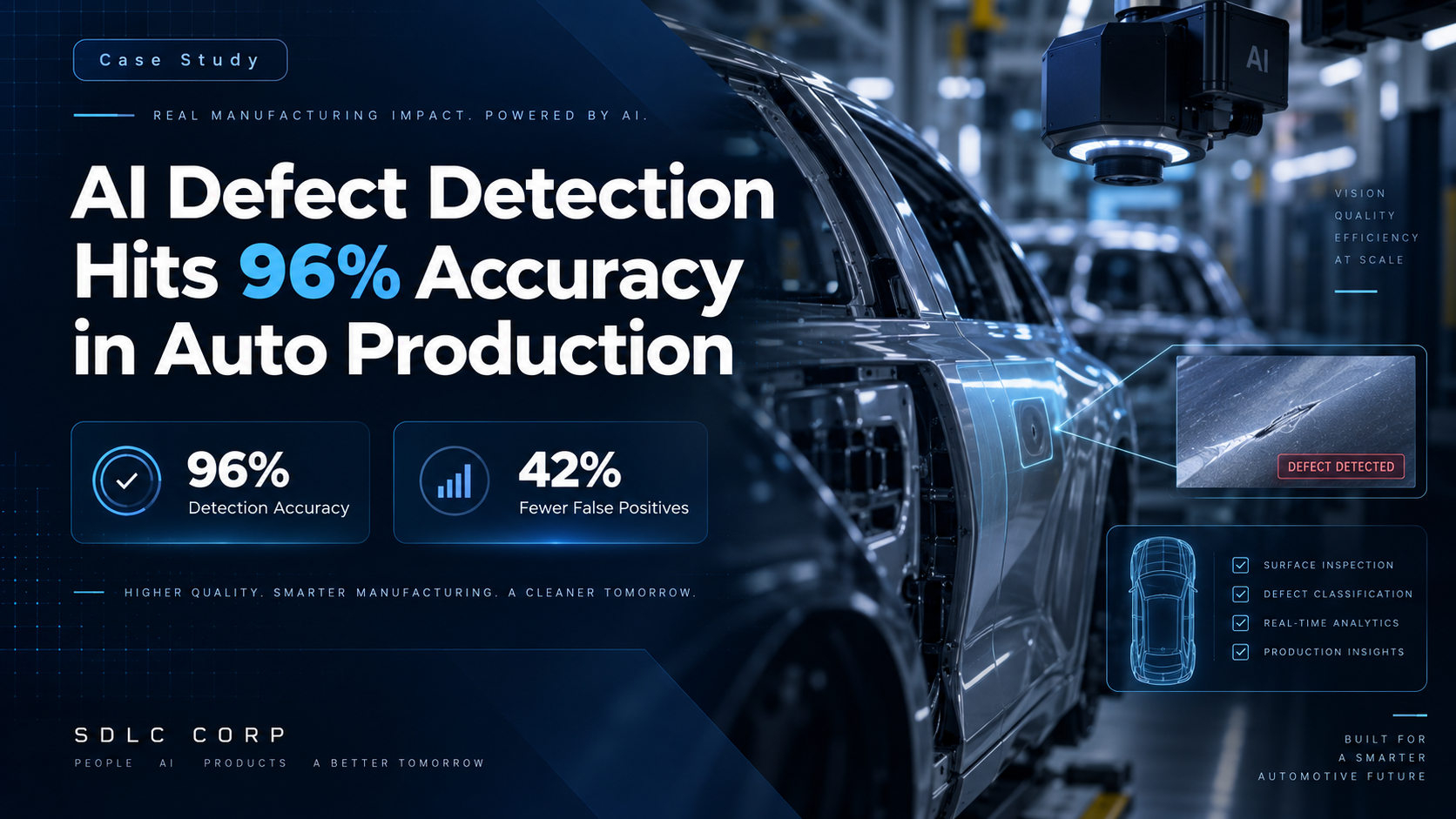
Connect vehicle data with business operations
Automotive platforms need dependable data flows across devices, applications and operational systems. Integration planning covers access rights, data quality, failure handling and the cost of third-party services.
Vehicle and telematics data
Review the device or OEM APIs, event formats, historical data, rate limits and permission model. Also plan buffering, retries, deduplication and stale-data warnings so teams can distinguish delayed signals from live readings.
Dealership, ERP and workshop systems
Map vehicle, customer, parts and service identifiers between systems. Odoo can be one option for agreed ERP workflows; the integration design follows your current platform and business needs.
Cloud, mobile and reporting
Separate device ingestion, application APIs, operational storage and reporting. Before release, agree data retention, deployment region, monitoring and alert ownership.
Custom Automotive Software Development
A phased plan makes hardware dependencies, integration risks and acceptance criteria visible before the main build. Scope and milestones are confirmed in the proposal.
- 01
Discovery and feasibility
Review users, operating workflows, existing applications and available data. First, identify device access, integration dependencies, safety boundaries and the first release to validate.
- 02
UX and architecture
Map driver, operator and customer journeys. Next, design interfaces, roles, data flows and environments, then agree testable acceptance criteria with your stakeholders.
- 03
Build and integrate
Deliver the agreed workflows in reviewable increments. Connect APIs and data sources, document interfaces and review changes against scope and priorities.
- 04
Test under operating conditions
Check permissions, API failures, delayed telemetry, intermittent connectivity and device compatibility. Test load and data quality against the requirements agreed for the application.
- 05
Pilot and rollout
Run the agreed pilot with representative users and data. After that, review defects and acceptance results, prepare deployment and rollback steps, and train operational users.
- 06
Handover and support
Confirm source-code, documentation and environment handover in the contract. Delivered work includes 30 calendar days of defect correction; ongoing maintenance and response targets are agreed separately.
Security, validation and operational control
Custom automotive software development needs an assurance plan suited to the application, whether it manages fleet records, inspects factory output or connects with vehicle systems. Therefore, define controls and validation evidence around the actual scope.
Privacy
Data privacy and access
Plan least-privilege roles, authentication, protected API access, audit records and retention rules. Because location and driver data can identify people, define access and consent rules for your deployment region.
Quality
Reliability and release readiness
Define monitoring, backups, recovery, rollout and rollback responsibilities. For AI inspection, evaluate missed defects and false positives under representative line and lighting conditions.
Safety
Safety-related engineering boundaries
For ADAS, embedded or vehicle-control work, agree the applicable standards, safety analysis, traceability and independent validation responsibilities before scope approval. Automotive-specific certification is not implied by a business application engagement.
Review company assurance information in the SDLC Corp Trust Center. In addition, agree project-specific standards and acceptance evidence for your use case.
Software for automotive teams
The right first release depends on who uses the system and the operational problem it needs to solve.
Manufacturing
OEMs and suppliers
Production visibility, quality inspection and integration with factory systems. Specialist vehicle engineering requires a separately validated scope.
Sales and aftersales
Dealerships and service centres
Stock visibility, enquiries, service bookings, workshop records and parts coordination across locations.
Operations
Fleet and mobility operators
Vehicle records, maintenance planning, driver workflows and data dashboards linked to your available systems.
Electric mobility
EV service providers
Customer apps, charging-session visibility and fleet charging workflows shaped by provider API access and network requirements.
Automotive software development cost
Indicative prices for defined first releases and pilots. Larger automotive systems are estimated on scope.
Fleet Records & Operations Application
Vehicle and driver records, maintenance scheduling and basic reporting. GPS tracking, telematics integrations and route optimisation are scoped separately.
- Indicative price
- $15,000
- Timeline
- Confirmed in proposal
Dealer Management System
Existing-platform configuration for the agreed sales, stock and service workflows.
- Indicative price
- $20,000
- Timeline
- Confirmed in proposal
Telematics Dashboard
One existing data source, tracking views and alerts
- Indicative price
- $20,000
- Timeline
- Confirmed in proposal
AI Inspection Pilot
One inspection use case; equipment and production deployment separate
- Indicative price
- $20,000
- Timeline
- Confirmed in proposal
EV Software Systems
Based on network scale
- Indicative price
- Estimated on scope
- Timeline
- 6–14 months
Automotive ERP Systems
Large enterprise scope
- Indicative price
- Estimated on scope
- Timeline
- 8–18 months
Pricing notes: Indicative prices in USD. Dashboards and pilots do not include vehicle-control or ADAS systems, which are estimated on scope. Delivered work includes 30 calendar days of defect correction; ongoing support is separate. Taxes, platform subscriptions, hosting and third-party fees are excluded unless agreed; final pricing is confirmed in your proposal.
Choose an automotive software development company
Choose a custom automotive software development partner based on relevant project evidence, integration planning and acceptance criteria you can review.
Project evidence
Evidence you can examine
Review the published automotive inspection engagement and discuss how its data, runtime and integration constraints compare with your use case.
Practical architecture
Scope matched to your systems
Define what can be configured, what needs custom development and what depends on access from vehicle, device or platform vendors.
Accountability
Reviewable delivery
Agree milestones, acceptance tests, responsibilities and handover deliverables before implementation. Then use those criteria to assess each release.
Automotive software development FAQs
Answers about scope, apps, cost, integrations, validation and ongoing support.
Our automotive software development services cover fleet and dealer applications, telematics dashboards, connected mobility apps, integrations and AI inspection workflows. Custom automotive software development is scoped around users, data access, existing systems and acceptance criteria. Embedded and safety-related work requires a separate capability and validation review.
Yes. As an automotive app development company, we can scope driver, customer, dealership and connected mobility applications for iOS, Android or cross-platform delivery. Our automotive app development services include UX, backend integration, device testing and release planning. Vehicle commands and data availability depend on authorized provider APIs.
Indicative prices are $15,000 for the defined fleet records and operations application, $20,000 for dealer management configuration on an existing platform, $20,000 for a telematics dashboard with one existing data source, and $20,000 for an AI inspection pilot with one use case. See the pricing section for inclusions, exclusions and support terms. Larger EV networks, vehicle-control systems, ADAS and custom ERP are estimated on scope.
Delivery depends on the release scope, data readiness, hardware access and integrations. Indicative planning ranges are 6–14 months for EV systems and 8–18 months for large automotive ERP systems. Focused application and pilot schedules are confirmed in the proposal. The published eight-week AI inspection engagement is a specific project example, not a standard timeline for every build.
Integration feasibility depends on API documentation, permissions, data formats and vendor restrictions. We review those dependencies before committing to scope. Odoo can support agreed ERP workflows, but the automotive platform can be designed around the business systems you already use.
The project security plan defines authentication, roles, API access, logging, retention, deployment region and data handling responsibilities. Location and driver data require privacy decisions appropriate to your users and market. Required controls and testing evidence are agreed for the application.
Safety-related software needs a separate engineering and assurance plan. Applicable standards, hardware access, traceability, specialist capabilities and validation responsibilities must be reviewed before a commitment. Automotive-specific certification and deployment approval depend on the agreed engineering programme and its validation evidence.
Offline behaviour is designed per workflow. Driver checklists or job updates may need local capture and later synchronization, while vehicle commands or live telemetry need explicit connection-state handling. We agree which actions remain available offline and how conflicts, stale data and retries are managed.
Delivered work includes 30 calendar days of defect correction. Ongoing maintenance, monitoring, response targets and third-party fees are agreed separately. Source-code ownership, third-party licenses, documentation, deployment access and handover responsibilities are defined in the contract.
Share the users and workflows, existing applications, device or OEM API documentation, sample data, required integrations and deployment constraints. A budget range and target date help define a realistic first release. An NDA can be signed before detailed discovery begins.
Yes. Our automotive app development services can modernize an existing driver, dealer or customer app while retaining suitable backend systems. First, review the source code, API contracts, data model and deployment access. Then agree which components to retain, replace or migrate and how to validate the release before switching users.
- Contact Us
Let’s Talk About Your Project
What happens next?
- We review your requirements
- Strategy call with experts
- Clear roadmap & estimate
- NDA Protected
- Enterprise Grade Delivery
- Global Clients