Risk-Aware AI Voice Agent with Human Escalation

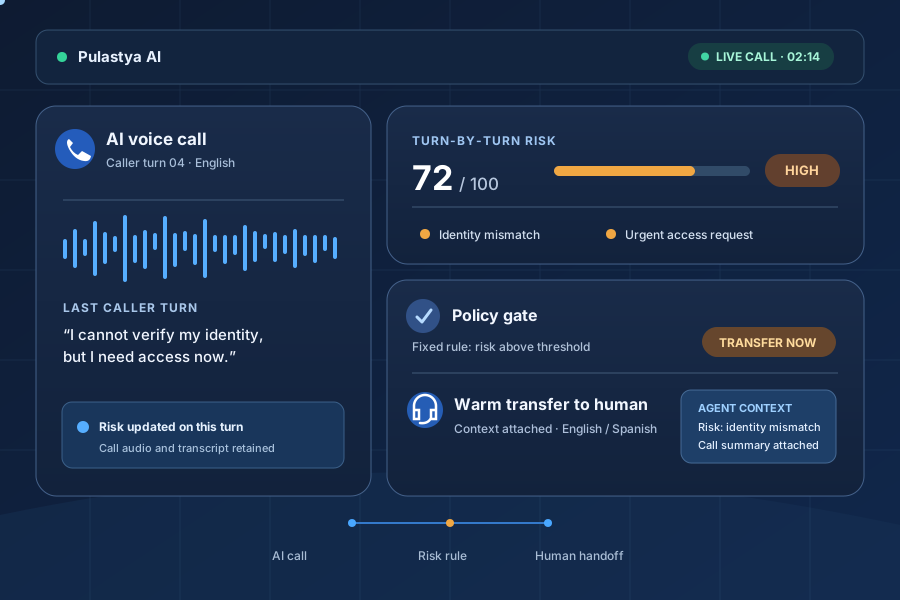
Pulastya is a risk-aware AI voice agent for phone lines where a routine call can turn serious within a few sentences. It scores risk on every caller turn, and fixed policy rules, not the model, decide when to escalate, transfer, or open the call for admin takeover.

  • Risk scored on every caller turn
  • Fixed rules control escalation
  • Warm transfer in English and Spanish
Pulastya AI voice agent detecting rising risk during a live call and preparing a warm transfer
At A Glance

Pulastya AI Escalation Build in Numbers

The risk model, decision layer, and languages behind this escalation build.

Risk Levels
3Risk Tiers
Low, High, and Critical, each tied to one policy action.
Languages
2Languages Supported
English and Spanish, with the same escalation rules in both.
Decision Layer
1Policy Engine
Deterministic rules control every critical action, separate from the LLM.
Platform
1Voice Agent
Pulastya AI handles inbound, outbound, and campaign calls.

FocusRisk-Aware Human Handoff

Non-emergency and business calls

Shashank Jaiswal, Project Lead at SDLC Corp
Project LeadShashank Jaiswal

Risk-Aware Escalation

Verified Review5.0 on Clutch

Prabhat Mishra, CEO, Pulastya AI

The Challenge

Why a Fixed Script Cannot Handle These Calls

Some calls start routine and turn serious within a few sentences. The escalation layer has to catch that shift as it happens, and act on it.

Four requirements define what the escalation layer needs to do.

  • Re-Check Intent and Risk Throughout the Call

    A call that opens as a general report can become a medical emergency two sentences later. Classifying once at the start misses that shift.

  • Keep Critical Actions Under Organization Rules

    Emergency transfer, priority escalation, and admin takeover have to run through rules the organization defines, tests, and audits, not a model's best guess.

  • Give the Human Full Context at Handoff

    The person who answers needs the summary, the risk level, and the escalation reason before they say a word to the caller.

  • Protect English and Spanish Callers Equally

    The same risk rules and the same path to a person have to apply in both languages, during business hours and after.

Escalation Features

Six Features Behind Every Escalation Decision

Pulastya AI scores risk, applies fixed rules, and hands off calls with full context, in English and Spanish.

01 / 07
Feature 01

Dynamic Risk Scoring

Risk is scored on every caller turn, not once at the start, so it rises the moment the facts change.

Feature 02

LLM Classification, Deterministic Rules

A language model reads intent, risk, and language. Fixed rules turn that reading into one action, the same way every time.

Feature 03

Human-Request Detection

When a caller asks for a person, the request is recognized and honored immediately, in either language.

Feature 04

Warm Transfer With Context

The person who answers sees the intent, risk level, escalation reason, and language before they pick up.

Feature 05

After-Hours Routing and Failover

Hours-aware policies and a configured fallback route mean a missed connection never means a dropped call.

Feature 06

Full Audit Trail

Every risk change, rule, and action is timestamped and stored with the transcript, recording, and summary.

Next Step

Planning Voice AI Around Risk?

Do your callers sometimes need more than a script? Start by mapping which phrases and situations should always reach a person.

The Pulastya AI Solution

AI Understands the Conversation, Policies Decide the Action

The AI works out what the caller means. A deterministic policy engine, rules that return the same action for the same inputs, decides what happens whenever risk or a human request is involved.
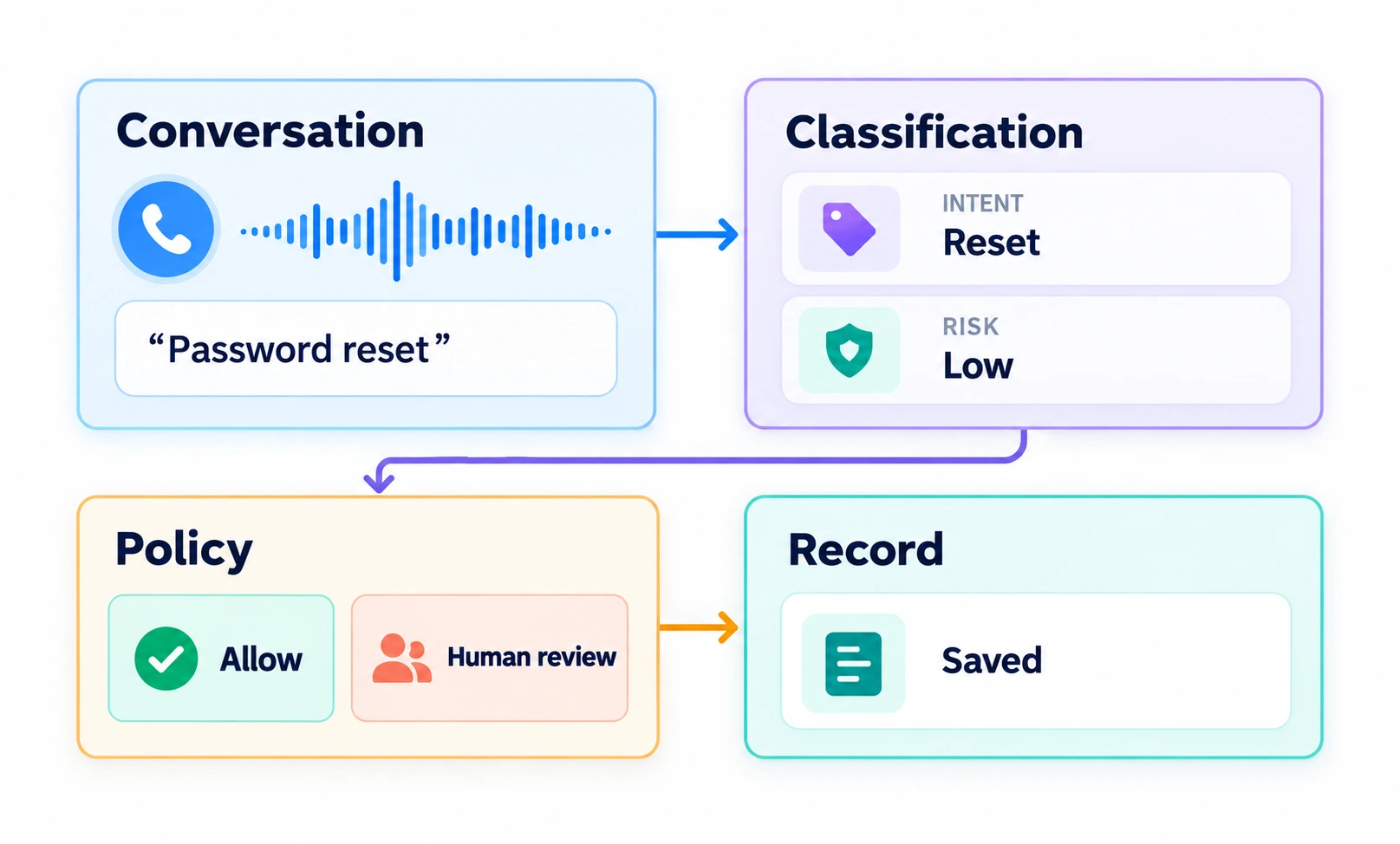
Pulastya AI voice agent architecture showing conversation, classification, policy, and record layers for risk-aware escalation.

Conversation Layer: Speech, Knowledge, and Voice

Speech-to-text captures the caller, retrieval-augmented generation (RAG) pulls answers from the organization's approved knowledge base, and text-to-speech replies in a natural voice.

  • Speech-to-text capture
  • RAG over approved knowledge
  • Natural voice reply

Classification Layer: Intent, Risk, and Language

On each caller turn, a large language model (LLM) uses natural language processing to label the current intent, risk signals, language, and any request to speak with a person.

  • Re-evaluated on every caller turn
  • Flags a human request instantly
  • Feeds the policy layer, never acts alone

See our approach to natural language processing.

Policy and Record Layers: Rules Decide, Everything Is Logged

Rules turn each classification into one action: continue with AI, escalate with priority, transfer to a human, or open the call for admin takeover. Every action is captured in a timestamped audit trail alongside the transcript and recording.

  • Only a rule can trigger a critical action
  • Same result for the same inputs, every time
  • Full audit trail for QA and review
How Escalation Works on a Live Call

How the AI Voice Agent Hands a Critical Call to a Person

Here is how Pulastya handles a call to a non-emergency line that turns critical within three caller turns.

Workflow · Warehouse Incident Report

Caller says: “There is a problem at our warehouse.”

  1. General Incident Report

    The caller says there is a problem at the warehouse.

  2. Pulastya Continues With AI

    The agent asks what happened and keeps talking.

  3. Injury Reported

    The caller says a worker has been injured.

  4. Priority Escalation Rule Applied

    The call is flagged and prepared for human handoff.

  5. Medical Emergency

    The caller says the worker is unconscious.

  6. Normal AI Workflow Stops

    The configured emergency workflow runs instead.

  7. Warm Transfer to a Person

    The caller is connected to someone who already has the summary and reason.

The agent never stayed locked on the first intent, and a configured rule made the transfer, not the model's choice of words.

Architecture Decisions

Risk-Aware AI Voice Agent vs. Ordinary AI Phone Bot

An ordinary AI phone bot classifies a call once and follows a fixed script. Pulastya re-checks intent and risk on every caller turn, and lets policy rules, not the model, control what happens next.

Ordinary AI phone bot compared with Pulastya across 10 points
10 points comparedOrdinary AI Phone BotPulastya
IntentSet once near the startRe-evaluated every turn
RiskKeyword match or noneScored by level throughout the call
Critical DecisionsLeft to the model's replyControlled by deterministic rules
Request for a PersonOften looped backRecognized and honored
HandoffBlind transferWarm transfer with summary and reason
LanguagesUsually English onlyEnglish and Spanish, same rules
Missing KnowledgeImprovises an answerStates it, offers the next step
After HoursVoicemailHours-aware routing
Failed TransferCall dropsConfigured fallback destination
RecordRecording at bestTranscript, summary, and audit trail

Why the Separation Matters

A model's reply can vary between calls even when the situation is the same. A policy rule returns the same action every time, so it can be tested before launch and audited after every call.

Keeping interpretation and authority separate keeps every escalation traceable to a rule. Teams planning this kind of build can learn more about our approach to enterprise AI development.

Routine vs. Critical

What Changes When a Call Turns Critical

The same agent takes every call. What changes is which rules fire and where the call ends up.

Routine call compared with critical call across 4 points
4 points comparedRoutine CallCritical Call
Example Statement“There is a problem at our warehouse.”“He is unconscious.”
Risk LevelLowCritical
What Decides the Next StepAI continues the conversationA configured policy rule
How the Call EndsThe AI keeps answering questionsWarm transfer to a person with full context
Results

How Each Requirement Was Met

Client details and measured results are not published. Each change reflects how the escalation layer operates.

Intent and Risk Re-Checked Throughout the Call

Every caller turn is classified, and risk levels rise as the facts change, so a call escalates the moment it needs to.

Critical Actions Stay Under Organization Rules

Only policy rules can trigger an emergency transfer, priority escalation, or admin takeover, never the model alone.

English and Spanish Callers Get the Same Protection

The same rules apply in both languages, backed by hours-aware routing and a configured fallback route.

4
Context Fields Passed at HandoffIntent, risk level, escalation reason, and language reach the person before they pick up.
2
Languages on the Same Escalation RulesEnglish and Spanish callers follow one rule set and one path to a person.

Results disclosure: Client details and measured performance data are not published. The figures above describe how the escalation layer is configured, not measured outcomes.

Client Stories

What Clients Say About Building With SDLC Corp

Prabhat Mishra, CEO of Pulastya AI, reviewed the risk-aware escalation build on Clutch. Leaders from other client teams share what it is like to work with us.

Client story

Eric Leist

CEO, Edgerton Strategies

Client story

Doug Schmidt

CEO, Roofaid USA

Client story

Reyzal Razmi

All Star Influencers

Verified Clutch review
01 / 01
What stood out most was their ability to understand the problem before writing code.

SDLC Corp built the risk-aware escalation layer for Pulastya AI. Risk is scored on every caller turn, deterministic policy rules control emergency transfer, priority escalation, and admin takeover, and every call reaches a person with full context in English and Spanish.

Quality 5.0 Schedule 4.5 Cost 4.5 Willing to Refer 4.5
Overall rating
01 / 01

Rated 5.0 on Clutch for the Pulastya AI risk-aware escalation build.

Read the Review on Clutch
Common Questions

FAQs About Risk-Aware AI Voice Agent Escalation

Questions teams ask when evaluating a voice agent that scores risk and controls escalation with policy rules.

Is Pulastya AI Just A Conversational Chatbot?

No. It scores risk on every caller turn and lets deterministic policy rules control critical actions such as emergency transfer, priority escalation, and admin takeover. The conversation is only one part of what it does.

How Does Pulastya Decide When To Escalate A Call?

An LLM labels intent, risk signals, language, and human requests on every caller turn. Policy rules then turn those labels, plus conditions such as business hours, into one action: continue with AI, escalate with priority, transfer to a human, or open the call for admin takeover.

Does The Language Model Make The Final Escalation Decision?

No. The model interprets the conversation and can raise a risk flag. Emergency transfers, priority escalation, and call takeover run only through policy rules, which return the same result for the same inputs and can be audited.

What Happens If The AI Misses A Risk Signal?

Critical phrases set by the organization trigger rules alongside the LLM's classification, and callers can ask for a person at any point. Every call is recorded and reviewable, so QA teams can find a missed signal and add it to the rules.

What Happens When A Caller Asks To Speak To A Person?

Pulastya recognizes the request in English or Spanish and the policy honors it with a transfer. Outside staffed hours, the caller hears the after-hours options the organization has set.

Does Escalation Work The Same For Spanish-Speaking Callers?

Yes. Risk scoring, human-request detection, and escalation rules apply the same way in English and Spanish.

What Happens If The AI Cannot Answer Or A Transfer Fails?

If the knowledge base has no reliable answer, the agent says so and offers the next step the policy allows. If a transfer does not connect, the policy moves to the next configured destination and logs the attempt.

Does Pulastya Replace 911 Or Emergency Dispatch?

No. Pulastya runs on non-emergency and business phone lines. When a call turns critical, it hands the caller to the people and emergency workflow the organization has defined. Anyone facing an emergency should call 911.

Is Every Escalation Decision Recorded?

Yes. Each call keeps a timestamped audit trail of risk changes, rules triggered, actions taken, transfer attempts, and admin takeovers, stored with the transcript, summary, and recording.

See Risk-Aware Escalation on Your Call Flow

See Pulastya AI Work
on Your Own Calls

Pick one call type where escalation matters. We will map how Pulastya would score it, which rules would act, and where each handoff would go.

  • Use Your Own Call Scenarios
  • Risk Rules Mapped to Your Policies
  • English and Spanish Escalation Paths

Pulastya AI

Escalation Preview

  1. 01Score the Risk
  2. 02Apply the Rule
  3. 03Warm Transfer

Let’s Talk About Your Product

Get expert guidance on scope, architecture, timelines, and delivery approach so you can move forward with confidence.

What happens next?