
- Home
- Industries
- Hospitality Software Development
Hospitality Software Development Company
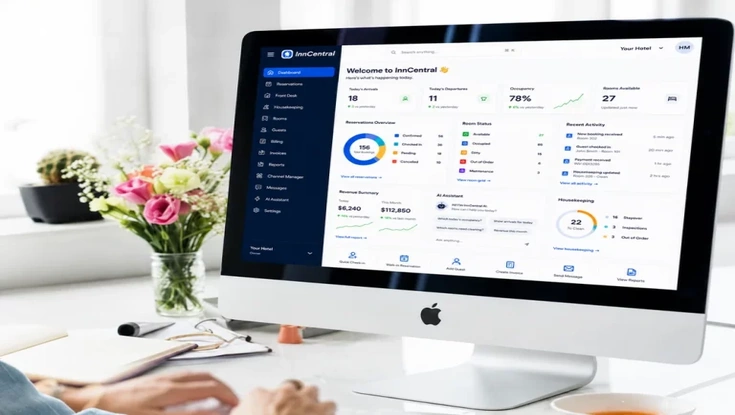
SDLC Corp is a hospitality software development company for hotels, restaurants and resorts. We build PMS platforms and booking workflows around your existing systems, with integrations and migration planned before launch. Our hospitality app development services connect guest and staff apps to reservations, payments and daily operations.
Hospitality Projects
Hospitality Software Development Services
Connect a single workflow or build a hospitality platform, with a clear scope and acceptance criteria for each release.
01 · Hotel operations
Hotel PMS Development
Replace separate room lists and billing records with reservations, room allocation, housekeeping and guest folios in one workflow. Build a custom PMS or extend your current platform, with access and accounting requirements agreed first.
Discuss this service →02 · Distribution
Booking Engines & Channel Integration
Keep direct bookings and channel availability aligned with the PMS. Define rate mappings, reservation status, cancellations and failed-sync handling. OTA connectivity depends on approved vendor interfaces and API access.
Discuss this service →03 · Food & beverage
Restaurant POS & Kitchen Workflows
Connect table orders, kitchen tickets, stock records and billing. Support split payments, voids, refunds and outlet reporting, with printer compatibility and offline behaviour checked against your devices and POS platform.
Discuss this service →04 · Mobile
Hospitality App Development Services
Let guests book, check in and request service while staff receive tasks and update room status. Our hospitality app development services cover UX, supported API integration, testing and store submission.
Discuss this service →05 · Guest relationships
Guest CRM & Loyalty
Give authorised staff one view of guest preferences, stay history, consent and service follow-ups. Define loyalty tiers and redemption rules across properties, with access and communication permissions agreed before integration.
Discuss this service →06 · Modernisation
Integration, Migration & Support
Connect existing systems without re-entering reservations or charges. Map exportable data, reconcile migrated records and rehearse cutover. Ongoing monitoring, maintenance and support coverage are agreed separately.
Discuss this service →Custom Hospitality Software Development
Custom hospitality software development suits workflows, integrations and guest experiences that standard products cannot support. Compare configuration, extensions and a custom build before choosing an approach.
Configure an existing platform
Choose implementation when standard reservation, front-desk or POS features fit. Keep custom work limited to gaps. For an Odoo route, explore our hotel management services or restaurant management services.
Extend your current systems
Keep the PMS or POS your staff already know. Add an integration, staff portal or guest app where the vendor supports it. Check API rights, subscription limits and data export options first.
Build a custom product
Choose a custom platform when workflows, branding or distribution rules require more control. Scope backend services, admin tools, integrations and operating costs alongside the guest experience.
Compare Implementation Options
| Decision | Configure | Extend | Custom build |
|---|---|---|---|
| Best fit | Standard workflows meet most needs | Core system works; a specific workflow is missing | Critical workflows need a different product |
| Main dependency | Platform modules and licences | Supported APIs and vendor access | Agreed scope, data model and integrations |
| Ownership review | Vendor terms and configuration access | Vendor terms plus rights to custom extensions | Source-code rights and third-party licences |
| Delivery effort | Setup, data preparation and training | Integration build, regression tests and rollout | Design, build, integration, testing and phased release |
| Ongoing costs | Subscriptions and support | Subscriptions, API usage and extension maintenance | Hosting, third-party usage and product maintenance |
We review your current systems, operational gaps and first-release priorities before recommending an approach.
Software for Your Hospitality Business
Plan the software around your properties, guest journeys and staff responsibilities.
Hospitality operations
Hotels & resorts
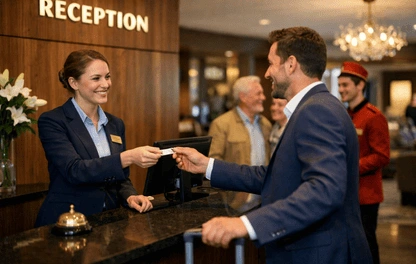
An independent hotel needs clear arrivals, ready-room status and guest folios. A property group also needs local staff access, shared policies and portfolio reporting. Resorts may connect dining, spa bookings and room charges.
Discuss Your Scope →Hospitality operations
Restaurants & F&B groups
A single outlet needs fast order entry and clear kitchen routing. A chain also needs controlled menus, ingredient stock and comparable outlet reports. Plan for busy shifts, local devices and network interruptions.
Discuss Your Scope →Hospitality operations
Travel operators & booking businesses
Connect supplier availability, booking changes, payments and itineraries through supported interfaces. Travel operators can also scope supplier distribution and itinerary management.
Discuss Your Scope →Hospitality operations
Hospitality startups
Launch one useful guest or staff journey, then expand to more properties, brands and integrations. Define the first release, backend requirements and acceptance criteria before development.
Discuss Your Scope →

Hospitality Software Case Studies
Explore hotel systems, restaurant POS and mobile booking projects delivered by SDLC Corp.
InnCentral Hotel Management Platform
A hotel team was coordinating bookings, rooms and payments across separate tools. InnCentral connected front desk, housekeeping, guest communication and owner reporting in one platform.
- 40% faster front-desk coordination35% faster housekeeping updates. Both results are based on internal workflow tracking during 2024–2025.

Odoo Hotel Management System
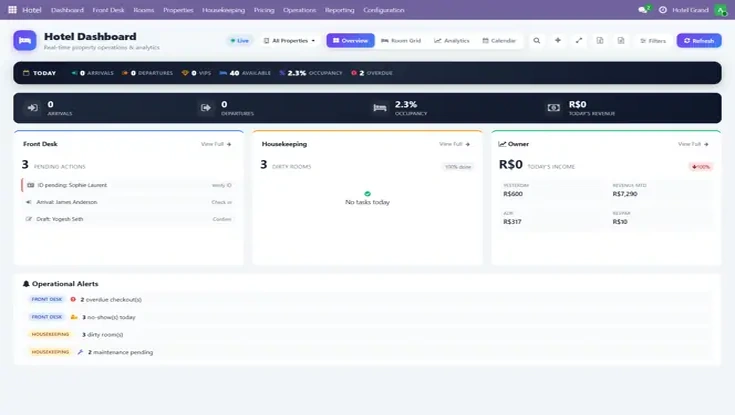
A hotel chain needed a shared view of reservations, rooms, housekeeping and billing. The Odoo 19 implementation connected those workflows with guest records and role-based dashboards.
- 9 built-in reportsRole-based views for front desk, housekeeping and owners.
FitBar Restaurant POS
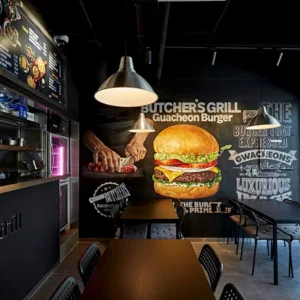
FitBar needed to connect restaurant orders with ingredient stock and receipt printing. SDLC Corp customised Odoo POS with ingredient deductions, expiry and scrapping workflows, and fiscal-printer integration.
- Connected restaurant workflowsOrders, ingredient stock and receipt printing connected through Odoo POS.
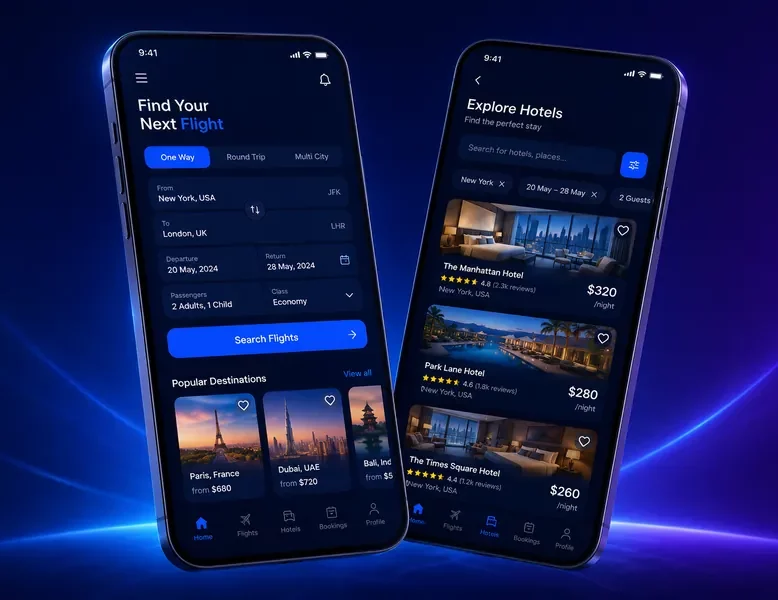
Travel Booking App
An iOS and Android travel app combined flights, hotels and local experiences from six live data sources. Delivery took six months from concept to launch.
- 42% conversion improvementReported for the checkout redesign from seven steps to three. Organic downloads grew 45% after launch.
Hospitality App Development Services
We build guest and staff apps that connect to reservations, payments and daily operations.
Guest journey
Guest apps
Guests can check availability, book, receive confirmation and request service during their stay. Pre-arrival check-in details connect to staff workflows where supported. Mobile keys require a compatible lock-provider interface.
Daily operations
Staff apps
Housekeeping staff receive room assignments, update cleaning status and flag maintenance issues. Authorised front-desk staff can then see which rooms are ready. Offline actions, sync conflicts, notifications and escalations are defined during design.
Platform choice
Native or cross-platform
Use native iOS or Android for platform-specific requirements, or a shared cross-platform codebase for a common guest journey. Scope authentication, notifications, accessibility and store release alongside the app. New backend services are estimated separately.
As your hospitality app development company, we define app-store ownership, release access, API maintenance and handover documentation in the proposal. For specialist itineraries and supplier booking, see travel app development.
Connected Systems, Controlled Data
Our hospitality software development services connect reservations, payments and guest data through supported vendor interfaces. Each integration defines data ownership, update rules and failure handling.
Reservations & PMS
Connect rooms, rates, reservations and booking status between the PMS and booking engine. Define which system owns inventory and confirms reservations, then check API rights and interface access.
Channels & Distribution
Synchronise availability, rates, restrictions and cancellations across supported channels. Define distribution rules and conflict handling, subject to provider approval, credentials and API limits.
POS & Accounting
Post charges, taxes, folios, invoices and settlements through supported POS and accounting interfaces. Agree ledger mappings and posting rules before integration.
Payments & Refunds
Track deposits, payment status and refunds using provider transaction references. Define reconciliation rules and webhook handling around your merchant account and supported payment flow.
Guest Apps & Devices
Connect service requests, room status and supported access actions to the system responsible for each task. Check device compatibility, vendor SDKs and permissions before development.
Security & Reconciliation
Define permissions by role and property, audit sensitive actions and agree retention and backup requirements. Scope consent, local tax and reporting needs for the markets you operate in.
From Discovery to Live Operations
Keep existing bookings and guest services in view throughout custom hospitality software development. Migration checks, release criteria and a rollback plan are agreed before cutover.
- 01
Discover & scope
Review guest and staff journeys, existing contracts, API access and exportable data. Compare implementation, extension and custom development. Agree the first release and measurable acceptance criteria.
Deliverables: Scope document, integration inventory and acceptance criteria.
- 02
Design & validate
Prototype booking, payment and staff workflows. Test the proposed journey with your users. Define the data model, access rules, integrations and error handling before build.
Deliverables: Reviewed prototype, data model and integration map.
- 03
Build & integrate
Deliver working increments in fortnightly sprints with demos and agreed sign-off. Connect approved interfaces and validate tax, inventory, booking and payment rules.
Deliverables: Working increments, documented interfaces and a prioritised backlog.
- 04
Test & rehearse
Exercise booking changes, refunds, failed payments, provider timeouts and concurrent updates. Reconcile migration samples and run load tests against agreed peak scenarios.
Deliverables: Test findings, migration reconciliation and release acceptance.
- 05
Train & launch
Prepare role-specific training, operational checklists and a planned cutover. Use parallel runs where appropriate and confirm owners for monitoring and issue triage.
Deliverables: Training materials, cutover checklist and agreed handover pack.
- 06
Support & improve
Delivered work includes 30 calendar days of defect correction. Ongoing support is scoped separately, with coverage hours, response targets and responsibilities defined in the support plan.
Deliverables: Defect log, support responsibilities and an agreed maintenance scope.
AI for Hospitality, With Human Control
Apply AI where reliable data can support a measurable operational improvement. Staff retain control of decisions affecting rates, guest commitments and food safety.
Forecast
Demand & revenue support
Use occupancy history, booking pace and seasonality to produce demand forecasts or rate recommendations. Revenue managers approve pricing rules. Compare forecast error and rate decisions against the agreed baseline before expanding.
Assist
Guest service assistance
Use approved property information to answer guest questions and route exceptions to staff. Booking changes require authorised APIs and confirmation rules. Evaluate answer accuracy, escalation quality and task completion with representative requests.
Plan
Kitchen & operations insights
Use stock movements, recipes and sales history to suggest preparation or ordering quantities. Staff approve changes and validate food-safety information. Evaluate forecast error and waste trends; allergen details remain tied to approved recipe records.
Engagement Models for Hospitality Projects
Choose a fixed-price release, a dedicated team or specialists who work alongside your existing team.
Defined release
Fixed price
For defined requirements, agree deliverables, cost, timeline and milestone payments upfront. A written scope is provided before commitment.
Ongoing roadmap
Dedicated team
For an evolving platform, assign a team around the required roles and backlog. Team size, delivery capacity and notice periods are agreed for the engagement.
Team extension
Staff augmentation
Add backend, mobile, integration, DevOps or QA specialists to your team. Engineers work within your agreed processes, tools and release responsibilities.
Start with a free 30-minute scoping call. An NDA can be signed before detailed discovery begins. Bring your current system list, property or outlet count and first-release goals so we can define dependencies and next steps.
Ongoing Support & Initial Response Targets
Indicative business-hours coverage is 8 hours per day, Monday to Friday, in the timezone and holiday calendar agreed in your support plan. Critical-incident coverage outside those hours, including 24×7 support, requires a separate agreement.
| Priority | Example impact | Initial response target |
|---|---|---|
| P1 · Critical | Production unavailable or booking/payment workflows blocked with no workaround | Within 1 covered hour |
| P2 · High | Major service degradation affecting key operations | Within 4 support hours |
| P3 · Medium | Limited operational impact with a usable workaround | Within 1 business day |
| P4 · Low | Minor issue, guidance or enhancement enquiry | Within 2 business days |
Response targets apply during contracted coverage. One business day means 8 support hours. The P1 clock runs continuously only with an agreed 24×7 critical-support plan. Initial response means acknowledgement and triage, not a guaranteed fix. Resolution and update frequency depend on severity, diagnosis and third-party dependencies.
Hospitality Project Feedback
Client feedback on a hospitality workflow project.
Well documented approach
Hospitality Software Cost & Timeline
Compare indicative prices for defined implementations and apps. Custom builds and group platforms are estimated after reviewing scope, integrations, data and rollout requirements.
Defined Implementation & App Offers
Restaurant POS system
One outlet with standard POS, menu and staff configuration on an existing POS platform such as Odoo restaurant POS. Custom POS development and multi-location F&B are estimated on scope.
- Indicative price
- $10,000
- Timeline
- Confirmed in proposal
- Single outlet
Hotel management system (PMS)
One property with reservation, room and front-desk workflows on an existing PMS platform such as Odoo hotel management. Custom PMS development and property groups are estimated on scope.
- Indicative price
- $20,000
- Timeline
- Confirmed in proposal
- Single property
Travel booking website
A booking website connected to an existing booking service.
- Indicative price
- $15,000
- Timeline
- Confirmed in proposal
- Existing booking service
Guest mobile app
One native app per OS (iOS or Android) or one cross-platform app for both, connected to an existing backend.
- Indicative price
- $10,000
- Timeline
- Confirmed in proposal
- Native: per OS · cross-platform: both
Custom Development & Group Platforms
CRS + Channel Manager platform
Central Reservation System with OTA integration (Booking.com, Expedia, Airbnb) and real-time availability sync.
- Indicative price
- Estimated on scope
- Timeline
- 3–8 months
- API count drives cost
Full hospitality platform (hotel + F&B + ERP)
Complete Odoo or custom platform covering PMS, restaurant POS, procurement, HR, and group financial reporting.
- Indicative price
- Estimated on scope
- Timeline
- 6–18 months
- Multi-property group scope
Prices and scope: Indicative prices in USD. Delivered work includes 30 calendar days of defect correction; ongoing support is separate. Taxes, platform subscriptions, hosting and third-party fees are excluded unless agreed. Final pricing is confirmed in your proposal. Book a scoping session for a written scope document before any commitment.
Hospitality Software Development FAQs
Find answers about development options, costs, integrations, migration and support.
A hospitality software development company designs, builds and connects systems for reservations, guest services and daily operations. SDLC Corp covers hotel PMS, restaurant workflows, booking platforms, guest apps and integrations, with scope defined around your current systems and first-release goals.
Use an existing platform when its workflows fit and extensions are manageable. Custom hospitality software development is appropriate when critical requirements cannot be met through configuration or supported integrations. Discovery compares those options, including licences, migration, ownership and ongoing operating costs.
Our hospitality app development services cover guest and staff journey design, mobile development, supported API integrations, testing and release preparation. Native iOS and Android are scoped per OS. A cross-platform app can share code across both. An existing backend is required for the stated app price; a new backend is estimated separately.
Indicative prices are $10,000 for a single-outlet POS implementation, $20,000 for a single-property PMS implementation and $15,000 for a booking website using an existing booking service. A guest app with an existing backend is $10,000 per OS for native development, or $10,000 for one cross-platform app for both. Custom platforms are estimated on scope. Taxes, subscriptions, hosting and third-party fees are excluded unless agreed.
Timelines for the defined implementation offers are confirmed in the proposal. The current planning ranges are 3–8 months for a CRS and channel manager platform, and 6–18 months for a full hospitality platform. These are indicative ranges, not promised deadlines. The published travel app case study records six months to launch. Your schedule depends on scope, API access, data readiness and acceptance testing.
We assess the interfaces and access rights of your specific vendors before committing to an integration. The plan defines the source of truth, field mappings, inventory updates, retries, cancellations and reconciliation. Vendor subscriptions, API approval and provider certification may be separate dependencies.
We review export formats and data quality, map fields, test sample migrations and reconcile reservations, balances and guest records. The rollout plan covers staff training, parallel running where appropriate, cutover checks and rollback. Downtime requirements are agreed before migration; zero downtime is not assumed.
Yes, multi-property access, shared guest records and group reporting can be scoped with permissions for each location. We assess languages, currencies, taxes, data hosting and reporting rules for your operating markets. Market-specific integrations are confirmed during discovery rather than assumed to be included.
The scope defines role-based access, audit logs, encryption, backup and retention requirements for the selected architecture. The contract states source-code rights, third-party licences, hosting and app-store account ownership, and handover deliverables. Payment and privacy compliance responsibilities depend on the implementation and are agreed before delivery.
Delivered work includes 30 calendar days of defect correction. Ongoing support is separate. The indicative support option covers 8 hours per day, Monday to Friday, in an agreed timezone. Initial response targets are 1 covered hour for critical incidents, 4 support hours for high-priority issues, 1 business day for medium-priority issues and 2 business days for low-priority issues. These are response targets, not resolution guarantees. Final coverage, holidays and escalation terms are confirmed in the support SLA. Any 24×7 critical coverage requires a separate agreement.
Book a free 30-minute call and share your property or outlet count, current systems, integration needs and desired first release. An NDA can be signed before detailed discovery begins. You receive a written scope before commitment, with assumptions, dependencies and delivery milestones.
Define peak booking scenarios, expected concurrent users and provider limits during discovery. Test search, availability, checkout and confirmation under that load. Agree scaling, monitoring and failure thresholds before release; capacity and service targets are confirmed for the selected architecture.
The integration design defines retries, exception queues, duplicate protection and reconciliation. Staff need a visible status and an escalation route when a provider cannot confirm a booking or payment. The expected behavior for each failure is agreed and tested before launch.
Define exportable records, formats, attachments and access rights in the contract and handover plan. Check vendor export restrictions and third-party licences before selecting a platform. Source-code rights, documentation and migration assistance depend on the agreed delivery and support scope.
- Contact Us
Let’s Talk About Your Project
What happens next?
- We review your requirements
- Strategy call with experts
- Clear roadmap & estimate
- NDA Protected
- Enterprise Grade Delivery
- Global Clients