PMIS Implementation Solutions.
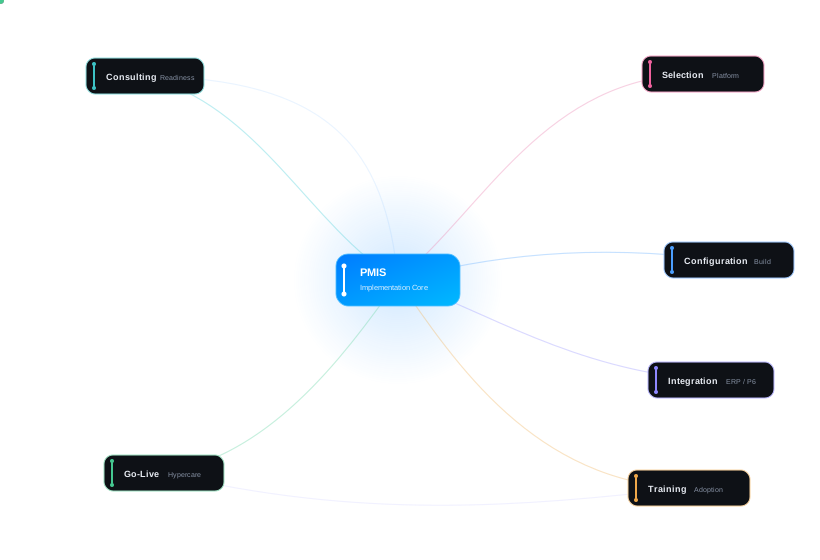
Plan, select, implement, integrate and optimize a PMIS that connects project controls, people, processes and enterprise data. SDLC Corp supports the full lifecycle, from consulting and platform selection to configuration, migration, integration, training and go-live support.
Why PMIS Implementations fail Before they Deliver Value.
PMIS rarely breaks at the platform. It breaks in the gaps between trusted data, connected systems, prepared teams, and clear ownership.

Selection Happens Too Early
Choosing software before workflows, controls and reporting are understood creates costly compromises later.

Processes Copied Without Review
Moving inefficient approvals and spreadsheet habits into a new platform does not fix the operating problem.

Migrated Data Is Not Trusted
Duplicate records and inconsistent coding undermine confidence from the first reporting cycle.

Integration Left Too Late
ERP, scheduling, document and BIM requirements should shape architecture before configuration is finalized.

Training Without Responsibility
Adoption improves when people learn how the PMIS supports their role, not just its menus and screens.

No Ownership After Go-Live
Without administration and governance, configurations drift and teams slide back to offline processes.


Our PMIS implementation solutions address these areas as one programme, from requirements and platform strategy through implementation, integration and operational support.
One PMIS Programme. Every Critical Workstream Connected.
From early decisions to enterprise integration, we bring strategy, implementation, data, systems, and adoption together under one coordinated programme.
 01
01PMIS Consulting & Readiness
Assess your existing project environment, business processes, systems, data, governance and implementation readiness.
We help define what should change before technology decisions are made.
 02
02PMIS Selection Services
Translate business requirements into structured platform evaluation criteria and compare PMIS options based on functional fit, integration, reporting, scalability, security and total lifecycle requirements.
 03
03PMIS Implementation Services
Configure workflows, project structures, permissions, controls, forms, registers, dashboards, reporting and system rules around approved business processes.
 04
04PMIS Data Migration
Profile, cleanse, map, transform, validate and migrate legacy project information into the new PMIS without simply carrying historical data quality problems forward.
 05
05PMIS Integration Services
Connect project information with ERP, finance, scheduling, CRM, BIM, document-management, identity and analytics platforms.
 06
06PMIS Reporting & Analytics
Create operational, project, portfolio and executive reporting around governed project information.
 07
07PMIS Training & Change Management
Prepare administrators, project managers, finance teams, controls teams, field users and executives to work effectively in the new environment.
 08
08PMIS Optimization & Managed Support
Improve live systems through configuration enhancements, reporting improvements, administration, integration monitoring and continuous support.
Build the right PMIS foundation before Implementation Begins.
Our PMIS consulting and selection services turn operational requirements into a clear platform, architecture and implementation strategy.

Current-State Assessment

We review the applications, spreadsheets, workflows, data and integrations supporting project delivery today.
Requirements Discovery

We work with project controls, finance, procurement, IT and leadership to set functional and technical requirements.
Process Mapping

Budgets, commitments, contracts, changes, invoices, RFIs, risks and approvals are mapped into a future-state model.
Platform Evaluation

Platforms are compared on functional fit, integration, reporting, security, scalability and total cost of ownership, including PMIS Trestle.
Solution Architecture

We define how the selected PMIS interacts with ERP, scheduling, document management and reporting applications.
Implementation Roadmap

Delivery phases, dependencies, migration scope, integration priorities, testing and governance are set out in sequence.
Connect your PMIS with the Systems that run Your Business.
A PMIS should not become another isolated source of information. We design integrations around clear system ownership, validation and reconciliation.

ERP & Finance Integration
Connect PMIS information with ERP and financial applications.

Scheduling Integration
Connect Primavera and other scheduling environments with project-controls reporting.

BIM & Design Integration
Connect project workflows with design, construction and model-based information where required.

Document Management Integration
Connect controlled project documents, metadata, revisions and records with enterprise content environments.

BI & Analytics Integration
Feed governed PMIS information into reporting environments such as Microsoft Power BI and enterprise data platforms.

Custom API & Middleware Development
Where native connectors are insufficient, we can create APIs, middleware and data-transformation services around approved integration requirements.
 Integration principle
 Every shared data element should have a defined source, owner, destination, synchronization rule, validation process and exception-handling approach.
Implement and integrate the PMIS that fits your Programme.
From established PMIS platforms to ERP, planning, analytics, and construction systems, we connect the technologies your programme already relies on into one coordinated environment.


 Autodesk Construction Cloud
  Bentley SYNCHRO
  Microsoft Planner
  Microsoft Power Platform
  Dynamics 365 Project Ops
  Microsoft Dynamics 365
  Microsoft Power BI
  SAP
SAP  Oracle Applications
  NetSuite
  Odoo
Odoo  Planview
  Jira
Jira  Jira Align
 Already using another PMIS? We can assess the platform, APIs, data structure and configuration before recommending optimization, extension or replacement.
Should you Buy, Build or Combine Both?
The strongest PMIS architecture is not always the platform with the longest feature list. It is the solution that supports your critical requirements without creating unnecessary complexity.
| PMIS Approach | When It Fits | Best Fit |
|---|---|---|
 Commercial PMIS | Suitable when an established platform supports most core requirements through standard configuration, giving a faster implementation path, proven functionality and vendor support. |  Fastest route when standard configuration fits Fastest route when standard configuration fits |
 Hybrid PMIS Often strongest | For many organizations, a commercial PMIS combined with custom integrations, applications, workflow extensions and reporting provides the strongest balance of speed, fit and long-term control. |  Packaged core plus targeted extensions Packaged core plus targeted extensions |
 Custom PMIS | Appropriate when differentiated workflows, regulatory requirements or architecture constraints cannot be supported by packaged software, giving greater control over integration and product evolution. |  Full control of workflows and architecture Full control of workflows and architecture |

Our PMIS consulting process evaluates these options before the implementation architecture is finalized.
From Discovery to Continuous PMIS Improvement.
Each phase of the PMIS implementation produces a reviewable output before major downstream decisions are made.

 Phase 01
Discovery & Assessment
Understand current processes, systems, project controls, users, reporting, data and integration requirements.
OutputCurrent-state assessment and agreed requirements.
 Phase 02
Solution Definition
Define future processes, platform strategy, architecture, integrations and implementation priorities.
OutputApproved solution blueprint.
 Phase 03
Configuration & Development
Configure the PMIS and develop approved custom components, workflows and reports.
OutputConfigured test environment.
 Phase 04
Data Migration & Integration
Cleanse and migrate approved data while developing enterprise integrations in parallel.
OutputValidated data and tested integrations.
 Phase 05
Testing & User Preparation
Complete functional testing, UAT, security validation, administrator preparation and user training.
OutputGo-live readiness approval.
 Phase 06
Deployment
Move the approved solution into production through a controlled cutover.
OutputLive PMIS environment.
 Phase 07
Hypercare & Continuous Improvement
Monitor adoption, reporting, integrations and configuration after deployment.
OutputStable PMIS operating model and improvement backlog.
Bring Critical Project Controls into a Connected Information Model.
A properly designed PMIS can connect processes that currently operate across spreadsheets, emails and isolated applications.

Cost & Budget Management
Budgets, commitments, actual costs, forecasts, cash flow and cost structures.

Contract Management
Contracts, procurement, commitments, payment workflows and commercial records.

Change Management
Change requests, change orders, cost impact, schedule impact and approval history.

Schedule Management
Milestones, baselines, progress, forecasts and schedule-performance information.

Document Control
Drawings, specifications, registers, transmittals, revisions and controlled approvals.

Project Workflows
RFIs, submittals, inspections, issues, actions and approvals.

Risk & Governance
Risks, issues, decisions, escalation, compliance controls and audit history.

Portfolio Reporting
Programme health, cross-project performance, financial exposure, schedule status and executive reporting.





One Partner Across PMIS Consulting, Implementation and Integration.
Successful PMIS programmes sit at the intersection of project processes, enterprise technology, data and organizational adoption.

We define processes, data and business outcomes before any platform decision is finalized, so the build follows the requirements.
Recommendations follow your requirements, not a need to resell a particular PMIS license.
Our work extends past platform setup into software engineering, APIs, automation and custom modules where standard configuration falls short.
ERP, scheduling, documents and reporting are designed into the solution from the start rather than bolted on after go-live.
Choose the level of PMIS Support your Programme Needs.
Start with consulting, engage us for the complete implementation, or retain ongoing PMIS support once the platform is live.

PMIS Consulting & Selection
For organizations defining requirements, reviewing an existing environment or choosing a new PMIS.


End-to-End PMIS Implementation
For organizations with defined requirements, delivered as one programme from configuration through data migration, enterprise integration and go-live.

Managed PMIS Services
For live platforms requiring ongoing administration, dedicated capacity and continuous improvement.
Plan your PMIS implementation with a clear starting point.
Share your current environment, platform position and reporting requirements, and we will outline the practical route forward.

Real Programmes. Real Results.
Founders, CEOs and operating leaders share what it is like to build with SDLC Corp.
Eric Leist
CEO, Edgerton Strategies
Doug Schmidt
CEO, Roofaid USA
Reyzal Razmi
All Star Influencers



They approached our Salesforce discovery with real technical depth, uncovered structural gaps others missed, and delivered a solution that worked exactly as promised.
From planning to post-launch, SDLC Corp guided us every step of the way. Their support makes them more than a vendor. They are a trusted partner.
Field notes from PMIS Delivery.
Practical guidance from the teams selecting, implementing and integrating PMIS platforms on live capital programmes.
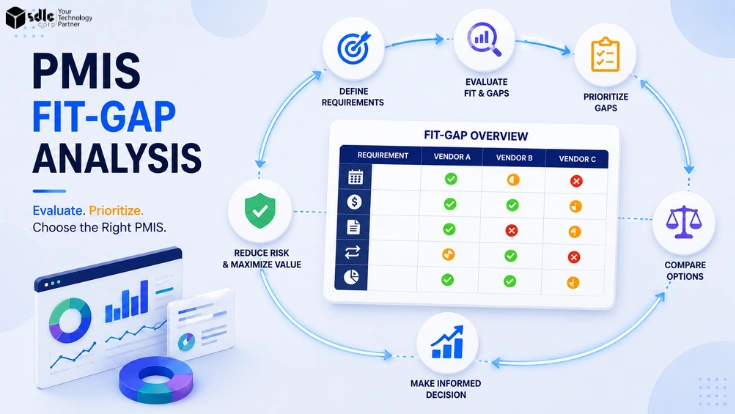
PMIS Fit-Gap Analysis: Evaluate Requirements and Gaps
Selecting a Project Management Information System should start with requirements, not a vendor feature list. Evaluate fit, gaps, evidence, cost and risk before selection.
Read article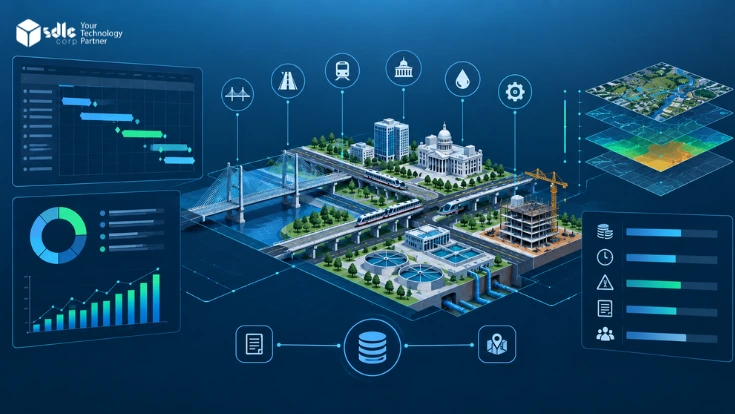
PMIS for Public Infrastructure & Capital Improvement Programs
A practical look at how public capital programs connect funding, approvals, project records, schedules and audit evidence inside a PMIS.
Read article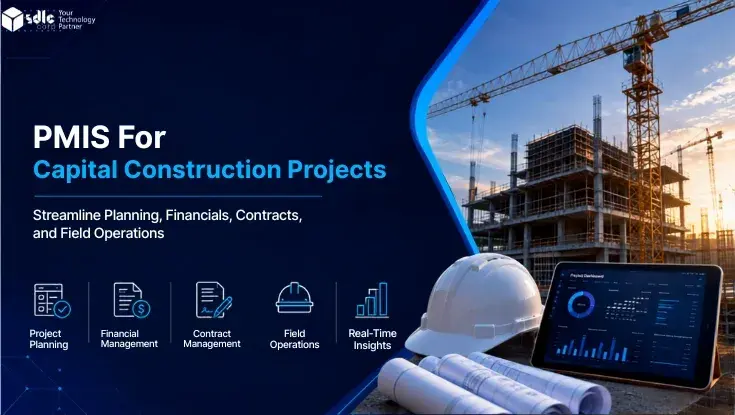
How to Choose the Right PMIS for Capital Construction Projects
A requirements-led approach to evaluating project controls, workflows, integrations, implementation effort and long-term PMIS cost.
Read article