Event Management Software Development Services
Build configurable event registration and management platforms for conferences, training programs, workshops, public-sector events, educational programs and complex multi-session events. Built around your workflows and connected to the enterprise systems you already use.
The Cost of Renting Your Event Stack
Subscription event platforms are excellent at getting a first event live quickly. The problems show up later, and they are the same three every time.

Per-Ticket And Per-Registrant Fees
Cost scales with your success, not with the value you receive. A programme that grows from 5 events to 50 sees its platform bill grow proportionally, with no corresponding gain.

Your Attendee Data Sits On Someone Else’s Infrastructure
Exports are usually possible. Real-time, field-level control usually is not. That becomes a compliance problem the moment you operate in a regulated sector or across data-residency borders.

The Platform Bends Your Process, Not The Other Way Round
Approval chains, sub-event logic, multi-entity billing, delegate allocation by member tier: these are the things enterprise event teams actually need, and they are the things a horizontal SaaS product will not build for one customer.
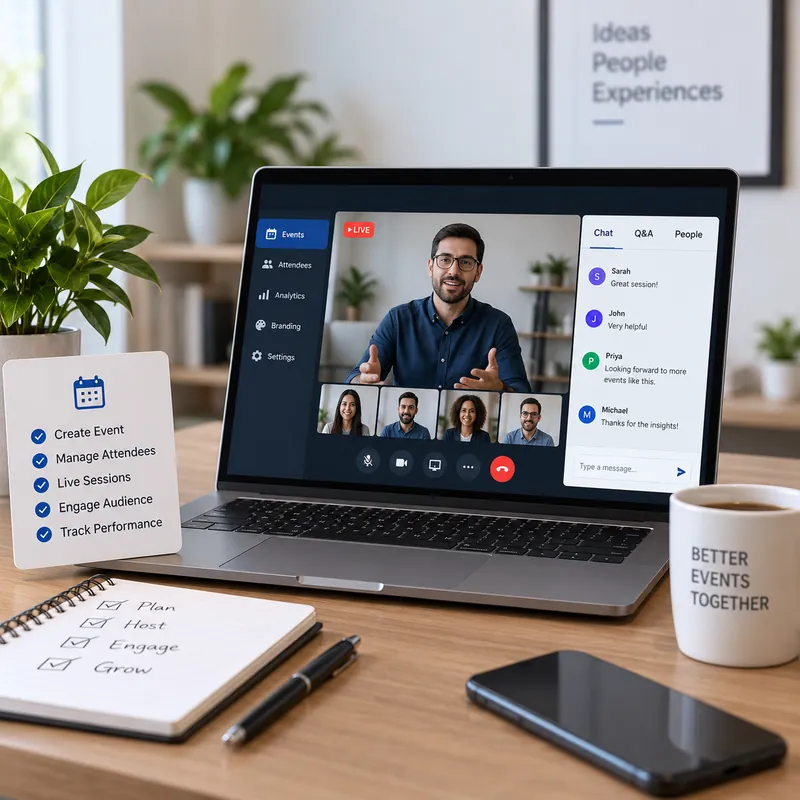

A custom-built platform removes all three. You pay to build it once, you own the data and the codebase, and the workflow is modelled on how your team already works.
One Platform From First Invite to Final Report
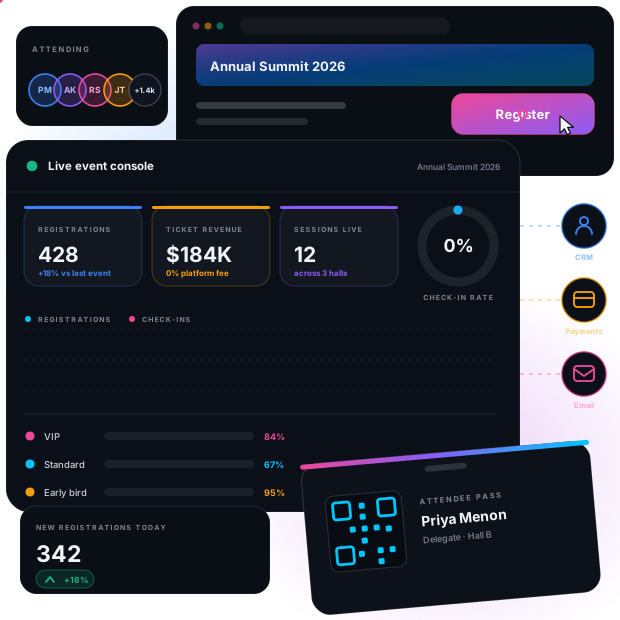
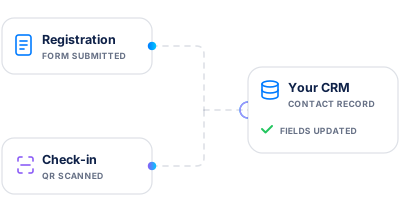
Connect registration, payments, session bookings, check-ins and attendee feedback to one profile for accurate reporting and reliable CRM synchronization.



01 Plan
Configure sessions, ticket tiers, capacity rules and approvals. Reuse past event setups to launch faster.
02 Promote
Publish branded event pages, automate invitations and reminders, and track which channels drive registrations.
03 Register
Manage event registration and payments with conditional forms, group bookings, promo codes, waitlists and confirmations.
04 Run
Support QR check-in, badge printing, access control and live attendance tracking across sessions and venues.
05 Measure
Track revenue, attendance, session performance, leads and survey results, then sync event data to your CRM.
Core Modules Inside Your Event Platform
A custom event management platform connects registration, payments, scheduling, attendee operations, analytics and integrations around the same attendee record.

Event Registration & Enrollment
Custom forms, group enrollment, approval rules, waitlists and capacity controls.

Payments & Financial Management
Online payments, invoices, refunds, discounts and secure gateway integration.

Attendee Management & Check-In
Attendee profiles, QR check-in, badge printing, attendance tracking and history.

Event Scheduling & Agenda Management
Manage sessions, tracks, speakers, capacity and personalized attendee agendas.

Event Analytics & Reporting
Track registration, attendance, finance and performance with reports and KPI dashboards.

Event Management System Integrations
Connect ERP, CRM, finance, LMS, BI, identity, email, SMS and calendar systems.
Looking for a ready-built registration solution?
Explore Rostra, our registration platformTell us How your Events Run Today
Send us your current process, your volumes and the systems you need it to talk to. We will come back with a scope, a timeline and a cost range.
- Scope, timeline and cost range
- No per-registrant fees
- Fixed-scope deliverable list
 Scope, timeline and cost range
Built for In-person, Virtual and Hybrid formats.

In-Person
Venue-side operations are where most platforms fail. Check-in queues, badge reprints, restricted-zone access and offline network conditions all get designed for explicitly, not assumed away.


Virtual
Streaming, session rooms, chat, Q&A, polls and on-demand replay, with engagement tracked per attendee rather than reported as an aggregate view count.

Hybrid
One registration flow, one attendee database and one report across both audiences. Hybrid falls apart when the two audiences live in two systems, so they do not.




Connects to the systems you already run
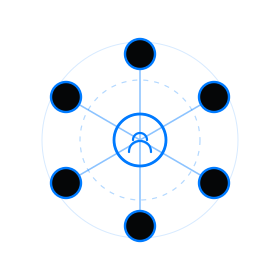
Connect your event platform through a secure API and integration layer to ERP, CRM, finance, payment, identity, LMS, BI, communication and calendar systems, with direct or secure alternative data exchange based on your architecture.

CRM
Connects to
ERP
Connects to
Marketing Automation
Connects to
Payments
Connects to
Identity
Connects to
APIs & Enterprise Systems
Connects toBuild, Extend and Connect the Platform that fits your Programme
Our event management software development approach is requirements-led. We build custom platforms, extend existing systems and integrate the technology you already run based on event volumes, workflows, security requirements and enterprise architecture.
 Cvent
Cvent  Eventbrite
  Zoho Backstage
  Hubilo
  Whova
Whova  Bizzabo
  vFairs
  Accelevents
  Salesforce
  HubSpot
  Microsoft Dynamics 365
  Oracle NetSuite
  Odoo Zoho CRM
  Microsoft Power BI
  Stripe
  Razorpay
  PayPal
  Zoom
Zoom  Twilio
  Amazon Web Services
  Zapier
Already on an event platform? We can assess its APIs, data structure, fee exposure and configuration before recommending optimization, extension or replacement.
See it Running Against Your Own Stack
We will demo the platform wired to a sandbox of your CRM so you can see the actual data flow, not a slide about it.
- Wired to your CRM sandbox
- Live registration on the call
- Two-way integration layer
 Wired to your CRM sandbox
Bring your own field mapping and we will run it live.
How a Build runs, Week By Week
A structured delivery process takes the platform from requirements and workflow discovery through UX, architecture, development, integrations, QA, security, deployment and ongoing support.
- Stage 01
Discovery & Requirements
Process mapping, event requirements, user roles, integration audit, data model and success criteria.
DurationWeek 1 to 2
- Stage 02
UX/UI & Workflow Design
Registration, attendee and admin workflows, event portal UX, scheduling journeys and clickable prototypes.
DurationWeek 3 to 4
- Stage 03
Architecture & Development
Platform architecture and development for registration, payments, scheduling, attendee management, communications and administration.
DurationWeek 5 to 10
- Stage 04
Integrations & Enterprise Connectivity
ERP, CRM, finance, payment, SSO, LMS, BI and communication integrations through secure APIs and synchronization workflows.
DurationWeek 8 to 12
- Stage 05
QA, Security & Dry Run
Functional QA, load testing, security review and full rehearsal of registration, payments, scheduling and attendee check-in workflows.
DurationWeek 12 to 14
- Stage 06
Deployment, Training & Support
Production deployment, administrator training, documentation, go-live support and ongoing platform maintenance.
DurationWeek 14 to 16


Custom Build versus off-the-shelf Platforms
The same eight questions, answered honestly for both routes, so the comparison is on the terms that actually decide it.


Honest answer: if you run two or three straightforward events a year, buy a subscription platform. Custom starts paying back when event volume, per-ticket fees, workflow complexity or data-residency requirements make the rented option expensive or impossible.
What it Costs to Build and to Run
Every quote is based on a defined scope and written deliverables. No per-registrant fees or per-event surcharges.

Event Registration Platform Development
Branded event portal, configurable registration workflows, payments, attendee communications and reporting.
 Most popular
Custom Event Management Platform
Registration, payments, scheduling, attendee management, analytics and CRM or ERP integration.

Enterprise Platform
Multi-entity event management, exhibitor workflows, enterprise integrations and private deployment options.
Pricing ranges are indicative and include design, development, integrations, testing and go-live. Ongoing hosting, monitoring, updates and event support are scoped separately. Final pricing is based on the agreed scope and written deliverables.
Why Teams Choose SDLC Corp

Enterprise software delivery experience across ERP, CRM and custom platform builds, not an event-tech startup learning integration on your project.
In-house teams for Odoo, Salesforce, NetSuite and custom engineering, so the integration layer is built by the people who build those systems daily.
You receive the codebase, the documentation and the infrastructure. No lock-in.
On-site support for your first live event, because the first check-in queue is where every platform is genuinely tested.
Real Programmes. Real Results.
Founders, CEOs and operating leaders share what it is like to build with SDLC Corp.
Eric Leist
CEO, Edgerton Strategies
Doug Schmidt
CEO, Roofaid USA
Reyzal Razmi
All Star Influencers



They approached our Salesforce discovery with real technical depth, uncovered structural gaps others missed, and delivered a solution that worked exactly as promised.
From planning to post-launch, SDLC Corp guided us every step of the way. Their support makes them more than a vendor. They are a trusted partner.
Field Notes from Event Platform Builds
Practical guidance from the teams selecting, building and integrating event platforms for live programmes.

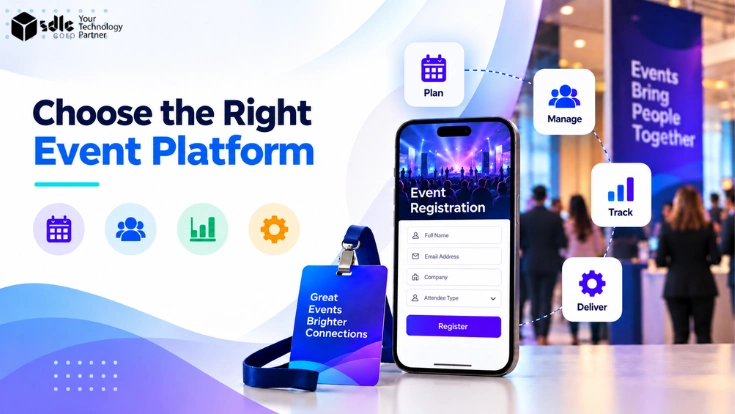
Event Management Platform Buyer’s Guide: How to Choose
A practical framework for comparing event platforms by requirements, workflows, integrations, security, total cost and operational fit.
Read article 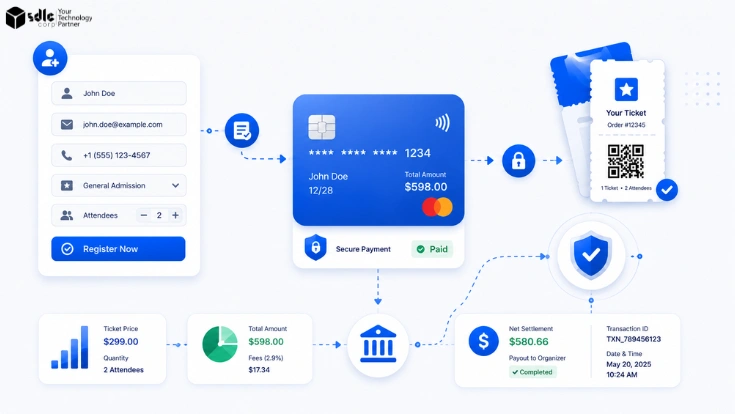
Event Registration and Payment Processing Features
Explore the registration, ticketing, payment, refund and reconciliation features that keep attendee and financial records connected.
Read article 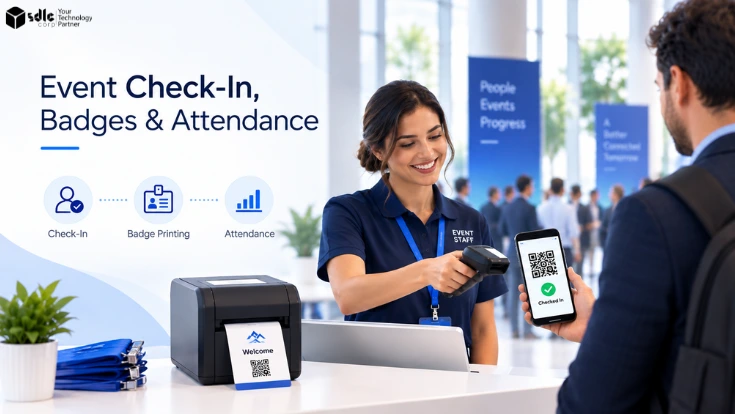
Event Check-In, Badge Printing & Attendance Tracking
See how connected check-in, on-demand badge printing and attendance tracking support faster arrivals, access control and event-day reporting.
Read article Start With Your Event Platform Scope, Not a Sales Pitch
Book a 30-minute call to map your registration, scheduling, attendee, payment, reporting and integration requirements and determine the right event management software development approach for your programme.
- 30-minute call
- Honest buy-or-build answer
- Integration work flagged upfront
 30-minute call