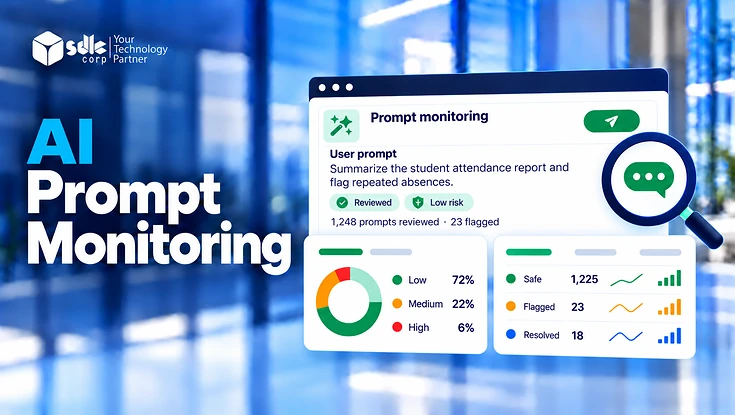
An employee pastes a customer complaint containing an email address. A teacher asks an assistant to analyze grades and attendance. A developer submits source code containing an API key.
In each case sensitive information enters an AI system before the model generates anything, and can then move somewhere else.
AI prompt monitoring for security inspects those interactions for sensitive information and applies controls such as warning, masking, redaction, blocking or escalation. This guide covers that security control, not generative engine optimisation, brand visibility, prompt management or LLM observability.
OWASP lists sensitive information disclosure in its Top 10 for LLM Applications, covering PII, financial records, health information, confidential business data and security credentials.
The exposure runs both ways. A user may paste sensitive data in, and the model may return it later.
OWASP names three common cases: PII leakage, proprietary algorithm exposure and sensitive business data disclosure.
It also warns that system prompt limits can be bypassed by prompt injection, so they are not enough alone.
OWASP GenAI Security Project, OWASP Top 10 for LLM Applications 2025, LLM02:2025 Sensitive Information Disclosure. View sourceNIST SP 800-122 sets out how to identify PII and select safeguards based on the context of collection and the potential impact of a breach, rather than on the format of a value alone.
The guide rates each instance of PII with a confidentiality impact level of low, moderate or high.
That level follows the FIPS 199 scale, so protection rises with the harm a disclosure would cause. Suggested safeguards span access control, auditing and media protection.
It also covers response plans for PII incidents, and it expects agencies to tailor the recommendations.
National Institute of Standards and Technology. View sourceUnder FERPA, personally identifiable information in education records includes, but is not limited to, direct identifiers such as a student’s name or personal identifier.
It also covers indirect identifiers such as date of birth, place of birth and mother’s maiden name.
It reaches any information that would let a reasonable person in the school community, without personal knowledge of the circumstances, identify the student with reasonable certainty.
Paragraph (g) adds information requested by a person the institution reasonably believes knows the student’s identity.
U.S. Department of Education, Student Privacy Policy Office. View sourceWhat Is AI Prompt Monitoring for Security?
AI prompt monitoring for security is the inspection of AI inputs to identify sensitive information and apply policy-based controls before or during AI processing. It answers five operational questions.
- What sensitive information is entering the AI system?
- Who is sending it?
- Where is the information going?
- Is the user authorized to process it?
- What should happen when sensitive information is detected?
Teams routinely confuse security-focused monitoring with three neighbouring disciplines. They can run alongside each other, but they answer different questions and buying one does not deliver another.
Focuses on who is using AI, when, and how. Useful for adoption and shadow AI, not for inspecting content.
Focuses on latency, tokens, errors and traces. It measures whether the application performs, not whether data leaks.
Covers prompt creation, versioning, testing and lifecycle. An engineering discipline rather than a security control.
Measures whether a brand appears in AI-generated answers. A marketing measure that shares the vocabulary and nothing else.
What Sensitive Information Can Appear in AI Prompts?
Sensitive information can appear directly in a prompt, or enter through documents, retrieved context, tool calls, connected applications and agent interactions. Which categories matter depends on the industry, data policies, contractual commitments and regulatory obligations of the organization.
| Data category | Examples | Monitoring concern |
|---|---|---|
| PII | Names, emails, phone numbers, identifiers | Privacy exposure |
| Student data | Student IDs, grades, attendance, assessments | Education-data exposure |
| Financial data | Card numbers, account details, transactions | Financial and privacy risk |
| Health data | Diagnoses, treatment details, medical records | Sensitive-data exposure |
| Credentials | API keys, passwords, tokens, private keys | Account or system compromise |
| Business data | Contracts, pricing, M&A plans | Confidentiality loss |
| Intellectual property | Source code, algorithms, designs | IP or trade-secret exposure |
Assess PII according to the context in which the organization collects and uses it.
NIST SP 800-122 provides guidance for identifying PII and determining appropriate protection based on context and potential impact, which is why a single list of patterns rarely survives contact with a real enterprise.
How Does AI Prompt Monitoring Detect Sensitive Information?
A monitoring system combines several techniques, because each one fails in a different way. The right mix depends on the type of information and the accuracy the workflow needs.

Pattern-Based Detection
Regular expressions and structured patterns work well for predictable values: email addresses, phone numbers, account numbers, government identifiers, payment-card patterns, API keys and credential strings.
Organizations can add custom patterns for internal identifiers such as employee IDs, student IDs and customer numbers.
Pattern matching cannot identify every sensitive interaction. Some risks depend on the relationship between several pieces of information rather than on one recognisable string.
Named-Entity Recognition
Entity recognition identifies people, organizations, locations and institutions. It helps when sensitive information does not follow a predictable numeric or string pattern.
A person’s name may not look sensitive by itself, but its relationship with a medical diagnosis, an academic result or an internal investigation changes the security context entirely.
Context-Based Detection
Context decides whether an ordinary value is sensitive. Consider this prompt:
John scored 92 in mathematics.A conventional pattern scanner finds nothing unusual. A contextual detector recognizes that a person is associated with an academic result.
The same principle applies to financial information, health information and confidential business records: monitoring should evaluate relationships between signals, not isolated strings.
Classification and Policy Rules
Detection identifies what appears to be present. Classification determines how to treat it in a particular context.
A policy engine can evaluate the student identifier, the academic grade, the educational context, the user’s authorization and the destination application together, which produces a far more targeted decision than treating every identifier as equally sensitive.
How to Detect PII in AI Prompts
PII can include names, email addresses, phone numbers, postal addresses, government identifiers, customer IDs, employee IDs and other information that can identify or distinguish an individual. Internal identifiers usually need custom detection rules, because they rarely follow a standard format.
Summarize this customer complaint from XYZ, xyz@example.com, phone number 98XXXXXX12.Against that prompt, a monitoring system could identify three separate signals and the method that found each one.
| Signal | Detection method | Why it matters |
|---|---|---|
| Person name | Entity recognition | No fixed pattern, so regular expressions alone will miss it |
| Email address | Pattern matching | Predictable structure, high precision |
| Phone number | Pattern plus contextual detection | Format varies by region, so context reduces false positives |
What happens next depends on organizational policy rather than on the detection itself. An approved internal workflow may permit the interaction, while another situation requires masking, redaction, blocking or escalation. Available responses generally include:
- Allow an approved use
- Warn the user
- Mask the sensitive value
- Redact it before processing
- Block the interaction
- Escalate it for review
How to Detect Student Data in AI Prompts
Student data shows why conventional PII scanning is not always sufficient. An identifier may look unremarkable on its own, yet its meaning changes once academic information sits beside it.
Under FERPA, personally identifiable information in education records includes, but is not limited to, direct identifiers such as a student’s name or personal identifier, and indirect identifiers such as date of birth, place of birth and mother’s maiden name.
The definition also covers other information that, alone or in combination, is linked or linkable to a specific student.
The test is whether it would allow a reasonable person in the school community, who does not have personal knowledge of the relevant circumstances, to identify the student with reasonable certainty.
It further covers information requested by a person the educational agency or institution reasonably believes knows the identity of the student. The definition sits in 34 CFR § 99.3.
This is a United States education-privacy example rather than a universal definition of student data.
Potentially sensitive education information includes student names and IDs, grades and test scores, attendance, assessments, academic performance, disciplinary information, and parent or guardian information.
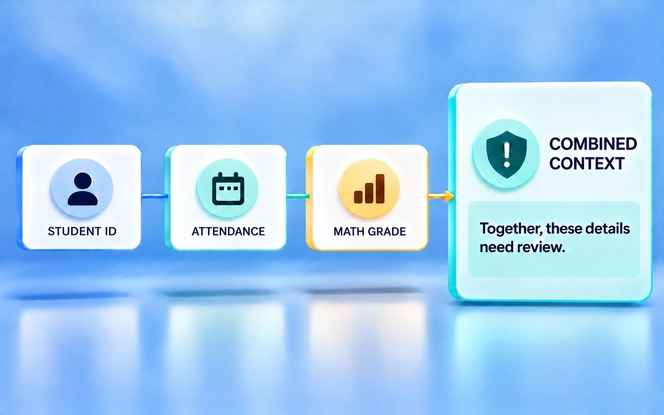
Example: Context Changes the Risk
Analyze student ID 10482's performance. The student has 71% attendance and received a C in mathematics.The number 10482 alone may mean nothing to a generic PII detector. Placed next to attendance, a grade and an academic framing, it becomes a much stronger signal of education information.
The security principle generalises: sensitivity can emerge from the relationship between otherwise ordinary data elements.
What Should an AI Prompt Monitoring System Inspect?
Define the inspection boundary before deployment, because a control that evaluates only the visible text prompt may never see most of the workflow.
Parts of an AI interaction that often fall outside a prompt-only control:
- Uploaded files
- Retrieved documents
- Tool arguments
- Tool results
- Agent memory
- Data returned from connected systems
- Model responses
This matters because sensitive information can enter or leave through paths other than the user’s original prompt. An employee may submit a harmless request to an agent.
The agent then retrieves a customer record from an internal system and passes it to a downstream tool. If monitoring evaluates only the original prompt, monitoring never inspects the customer information that arrives later.
Where to Implement AI Prompt Monitoring
There is no single mandatory inspection point. The right location depends on how people reach AI, where information enters the workflow, and which traffic the organization can actually observe.
Internal AI Applications
For internally developed applications, monitoring can inspect user input before it reaches the model. The question to settle during design is whether that same layer can also see attachments, retrieved context, tool calls, model responses and data from connected systems.
AI Gateways
A gateway can provide a centralised policy layer across applications and model providers, but only for traffic that actually travels through it. A gateway does not automatically deliver complete visibility, and applications that bypass it stay outside the monitoring boundary.
Third-Party AI SaaS
Employees often interact with external AI applications without passing through any internal gateway, which is the same blind spot that makes shadow AI difficult to govern.
Additional controls can close that gap: identity controls, endpoint controls, browser controls, network controls, CASB or DLP capabilities, vendor-native security controls, and approved application policies.
Agentic AI and Tool Use
Agentic systems add inspection points because information moves between users, models, retrieval systems, tools and connected applications. Relevant points include tool arguments, tool results, retrieved context, files passed to tools, agent memory and data returned from connected systems.
An agent can receive a prompt containing no PII and then retrieve a customer record that does.
Worked Example: From Detection to a Security Decision
Consider an employee using an internal AI assistant.
Summarize the complaint from customer XYZ, customer ID C-10482, email xyz@example.com, and recommend a response.The monitoring layer identifies the name, the customer ID and the email address, and classifies them as customer PII. What happens next depends on context.
If the employee holds an approved customer-support role and the internal application is authorized to process that information, the interaction may be allowed, or the email masked according to policy.
Now change only the destination.
Paste the same customer information into this public AI assistant and rewrite the complaint.The information is identical. The destination and the authorization context are not. A policy that permits customer information inside an approved internal application may prohibit sending the same data to a public AI service.
Detection alone is therefore insufficient: the decision depends on the data, the user, the application, the destination, the authorization and the purpose.
Enterprise AI Prompt Monitoring Architecture
Prompt monitoring belongs inside a broader enterprise security architecture rather than sitting alone as a PII scanner. Identity and access controls determine who can use an AI application and what they are authorized to process.
Existing DLP can supply sensitive-data classifications. A policy engine evaluates detections against organizational rules, and SIEM or case-management systems receive the resulting events.
Determines who may use the application and which data they are authorized to process.
Supplies existing sensitive-data definitions rather than duplicating them in a new tool.
Evaluates detections against organizational rules, risk levels and destination.
Receives security events so AI incidents are investigated like any other.
Logging deserves particular care, because the monitoring layer creates another copy of the information it exists to protect.
Treat that copy with the same controls applied to the original interaction: data minimisation, least-privilege access, defined retention, encryption, redaction, auditability and access controls. These are the same obligations an enterprise data governance framework already sets for other sensitive stores.
Human review remains useful for uncertain or high-impact cases, and teams should document failure behavior before production. A high-risk workflow may need to prevent uninspected information from proceeding when the monitoring service is unavailable.
A lower-risk workflow may take a different approach. Neither model is universally correct, and the decision should reflect the consequences of allowing uninspected data through against the operational cost of interrupting legitimate work.
How Should Monitoring Handle Detection Uncertainty?
Detection confidence can influence enforcement, but confidence is not the same thing as risk. A high-confidence detection of an API key may justify immediate blocking. By contrast, a high-confidence detection of a customer name may not.
A medium-confidence detection involving health or education information may warrant review even while the detector is unsure.
Calibrate detection and enforcement against labeled test cases, measured detector performance, business requirements, user experience, and the cost of both false positives and false negatives.
How to Measure AI Prompt Monitoring Effectiveness
Counting blocked prompts does not establish whether a monitoring program works. A high block count could reflect strong detection, overly aggressive policy, poor user behavior, or simply heavy traffic.
A meaningful program measures detection quality, enforcement quality, coverage and operational impact.
| KPI | What it measures | Example measurement |
|---|---|---|
| Detection rate | Sensitive test cases identified | Detected sensitive cases ÷ total sensitive test cases |
| False-positive rate | Legitimate cases incorrectly flagged | Incorrectly flagged legitimate cases ÷ total legitimate test cases |
| False-negative rate | Sensitive cases missed | Missed sensitive cases ÷ total sensitive test cases |
| Policy-violation rate | Risky interactions observed | Policy violations ÷ inspected interactions |
| Coverage | AI surface actually monitored | Monitored applications or paths ÷ identified AI paths |
| Investigation time | Operational response | Median time from alert to resolution |
| Repeat-violation rate | Recurring risky behavior | Repeat violations ÷ users or applications with prior violations |
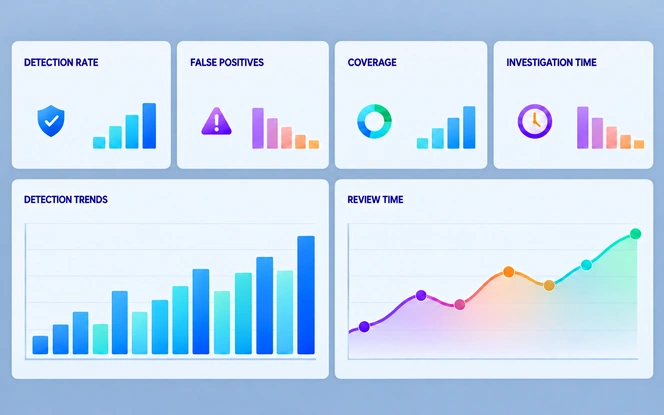
Every one of these requires a defined test population. Detection rate calculated from randomly collected production prompts and presented as an accuracy figure is not a measurement, because the denominator is unknown.
A stronger evaluation uses a labeled and approved test set containing known sensitive and non-sensitive cases, with synthetic cases added to compare detector behavior before and after a policy change.
Testing should include the variations the organization actually encounters:
- PII
- Student information
- Credentials
- Internal identifiers
- Multilingual content
- Multi-turn conversations
- Attachments
- Tool interactions
Prompt Monitoring vs Other AI Monitoring
The phrase "AI prompt monitoring" is used differently across the market, which matters for buyers and for anyone searching the term. Some platforms use it to describe AI visibility or GEO tracking.
Others use related wording for prompt management or LLM observability. Security teams use it to mean inspection of AI interactions for sensitive information.
| Approach | Primary question | Main focus |
|---|---|---|
| Security-focused prompt monitoring | Is sensitive information entering or moving through an AI workflow? | Data protection |
| AI activity monitoring | Who is using AI and how? | Usage visibility |
| LLM observability | Is the AI application performing reliably? | Performance |
| Prompt management | How are prompts created, tested and maintained? | Lifecycle |
| AI visibility tracking | Does a brand appear in AI-generated answers? | GEO and marketing |
These categories coexist inside most enterprises, but they are not interchangeable.
An organization may use AI usage monitoring to understand adoption, security-focused prompt monitoring to identify sensitive information, observability to troubleshoot behavior, and DLP or SIEM to investigate the resulting events.
Input Monitoring vs Output Monitoring
Prompt monitoring primarily addresses information entering a workflow. Sensitive information appears elsewhere in the interaction too.
- Uploaded documents can introduce sensitive information.
- Retrieved context can contain customer or employee records.
- Agents can retrieve protected information.
- Tools can receive sensitive arguments.
- Tools can return confidential information.
- Model responses can disclose information the organization never meant to release.
An enterprise strategy therefore usually requires both input and output inspection, with the required coverage set by the application architecture and its risk profile.
Verify exactly which interaction types the monitoring technology can inspect rather than assuming that "prompt monitoring" means complete AI traffic inspection.
Key Challenges in AI Prompt Monitoring
False Positives and False Negatives
Aggressive detection disrupts legitimate work; weak detection lets sensitive information through. The goal is not maximum blocking. Measure detection quality against representative test cases and tune it to business risk.
Context-Dependent Sensitivity
A name, number or code may be insignificant in isolation and sensitive once associated with academic, medical, financial, customer or confidential business information. This is why combination-based and contextual detection matter for enterprise use cases.
Multi-Turn Conversations
Context accumulates across messages. A student identifier may appear in one message while grades and attendance arrive several messages later. A monitoring layer that evaluates each request independently will not recognize the relationship unless conversation context is available to it.
Verify whether the technology maintains that context and how it affects detection.
Attachments and Unstructured Data
Text-only coverage is rarely sufficient. Confirm support for PDFs, Word documents, spreadsheets, images, CSV files, source code and the other file types the business actually uses. Coverage varies by file size, modality, region, integration method and vendor implementation.
Multilingual and Encoded Content
Detection quality varies by language and content representation. Test the languages employees use, and establish how the system handles transformed content. Do not assume that Base64, hexadecimal, URL-encoded, encrypted or otherwise transformed content is automatically decoded and inspected.
The Monitoring System Can Become a Data Store
A monitoring system can create another copy of the information it protects. A platform may mask PII before sending a prompt to a model while retaining the original value in an application log or trace.
Protecting the model input does not protect every copy of that input created by the surrounding system, so monitoring data needs the same governance as the original interaction.
How to Build an AI Prompt Monitoring Policy
A policy should start by defining which categories of information require protection: PII, education data, credentials, financial information, health information, confidential business information and intellectual property.
It should then define how those categories are detected, since pattern matching, entity recognition, proximity rules, contextual detection, keywords and custom detectors each have a role.
- Define the protected categories and the risk level attached to each.
- Specify the detection methods used for each category.
- Set the response for each risk level: allow, warn, mask, redact, block or escalate.
- Write separate rules for logging and retention, including when the system must never store raw prompt content.
- Document exceptions with explicit ownership and authorization rather than handling them informally.
- Define coverage across AI applications, model providers, third-party SaaS, files, tools, agents, communication channels and connected systems.
- Assign ownership and a review cadence across security, privacy, legal, data owners, application teams and AI governance.
Logging and retention deserve their own rules: what security metadata is necessary, how long it is kept, who can access it, and when raw prompt content should never be stored at all.
Some approved workflows legitimately require sensitive information, and those exceptions need named owners.
How We Built This Guidance
The structure of this guide comes from three inputs rather than a single source, and each is identifiable in the text.
- Published risk guidance read against the primary documents: the OWASP Top 10 for LLM Applications 2025 entry LLM02:2025 Sensitive Information Disclosure, and NIST SP 800-122 for the context-based treatment of PII.
- The United States education-privacy definition in FERPA and 34 CFR § 99.3, used only as a worked illustration of indirect identifiers rather than as a universal standard for student data.
- Enterprise delivery practice, which supplies the inspection boundaries, the architecture integration points and the policy sequence.
The prompts, the detection tables, the KPI definitions and the policy sequence are practical recommendations for buyers rather than official standards, and they are labeled as such where they appear.
This guide tests no vendor, and none of its figures are benchmarks.
- OWASP Top 10 for LLM Applications 2025, LLM02:2025 Sensitive Information Disclosure, application-risk reference.
- NIST SP 800-122, guidance on identifying and protecting PII by context and impact.
- FERPA, U.S. Department of Education and 34 CFR § 99.3, education-records definitions.
Enterprise AI Prompt Monitoring with SDLC Corp
Implementing prompt monitoring across an enterprise takes more than detecting sensitive strings. The layer has to work across AI applications, model providers, attachments, agents and connected tools, and it has to feed the security workflows a team already runs.
SDLC Corp works with organizations on enterprise AI monitoring and security controls across applications, workflows and connected systems.
Our AI governance consulting services cover policy design and decision rights, while AI integration and implementation services connect those controls to the systems where AI actually runs.
The Foresite platform is where organizations can review AI visibility, monitoring and governance evidence in one place. Published AI case studies show how the delivery process runs end to end.
For teams preparing a production deployment, the practical first step is evaluating monitoring coverage against representative use cases before applying policy across live AI environments.
Find Out What Your AI Monitoring Can Actually See
Map your AI paths, test detection against representative cases, and set enforcement and retention rules before policy goes live across production AI environments.
Conclusion
AI prompt monitoring is a security control for identifying sensitive information before it becomes an unauthorised disclosure. Effective monitoring goes beyond basic PII scanning by weighing data context, user identity, application, destination and authorization together.
Modern AI environments also need visibility into uploaded files, retrieved context, agent interactions, tool calls, connected systems, model responses and the monitoring data itself.
Student data makes the point most clearly: an identifier becomes sensitive the moment grades, attendance or assessments sit beside it.
The objective is not to block every AI interaction. It is to prevent unauthorised disclosure while approved business workflows continue to run.
Frequently Asked Questions
Yes. Pattern matching, entity recognition, contextual detection and custom rules can identify many types of PII. Exact coverage depends on the monitoring technology, its configuration and the content it inspects, so test internal identifier formats rather than assuming them.
By combining student-specific identifiers with academic attributes and contextual signals. Technical monitoring can identify likely education information, while privacy and legal teams determine which requirements apply to the specific record and use case.
Patterns, custom detectors and vendor-specific sensitive-information controls can identify many structured secrets. Organizations should test their own credential formats rather than assuming every monitoring system identifies every type of secret.
It can operate at the AI application, gateway, endpoint, SaaS-security or provider-guardrail layer. The right location depends on where AI traffic flows and whether prompts, files, retrieved context, tool calls and agent interactions are visible to the control.
It can, but the architecture has to account for more than the initial user prompt. Tool arguments, tool results, retrieved content, agent memory and connected-system data may each require their own inspection point.