A single call contains turns of wildly different difficulty.
Greeting somebody and confirming a spelling ask almost nothing. Interpreting a rambling complaint against a policy document asks a great deal. Routing is the practice of noticing that difference before generation begins and sending each turn to a destination suited to it.
- A choice, not a reaction Routing runs when everything is healthy and picks a destination on purpose, which is what separates it from a fallback triggered by trouble.
- Decided before generation The router can only use signals that exist before the answer does, which rules out deciding on the basis of the answer's content.
- Consistency is the hard part Persona, refusal thresholds and output conventions have to match across destinations or the seam becomes audible to the caller.
The appeal is obvious once it is stated, and the mechanics are less obvious than they look. The decision has to be made in the gap the caller hears as silence, using only information that exists before the answer does.
It also introduces a class of problem that a single-model system cannot have: two destinations that have to sound like one agent, behave to the same thresholds, and hand the conversation back and forth without the caller noticing a seam.
Routing Is a Choice per Turn, Not a Reaction to Trouble
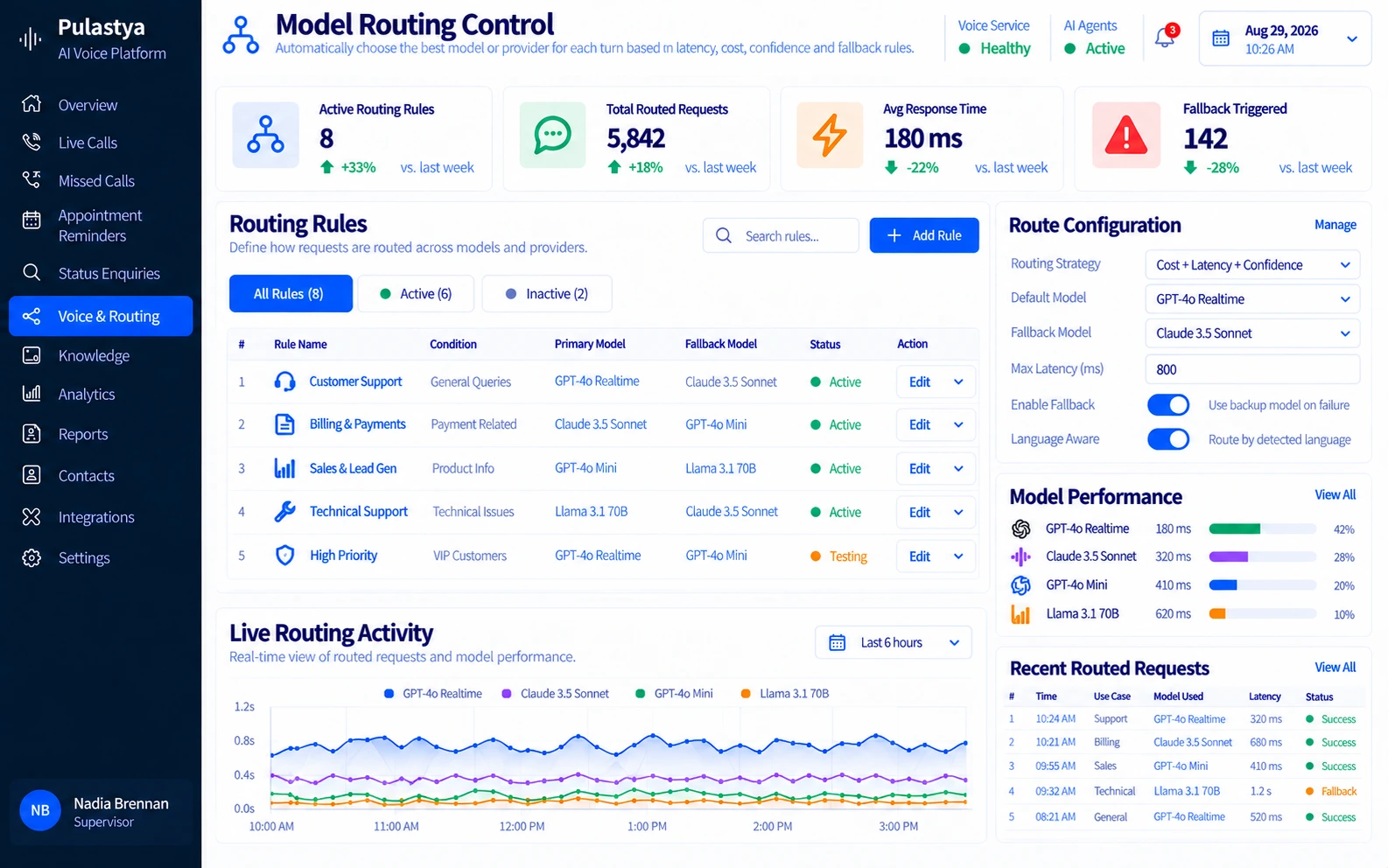
A voice agent is under no obligation to send every turn to the same place. Opening a call, collecting a postcode, reading back a confirmation and reasoning through an exception are four different jobs, and they do not need the same machinery.
Routing means a rule or a classifier picks a destination for each turn based on what that turn appears to need. It runs on a healthy system, every turn, as an ordinary part of the pipeline.
That is the distinction from a fallback arrangement, and the two get conflated constantly. A fallback is triggered by something breaking and exists to keep a call alive under duress, which is a different design with different requirements, covered in what happens when the model a call depends on stops answering.
It is also distinct from the question of which models to have available at all. That selection happens once, before any call, and is set out in the behaviors that make a model good on a call.
A useful test: if the destination would still be chosen when every option is healthy and responding normally, it is routing. If it only happens because something went wrong, it is failover.
What the Routing Decision Is Made On
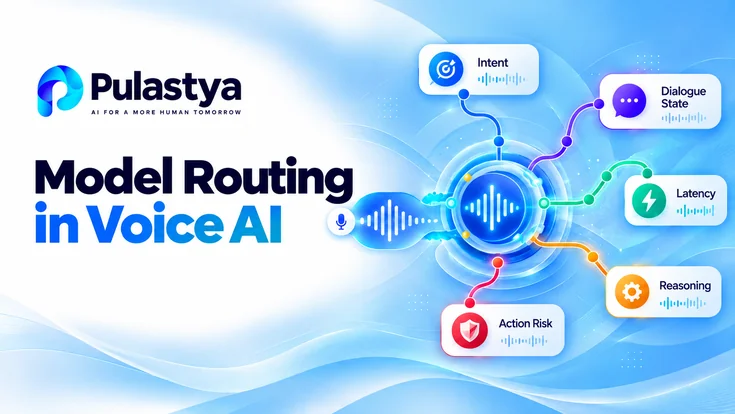
The router runs before generation, so it can only use what the system already holds at that moment. That constraint is what shapes the whole design, and it eliminates the most tempting signal of all.
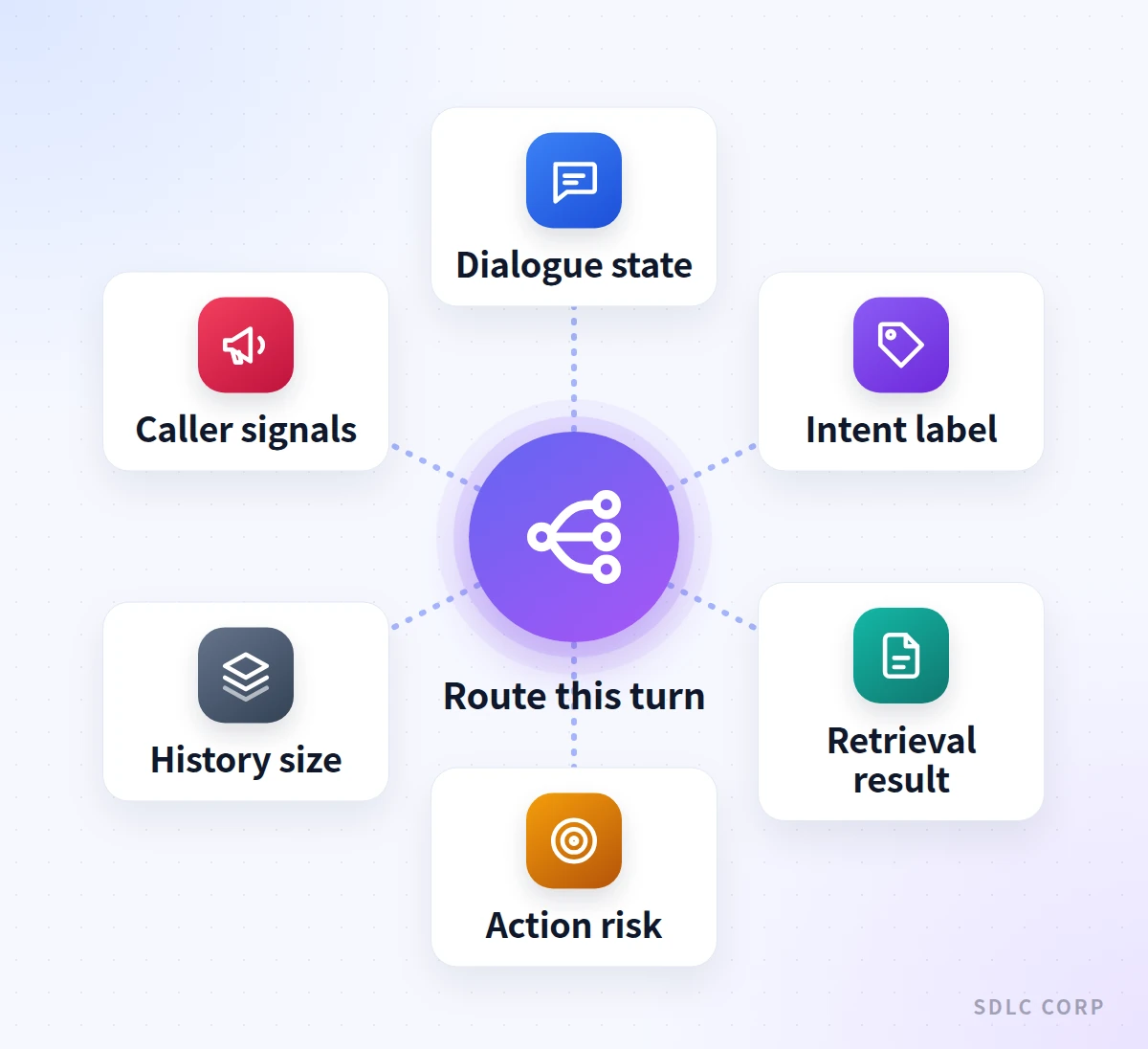
- Dialogue state: whether the agent is greeting, collecting a value, confirming something back or closing the call.
- A classified intent, where classification is already running as part of the pipeline.
- Whether retrieval returned anything usable, and how much of it there is to read.
- Whether the turn is about to trigger an action with real consequences rather than just produce speech.
- Turn position and history size, since a long call carries a heavier prompt regardless of what is being asked.
- Explicit signals in the caller's words, such as an escalation phrase or an unambiguous request for a person.
What the decision is not usually made on is the content of the answer, because the answer does not exist yet. A design that inspects a draft reply before choosing where to send it has run a model twice for one turn, and the caller has paid for both.
Where classification already exists in the pipeline it is the cheapest available signal, since the work has been done for another purpose. How that step is built is described in working out what a caller is asking for.
Fixed Rules or a Learned Router
Explicit conditions on dialogue state and intent. Auditable, debuggable, and predictable, at the cost of needing to be maintained by hand.
A small classifier scoring which destination suits the turn. Adapts to patterns nobody wrote down, and needs labeled examples plus watching for drift.
Most systems that work well start with rules, because rules make the first few weeks of debugging possible. A learned router is worth introducing once there is enough traffic to label and a clear case that the rules are leaving something on the table.
Where the Router Itself Costs Time
The router sits directly inside the gap between the caller finishing and hearing a reply. Whatever it costs is paid on every turn, by every caller, whether or not the routing decision turns out to matter for that turn.
- The decision itself, which is negligible for rules over existing state and substantial for anything that makes its own network call.
- The loss of a warm path, since alternating destinations means fewer reused connections and more setup work.
- The cost of being wrong, which is not paid on the routing turn but on the correction turn that follows it.
The first of those is the one teams control most directly. A router that needs its own model call to decide has added a full round trip in front of the round trip it was trying to optimize, which is how a routing layer ends up making an agent slower.
The expensive failure is re-routing part way through. If the system discovers after generation has started that this destination cannot handle the turn, the caller waits through both attempts, and the wider chain that wait sits in is described in where the delay in a spoken turn comes from.
The design that holds up is to decide once, before generation, on signals already present, and to accept a slightly worse destination occasionally rather than build a mechanism for changing your mind mid-sentence.
What Has to Stay Consistent Across Destinations
From the caller's side there is one agent on the line. Two destinations answering alternate turns have to agree on a surprising number of things before that illusion holds.
| What has to match | What the caller notices if it does not | Where it is usually enforced |
|---|---|---|
| Persona and register | The agent becomes warmer or more formal mid-conversation | A shared prompt fragment used by every destination |
| Answer length habits | One turn is a sentence, the next is a paragraph | Explicit length instruction, repeated identically |
| Number and name conventions | A reference is grouped one way, then read as one long string | A normalization step after generation, before synthesis |
| Refusal thresholds | One destination declines, the other answers the same question | Shared grounding rules and a shared confidence policy |
| Tool and action shapes | An action silently does not happen on one route | One schema, validated identically wherever it is produced |
Refusal thresholds are the subtle one and the one with real consequences. If one destination declines on thin material and another produces an answer anyway, whether a caller gets a guess depends on an invisible routing decision, which is covered in keeping a voice agent from inventing answers.
State has to be portable too. Whatever history, summary and retrieved material one destination saw, the next has to receive in a form it reads the same way, and how that state is carried is described in how a voice agent carries context across turns.
Prompts drift apart over time, which is the practical enemy here. Keep the shared part genuinely shared in one place rather than copied, or the two destinations will diverge quietly across a few months of small edits.
The Failure Shapes Routing Introduces
Some faults belong to routing specifically. They do not exist in a single-model system, and they are almost all invisible in aggregate quality numbers.
Alternating between destinations within one call, so tone and answer length change from sentence to sentence for no reason the caller can perceive.
An early decision that was wrong and is never revisited, leaving the rest of the call handled by the less suitable destination.
Routing a turn to a destination that lacks a tool or a piece of context the turn needed, which shows up as a vague answer rather than an error.
One destination updated and the other not, so behavior that was consistent last month quietly stops being consistent.
The one that hides longest is evaluation blindness. Overall quality can look healthy while one route performs badly, because the good route carries enough volume to cover for it in any averaged figure.
That is also why routing tends to be introduced too early. It adds a decision, a seam and four new failure shapes, and it should be earning something concrete in return before any of that is worth carrying.
Watching a Router in Production
A router is a piece of logic making thousands of decisions a day that nobody sees. It needs the same observability as any other component making choices on your behalf.
- Record the route on every turnWhich destination was chosen and which signal chose it, stored with the turn so any transcript can be read back with that context.
- Report quality per routeSegment every measure you already track by destination, because an averaged number is exactly where a bad route hides.
- Watch the route mixThe proportion going each way should be stable. A sudden shift usually means the input changed, not that the router improved.
- Keep a single-destination controlA slice of traffic that always goes one way, so the routed path has something honest to be compared against.
- Re-check after any changeA prompt edit or a model update on one side can change which destination is actually better without touching the router at all.
The bar for keeping a router is that the per-route numbers beat the control. Cost is frequently the motivation for building one, and it is not evidence that the routed path is better, which is a separate subject with its own levers in bringing down what the model step costs per call.
Conclusion
Model routing in voice AI is most useful when different turns have genuinely different requirements. A well-designed router makes a deliberate choice using available signals such as intent, dialogue state and action risk, without unnecessarily increasing the delay a caller hears.
That benefit depends on consistent behavior across destinations. Shared policies, portable context, compatible tools and per-route monitoring help prevent changes in tone, unsupported actions and hidden quality regressions.
The practical approach is to establish a reliable single-model baseline, introduce routing for a measurable reason, and compare routed calls against a control. The aim is not more model switching; it is better call outcomes at an acceptable cost and latency.
Frequently Asked Questions
Routing is a deliberate per-turn choice made while everything is working normally, based on what the turn appears to need. Failover is a reaction to something breaking, made to keep the call alive. They use different signals, run at different moments and have different success criteria, so they are worth building and testing as separate mechanisms.
Only what exists before generation: dialogue state, a classified intent if classification already runs, whether retrieval returned anything usable, whether the turn will trigger an action, and how long the conversation has become. It cannot use the content of the answer, because the answer has not been produced yet.
It can, and whether it does depends on how the decision is made. Rules evaluated over state the system already holds cost almost nothing. A router that makes its own model call adds a full round trip in front of the model step, on every turn, which is often more than the routing saves.
Share the parts that shape voice rather than copying them. One persona fragment, one length instruction, one set of grounding and refusal rules, and one normalization step for numbers and names after generation. Copied prompts drift apart over months of small edits, which is how a seam appears without anyone deciding to create one.
When there is a measurable difference between destinations on turns you can identify in advance, and enough traffic that the difference matters. Until then a single destination is easier to debug, easier to evaluate and has fewer failure shapes. Introduce routing against a control slice so the benefit is demonstrated rather than assumed.