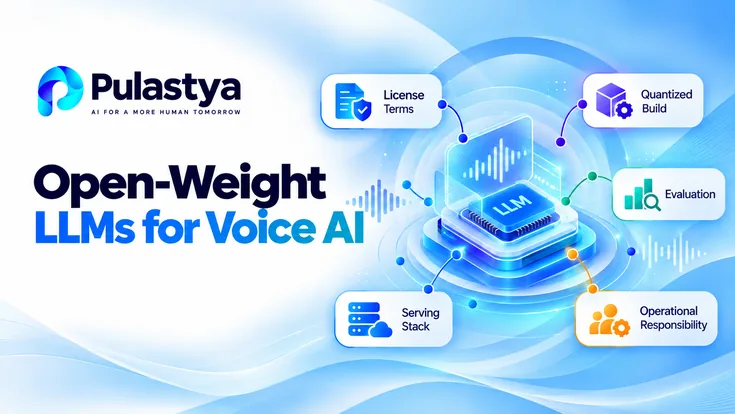
Reaching for a downloadable model changes more than where the inference happens.
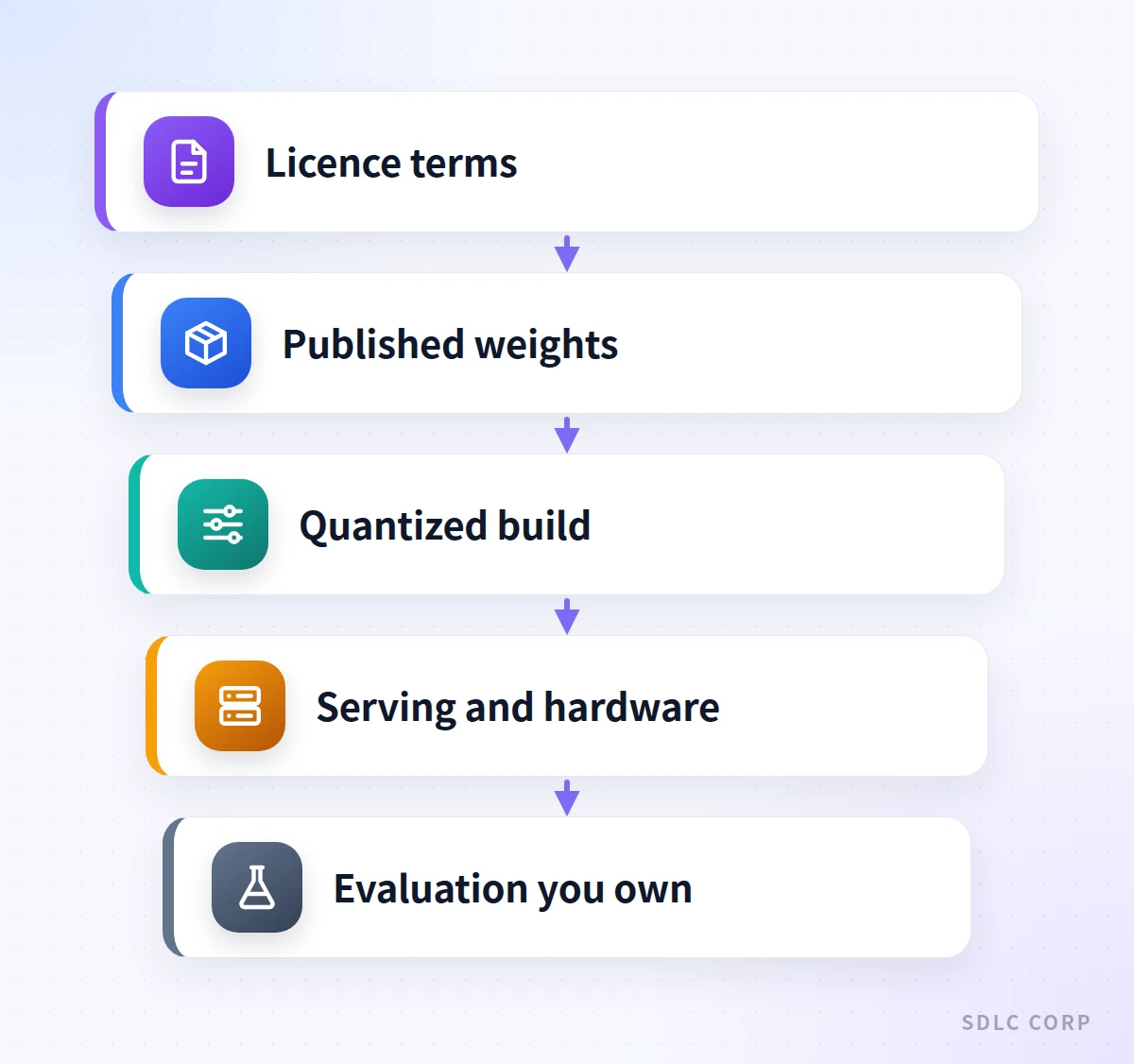
It moves a set of obligations onto the team that were previously somebody else's: reading the terms the weights arrive under, deciding how much precision to trade for speed, and proving the result is good enough to put in front of a caller. None of that work is exotic, but all of it is new.
- Open-weight is the accurate term Downloadable parameters are not the same as an open-source software license, and several widely used releases carry conditions.
- Quantization is not free Reducing precision buys speed and smaller hardware, but the behaviors a call depends on degrade before general fluency does.
- Evaluation becomes yours Nobody else regression-tests your deployment, so a fixture set and a baseline stop being optional the moment you hold the weights.
The phrase itself is the first thing to get straight. Most models described as open source in a voice AI context are open-weight: the parameters can be downloaded and run, which is a narrower claim than the one the words usually make.
That narrower claim is often enough. It is just worth knowing what it does and does not include before a legal review asks, and before a team commits to carrying work that a hosted service was previously doing invisibly.
Open Weights and Open Source Are Not the Same Claim
Open source has a specific meaning in software: source code available, modification and redistribution permitted, no restriction on who may use it or for what. Model releases described the same way frequently do not meet all of that.
What is usually released is the trained parameters, in a format a serving stack can load, together with a document stating what you may do with them. That document is written by the organization releasing the model and varies release by release.
- The weights themselves are the thing that is almost always published.
- The training data is rarely published, and its provenance is often not described in detail.
- The training code may or may not be included, and inference code is a separate matter again.
- The terms attached range from recognized permissive software licenses to bespoke documents written for that one release.
- Terms can differ between versions of the same model, so a previous review does not carry forward automatically.
Treat the word open as describing availability, not the absence of conditions. The only dependable way to know what a particular release permits is to read the license that shipped with it.
What the License Actually Governs
A voice agent answering customer calls is a commercial use of whatever model sits behind it. That makes the terms a procurement question rather than an engineering footnote, and there are four areas worth reading closely.
Whether the weights may be used in a revenue-generating product at all, and whether any category of use is carved out.
Some terms apply conditions above a stated size, or restrict particular application areas rather than restricting commerce broadly.
Requirements to state which model is in use, to carry notices forward, or to follow naming rules for anything derived from it.
What you may do with generated text and with a fine-tuned version, including whether either can be used to train another model.
None of these is disqualifying on its own. Plenty of teams run models with conditions attached quite happily, because the conditions do not touch what they are doing. The failure mode is assuming rather than reading.
Which terms apply to a given deployment depends on the release, the jurisdiction and how the agent is used, so the applicable position is one to establish with counsel rather than infer from a summary. The named families and their individual terms are set out in the open-weight model families teams actually use for voice.
Quantization and What It Costs a Spoken Turn
Published weights are large. Quantization stores them at lower numerical precision so the model fits on smaller hardware and produces tokens faster, which is why almost nobody runs a voice agent on full-precision weights.
The appeal is immediate on a call, because the model step sits inside a gap the caller hears as silence. Faster generation shortens that gap directly, and the chain it sits in is described in where the delay in a spoken turn comes from.
What quantization costs is not spread evenly across behaviors, and this is the part that surprises teams. General fluency is remarkably robust. The narrow, precise behaviors that a call depends on are not.
- Instruction following over a long conversation, which weakens before the prose ever sounds wrong.
- Exact reproduction of strings from supplied material, such as a reference number or a surname spelling.
- Refusal discipline, where a more heavily quantized build becomes more willing to answer from thin context.
- Consistency between identical runs, which matters because a flaky behavior is far harder to test than a bad one.
- Reliability of structured output, where a malformed field can break the step that was meant to consume it.
The practical rule is to evaluate the build you intend to run. Published results describe the original weights, and a quantized variant is a different artifact with different behavior, sometimes noticeably so on exactly the dimensions a voice agent leans on.
The Evaluation Burden Moves Onto Your Team
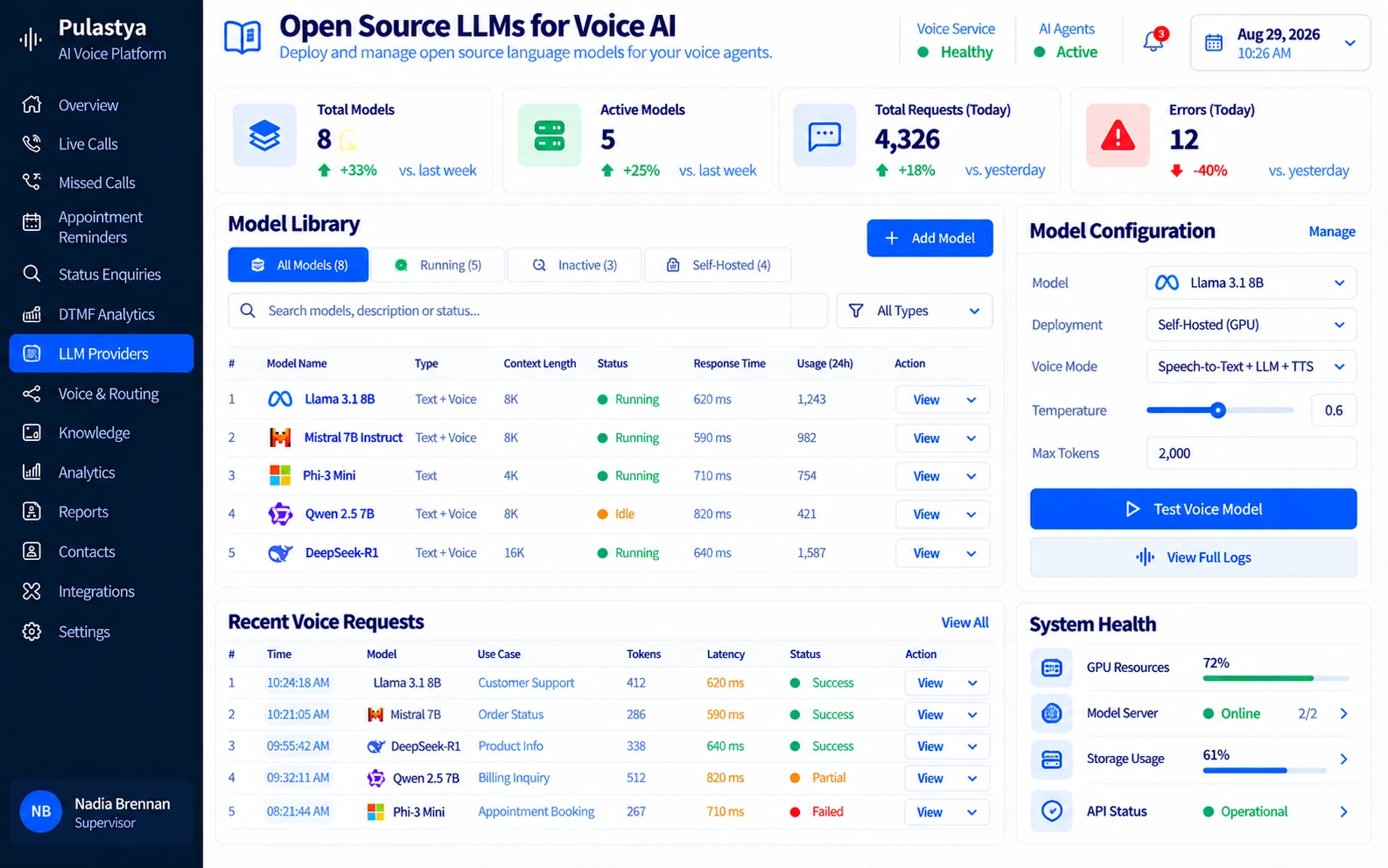
A hosted service does continuous work on your behalf that is easy to stop noticing. It tests the model, watches for regressions, and decides when a change is safe to ship. Holding the weights ends that arrangement.
The upside is genuine and is the strongest single argument for open weights. Nothing changes underneath you. A build that behaved a particular way last quarter behaves the same way today, because nobody upgraded it without telling you.
The obligation is the same fact seen from the other side. If the agent handles a particular kind of call badly, no external party will discover that, and improvements do not arrive unless you go and get them.
- Build fixtures from your own callsReal caller turns, including the awkward ones, scored against the prompt and knowledge you actually intend to ship.
- Record a baseline before anything elseCapture how the current build behaves so a later change can be compared against something rather than against memory.
- Re-run on every variableNew weights, a different quantization, a serving stack upgrade or a prompt edit each change behavior and each need the same pass.
- Keep the previous build runnableA rollback is only useful if the artifact and its configuration are still available and still start.
What to score is a separate question with a separate answer, and it is set out in the behaviors that make a model good on a call.
What the Team Takes on Beyond the Model
Choosing open weights is partly a staffing decision. Somebody has to keep the model serving, and that somebody has to be reachable when a call is failing rather than when a ticket is triaged.
The skills involved are specific rather than rare: capacity planning for accelerator hardware, familiarity with a serving stack and its batching behavior, and an on-call rotation whose scope explicitly includes the model step.
How that translates into day-to-day operations, capacity behavior and cost is a comparison in its own right, covered in who runs the inference and what that changes. Where the surrounding voice platform itself runs is a different question again, handled in the deployment models a voice platform can offer.
There is a quieter cost that rarely appears on a plan: attention. Open-weight releases move quickly, and there is always a newer one with better published numbers. Deciding when not to chase it is a discipline the team has to develop, because every move costs a full evaluation pass.
When Open Weights Earn Their Keep
The reasons teams give for going open-weight are not all equally well supported by what the choice actually delivers. It is worth matching each stated reason against what it genuinely requires.
| The reason given | What it actually requires | How well the choice delivers it |
|---|---|---|
| A model version that never moves | Discipline to re-evaluate deliberately rather than never | Strongly, this is the clearest benefit |
| Control over where inference happens | Infrastructure the team already operates and can secure | Well, where that capability genuinely exists |
| Freedom to adapt the model | Labeled examples and a way to measure the result | Only with the data and evaluation to back it |
| A lower bill at high volume | Steady, predictable volume and honest utilization maths | Sometimes, above a threshold worth calculating first |
| Avoiding dependence on one supplier | A prompt and evaluation layer that is portable by design | Partly, the portability comes from that layer |
The last row is the one most often misread. Portability is a property of how the agent is built, not of where the weights came from. A system with the model access wrapped behind one interface can move between options regardless of which kind it started on.
The honest summary is that open weights reward teams who would have built the evaluation and operations capability anyway. For a team that would not, the same decision buys a frozen model and an unstaffed obligation.
Conclusion
Open-weight LLMs can give voice AI teams more control over model versions, hosting and customization, but downloading a model also means taking responsibility for licensing, quantization, evaluation and operational support.
Before deploying a model for real customer conversations, confirm its license terms, test the exact quantized build on realistic call scenarios, and establish monitoring, incident response and rollback procedures. Hosted models may be a more practical choice when a team does not have the infrastructure or testing capacity to maintain these responsibilities.
The right choice is the one that meets the voice agent's latency, reliability and business requirements with responsibilities the organization can consistently support.
Frequently Asked Questions
Sometimes, and it depends entirely on the release. Some weights ship under recognized permissive software licenses with very few conditions. Others carry bespoke terms covering scale, field of use, attribution or what may be done with outputs. The position for a particular model and a particular deployment is one to establish with counsel rather than assume.
Usually not. Publishing parameters and publishing the corpus they were trained on are separate decisions, and the second is far less common. Some releases describe their data sources in general terms, some do not describe them at all. If provenance matters for your review, treat it as a question to ask rather than something the label answers.
Less than people expect on fluency and more than they expect on precision. Conversational output stays natural at fairly aggressive settings, while instruction following over long calls, exact copying of reference numbers and willingness to decline on thin context degrade earlier. Test the quantized build itself, because published results describe the original weights.
Three things mainly. Reading and clearing the license terms, keeping the serving stack running with someone on call for it, and owning evaluation, because nobody external will discover that your deployment handles a particular call type badly. The first is one-off per release. The other two are continuous.
Yes, if the system was built for it. Keep model access behind a single interface, keep the prompt and the evaluation fixtures outside the model layer, and avoid depending on behavior peculiar to one option. Done that way, changing which model answers a turn is a configuration change rather than a rebuild.