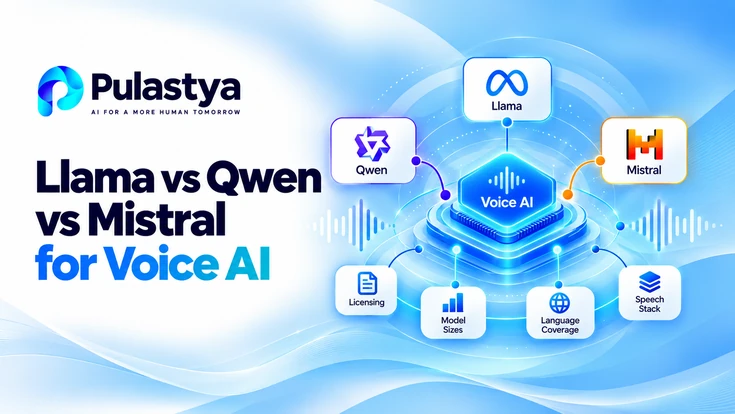
Three names come up in almost every shortlist a voice team draws up: Llama from Meta, Qwen from Alibaba Cloud and Mistral from Mistral AI. They are usually discussed as if they were interchangeable parts, and for a workload built around phone calls they are not.
The differences that matter are structural rather than positional, and they show up in procurement, in hardware planning and in which languages a caller can be answered in.
- Three different license postures One family ships terms written by its publisher, one states a single permissive license across its open lineup, and one mixes both.
- Size range decides the hardware A family that publishes very small instruction-tuned models gives a voice team options that a family of large ones alone does not.
- Only some ship speech models Two of the three publish open-weight recognition or synthesis next to the text model, which changes how much of a call stays in one family.
A shortlist built from published scores reshuffles every few weeks, which makes it a poor basis for a system that has to be supported for years. The properties that move slowly are more useful: what each publisher permits, what sizes exist, and what else the project ships.
This is a snapshot taken from each project's own documentation. Releases move quickly, so treat the shape of a family as durable and confirm the specifics of any particular version against the model card that comes with it.
What Actually Separates the Three Families
The published comparison between these projects is almost always a table of scores. That table is the least durable thing about them, and it answers a question a voice team rarely has.
A phone deployment is a long-lived commitment with a procurement review attached, machines behind it and callers who speak whatever they speak. Those constraints do not change when a new version lands, so they are the better axis to compare on.
- The terms each publisher attaches, and what they ask of a company using the models commercially.
- The range of sizes offered, because that sets what machines the model step can live on.
- The languages each project states it expects to perform well in, and how specific that statement is.
- Whether the same project also ships speech recognition and speech generation you can run yourself.
- How each family is distributed, including whether obtaining it requires accepting terms first.
None of these is a ranking. They are shapes. A family that fits one team's constraints badly can fit another team's perfectly, and the exercise is matching rather than scoring.
Where the Three Publishers Differ on Terms
This is where the three genuinely diverge. Each publisher has settled on a different posture, and the posture is stable even when the individual releases are not.
Published under the Llama Community License, a document Meta wrote for its own models rather than a standard software license.
The Qwen project states that all of its open models carry Apache 2.0, a widely used software license with no scale or revenue condition.
Most open Mistral models carry Apache 2.0, while certain versions use a modified document adding a condition above a stated company revenue level.
The Llama terms are the ones with named obligations, and three of them are concrete enough to plan a product around rather than merely to note.
- Attribution: distributors are asked to prominently display the phrase Built with Llama on a related website, interface or product documentation.
- Naming: a model you train or fine-tune from these materials and then distribute is asked to carry Llama at the start of its name.
- Scale: the license text names 700 million monthly active users in the preceding calendar month as the point above which a separate license must be requested from Meta.
- Acceptance: the distribution page asks you to accept the terms and an acceptable use policy before the files are released to you.
That user threshold sits far above most businesses, which is why it is usually the clause people repeat. The attribution and naming clauses are the ones that reach an ordinary deployment, because they are commitments about your own product surface.
The practical difference is therefore not permission but paperwork. Two of the postures ask almost nothing of the deploying company, and one asks for specific things a product team has to agree to carry.
Which terms bind your deployment depends on the version, the jurisdiction and how the agent is used, so establish that with counsel rather than from any summary. The wider review this sits inside is in what a team takes on with downloadable weights.
Size Range Decides What Your Machines Can Hold
A voice agent is unusual among model workloads because it is latency-bound rather than capability-bound. The model has to start producing words inside a gap the caller hears as silence, and that pressure pushes teams toward smaller models than they expected to need.
So the useful question about a family is not how large its flagship is. It is whether the project offers anything small enough to be worth running, and whether those small versions are instruction-tuned rather than base models.
The Qwen project documents an unusually wide span. Its lineup runs from dense models well under a billion parameters up to mixture-of-experts models in the hundreds of billions, so the same family can supply both a cheap turn-level model and a larger one for harder work.
Meta's public model organization shows a different shape: text and vision models alongside small purpose-built safety classifiers, some of them very small indeed. Mistral labels its open lineup by tier, with the smaller tiers carrying the Apache document.
A very small model is not automatically the wrong answer on a call. Much of what a spoken turn asks for is brevity, restraint and following an instruction, none of which scale with parameter count the way reasoning does.
What a given size costs to serve, and how that behaves when calls arrive together, is a separate question covered in who runs the inference and what that changes.
Language Coverage and What a Call Demands of It
Language coverage is the dimension where the three families state the most different things, and where the stated claim is furthest from what a phone call actually tests.
The Qwen project states support for more than a hundred languages and dialects across its open-weight lineup, and describes multilingual instruction following and translation as part of what the models do.
Mistral takes a more qualified approach in its documentation. It publishes supported languages grouped by region, covering European, Middle Eastern, South Asian, Southeast Asian and East Asian languages, and states that the lists reflect languages with strong expected performance while the models can also perform well in others.
That qualification is the honest form of the claim, and it is worth carrying over to every family. A stated language list describes text. It does not describe a caller with an accent, a bad line and background noise.
What the Stated List Does Not Tell You
- Whether the model holds one language for a whole call, rather than drifting into another mid-turn.
- Whether it handles a caller who switches between two languages inside a single sentence.
- Whether numbers, dates and addresses come out in a form the voice step pronounces correctly in that language.
- Whether the speech recognition in front of it covers the same language at the same quality.
- Whether the accent of your actual callers is represented, which a language name never captures.
The recognition point is the one that quietly decides the outcome. A model fluent in a language it is never handed a clean transcript of is not usable, and the practical handling of that sits in how accents and multiple languages are handled on a live call.
Whether the Project Ships Speech Models Too
This dimension gets left out of general model comparisons and matters more to a voice team than any of the others. A call needs recognition and synthesis as well as a language model, and some of these projects publish all three.
The Qwen team maintains separate speech recognition and speech generation projects alongside its text models, both carrying the same Apache document. Its recognition release states coverage of a set of languages and Chinese dialects, and its synthesis release states support for streaming generation.
Mistral ships speech understanding models under Apache 2.0, in a larger variant aimed at production scale and a smaller one aimed at local and edge deployment, described as doing transcription together with answering questions about the audio.
Meta's public catalog, by contrast, is centered on text and vision models with accompanying safety classifiers. A team choosing that family for the language step will be sourcing recognition and synthesis from somewhere else.
None of that makes one family correct. It changes the scope of the decision. Picking a family that also publishes speech models is an option to keep more of the pipeline under one set of terms, not an obligation to use it.
The streaming detail is the one to check first, because a synthesis model that renders a whole sentence before returning audio changes the shape of every turn. Why that matters is set out in where the delay in a spoken turn comes from.
Running the Comparison on Your Own Calls
The four dimensions above narrow a shortlist to one or two families. Choosing between what survives is a matter of your own callers, and a few things make that comparison fair rather than accidental.
- Settle the terms before testingAn afternoon with three license documents removes candidates for free. Doing it after an evaluation wastes the evaluation.
- Compare at matched sizesA large model from one family against a small one from another measures size, not family. Pick comparable sizes or admit the comparison is about hardware.
- Run every language you answer inStated coverage is the claim. Your own call audio in each language is the test, and the two diverge most on the languages you serve least.
- Decide the speech question explicitlyIf a family publishes recognition or synthesis, test whether you actually want them, rather than adopting them because they arrived together.
What to score on a turn, rather than which family to score, is set out in the behaviors that make a model good on a call. The equivalent comparison across hosted families is in how the hosted model families differ for voice work.
Expect a mixed result. One family often wins the short factual turns and another the difficult ones, and using both inside one agent is a design in its own right, described in how one agent uses more than one model.
Conclusion
Choosing between Llama, Qwen and Mistral for voice AI requires more than comparing benchmark scores. The practical differences lie in the license attached to the specific release, available model sizes, language coverage and the speech technologies that can support a real-time call.
Llama is an option for teams comfortable with Meta's model-specific terms. Qwen offers a broad range of open-weight text models and dedicated speech releases. Mistral provides several text and audio models with licensing and capabilities that vary by release.
Shortlist the versions that meet your commercial and infrastructure requirements, then test them on representative calls. Measure end-to-end latency, response accuracy, multilingual behavior and performance under concurrent load before committing to a production deployment.
Frequently Asked Questions
That question does not have a general answer, because the families differ in shape rather than in quality. The license one team cannot accept is irrelevant to another, and the language coverage that decides it for one deployment does not come up in the next. Narrow on terms, sizes and languages first, then test the survivors on your own call audio.
Not on identical terms, and that is the main thing separating them. Two of the three lean on a recognized permissive license for most or all of their open releases. The third publishes under terms its own company wrote, which add attribution, derivative naming and a scale condition. Check the document attached to the specific release.
Some do, and it varies by family rather than being a property of open weights generally. One publishes a span running from dense models well under a billion parameters up to very large mixture-of-experts models. Others concentrate on a narrower band. If a small model is what your latency budget wants, check the lineup before the scores.
With some of them, yes. Certain projects publish open-weight speech recognition and speech generation alongside their text models under the same license, which lets a team keep more of the pipeline under one set of terms. Others publish text and vision models only, so recognition and synthesis are sourced separately. Check what a family actually publishes.
Less often than the release cadence suggests. The structural differences between these families move slowly, while published scores move constantly. Revisit when something structural changes, such as a license revision or a new size becoming available, rather than every time a new release appears with better numbers attached.