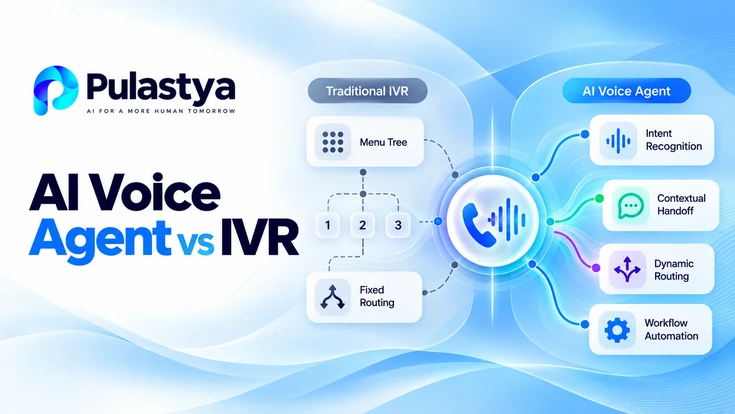
The AI voice agent vs IVR decision starts with how much conversational flexibility a call flow needs: one model guides callers through predefined paths, while the other can interpret open language and adapt the next action inside a governed workflow.
- IVR strength Deterministic menus are reliable for fixed navigation and tightly controlled routing paths.
- Voice AI strength Conversational handling works better when callers speak naturally or requests vary in shape.
- Modern design choice Many teams will augment or coexist with IVR before replacing it outright.
That does not mean IVR is obsolete. Many organizations still need deterministic menus for containment, authentication, or routing guardrails. The real decision is where a static call tree is enough and where conversational handling adds measurable value without giving up control.
How Traditional IVR Works
Traditional IVR routes callers through a predefined menu tree. The system plays prompts such as "For billing, press 1. For technical support, press 2," waits for a key press or a short spoken keyword, and moves the call to the next branch. Each branch leads to another sub-menu, a recorded message, or a fixed queue.
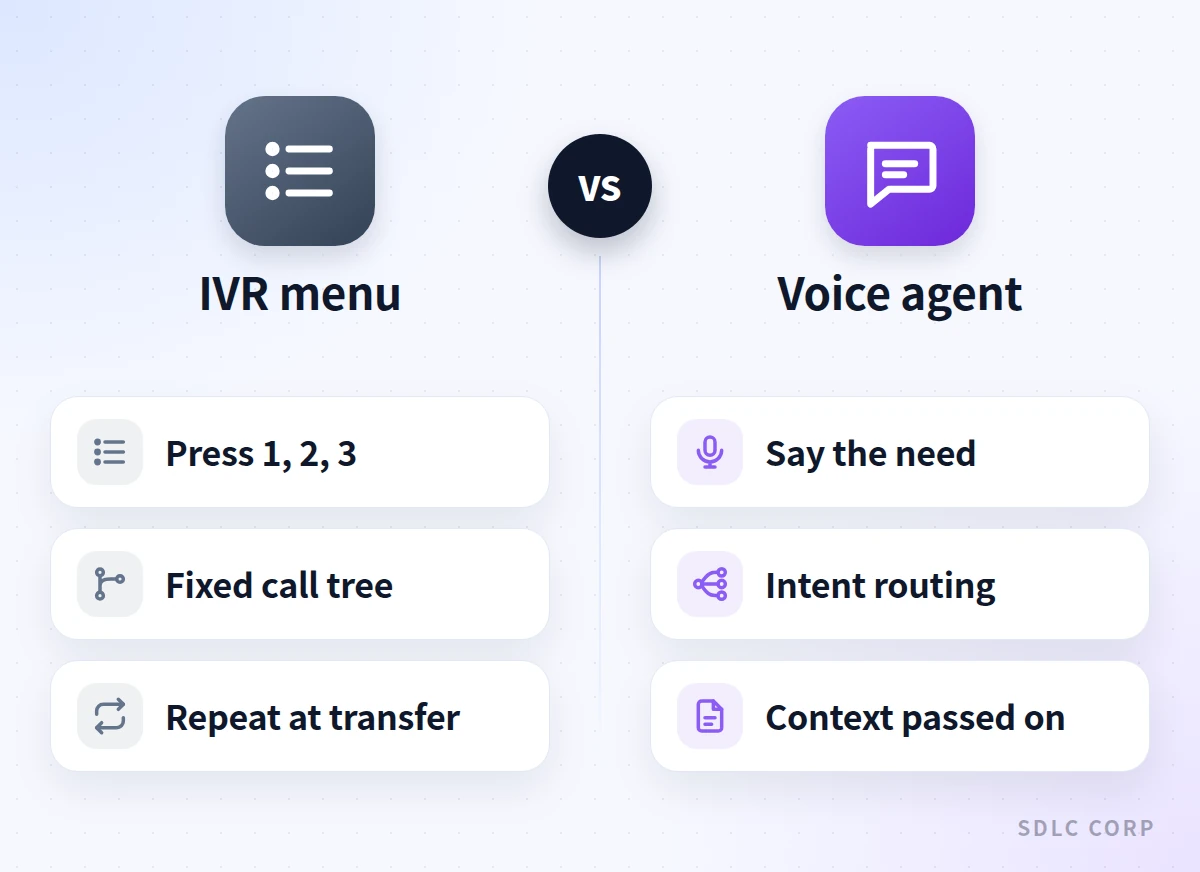
Speech-enabled IVR accepts words such as "billing" instead of key presses, but it still matches the input against the few options offered at that menu level. That makes the behavior predictable, which is one reason IVR remains common in regulated or high-volume environments.
The tradeoff is rigidity. When callers do not know which path fits, have multiple issues, or describe the problem in their own words, the menu becomes friction instead of guidance. Every extra branch is an attempt to predict the conversation in advance.
IVR can still be useful when the task is simple and the route boundaries are clear. The problem appears when the business expects a menu tree to behave like a conversational system without giving it conversational intelligence.
How Conversational Voice Agents Differ
Conversational systems start from language rather than from option numbers. The caller describes the need in a full sentence; speech recognition transcribes it, an intent classifier maps it to one of a defined set of call types with a confidence score, and the agent extracts details such as an order number or a date.
Routing rules then use the intent, the confidence and the call context to choose the next step.
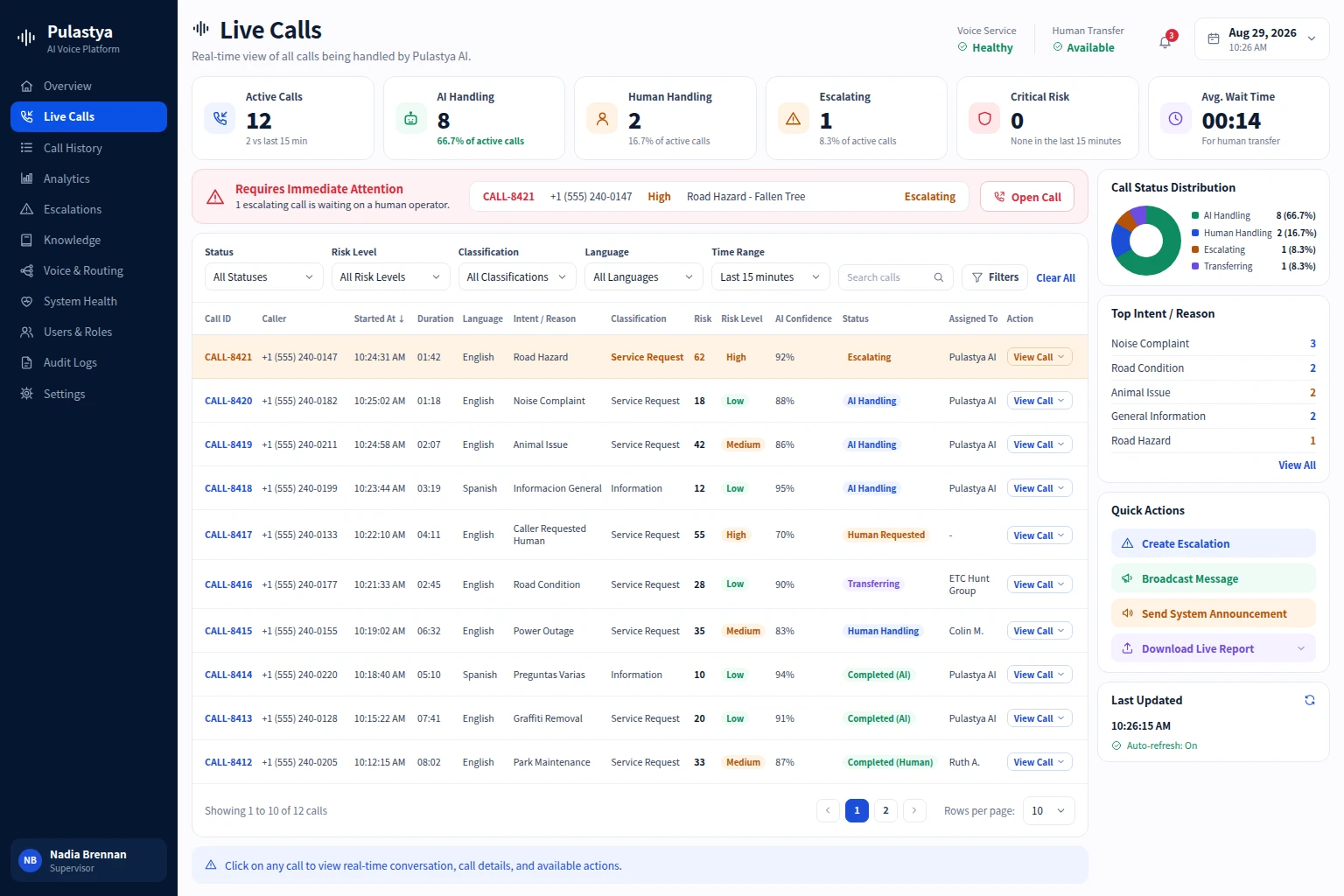
An AI voice agent architecture therefore needs an orchestration layer that connects language understanding with knowledge, rules, and downstream actions.
The key difference is not simply that the caller can "talk naturally." The deeper change is that the system can interpret requests that do not fit a fixed call tree, ask clarifying questions, and connect the call to knowledge, workflow actions, or escalation logic without forcing every path into a menu branch.
That flexibility is useful only when it is governed. A voice agent still needs clear boundaries around source selection, routing authority, authentication, and failover behavior.
The caller experience changes as well. Instead of memorizing menu paths, people can describe the actual issue, correct themselves mid-sentence, and give nuance that a fixed tree would either ignore or split into several transfers.
Menu Navigation vs Natural-Language Intent
Menu navigation assumes the organization can predict the categories callers will understand and use correctly. Natural-language handling assumes callers will describe the problem in their own way, and the system should translate that language into an operational intent without relying on rigid option order.
This matters most when requests are ambiguous. A caller may say, "I need help with a missed delivery and also need to change the address." That sentence can cut across several menu branches, but a conversational system can identify the dominant need, ask a follow-up question, and decide whether one or more workflows should be triggered.
In a menu tree, the same caller might press 2 for orders, then 3 for delivery problems, and then return to the main menu or wait for an agent to change the address. With intent routing, the agent recognizes both requests from one sentence, handles or routes the first, and carries the second forward without a restart.
The goal is not to eliminate structure. It is to let structure appear after the caller speaks, rather than demanding that the caller understand the structure first.
Side by side
IVR Menu Tree vs Conversational Intent Routing
| Aspect | IVR menu tree | Conversational intent routing |
|---|---|---|
| How the caller starts | Listens to options, then presses a key or says a keyword | Describes the need in their own words |
| How the route is chosen | Each branch leads to a fixed sub-menu, message or queue | Intent, confidence, context and rules select the destination |
| Unclear or mixed requests | Caller guesses a branch or returns to the main menu | Agent asks one clarifying question or handles each request |
| Changing the logic | Add or rewrite branches and recorded prompts | Update intents, routing rules and thresholds in configuration |
| Handoff to a person | Transfer often arrives with only the menu path taken | Transfer carries intent, summary and captured details |
| Best fit | Narrow, stable call reasons and fixed navigation | Varied requests and routing that depends on context |
Notice that IVR asks the caller to fit the menu, while intent routing fits the route to what the caller said and still applies fixed rules.
Static Call Trees vs Dynamic Routing
Static trees map one branch to one destination. Dynamic routing makes the destination conditional on what the caller said, what the current operating context looks like, and what the rules permit. This is where intelligent call routing becomes useful, because the destination can depend on intent, availability, and operating context rather than a fixed branch.
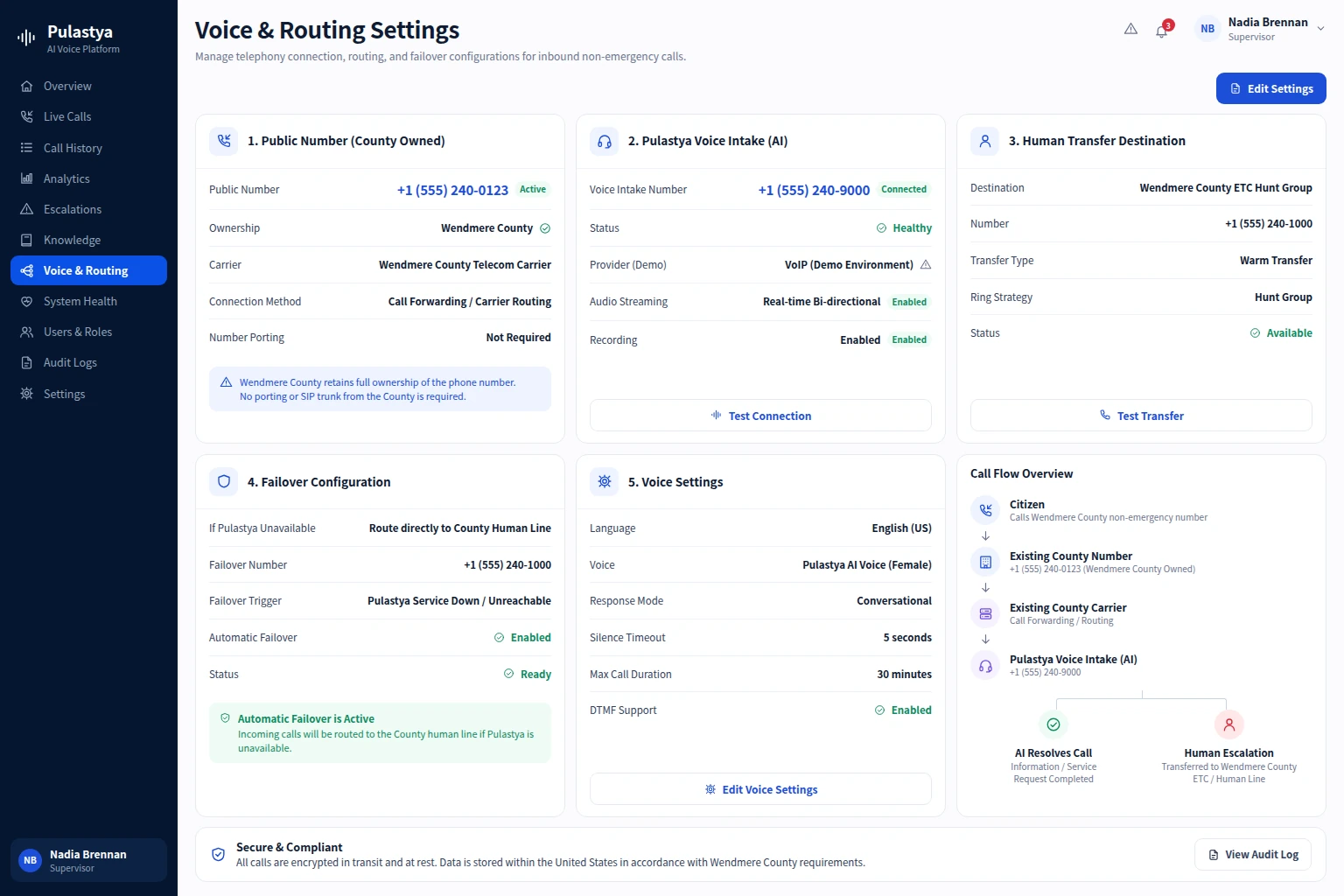
A dynamic route can consider urgency, language, authentication state, availability, previous interactions, or whether the request can be resolved in-call. Static IVR can simulate some of that through increasingly complex trees, but complexity in the tree usually means complexity for the caller as well.
Unclear requests show the difference most clearly. When a menu choice does not fit, the caller has to guess a branch or start over. When a conversational agent has low confidence in the intent, it asks one clarifying question, such as whether the call is about a bill or a service outage, and then routes on the answer.
The business question is whether the routing logic should stay fixed in prompts or move into a control layer that can change without rewriting the whole caller experience.
Knowledge Retrieval and Workflow Automation
IVR is normally weak at grounded explanation and workflow packaging because it is designed around branch selection, not knowledge retrieval. It can play a recorded message for fixed information such as opening hours, but it cannot answer a question no recording anticipated.
Voice AI can answer with approved information, gather structured details, and trigger a workflow when the right evidence and permissions are available.
That does not mean every answer should come from the model. Approved knowledge should be retrieved with provenance, and live actions should depend on authorized systems and defined rules. The value is that a conversational system can move from spoken request to governed next step in a way IVR usually cannot.
This is often where organizations first notice operational gains: callers get a better front-end experience, and internal teams receive a more actionable request package.
- Use knowledge retrieval for approved policy, FAQ, and product guidance.
- Use live systems for current state, entitlements, and authenticated actions.
- Keep routing and escalation rules in configuration rather than in retrieved text.
Human Handoff and Exception Handling
Exception handling is one of the clearest differences between the two models. When IVR fails, it often falls back to a generic transfer or forces the caller to restart with a live agent. A better hybrid AI and human contact center design treats handoff as part of the operating model rather than as a failure afterthought.
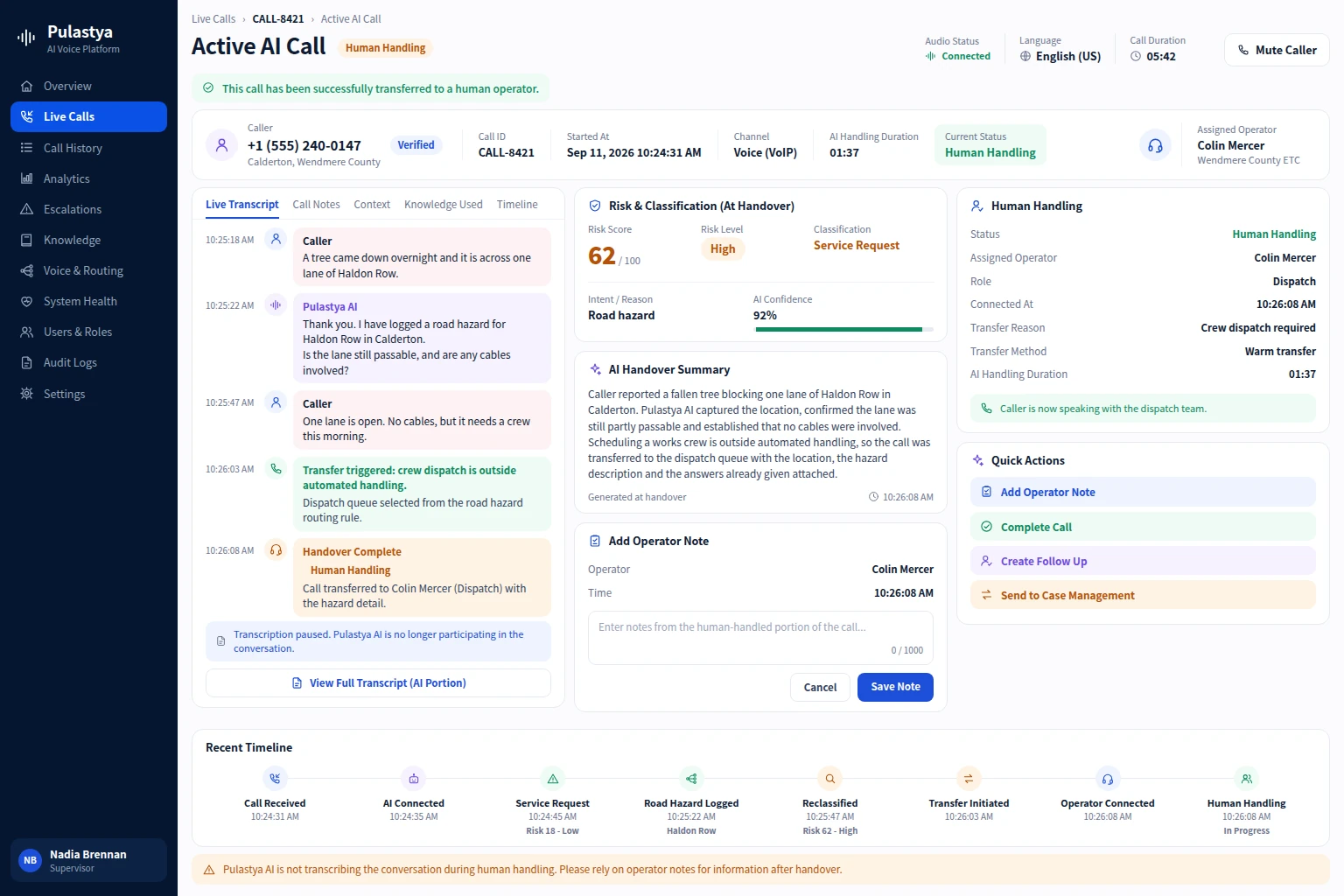
A conversational system can summarize the issue, pass extracted details, flag risk, and preserve the recent call context before a human receives the transfer. That makes escalation more useful and reduces the common frustration of repeating the whole problem after the system has already heard it.
The quality of the handoff matters more than the fact that one occurred. A controlled transfer is often the right outcome when judgment, empathy, or exception approval is required.
Reliability, Compliance and Deterministic Controls
Reliability is one reason IVR survived for so long: deterministic menus are easy to predict and easy to test. Voice AI should not abandon that operational discipline. It needs observable latency, retry boundaries, escalation rules, audit logs, and clear failover paths for missing evidence or unavailable systems.
Compliance also depends on design choices. If the answer uses approved knowledge, the retrieval source should be traceable. If an action touches current customer data, the system should rely on authorized systems and the right authentication state rather than on conversational confidence alone.
In other words, the comparison is not "static equals safe, AI equals risky." Safe AI requires deterministic controls around a more flexible conversational core.
For many organizations, this is the real modernization hurdle. The telephony layer may be easy to replace, but the control model behind authentication, approval, logging, and exception routing still has to be explicit before voice AI can be trusted in production.
When to Modernize IVR, Augment It or Keep It
Keep IVR when the call reasons are narrow, the destination logic is stable, and callers can navigate the menu with little confusion. Augment it when the organization needs better intent detection, smarter routing, or stronger handoff context but is not ready to redesign every telephony path at once.
Modernize further when the menu tree itself has become the bottleneck: high abandonment, heavy live-agent triage, poor routing accuracy, or requests that regularly spill across multiple static branches. In those conditions, conversational handling can improve both access and downstream efficiency.
The right answer is often phased. Start where the cost of caller confusion and repetitive triage is already visible, then expand only after the control model is proven. That sequencing lets teams keep deterministic coverage where it still works while modernizing only the call flows that justify conversational complexity.
Conclusion
IVR and voice AI are not enemies. They are different operating patterns with different strengths. The real design choice is how much conversational flexibility your callers need and how much deterministic control your operations require at each step of the call.
SDLC Corp's modernization approach can preserve existing telephony controls while introducing conversational handling selectively. Pulastya works with an existing Twilio number by pointing its webhook to Pulastya, and its routing settings include a failover path to a human line if the AI is unavailable.
Teams evaluating this operating model can explore the Pulastya AI call orchestration platform to see how controlled routing, answers grounded in business documents, and contextual human handoff fit together.
Many businesses replace a phone menu with a conversational front desk. The guide to an AI receptionist for business calls shows what that role covers and where calls still go to staff.
Frequently Asked Questions
No. IVR can still be the better choice for simple, stable navigation paths. Voice AI becomes more valuable when requests are varied, callers speak naturally, or routing decisions depend on richer context.
Yes. Many teams augment existing telephony or IVR layers before replacing them. That approach can reduce risk while proving where conversational handling adds the most value.
Because dynamic routing can consider intent, risk, availability, and context after the caller speaks. A larger IVR tree still depends on predefined branches and puts the navigation burden on the caller.
A safe deployment separates approved knowledge from live transactional data, enforces authentication and escalation rules, and records the evidence and control path behind each automated action.