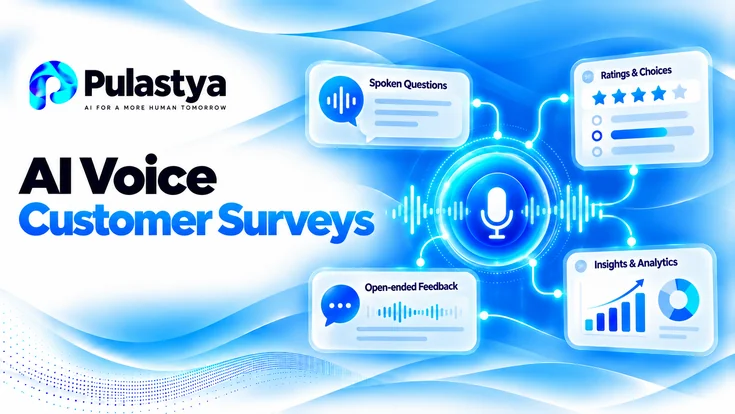
A survey delivered by voice is not a questionnaire read aloud. The respondent cannot see the scale, cannot skim ahead, cannot go back and change an answer, and is talking to something that will hear whatever they say. Every one of those differences changes the numbers that come out the other end.
- Serial, not visual Respondents hold the question and every option in working memory, which caps how complex either can be.
- The open answer is the prize Free speech is the reason to call rather than send a form, and it is also the hardest thing to turn into data.
- The instrument shapes the result Who answers the phone, what people will say aloud and what they are asked about all move the numbers.
That is not an argument against running one. Phone reaches people who will never open a form, and a spoken answer carries detail that a five-point scale cannot. Both of those are real advantages.
It is an argument for honesty about what the instrument is. A voice survey does not passively read an opinion that was already there. It participates in producing the answer, and the design decides how much.
A Spoken Survey Is a Different Instrument
On a screen, a question and its options sit in front of the respondent for as long as they need. On a call, both arrive once, in order, and then they are gone.
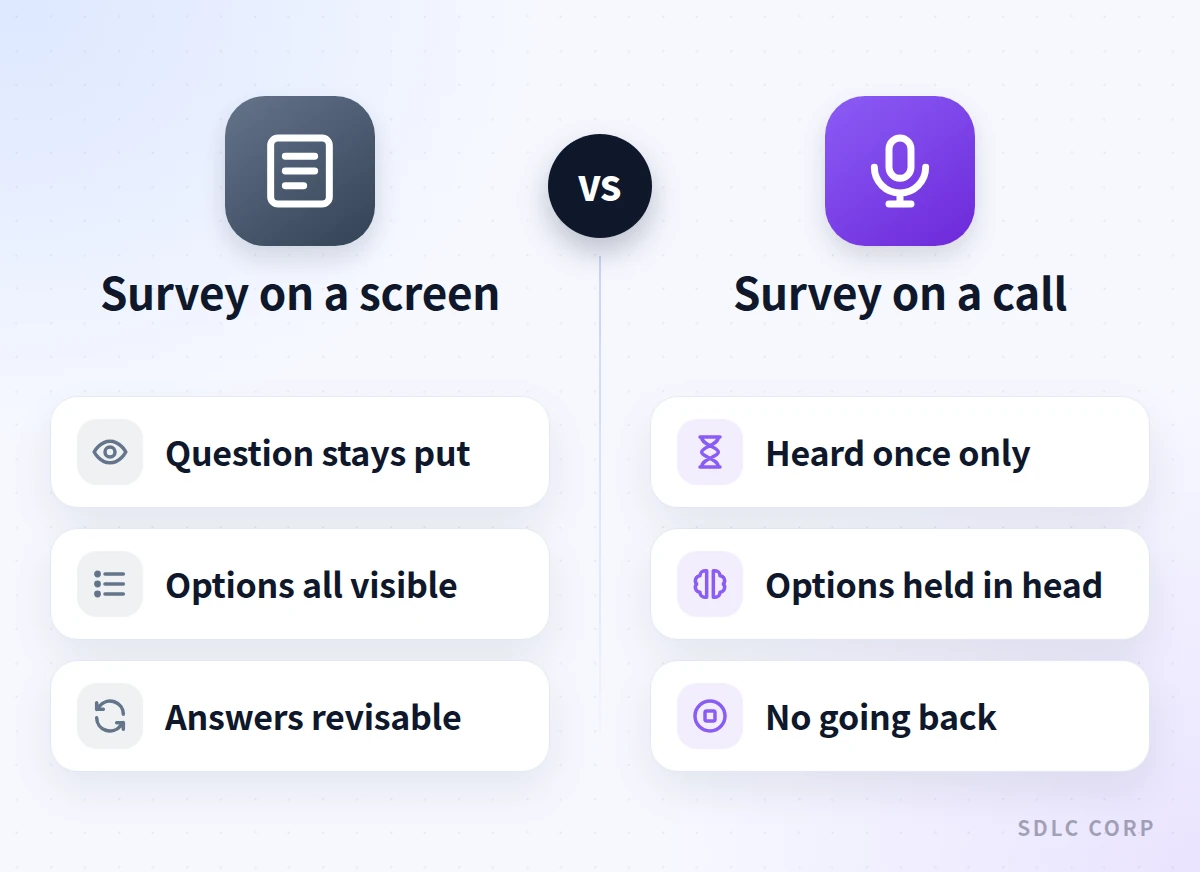
- Nothing can be re-read. Anything the respondent did not catch is answered from a half-memory of it.
- The options compete with the question for the same limited attention, so long scales lose their middle.
- Answers cannot be revised once the next question starts, so a misheard item stays wrong.
- There is no progress bar, so the respondent has no idea how much longer they have agreed to.
The last point drives most abandonment. A respondent who does not know whether they are two questions in or two from the end is deciding, on every question, whether to keep going.
Saying up front how many questions there are is the single cheapest improvement available, and it costs one sentence.
Questions People Can Answer Out Loud
Written survey questions are tuned for the eye. Read aloud, the same wording develops problems that were invisible on the page.
| Problem | Why it only shows up aloud | What works better |
|---|---|---|
| Long scale preamble | The explanation is forgotten before the question arrives | Ask the question first, then the scale |
| Ten-point scales | Ten spoken options exceed what anyone holds | Fewer points, with the ends named |
| Two ideas in one question | The respondent answers whichever half they heard last | Split it into two questions |
| Negatively worded items | Agreeing with a negative is confusing at speed | State the item positively |
| Options listed before the question | The respondent has nothing to attach them to | Question, then options, then pause |
Length is the other constraint and it is harsher than on a form. Every question is time the respondent is spending on the phone, and the drop-off is not gradual once patience runs out.
Where a numeric answer really is needed, the keypad is an option worth keeping. Digits spoken aloud are among the least reliable things a recognition engine handles, and the alternative is covered in accepting keypad input alongside speech.
Read every question aloud at conversational speed before it ships. Anything you stumble over, or have to read twice, will be misheard by respondents who only get it once.
Capturing the Open-Ended Answer as Data
The open question is why a call is worth placing at all. It is also the part that arrives as unstructured speech and has to become something a team can count.
Two different things come out of it and they should be kept apart. One is the quotation, in the respondent's own words, which is evidence. The other is a category assigned afterwards, which is an interpretation.
Collapsing them is the standard mistake. Once an answer is stored only as a category, nobody can check whether the category was fair, and the coding scheme quietly becomes the finding.
- Keep the verbatim answer, so any later coding can be checked against what was actually said.
- Let the agent ask once for more, then stop. Repeated probing produces compliance rather than detail.
- Expect product names, place names and jargon to come back misrecognized, since those carry the least context.
- Do not let the agent paraphrase the answer back into the record as though it were the answer.
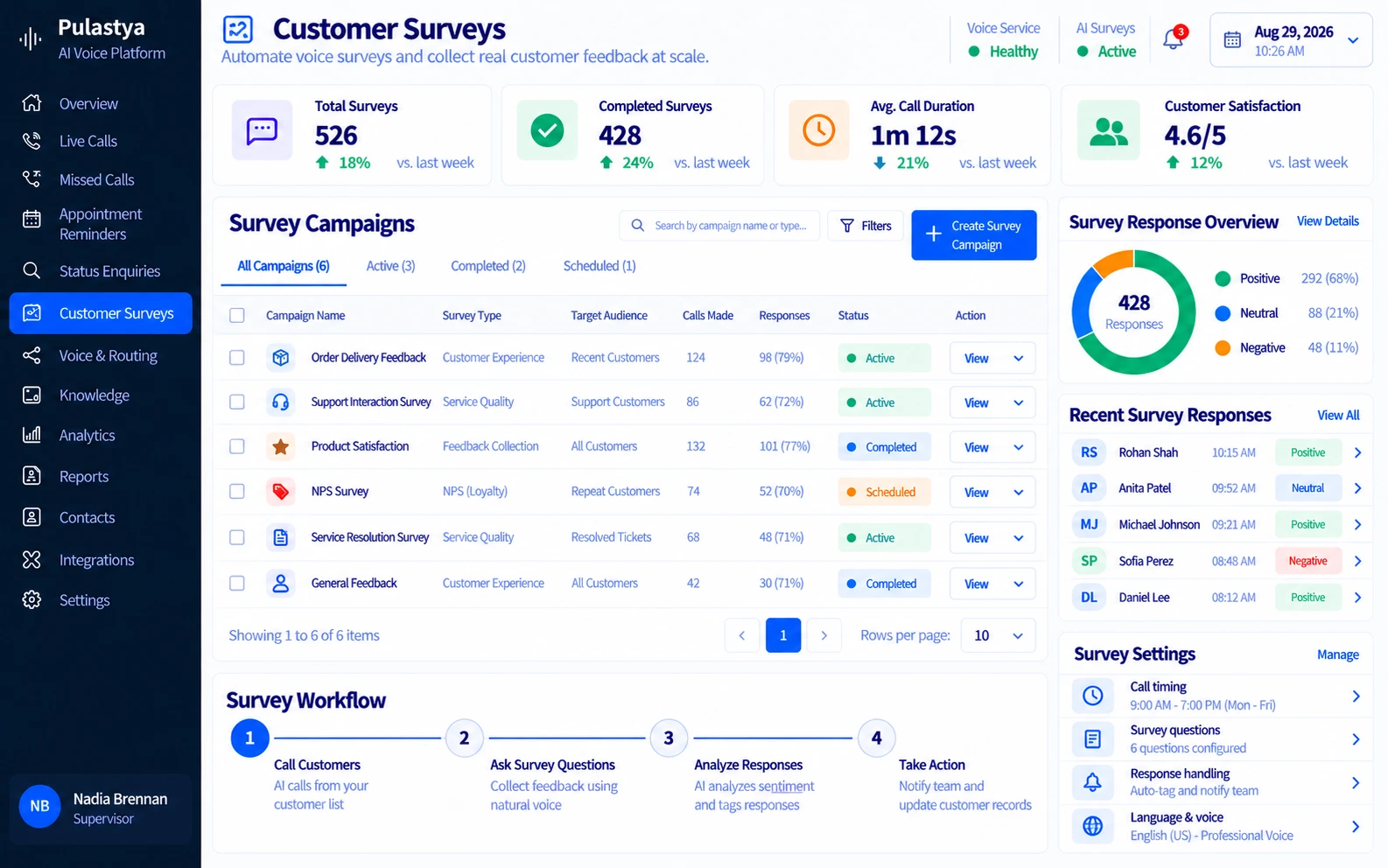
Pulastya, the SDLC Corp voice platform for inbound and outbound business calls, leaves a transcript and a call summary against each call, which is the arrangement an open question needs: the respondent's own words preserved, with the shorter account sitting alongside rather than replacing them.
Where the open question sits also changes what comes back. Asked first, it collects whatever is most present in the respondent's mind. Asked after a run of rated items, it collects an explanation of the rating they just gave, which is a narrower and more useful thing.
Neither placement is wrong, but they answer different questions and their results should not be pooled. Moving the open question between waves quietly changes the series without anything in the data showing that it moved.
How spoken values are turned into named fields, as opposed to free text, is a separate discipline covered in turning spoken answers into structured values.
The Bias a Voice Survey Introduces
This is the part usually left out of the deck. A voice survey does not read an opinion off the respondent; it creates a situation in which an opinion is stated, and situations have effects.
The people who pick up an unexpected call differ from those who do not, and nothing in the responses reveals how.
Criticism is harder to voice than to type, and mild complaints often arrive as satisfied answers.
Agreement is the fastest way to end a question, which quietly rewards whichever option was offered first.
Immediately after a call you measure relief or irritation, which is not the same as the outcome.
None of these are fixable by better wording. They are properties of asking by voice, and the honest response is to account for them rather than to claim a survey design that eliminates them.
Accounting for them mostly means restraint in how the numbers are used. A voice score is comparable with the same voice score last quarter, asked the same way, and it is not comparable with a form score from the same population.
It also means publishing the question text next to the number. A figure quoted without its wording invites everyone reading it to imagine a question that was never asked.
When the Agent Asks About Itself
A special case deserves its own treatment: the automated agent asking how the automated call went. The instrument and the subject are the same thing.
People soften criticism when the thing being criticized is listening, and some soften it further when they are unsure whether a person will ever read it. Both push the result upward.
There is a second problem underneath. The respondents most annoyed by the automation are the ones least likely to stay on the line for a question from it, so the unhappiest opinions are the ones missing from the sample.
Where this matters, the workable answers are to ask through a channel the agent does not control, to route the question to a person, or to weight the result against a behavioral signal rather than trusting it alone.
Any survey answer that reports a serious problem should also have somewhere to go immediately. The triggers that should pull a live person into a call are covered in recognizing when a caller needs a person.
Using the Results Honestly
A feedback programme earns its keep by changing something. That requires treating the output as one signal among several rather than as a verdict.
- Freeze the wordingComparisons over time only hold if the question did not change. Date-stamp any rewording and break the series there.
- Report the response rateA score from a small, self-selected fraction should never be quoted without saying how small it was.
- Read the verbatimsThe categories tell you the shape of the feedback. The actual sentences tell you what to fix.
- Check it against behaviorWhat people did afterwards is the test of what they said, and disagreement between them is worth investigating.
Survey results and operational figures answer different questions and should not be blended into one health score. What the calls did is measured separately, and those measures are covered in the measures worth tracking for a voice agent.
Who may be called, when and on what basis is not a survey design question either. Those obligations vary by jurisdiction and purpose and are set out in consent, suppression and calling-window controls.
Conclusion
AI voice customer surveys work best when they are designed for spoken conversations rather than adapted directly from online questionnaires. Clear questions, manageable rating scales, thoughtful follow-ups, and accurate transcription help businesses capture meaningful customer feedback without placing unnecessary demands on respondents.
Reliable results also depend on understanding the limitations of voice-based research. Response bias, question order, sampling differences, and interpretation errors can influence the findings. By preserving original responses, monitoring completion rates, and validating feedback against actual customer behavior, businesses can use AI voice surveys to identify improvement opportunities and make more informed decisions.
Frequently Asked Questions
Fewer than the equivalent form, and the number should be stated at the start. Respondents on a call have no progress bar, so they are deciding whether to continue at every question. Telling them there are three, and then asking three, keeps far more people to the end than asking a shorter survey they cannot see the end of.
Poorly. Ten spoken options are more than most people hold while also holding the question, so answers cluster at the ends and at round numbers. A shorter scale with the endpoints named aloud is easier to answer and easier to interpret. Where a longer scale is genuinely required, the keypad is more reliable than speech.
Keep the respondent's own words, and store any category as a separate field applied afterwards. If only the category survives, nobody can check whether it was assigned fairly, and the coding scheme becomes the finding. Expect names and jargon to come back misrecognized, since those carry the least surrounding context.
Generally yes, in ways the responses themselves do not reveal. Different people answer a phone call than fill in a form, criticism is harder to say aloud than to type, and agreeing is the quickest way to finish a question. Compare voice results with earlier voice results, not with form results from the same population.
It can, but the result leans positive for two reasons. People soften criticism when the subject of it is listening, and the most frustrated callers are the least likely to stay on the line for the question. Ask through another channel, route it to a person, or check the answer against what those callers did next.