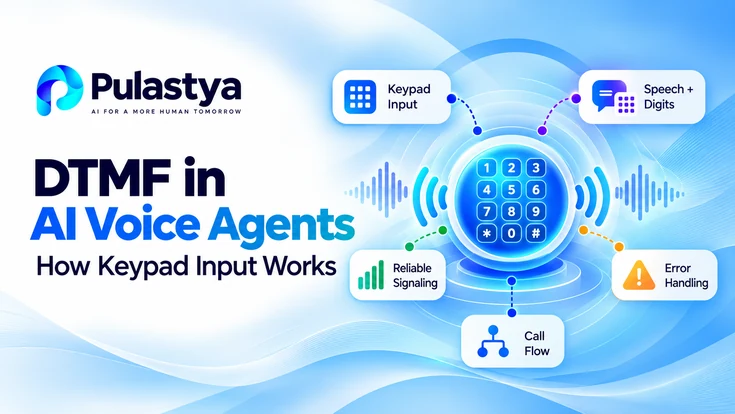
An agent that holds a conversation can feel like it has made the keypad redundant.
It has not. There are moments in a call where pressing a key is faster, more private and far more reliable than saying a thing out loud, and a caller who reaches for the keypad at one of those moments expects it to work.
- Digits are the reliable channel Key presses survive noise, accent and compression far better than speech, which makes them the natural fallback rather than a legacy feature.
- Tones travel two ways A key press can be carried as sound within the call audio or as a separate event beside it, and only one of those survives heavy compression.
- Collection is a state, not an event An agent taking digits has to know how many to expect, when the caller has finished, and what to do with a partial entry.
Keypad input is also the fallback that survives when everything else on the call is going badly. A noisy street, a strong accent against an unfamiliar model, a caller who cannot speak freely: in each case the digits still get through when the words do not.
Supporting them is less obvious than it looks, because a key press is not audio in the ordinary sense. It can travel as a sound inside the call or as a separate signal alongside it, and the two behave differently once compression and forwarding are involved.
What a Key Press Is, and Why It Still Matters
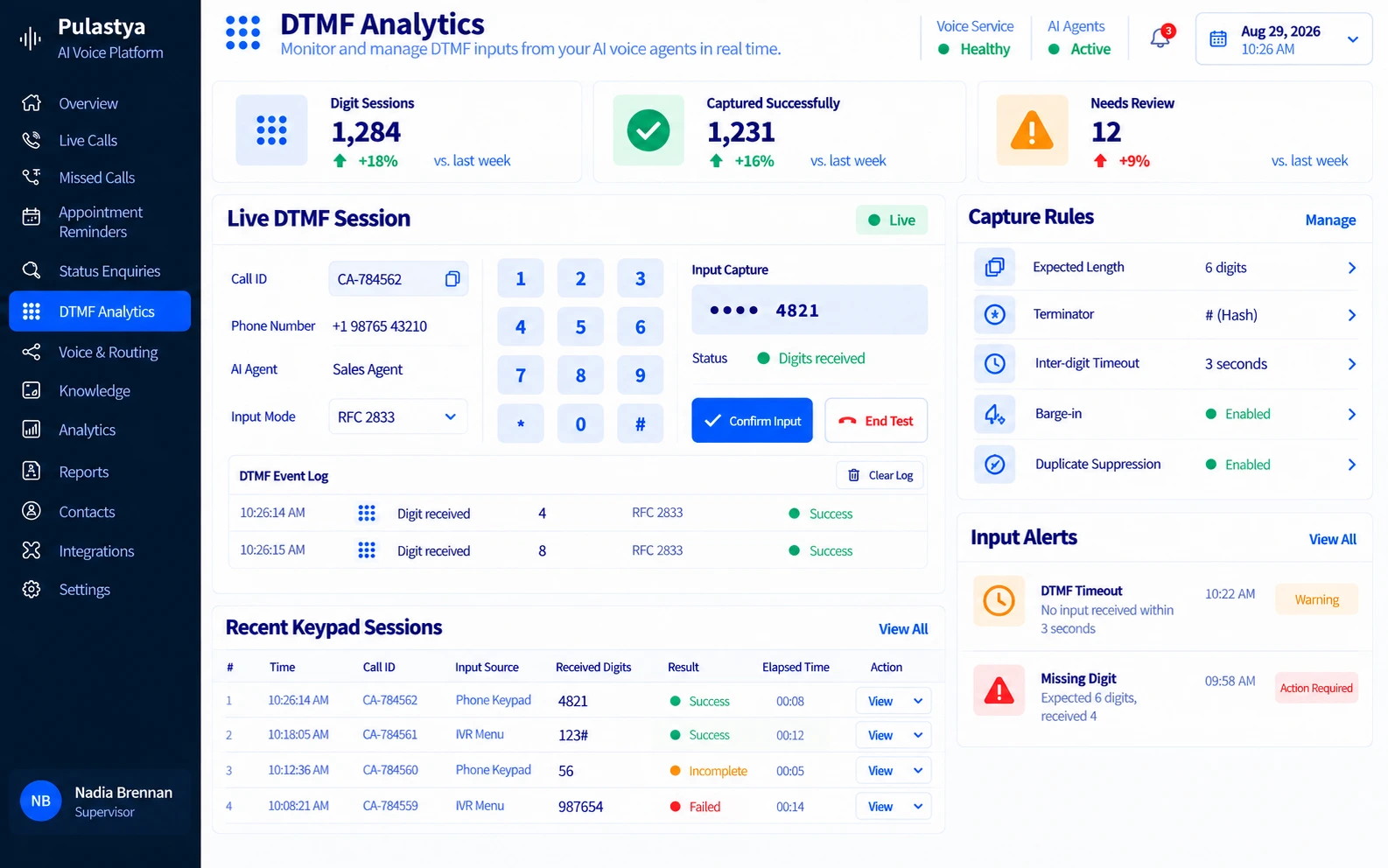
Pressing a key on a phone plays a pair of tones, one drawn from a low group and one from a high group, sounded together. That pairing is what makes a key press hard to confuse with speech or with background noise, and it is why the mechanism has outlived almost everything around it.
Callers already know how to use it. Nobody has to be taught that a keypad exists, which makes it the one input method an agent can offer without explaining.
The instinct on a conversational agent is to treat digits as a leftover from the menu era. That mistakes the delivery mechanism for the purpose. A menu is a way of navigating; a key press is a way of entering a value, and the second survives perfectly well without the first.
The comparison between menu navigation and open conversation is a separate subject, worked through in how a conversational agent differs from a phone menu. What follows assumes the conversation and asks only where the keypad still earns its place inside it.
Where Digits Beat Words
The keypad wins in specific, recognizable situations rather than generally. Knowing which ones lets an agent offer it exactly where it helps instead of everywhere.
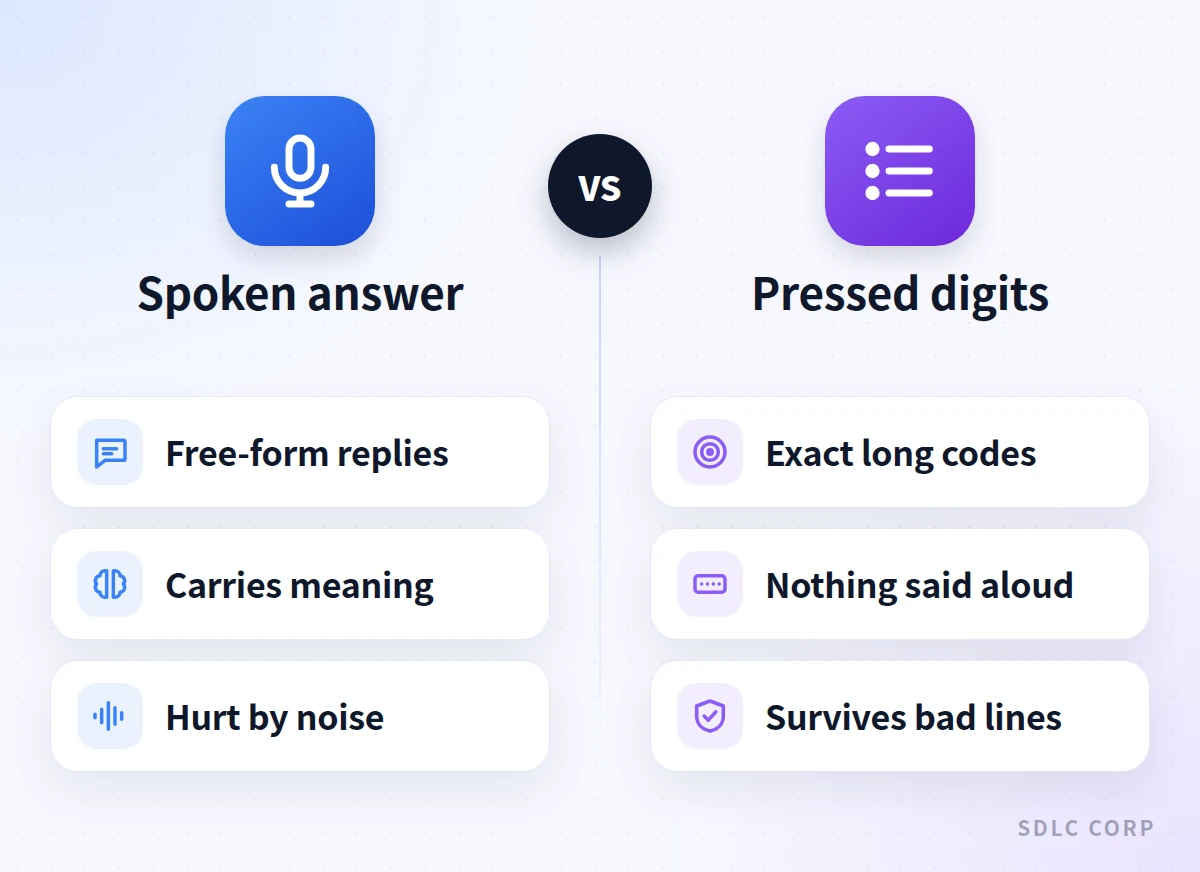
A reference, a policy number or an order code has no context to lean on. Speech has to be recognized character by character; digits arrive exactly as pressed.
An open office, a train, a shared room. Some callers will not read a number aloud in public and will abandon the call rather than do it.
Roadside, factory floor, a bad mobile connection. Tones cut through conditions in which recognition of speech is already struggling.
A speech difference, a temporary loss of voice or an accent the model handles poorly. The keypad is the accessible route, not the fallback.
There is a symmetric point worth making. Digits are bad at anything that is not already a number or a small closed choice, and an agent that pushes a caller toward the keypad for a free-form answer has thrown away its main advantage.
How spoken values of the same kind are captured, normalized and confirmed is covered in turning spoken requests into structured data. The keypad is a second route into the same field, not a different destination.
How a Key Press Reaches the Software
A key press can travel to the agent in two quite different ways, and which one a deployment gets is decided by the network path rather than by the application.
The tones are simply part of the audio, mixed in with everything else. Something downstream has to listen for them and recognize them as digits.
The tones are recognized early and sent onward as explicit digit events, separately from the audio. What arrives is already a digit rather than a sound.
The second route is more robust for one specific reason. Audio on an IP call is compressed, and compression is tuned to preserve the qualities of human speech. A pair of pure tones is not speech, and a codec that saves bandwidth by discarding what speech does not need can damage them enough to make them unrecognizable.
This is why a caller can be understood perfectly while their key presses arrive as nothing, as the wrong digit, or as the same digit three times. The audio path is working exactly as designed; it was never designed for this.
The terms for the layers involved, and which of them owns the audio, are set out in the path a call takes before software answers. What changes when the call arrives over IP rather than the switched network is compared in how transport affects the audio on a call.
Every extra hop is another chance to lose them. A call that is redirected through an intermediate leg before reaching the agent passes the tones through one more translation, and translations are where digits go missing.
What Breaks When Digits Are Not Handled Properly
Digit problems rarely announce themselves. The call continues, the caller sounds fine, and the failure shows up as a caller repeating themselves or hanging up.
| What the caller experiences | What is usually happening | Where to look first |
|---|---|---|
| Key presses do nothing at all | Tones are in the audio and nothing is listening for them | Whether digit events reach the application separately |
| One press registers as several | The same digit is being reported more than once | Whether repeats within a short window are collapsed |
| Some digits of a number go missing | Compression has damaged tones carried as sound | How the audio is encoded on the leg the caller is on |
| The agent talks over the entry | A press was not treated as the caller taking a turn | Whether a digit stops playback the way speech does |
| Entry is cut off before it is finished | The agent decided the number was complete too early | Expected length, terminator key and the wait between presses |
The last two rows are design faults rather than network ones. An agent that keeps talking while someone is entering a reference number is telling that caller it is not listening, and it will be believed.
Deciding that a key press means the caller has taken the floor is the same class of decision as deciding that speech has, which is worked through in deciding who holds the floor on a call.
Designing a Turn That Accepts Both
The useful pattern is not a keypad mode and a speech mode. It is a single question that will take either answer, with the agent not caring which arrives.
- Ask once, mention the keypad secondLead with the natural question and offer the alternative briefly. Callers who want the keypad will use it; the rest are not slowed down by a menu.
- Say what shape the answer hasHow many digits, or whether a key ends the entry. A caller entering a variable-length value with no terminator has no way to signal they are done.
- Treat a press as an interruptionStop speaking on the first digit. A caller who starts typing has decided what they are doing and does not need the rest of the sentence.
- Confirm the value, not the methodRead back what was captured in the same way whichever route it arrived by, so a mistyped digit is caught as readily as a misheard one.
- Keep a way out of the entryA caller who cannot complete it needs something other than silence, whether that is a retry, a different question or a person.
Where an agent collects digits that identify a caller, what is then done with that value is a policy question rather than a technical one, and the handling obligations vary by sector, jurisdiction and purpose. Those constraints are set out in handling calls that carry sensitive information, and the applicable rules should be established with counsel.
One quiet benefit of accepting both is diagnostic. If a field is suddenly being answered by keypad far more often than it used to be, something about the spoken route has stopped working and nobody has reported it yet.
Testing Keypad Input Before It Is Relied On
Keypad handling is one of the few things on a voice deployment that cannot be verified from a desk, because the failures live in the path rather than in the logic.
- Call from more than one kind of device. A desk phone, a mobile and a software client do not all send digits the same way.
- Call over more than one route, including any path that redirects the call before it reaches the agent.
- Press keys quickly and slowly, and press the same key twice in succession, which is where duplicate reporting shows itself.
- Press a key while the agent is mid-sentence, which is the case most likely to be missed in a scripted test.
- Enter a value that is shorter than expected and simply stop, to see what the agent does with an incomplete entry.
It is worth recording which route each captured value arrived by. Without that, a rise in failed entries is indistinguishable from a rise in callers who gave up, and the two have entirely different fixes.
Broader practice for proving behavior on live traffic rather than in a scripted run is covered in testing a voice agent against real calls.
Conclusion
DTMF keypad input remains an important capability for AI voice agents, even as conversational speech becomes more advanced. Keypad entry gives callers a practical alternative for entering reference numbers, making simple selections and responding when speech recognition is unreliable or inconvenient.
Reliable DTMF support requires more than detecting key presses. Voice AI systems must account for signal transport, input validation, timing, interruptions and error recovery. Testing these behaviors across real calling environments helps identify failures before they affect customers.
By supporting both natural conversation and keypad input, organizations can create more accessible, dependable and flexible AI-powered phone experiences without forcing callers through traditional IVR menus.
Frequently Asked Questions
Because some answers are easier pressed than spoken. Long reference numbers, values a caller will not read aloud in public, and calls made from noisy places all favor the keypad. It is also the route that still works when speech recognition is struggling with noise or an unfamiliar accent, which makes it a genuine fallback rather than a legacy feature.
Usually because the tones are travelling inside the call audio and nothing on the path is listening for them, or because compression has damaged them. Audio encoding on IP calls is tuned for speech, and a pair of pure tones is not speech. Digits sent as separate events alongside the audio survive this far more reliably.
Yes, on the first digit. A caller who has started entering something has already decided what they want to do, and continuing to speak over them suggests the input was not noticed. Treat the press as the caller taking their turn, exactly as you would treat them starting to speak.
By one of three signals: a known expected length, a key that marks the end of the entry, or a pause long enough to assume nothing more is coming. Variable-length values need one of the first two, because a pause alone will cut off anyone who types slowly or checks the number halfway through.
They should be able to, and in practice they will. A caller who has been talking comfortably may still reach for the keypad when asked for a long code. Accepting both answers to the same question, and confirming the captured value the same way either way, is simpler to build than two separate paths.