A caller dials a number and software answers.
That sentence hides four or five separate organizations, two different kinds of traffic traveling on different paths, and a routing decision made by a party neither the caller nor the business has ever spoken to. Knowing that shape turns a vague complaint about call quality into an answerable question.
- Several owners, one call A call crosses at least three organizations before the agent hears anything, and each owns a different part of the path.
- Control and audio are separate The events that say a call started and the audio itself travel on different paths, which is why a connected call can still be silent.
- The number is a routing entry A phone number is a record pointing at whoever currently terminates it, not a physical thing tied to a desk or a building.
Teams building a voice agent usually start at the interesting end: what it says, what it knows, how it sounds. The call has to arrive first, and arriving is not one step. It is a relay between organizations, each of which can be working perfectly while the seam between two of them is not.
The vocabulary is the other obstacle. Half a dozen terms get used interchangeably in sales conversations and they are not synonyms. Sorting them out early makes every later decision about telephony a narrower and much easier one.
The Organizations a Single Inbound Call Passes Through
A caller presses dial on a handset. Before any software has a chance to answer, the call has been handed between organizations that have no relationship with each other beyond an agreement to pass traffic along.
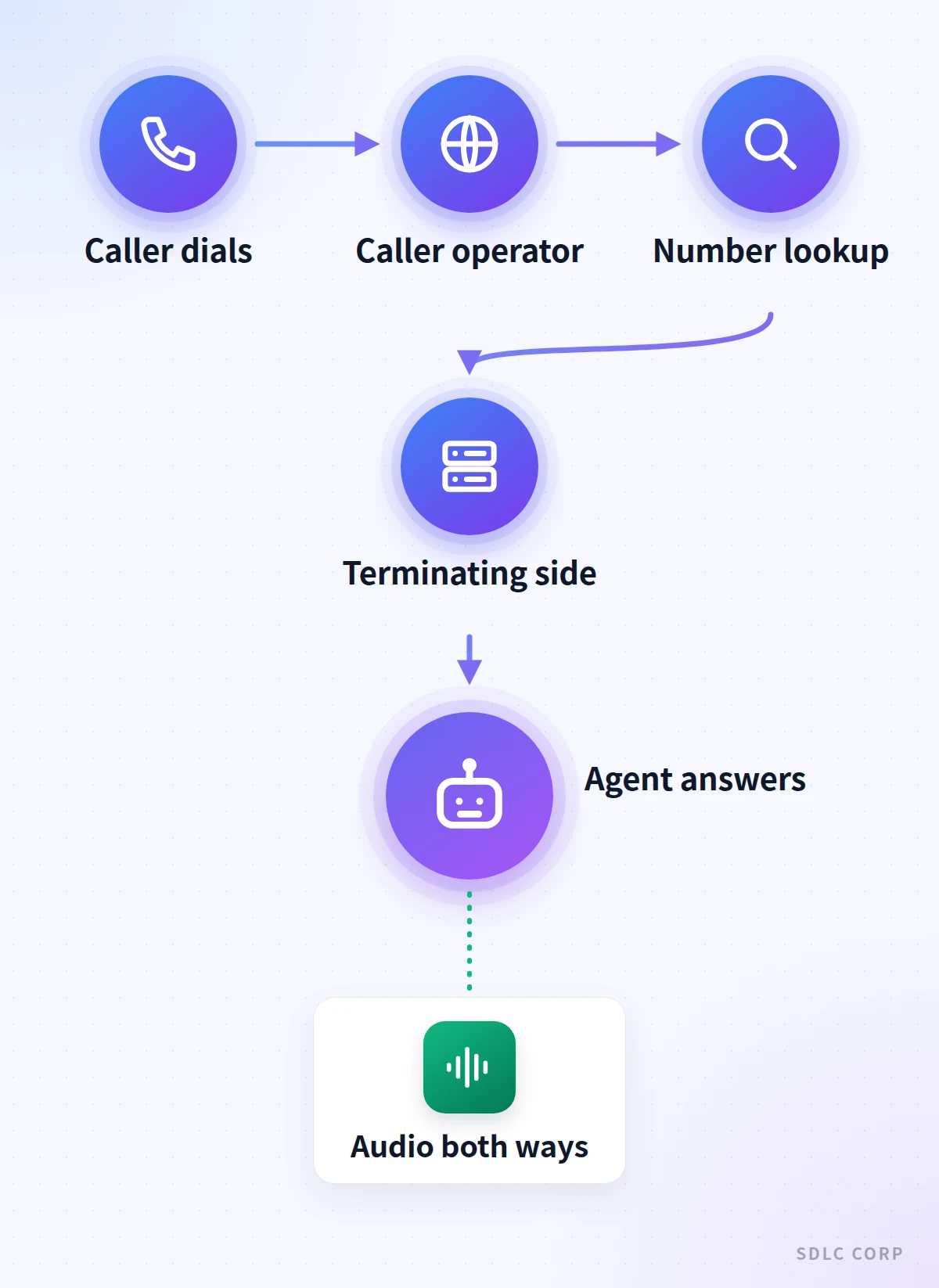
- The caller's own operatorWhoever provides the caller with mobile or landline service accepts the dialed digits and decides where to send them.
- The routing lookupThe dialed number is matched against records that say which operator currently serves it, which may not be the one it was first issued by.
- The terminating providerThe organization that holds the number today accepts the incoming call and is responsible for delivering it to whatever answers.
- The software that answersSoftware is told a call has arrived, decides to accept it, and from that moment owes the caller a voice.
- The return pathEverything the agent says travels back along the same chain, which is why quality problems are rarely one-directional by accident.
No single organization sees the whole path. The caller's operator confirms the call left cleanly. The terminating provider confirms it delivered. The answering software confirms it answered. A problem living in the seam between two of them cannot be seen from inside either one.
When a call problem is reported, the useful first question is not what went wrong but where the path stopped behaving. Never arrived, arrived silent, arrived and then degraded: three different investigations with three different owners.
The Vocabulary the Rest of This Subject Assumes
These words get used as if they were alternatives to each other. They are not. Most of them describe different layers of the same call, and a single conversation routinely involves all of them at once.
| Term | What it refers to | Why an agent build cares |
|---|---|---|
| PSTN | The everyday phone network that any handset can reach by dialing | It is what makes the agent reachable by people who have only a phone number |
| Carrier | An organization licensed to originate, carry or terminate calls on that network | One link in the chain is always a carrier, even when the invoice says software |
| VoIP | Carrying a conversation as data packets across an IP network | It is how audio usually reaches the machine the agent runs on |
| SIP | The control language used to set up, change and end a call over IP | It negotiates the call, then steps aside while audio flows separately |
| CPaaS | A provider that sells numbers and call control behind an interface software can drive | It is the usual way software gets a foot in the phone network |
| Webhook | An HTTP request a provider sends to an address the business publishes | It is how the agent first learns a call is waiting to be answered |
| Media stream | The live audio of the call, moving continuously in both directions | Conversation is only possible if this flows while the call is still open |
Read the table as a stack rather than a menu. A caller on the public network reaches a provider, that provider offers the call to the agent over IP, the agent accepts, and audio then runs between them for as long as the conversation lasts.
The provider row is where most deployments begin, because it is the layer that can be arranged quickly and without specialist equipment. What such an account contributes, and what it leaves to you, is set out in what a provider account brings to a deployment.
Call Setup and Audio Travel Separately
This is the single most useful idea in the subject, and it explains most of the confusing failures. Setting up a call and carrying its sound are two different jobs, done by two different flows of traffic.
Short messages that say a call is offered, accepted, put on hold, transferred or finished. Small, infrequent, and either they arrive or they do not.
A continuous stream in both directions for the whole conversation. It is sensitive to delay and to gaps in a way the control path never is.
Each path can be blocked, delayed or misrouted on its own, so a call can look perfect in one view and be unusable in the other.
The familiar case is a call that connects and then sits in silence, or one where the caller is heard but the agent is not. Nothing is wrong with the call setup at all. The audio is being dropped somewhere the control messages never travel.
An agent also needs the caller's audio while the caller is still speaking, so it can tell when a turn has finished and when it is being cut into.
That rules out any arrangement delivering audio only after the caller stops, and it is why hearing a caller talk over the agent depends on the network path as much as on the speech software.
Where the Number Lives and Who Answers for It
A phone number is not a wire and not a device. It is a record saying which provider currently serves it, and a second record inside that provider saying what to do when a call for it arrives.
Both records can change without the number changing. That is what makes it possible to put an agent on a number that has been printed on invoices for a decade without asking customers to learn a new one.
- Keep the current provider and change what it does on arrival, so the number is untouched and only its routing changes.
- Move the number to a different provider, which changes the routing record itself and is a slower, more formal process.
- Take a new number for the pilot, leave the main line alone, and decide later whether the agent earns the real one.
These are genuinely different commitments, with different reversal costs and different things that can go wrong midway. The trade between them is set out in moving a number versus repointing the one you have.
Outbound identity is a separate setting again. The number displayed when the agent places a call need not be the number it answers on, and when the two are allowed to drift apart, returned calls land somewhere nobody is watching.
Which Layer Is Responsible for Audio Quality
Audio quality is the most commonly misattributed trouble in voice deployments, because every layer can degrade it and no layer can prove it did not. Sorting reports by shape is faster than escalating everything to the loudest vendor.
| What the caller reports | Usually owned by | What to check first |
|---|---|---|
| Call rings and then goes silent | The audio path, not the call setup | Whether audio is reaching the answering side at all |
| One side can be heard, the other cannot | The audio path in a single direction | Which direction fails, on which calls, from which networks |
| Choppy or robotic voice | The IP network carrying the packets | Whether the problem follows a route, a site or a time of day |
| Muffled but steady voice | The audio type agreed when the call was set up | What both ends settled on and whether either was forced down |
| Agent talks over the caller | Speech handling above the network | Turn detection settings against recordings of real calls |
The last row is there deliberately. A caller who is cut off mid-sentence will describe it as a bad line, and the network is usually blameless. The distinction between a degraded path and a mistimed turn is worth making before a ticket is opened.
Where the sound itself is thin or flat rather than broken, the cause often sits in how the call was carried in the first place, which is compared in what changes when a call arrives over IP rather than the switched network.
What an Agent Needs From the Network to Hold a Conversation
A voice agent asks slightly more of the phone path than a human does. Not more bandwidth, but a particular shape of service, and a deployment that ignores these tends to work in a demo and disappoint in production.
- Audio in both directions while the call is liveNot a recording delivered afterwards. The agent has to hear the caller and speak into the same open channel at the same time.
- Delay that is low and, more importantly, steadyA conversation tolerates a small consistent lag far better than an unpredictable one that lands differently on every turn.
- Call events that are reliable and promptThe agent needs to know a call started, was answered, was transferred or finished, in time to act on it rather than after the fact.
- Room for calls that all arrive at onceAutomation removes the staffing limit on how many calls can be in progress, so the capacity bought has to reflect the new peak.
- A defined path when the agent cannot answerSomething has to happen when the agent cannot be reached, and letting the call ring out is a decision rather than an absence of one.
The last point is the one that gets skipped. Every other layer in a voice deployment has a fallback, and the phone path deserves the same treatment, which detecting failure and recovering safely sets out in full.
The steadiness requirement also connects directly to how a spoken turn is assembled, because network delay is added to every other delay in the chain before the caller hears anything, as described in where the delay in a spoken turn comes from.
Where an organization already runs its own telephony rather than buying it fresh, the agent usually joins through a dedicated connection to that estate, described in joining an agent to telephony that already exists.
Conclusion
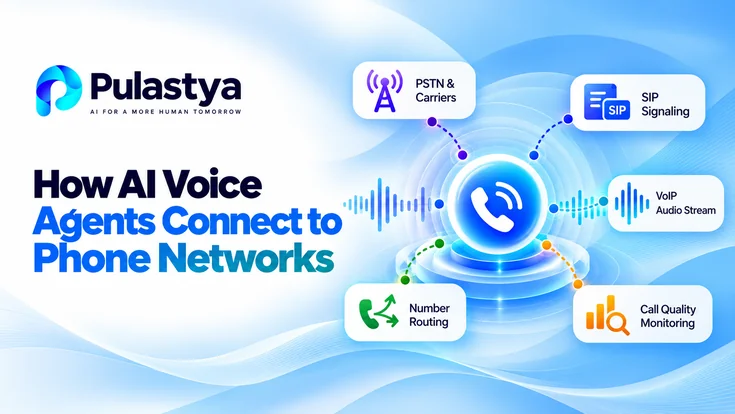
AI voice agents connect to phone networks through a combination of carrier routing, telephony providers, call signaling and live audio transport. Understanding the distinction between call setup and media delivery helps teams diagnose why calls may connect successfully yet suffer from silence, one-way audio or poor sound quality.
Reliable deployment also depends on choosing an appropriate number-routing arrangement, monitoring call quality, planning for simultaneous calls and defining what happens when the agent or telephony connection is unavailable. Treating these as separate but connected responsibilities makes voice automation easier to operate and troubleshoot as it scales.
Frequently Asked Questions
No. It needs a working number and a path that delivers live audio in both directions while the call is open. That path is usually an IP connection to a provider rather than a physical line, but the caller dials the same way they always have and cannot tell the difference from their side.
Because setting up a call and carrying its audio are separate flows of traffic. The setup messages arrived, so both sides believe the call is up, while the audio is being blocked or misrouted somewhere those messages never travel. It is one of the clearest signs that the trouble is in the audio path rather than the call control.
Usually yes, and there is more than one way to do it. The number can stay where it is with its arrival instructions changed, or it can be moved to a different provider entirely. The two options differ in speed, reversibility and who ends up holding the account, so the choice is worth making deliberately.
It depends on what is reported. Broken or choppy audio points at the network carrying the packets, silence on one side points at the audio path, and thin but even sound points at the audio type agreed during setup. An agent that talks over people is not a network problem at all, even though callers describe it as a bad line.
That is a provisioning question rather than a property of the software. The phone path has a limit on concurrent calls, and automation tends to raise the real peak because there is no longer a staffing limit on how many callers can be served at once. Size it against expected bursts, not the daily average.