Two people on a phone call never agree out loud whose turn it is.
They work it out continuously from pauses, intonation and the sense that a sentence has landed, and they repair it in half a second when they both start at once. An agent has to do the same job with far less to go on, and callers notice immediately when it does not.
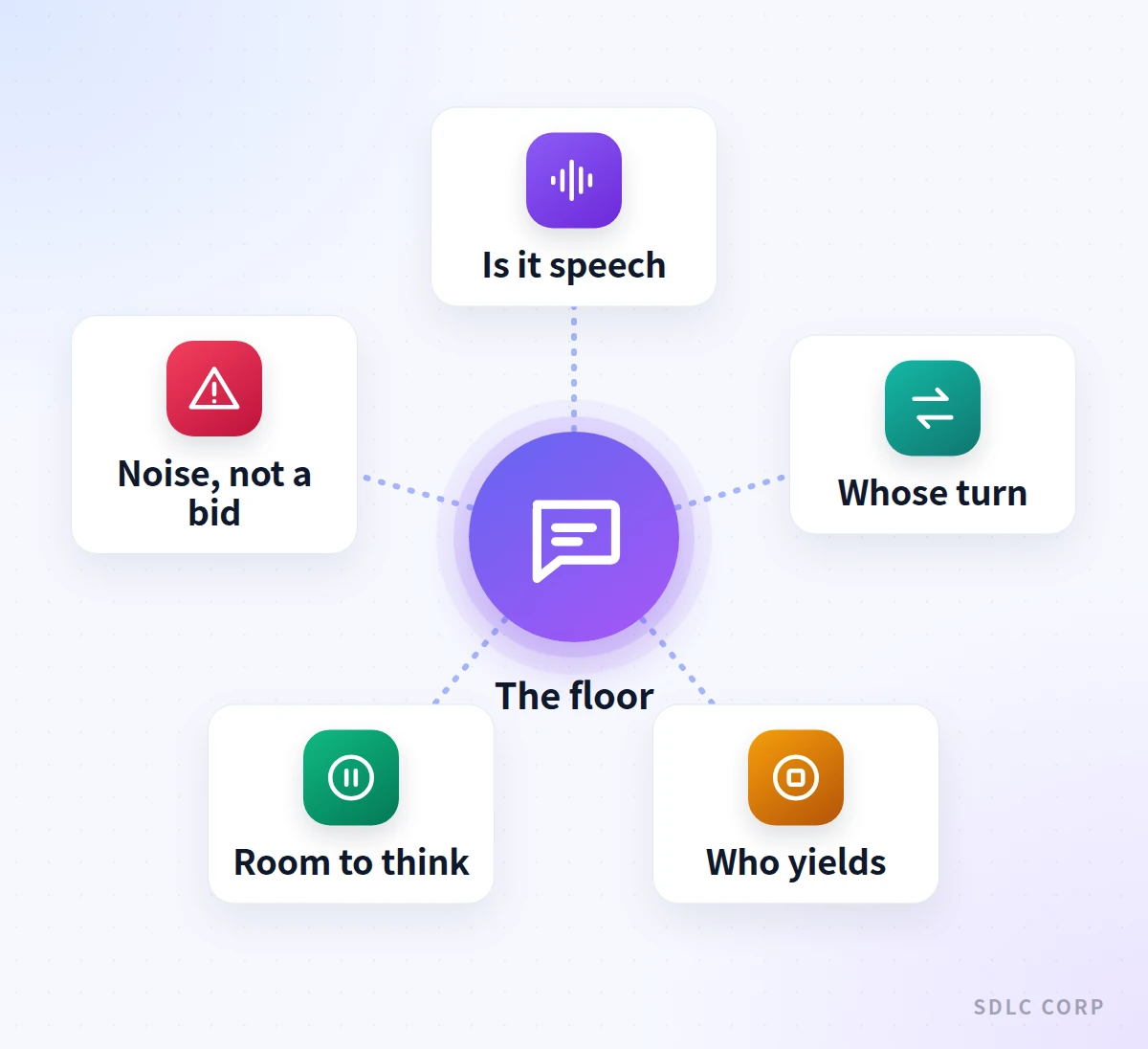
- Three decisions, not one Detecting speech, deciding whose turn it is, and handling a collision are separate problems solved by separate mechanisms.
- The floor is the design unit Good turn-taking is the caller never having to fight for a turn or wonder whether one has been offered to them.
- Interruption leaves a stump When the agent stops mid-sentence, the caller heard part of something, and what happens to the rest is a decision worth making deliberately.
Most complaints about a voice agent sounding robotic are not complaints about the voice. They are complaints about the rhythm: being cut off, being talked over, being left in a silence that was supposed to be an invitation.
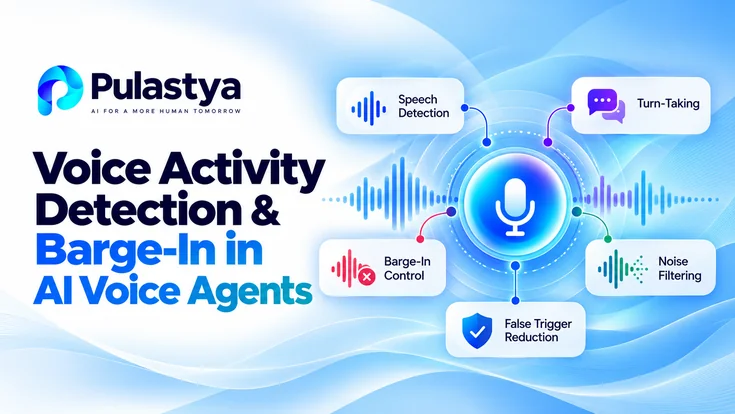
Three separate decisions sit underneath that rhythm. Whether the incoming sound is someone speaking at all, whose turn it currently is, and what to do when both parties are speaking at once. They are usually discussed as one setting, and they are not one thing.
Three Decisions Hiding Behind One Setting
Conversation runs on an unspoken agreement about who currently holds the floor. Holding it means you may keep speaking and the other party will wait. Yielding it means you have stopped and expect a reply.
Voice activity detection separates a human voice from a road, a television, a keyboard or a dog. It answers only that, and answers it constantly.
Turn-taking decides whether the floor has been offered, taken or held, and it is what a caller perceives as the rhythm of the conversation.
Barge-in is the collision case. Both parties are speaking and something has to yield, quickly and without asking.
Bundling these together is the common design error. A system tuned only on the first question will treat any sound as a bid for the floor, and one tuned only on the third will interrupt itself whenever a lorry goes past.
The caller is not evaluating any of these mechanisms. They are forming one impression: whether talking to this thing takes effort. Everything below is in service of that single judgement.
None of it is possible unless the agent receives the caller's audio continuously while the call is open rather than after the fact, which is a property of the network path described in the path a call takes before software answers.
What Voice Activity Detection Can and Cannot Tell You
Voice activity detection answers a narrow question: is there a human voice in this audio right now. It is deliberately cheap, it runs continuously, and it knows nothing about meaning.
That narrowness is the point and also the limit. It cannot tell you whether the voice belongs to the caller, whether they are addressing the agent, or whether what they are saying is finished.
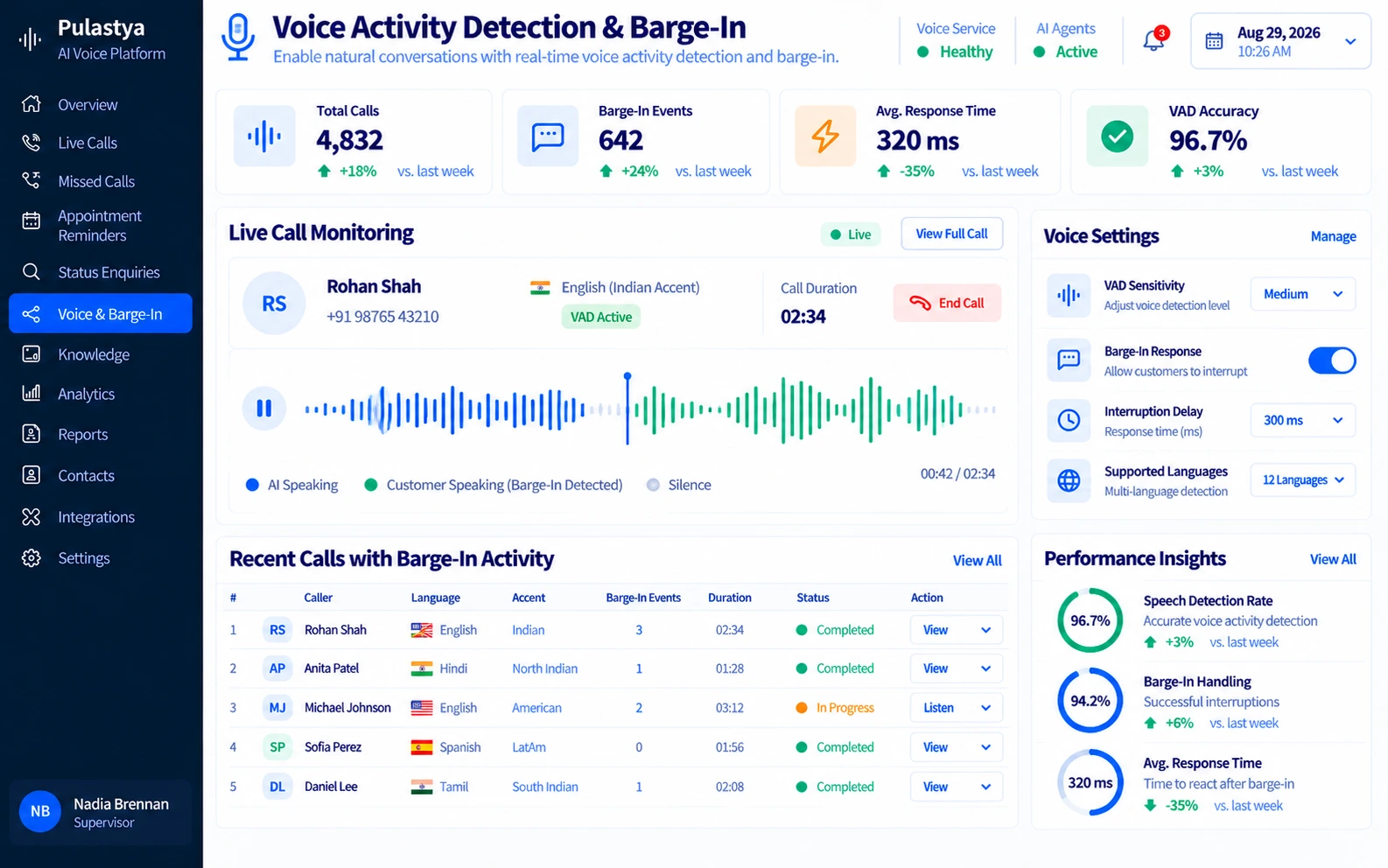
- A second person in the room, talking to someone else entirely, is a voice and will be detected as one.
- A television or a radio in the background produces speech that is genuinely speech.
- A caller on a hands-free car connection may be quieter than the road noise around them.
- The agent's own voice returning through a speakerphone is a voice arriving on the inbound audio.
Each of those has a failure direction. Detecting speech that was not meant for the agent makes it stop for no reason. Missing speech that was makes it talk over the person it is supposed to be serving.
The last item is the one with a specific remedy. Echo cancellation exists so that the agent does not hear itself, and where it is weak the agent will appear to interrupt itself at random. This is worth ruling out before any threshold is touched.
Quiet speech, unfamiliar accents and heavy background noise all shift where the boundary between voice and not-voice falls, which connects to the material in handling multiple languages and accents on live calls.
What Good Turn-Taking Feels Like
Turn-taking is judged by feel rather than by any measurement, and the feel is specific enough to describe. A caller should never be unsure whether it is their turn, and never have to raise their voice to claim it.
| What the agent does | How it reads to the caller | What to do instead |
|---|---|---|
| Ends a turn on a trailing clause | Unclear whether a reply is wanted yet | End on the question, with nothing after it |
| Asks two things in one turn | Only the second one is answered | One question per turn, always |
| Fills every pause with speech | There is no room to think or to check something | Leave the silence after a question open |
| Replies the instant a caller stops | Eager and slightly rude, as if not listening | A brief, consistent beat before answering |
| Resumes a long explanation after a pause | The caller believes the turn had been handed over | Break long content into parts and hand over between them |
The fourth row surprises people. An agent that answers with no gap at all reads as not having listened, because a human reply arrives after a small pause and its absence is heard as an absence.
The fifth is the most common fault in agents that answer from documents. A long answer delivered as one unbroken turn gives a caller no natural place to intervene, so they eventually intervene unnaturally.
Short acknowledgements have a role here that is distinct from filling silence. A brief marker that a request has been understood tells the caller their turn landed, which is a different job from covering a wait.
Barge-In and the Half-Finished Sentence
Barge-in is usually described as letting a caller interrupt. The harder half is what the agent does with the sentence it was halfway through when the interruption arrived.
Something has already reached the caller's ear. Something else was generated and queued but never played. If the agent carries on as though the whole thing was delivered, the two parties now disagree about what was said.
- Stop playing immediatelyCut the audio on detection rather than at the end of the current phrase. A pause of a second before stopping reads as being ignored.
- Discard what was queuedAudio already generated but not yet heard should be dropped, not held. Nothing is more disorienting than the interrupted sentence resuming later.
- Record what was actually heardThe conversation record should reflect the point the audio was cut, not the full text, or every later decision is made on a false transcript.
- Decide whether to return to itSome interrupted content matters and some does not. Abandoning it silently and repeating it in full are both wrong most of the time.
The third step is the one that causes trouble months later. If the record says the agent delivered a full explanation and the caller heard four words of it, every subsequent turn of the call is reasoning from something that did not happen.
A small number of utterances should be harder to interrupt than the rest. Where a disclosure has to be made, cutting it off on the first sound leaves it unmade, and whether that matters depends on jurisdiction, sector and the purpose of the call, so the applicable rules should be established with counsel.
The wider obligations are set out in disclosure and recording obligations on automated calls.
A key press is a bid for the floor in exactly the same way speech is, and should stop playback on the same terms, as described in accepting keypad input alongside speech.
False Barge-In, and the Case for Both Settings
An agent that yields to any sound is as difficult to talk to as one that yields to nothing. Both directions are real failures and teams tend to have only experienced one of them.
The agent stops for a cough, a door, a passing vehicle or a third party in the room, then restarts. Its answers arrive in fragments.
The caller has to say the same thing three times, louder each time, before the agent stops. They will remember this and not the answer.
Require a short run of speech rather than a single sound, so a noise is ignored and a word is not.
Requiring a brief run of speech before yielding is the single most useful adjustment available, because noises are short and human interruptions are not. A caller who means to interrupt keeps talking.
Call conditions change what the right setting is. Hands-free car audio, speakerphones and open-plan offices all produce sound that is not a bid for the floor, and an agent serving those callers needs more evidence than one serving handsets.
There is also a content dimension. An agent reading back a long confirmation should be easy to stop, because the caller who spots an error wants to say so immediately. A short acknowledgement barely needs to be interruptible at all.
Tuning It Against Calls You Actually Get
None of this can be settled by argument, and very little of it is visible in a summary. The only reliable method is listening to recordings with the two failure directions in mind.
- Count interruptions in both directions separately. One number hides whichever fault is currently rarer.
- Split recordings by device and environment, because a mobile in traffic and a desk phone are different problems.
- Look for repeated phrases from the caller, which is the signature of an agent that would not yield.
- Look for the agent restarting a sentence, which is the signature of yielding to noise.
- Test with someone reading a long number aloud, since the pauses in that are unlike ordinary speech.
The timing side of this sits in a separate subject. How long a reply takes to arrive once a turn has genuinely ended is a different question from whether the turn ended, and it is worked through in where the delay in a spoken turn comes from.
A caller who cannot get a word in is also a caller who is about to ask for a person, which makes interruption behavior a leading indicator worth watching alongside the signals in recognizing when a caller needs a human.
Conclusion
Voice activity detection, turn-taking, and barge-in handling work together to make AI voice conversations more natural and responsive. VAD identifies when speech is present, turn-taking helps determine when a caller is ready for a response, and barge-in handling lets callers interrupt without waiting for the agent to finish.
Getting that balance right requires more than a single sensitivity setting. Teams should evaluate background noise, echo, endpointing behavior, interruption timing, and what happens to audio the caller never heard. Testing against real calls helps reduce false interruptions without making callers struggle to take the floor.
Ultimately, a capable voice agent must not only provide useful answers but also know when to speak, when to listen, and when to yield control to the caller.
Frequently Asked Questions
It is the agent stopping what it is saying because the caller has started speaking. Without it the caller has to wait for a complete sentence before they can correct or redirect anything, which is the main reason automated calls feel rigid. With it badly tuned, the agent stops for background noise instead, which is its own problem.
Voice activity detection answers whether there is a human voice in the incoming audio at this moment. Turn-taking is the larger judgement about whose turn it is to speak. Detection is an input to that judgement rather than the judgement itself, which is why an agent can detect speech correctly and still handle the conversation badly.
Something in the inbound audio was treated as a voice. Common causes are a television, another person in the room, road noise on a hands-free connection, or the agent's own voice returning through a speakerphone. The last of those points at echo cancellation rather than at any threshold, and is worth ruling out first.
Usually not. Audio that was generated but never played should be discarded rather than resumed, because a sentence that restarts after the caller has moved on is disorienting. What matters more is that the record reflects the point the audio was cut, so later turns are not reasoning from words the caller never heard.
They can, and a small number should be. Where a disclosure has to be made, cutting it off at the first sound leaves it unmade. Whether that applies depends on jurisdiction, sector, call direction and purpose, so the list of protected utterances should be set with counsel rather than chosen by preference.