A business that already answers a phone has already published the number.
It is on invoices, on vehicles, in an email signature and in a search result that took years to earn. Putting an agent behind that number is therefore not a question about software first. It is a question about whether the number moves or stays.
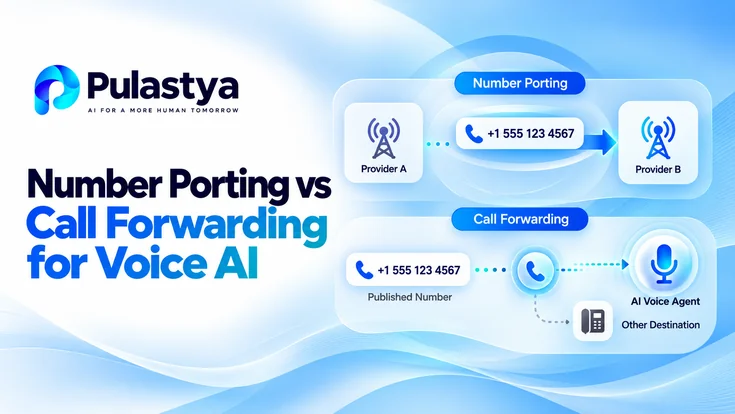
- Porting changes ownership A port moves the number to a different provider, along with the account and the billing relationship attached to it.
- Forwarding changes behavior Forwarding leaves the number where it is and only changes the instruction followed once a call for it arrives.
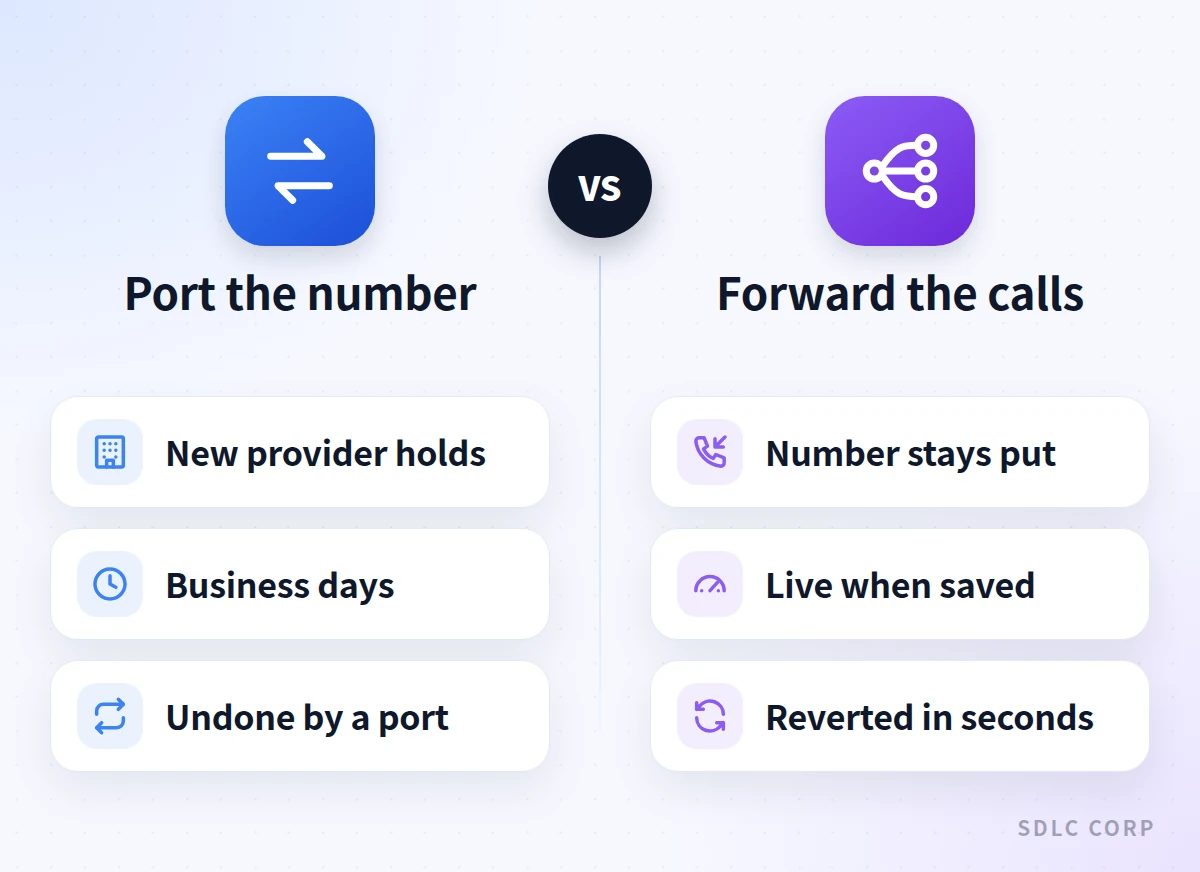
- Reversibility is the real axis One is a configuration change undone in minutes, the other a formal request between two providers that has to be repeated to undo.
Both answers work, and they are not the same commitment. One rewrites the record that says who serves the number. The other leaves that record alone and changes only what happens after a call arrives.
The difference that matters is not difficulty. It is how easily the decision can be taken back, how many organizations have to cooperate for it to hold, and what a caller experiences on the day it is done.
Two Ways to Put an Agent Behind a Published Number
Two records stand between a dialed number and whatever picks it up. One names the company responsible for the number. The second, held inside that company, says what to do the moment a call lands. Either can be edited, and choosing which is the whole decision.
Port it. The record naming its owner is rewritten, the account moves with it, and everything about that number is then administered in one place.
Keep the incumbent and change only what it does on pickup, either sending the call onward or handing it straight to software.
Take a fresh number for the agent, leave the published one alone, and defer the decision until the agent has proved itself on real calls.
Teams reach for porting because it sounds like the clean answer, and forwarding because it sounds like the cautious one. Both readings are roughly right, which is why the choice is usually made on appetite for risk rather than on capability.
Ask one question before anything else: if this turns out to be wrong on a Tuesday afternoon, how long does it take to put back? That answer separates the two options more cleanly than any feature comparison.
The parties involved, and which of them owns which stretch of the call, are set out in the path a call takes before software answers.
What Porting Actually Moves
Porting is a transfer of responsibility between two companies. The number itself is unchanged, and no caller can tell it happened. What changes is where the rest of the network hands the call.
- Responsibility: the record consulted when the number is dialed now points at a new owner.
- Billing: the number appears on a new invoice and disappears from an old one.
- The administrative account: answer instructions, outbound identity and call records are managed in the new place.
- The support path: when something goes wrong on that number, a different help desk is the one to ask.
It is a formal request rather than a switch you flip. The gaining side asks on your behalf, the losing side validates the request against the account details it holds, and both must agree before the record is rewritten.
That validation step is the usual point of failure, and it fails on paperwork rather than on technology. A trading name that differs from the registered account name, a stale service address or a recently changed account holder will each stall a request that is otherwise perfectly reasonable.
The vocabulary is worth knowing before the first email is sent. The business whose number is moving is the account holder, the company it is leaving is the losing side, and the one taking it on is the gaining side. In many markets a written authorization from the account holder has to accompany the request.
Timing is decided by those two companies and by the rules of the jurisdiction, not by you. It is measured in business days rather than minutes, and the cutover itself lands in a window you influence rather than choose.
Eligibility is not universal either. Some number types and some geographies do not move at all, and a number bundled with other services can be held by the contract around it rather than by anything about the number itself.
What Forwarding Actually Does
Forwarding leaves that first record alone. The number stays with whoever holds it today, and only the instruction executed on pickup is different. Two shapes of that instruction are in common use, and they behave differently.
The incumbent answers and immediately places a second call to a destination you supply. Two call legs now exist for one conversation.
The incumbent is told to notify an application on pickup and take its instructions from there, so no second leg is created.
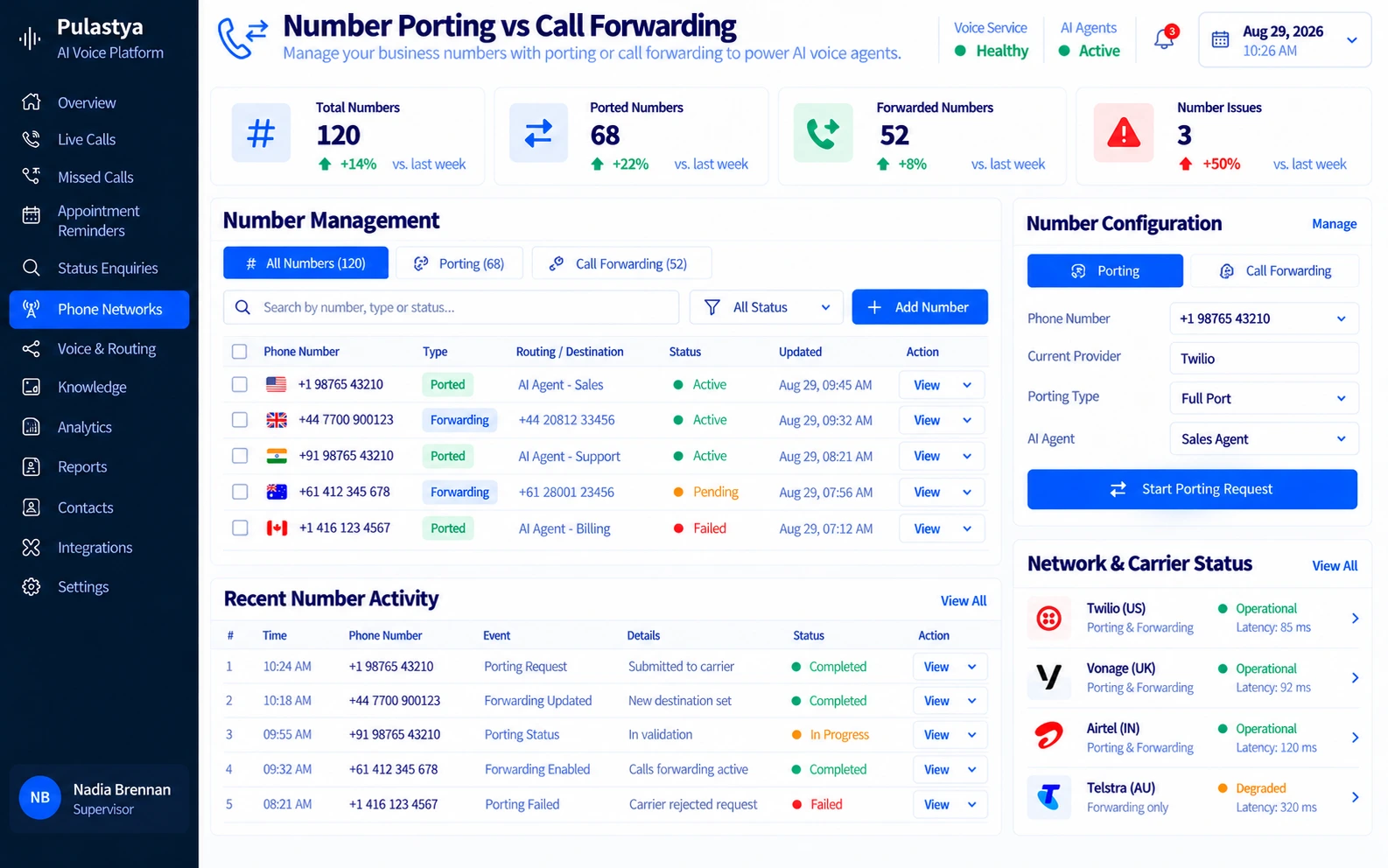
The second shape is the one that keeps a published number entirely intact while software answers it. Pulastya is used this way: the number remains with its existing provider and its webhook is pointed at the platform, so the agent answers a number that never moved.
Where a second leg is created instead, it is worth being precise about what the agent then sees. The caller identity presented on that leg may be the forwarding number rather than the original caller, which quietly removes the one piece of information most useful for recognizing who is calling.
The second leg also has its own capacity and its own bill. Both sides now count the call, and whichever has the lower concurrent-call limit decides how many callers can be handled at once.
What an account on the receiving side contributes to this, and what it leaves to you, is described in what a communications account brings to a deployment.
Risk, Time and Reversibility Compared
Set side by side, the two options differ on almost every practical question except the one people ask first, which is whether callers notice. In both cases they do not.
| Question | Porting the number | Forwarding the calls |
|---|---|---|
| Who holds the number afterwards | The new holder, along with the account | Whoever holds it today |
| How the change is made | A formal request both sides have to agree | A setting changed inside one account |
| How long it takes to take effect | Business days, in a window set by the two sides | Effective almost as soon as it is saved |
| How it is undone | A second port, requested the other way | Reverting the setting |
| Organizations on the live call path | One company between the network and the agent | Two, and both have to behave |
| What a bad day looks like | A rejected request, or a cutover nobody was watching | Calls landing in the wrong place until the setting is fixed |
The row about organizations on the path is the one that repays attention. Forwarding is quicker to put in place and marginally harder to run, because every call now depends on two relationships holding rather than one.
What Goes Wrong in Each Arrangement
Neither option fails often. Both fail in characteristic ways, and knowing the shape of the failure in advance is what turns an incident into a short one.
Where Ports Go Wrong
- The cutover happens outside working hours and nobody has tested the new answer path when it does.
- Other services sat on the same number or the same account and were not part of the request, so they stop.
- A rejected request is discovered late, because a rejection is quiet and a scheduled date passes without an event.
- The old account is closed before the new path has been proved on a real call from an outside line.
Where Forwarding Goes Wrong
- The onward destination stops answering and the original account has no instruction for that case, so callers hear ringing.
- The caller identity is replaced on the second leg, and personalization that depends on knowing the caller silently stops working.
- The onward leg is capped at a lower number of simultaneous calls than the published line, and busy periods hit the cap.
- Two forwarding rules point at each other, and a call loops until something in the chain gives up.
The quiet failure in both lists is the same one: an arrangement that has no defined behavior when the far end is unreachable. What that behavior should be is set out in detecting failure and recovering safely.
Sequencing the Decision Rather Than Making It Once
These are usually presented as alternatives. They work better as stages, because each one gives you evidence the next one needs and none of the early stages touches the published number.
- Start on a number nobody knowsPoint a fresh number at the agent and call it yourself from a mobile, a landline and an office phone before anyone outside is involved.
- Forward a slice of real trafficRedirect one line, one department or one set of hours. Real callers now reach the agent while the main number is untouched.
- Forward the published numberChange the arrival instruction on the number people actually dial, with the old behavior a single setting away.
- Port only when it has earned itMove the number once the agent has run on it for long enough that the reversal you are giving up is one you no longer expect to use.
Plenty of businesses stop at the third step permanently and are right to. Keeping the number where it is costs an extra relationship to manage, and buys a reversal that takes seconds.
Where a business runs its own telephony rather than renting it, the same staging applies but the redirection is arranged on the estate itself, as described in joining an agent to telephony that already exists.
One thing to settle before the first real call either way: the number the agent presents when it calls out. If returned calls land on a line nobody watches, the arrangement is only half finished.
Conclusion
Number porting and call forwarding can both connect an existing business number to an AI voice agent, but they serve different operational needs. Porting transfers service responsibility to a new provider; forwarding keeps your existing provider and redirects incoming calls.
Forwarding is often a practical starting point because routing changes can be tested and reversed quickly where the provider supports them. Porting may make sense for long-term consolidation, but requires eligibility checks, carrier coordination and a planned cutover.
Before launching, test caller ID, audio quality, ongoing charges, concurrent-call limits and fallback behavior. The right option is the one that protects your published number and keeps callers connected.
Frequently Asked Questions
Yes, and by more than one route. The number can stay where it is and have its answer instruction changed so the agent picks up, or it can be moved to a new holder altogether. Callers dial the same digits in both cases. The options differ in how quickly the change takes effect and how easily it is reversed.
Forwarding, and not by a small margin. It is a setting inside an account you already hold, so it takes effect almost as soon as it is saved. A port is a formal request that both the losing and the gaining side have to agree, and the date it completes is set between them rather than chosen by you.
They should not. The number itself does not change, so nothing a caller has saved or printed becomes wrong. What can be noticed is the cutover moment, when responsibility passes from one company to the other. Having someone call the number from an outside line at that point is the simplest way to confirm it landed correctly.
A redirect to another number creates a second call leg, and setting that leg up takes a moment the caller spends listening to ringing. Handing the call straight to software from the existing account avoids the second leg. Neither arrangement affects how quickly the agent replies once the conversation has started.
Generally yes, by requesting a port in the other direction, subject to the same validation and the same waiting period. It is reversible rather than permanent, but reversing it is another formal process rather than an undo. That asymmetry is the main reason to run on forwarding first and port once the arrangement has settled.