
Enterprises often use cloud AI because it offers fast access to powerful models. However, some workloads cannot send data outside a controlled network.
An air-gapped AI deployment runs models, data, applications, and supporting services inside an isolated network. The system does not depend on public model APIs, cloud monitoring, or internet package repositories.
This guide explains how to plan, build, secure, validate, and operate an enterprise air-gapped AI environment.
Key Takeaways
Isolation is architectural
Every runtime dependency must operate inside the approved boundary.
Imports need control
Verify, scan, approve, and record every model and software bundle.
Validation must repeat
Test for unexpected egress after every significant change.
Other risks remain
Isolation does not remove insider, supply-chain, or application risks.
Air-Gapped AI vs On-Premises, Private Cloud, and BYOC
On-premises describes where infrastructure runs. Air-gapped describes its network relationship with the outside world. Therefore, an on-premises server may still use public services.
| Model | Connectivity | Update method | Main advantage | Main limitation |
|---|---|---|---|---|
| Public cloud AI | Required | Continuous | Fast and elastic | Data may leave the enterprise boundary |
| BYOC | Usually restricted | Connected or controlled | Greater data control | Vendor dependencies may remain |
| On-premises AI | Optional | Online or offline | Direct infrastructure control | May still call public endpoints |
| Air gap with diode | One-way only | Controlled transfer | Approved export path | Higher operating complexity |
| Fully air-gapped | None | Offline transfer | Strongest isolation | Fixed capacity and slower updates |
The right choice depends on data classification and threat level. Consequently, teams should use the least restrictive model that satisfies the real requirement.
When Does an Enterprise Need Air-Gapped AI?
Consider an air gap when any external connection creates unacceptable risk. A classification rule, contract, regulator, or threat model may require that control.
Defense and intelligence
Process classified reports, imagery, and mission data inside an accredited boundary.
Critical infrastructure
Add local AI without connecting isolated operational networks to public services.
Government
Keep controlled records and model outputs inside a sovereign environment.
Healthcare
Protect selected clinical and research workloads with exceptional sensitivity.
Financial systems
Isolate high-risk fraud, trading, risk, or supervisory workloads.
Intellectual property
Protect drug, engineering, semiconductor, and pre-release product data.
When it is excessive: A full air gap may not fit workloads that need live web data, frequent releases, burst capacity, or external APIs. For connected or privately hosted conversational AI workloads, Convera enterprise chatbot can provide controlled access to business knowledge.
Air-Gapped AI Architecture: What Must Run Inside?
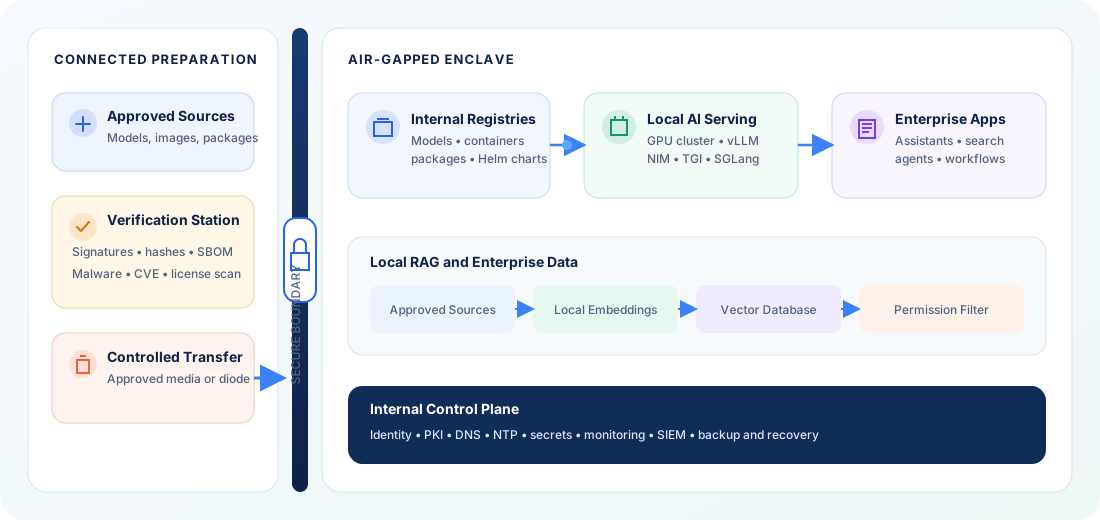
A complete air-gapped AI architecture must provide every service required during inference and operation.
Air-Gap Security-Zone Boundary
- Collect packages
- Scan and validate
- Sign approved bundle
bundle
- Transfer gateway
- Approved media or data diode
import
- Internal registry
- AI and RAG services
- Local monitoring
Model Registry
Store approved weights, tokenizers, hashes, licenses, owners, and evaluations.
Package Mirrors
Mirror containers, Helm charts, Python packages, drivers, and system packages.
Inference Layer
Serve local models through vLLM, NVIDIA NIM, TGI, SGLang, or llama.cpp.
Local RAG
Run embeddings, vector storage, ingestion, permissions, and evaluation internally.
Platform Services
Provide internal identity, PKI, DNS, NTP, secrets, logs, and alerting.
Recovery Services
Back up registries, configuration, knowledge stores, policies, and audit records.
NVIDIA documents a connected preparation phase followed by offline transfer and execution . Kubernetes also supports private image registries .
Select the LLM, GPUs, Storage, and Serving Stack
An air-gapped LLM deployment cannot call a hosted model during operation. Therefore, choose an open-weight or enterprise-licensed model that supports local hosting.
Start with measured work
GPU memory must hold model weights, KV cache, concurrent requests, and runtime overhead. Quantization can lower memory use. However, teams should compare quantized variants against the same private evaluation set.
Example GPU and Serving Stack
| GPU model | VRAM | Suitable starting point | Serving framework |
|---|---|---|---|
| NVIDIA L4 | 24 GB | Smaller quantized models and light inference | vLLM or llama.cpp |
| NVIDIA L40S | 48 GB | Medium models and higher concurrency | vLLM or NVIDIA NIM |
| NVIDIA A100 | 80 GB | Larger models, batching, and multi-GPU serving | vLLM, TGI, or NVIDIA NIM |
| NVIDIA H100 | 80 GB | High-throughput enterprise inference | vLLM, TGI, or NVIDIA NIM |
These are planning examples, not fixed sizing rules. Confirm model format, quantization, KV-cache demand, concurrency, drivers, and framework compatibility through load testing on the intended offline hardware.
This formula provides a starting point. Still, load tests on the final hardware must confirm capacity, latency, and failover behavior.
Build a Secure Offline AI Software Supply Chain
The transfer process becomes one of the most sensitive parts of an air-gapped system. Therefore, treat every imported model, container, package, and patch as untrusted until verified.
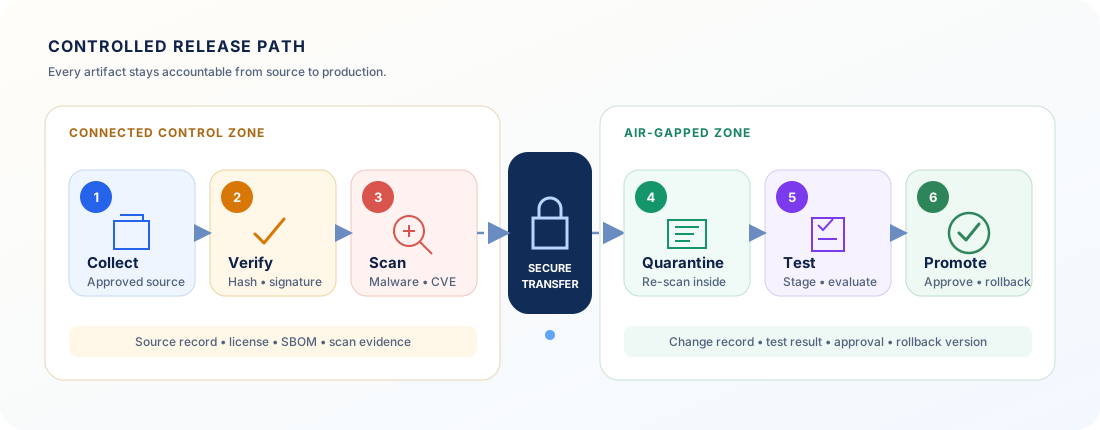
Pin every production artifact to an exact version or digest.
Do not deploy mutable tags such as latest.
Plan emergency patches early. Define risk levels, approvers, focused tests, rollback rules, and post-deployment review before launch.
NIST SP 800-161 provides guidance for cybersecurity supply-chain risk management.
Deploy RAG, Enterprise Data, Identity, and Integrations Offline
Local storage alone does not make RAG secure. The embedding model, vector database, document pipeline, identity checks, and evaluation tools must also run locally.
Offline RAG Flow
Preserve permissions
A vector search may find content that a user cannot normally access. Therefore, apply document-level authorization before returning content to the model.
Version the pipeline
Record the corpus snapshot, chunking rules, embedding model, index, prompt, and LLM.
Restrict agent tools
Use allowlists, short-lived credentials, read-only access, limits, and approval gates.
Network isolation cannot stop an authorized agent from making a harmful internal change. Consequently, least privilege remains essential.
Secure and Validate the Air-Gapped Environment
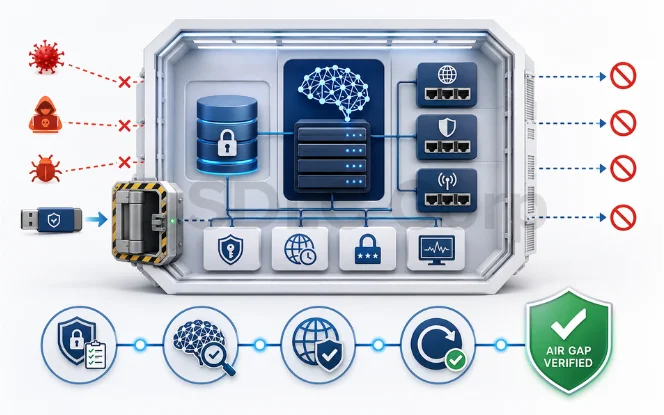
An air gap reduces remote exposure. However, it does not remove insider threats, malicious media, stolen credentials, unsafe agents, or configuration errors.
Infrastructure controls
Use deny-all egress, segmentation, internal PKI, encryption, secrets rotation, media controls, and physical security.
AI-specific controls
Test prompt injection, retrieval leakage, unsafe tools, sensitive output, poisoning, and excessive permissions.
Prove the gap
The NIST AI Risk Management Framework organizes AI risk work around Govern, Map, Measure, and Manage.

Operate, Monitor, Patch, and Recover Air-Gapped AI
An air-gapped environment needs the same operational discipline as connected AI. However, every monitoring and recovery tool must operate locally.
Infrastructure
Track GPU use, memory, queues, throughput, latency, errors, storage, and registry health.
AI quality
Track task success, retrieval relevance, citation accuracy, refusals, and escalations.
Recovery
Test registries, indexes, policies, identity configuration, audit logs, and keys.
Use separate change paths for routine releases, model upgrades, security patches, configuration changes, and knowledge refreshes. Each path needs an owner, test scope, approval rule, and rollback plan.
Backups are not proof of recovery. Schedule restoration exercises and record the result against defined recovery targets.
Plan Cost, Timeline, Team, and Success Metrics
Air-gapped AI shifts spending away from variable API use. Instead, it requires infrastructure, security controls, accreditation work, and ongoing offline operations.
Infrastructure
GPUs, storage, networking, redundancy, power, cooling, registries, and backups.
Security
Scanning, transfer controls, testing, audits, PKI, monitoring, and incident response.
People
AI, platform, network, security, data, compliance, identity, and application owners.
| Metric | What it shows | Measurement | Owner |
|---|---|---|---|
| Unexpected egress | Hidden external dependencies | Boundary monitoring | Security |
| Domain task success | Model fitness | Approved evaluation set | AI team |
| Peak latency | Capacity fitness | Load tests and traces | Platform |
| Retrieval relevance | RAG quality | Labeled retrieval set | AI and data |
| Update lead time | Patch responsiveness | Change records | Security and platform |
| Restore success | Recovery readiness | Restoration exercise | Infrastructure |
Do not copy generic targets from another organization. Instead, set thresholds from workload risk, user needs, and internal service levels.
Air-Gapped AI Deployment Checklist
Use this checklist before production approval.
Business and governance
Confirm the need, classify data, identify requirements, assign owners, and define prohibited actions.
Architecture
Document the boundary, mirror dependencies, configure internal services, and separate quarantine from production.
Models and data
Review licenses, record provenance, test quality, validate quantization, and enforce retrieval permissions.
Security
Apply deny-all egress, scan transfers, verify artifacts, restrict tools, and retain evidence.
Operations
Configure local observability, rehearse updates, test rollback, restore backups, and revalidate changes.
Approval gate
Require named owners to accept residual risk before production access begins.
Planning a Secure Private AI Environment?
SDLC Corp can help assess the workload, design the architecture, and build the controls required for reliable offline AI.
Discuss Your AI DeploymentConclusion
An air-gapped AI deployment can support sensitive workloads without public connectivity. However, network isolation alone does not make the system secure or reliable.
Every model, package, registry, identity service, monitoring tool, and update process must work inside the boundary. Moreover, teams must verify provenance, enforce access controls, monitor behavior, and maintain a tested recovery plan.
Start with the workload and data classification. Then select the least restrictive architecture that satisfies the real risk. If a full air gap is necessary, treat it as a long-term operating model.
Frequently Asked Questions
What Is An Air-Gapped AI Deployment?
It runs models, data, applications, and supporting services inside an isolated network without external runtime access.
Can An LLM Run Without Internet Access?
Yes. Teams can run locally licensed or open-weight models when all weights, tokenizers, packages, and services exist internally.
How Is Air-Gapped AI Different From On-Premises AI?
On-premises describes location. It may still access public services. Air-gapped AI has no unapproved external network route.
How Do Teams Update Air-Gapped AI Models?
Teams verify, scan, transfer, stage, evaluate, approve, and promote signed bundles through a controlled offline process.
Can RAG Work Inside An Air Gap?
Yes. The embedding model, vector database, documents, retrieval service, identity checks, and evaluation tools must run locally.
How Do You Verify An AI Environment Is Air-Gapped?
Apply deny-all egress, monitor outbound attempts, inspect configurations, restart services, and repeat the tests after changes.
Does An Air Gap Make AI Completely Secure?
No. It reduces network exposure, but insider threats, malicious media, unsafe agents, and weak access controls remain.
What Does An Air-Gapped AI Deployment Cost?
A small to mid-sized air-gapped AI deployment typically costs about $250,000 to $1 million in the first year. A highly available, regulated, multi-node environment can cost $1 million to $5 million or more, including hardware, software, security, and staffing.
How Can Organizations Reduce Air-Gapped AI Deployment Costs?
Organizations can reduce deployment cost by choosing right-sized models and hardware, reusing approved internal platforms, automating offline updates, and scaling capacity based on actual demand.