Home / Blogs & Insights / Voice AI vs IVR: Architecture, Costs, KPIs, and Migration Guide

Voice AI vs IVR: Architecture, Costs, KPIs, and Migration Guide

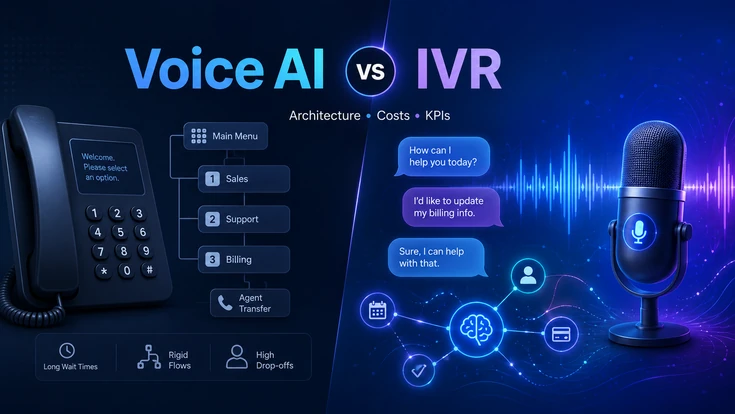
Voice AI vs IVR comparison showing traditional phone menu routing and conversational AI voice automation.

Table of Contents

Voice AI & Contact Center Modernization

For years, interactive voice response systems have handled the first few minutes of millions of customer calls. Press 1 for sales. Press 2 for support. Enter your account number. Wait while your call is transferred.

That model still works for predictable calls. But when a request falls outside the menu, Voice AI can understand the caller's intent, use connected systems, complete supported actions, and hand off to a person when needed.

That makes Voice AI vs IVR less about choosing the newest technology and more about choosing the right architecture for the job. The real comparison involves architecture, operating costs, containment, customer experience, integrations, security, KPIs, and migration risk.

Voice AI vs IVR: The Quick Answer

IVR uses programmed menus, routing rules, keypad inputs, and sometimes speech recognition to move callers through predefined paths. Voice AI uses conversational speech processing and AI-driven logic to understand more open-ended requests, interact with business systems, and potentially resolve calls without forcing customers through a menu tree.

Traditional IVR can collect DTMF keypad input or speech and use that input for routing and self-service. Modern voice-agent systems can go further by processing streaming audio and connecting conversational logic with external systems.

Neither approach automatically wins every use case. If your caller simply needs to choose between billing, support, and sales, a well-designed IVR may be enough. If the caller wants to say, “I was charged twice for my last order and I need someone to check it,” conversational Voice AI can be a much better fit.

Key Takeaways

  • IVR is strongest for predictable flows: short menus, fixed choices, and deterministic routing.
  • Voice AI is strongest for open-ended intent: callers can explain what they need in natural language.
  • Measure outcomes, not AI usage: task completion, cost per resolution, transfers, repeat contacts, and CSAT matter more than “calls handled.”
  • Migration does not have to be all-or-nothing: a phased hybrid rollout can preserve reliable IVR paths while Voice AI proves value.

Voice AI vs IVR Comparison

The core difference is not simply “old vs new.” IVR is designed around predefined paths. Voice AI is designed around understanding intent, maintaining context, and completing supported tasks through connected systems.

FactorTraditional IVRVoice AI
Interaction styleMenus and predefined promptsNatural-language conversation
Caller inputKeypad or constrained speechOpen-ended speech
Core logicRules and decision treesIntent, context, workflows, AI reasoning
Main goalRoute or automate simple tasksUnderstand and resolve requests
Backend accessPrebuilt integrations and lookupsAPIs, tools, knowledge sources and workflows
Conversation flexibilityLow to moderateHigh
ChangesFlow redesign and configurationWorkflow, prompt, model, tool or knowledge updates
AnalyticsMenu paths, queue and call metricsIntent, outcome, quality and conversation metrics
Human handoffUsually routing basedContext-aware escalation can be supported
Best fitPredictable and deterministic workflowsVariable and conversational workflows

The distinction matters because a bad IVR should not automatically be replaced with AI. Sometimes the better solution is simply to redesign the IVR. In other cases, the business problem itself requires a more conversational architecture.

How Voice AI and Traditional IVR Architecture Work

Both systems start with a phone call, but they process intent differently. IVR follows an explicit tree. Voice AI adds a conversational layer that can understand speech, use context, call business systems, and generate a response.
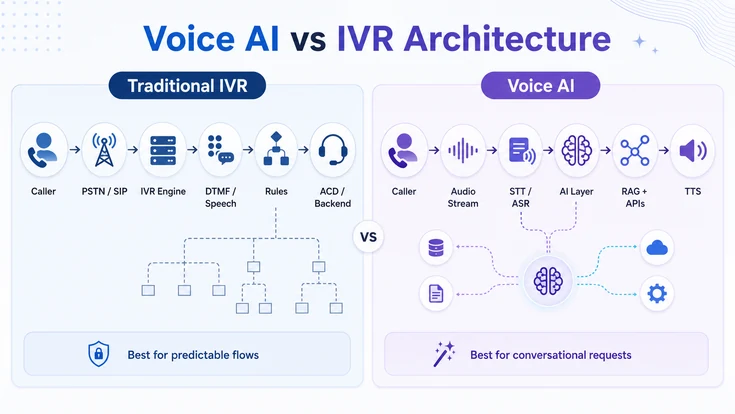
Voice AI vs IVR architecture comparison showing traditional IVR flow and conversational Voice AI workflow
Traditional IVR follows predefined routing paths, while Voice AI combines speech, context, AI, and connected business systems.
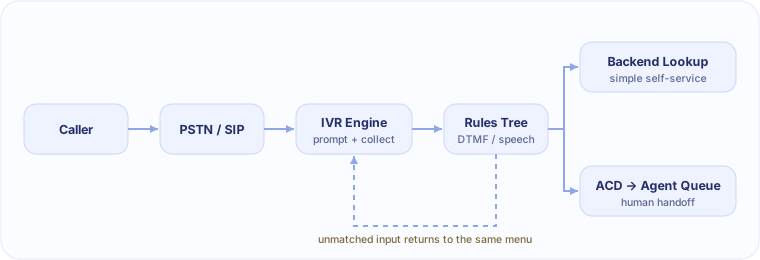
Traditional IVR architecture diagram. A caller enters through the PSTN or SIP trunk into the IVR engine. The engine plays a prompt and collects DTMF keypad input or constrained speech, evaluates it against a fixed rules and decision tree, and then either performs a simple self-service lookup against a backend database or routes the call through the ACD to a human agent queue. Unmatched input returns the caller to the same menu.
Traditional IVR architecture: every caller is pushed down a fixed decision tree, and anything the tree does not recognise loops back to the menu or transfers.
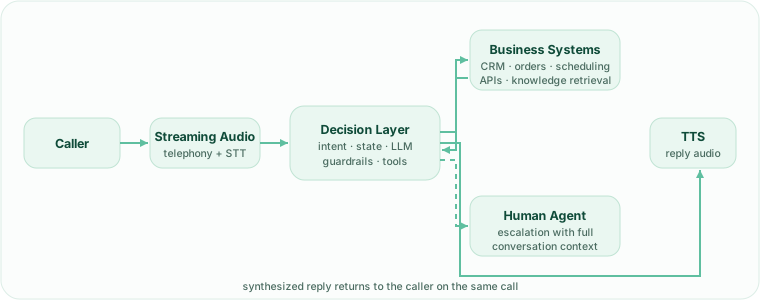
Voice AI architecture diagram. The caller's audio is streamed in real time from the telephony layer to a speech-to-text engine, which passes text to a decision layer containing intent detection, conversation state, guardrails and an LLM. That decision layer calls out to business systems including CRM, order management, scheduling and a knowledge base through APIs and retrieval, receives results back, and sends an approved response to text-to-speech, which returns audio to the caller. A separate escalation path hands the call and its full context to a human agent when the request exceeds approved automation.
Voice AI architecture: audio streams in, a guarded decision layer reasons over intent and calls real business systems, and escalation carries the conversation context to a human instead of restarting it.
Traditional flow

IVR Architecture

Caller PSTN / SIP IVR Engine DTMF / Speech Rules ACD / Backend

An IVR system is essentially a controlled telephone workflow. When someone calls, the telephony platform passes the interaction into an IVR flow. The system plays a prompt and waits for input. Many long-running IVR estates are still built on the vendor-neutral VoiceXML specification published by the W3C, which is why call-flow logic is so often expressed as an explicit document tree.

  • A keypad selection
  • An account or order number
  • A short spoken phrase
  • A yes/no response
  • A predefined menu choice

IVR platforms can accept both DTMF and speech input. Twilio, for example, documents interactive voice response workflows that collect touch-tone keys or speech and then route callers or perform self-service actions based on those inputs.

Strength: predictability. Limitation: callers who fall outside the expected flow can end up repeating prompts, transferring, or reaching the wrong queue.

Conversational flow

Voice AI Architecture

Caller Audio Stream STT / ASR AI Layer RAG + APIs TTS

Voice AI adds a conversational layer between the caller and the systems required to solve the caller's problem. Modern programmable-voice platforms can stream call audio in real time so an external system can process speech while the conversation is happening.

Automatic speech recognition converts incoming audio into text. Cloud speech platforms other than the one cited above document the same capability. Google Cloud, for example, publishes streaming speech recognition for applications that need a transcript while the caller is still talking. The quality of that transcript, and of the intent detection built on top of it, is the job of the natural language processing services layer behind the call.

"I need to move my appointment from Friday afternoon to Monday morning."

Instead of asking the caller to press a sequence of menu options, the system can work with the intent directly.

1. Telephony & Streaming The call starts in the phone network and audio is streamed to the Voice AI application.
2. Speech-to-Text ASR converts incoming speech into text that downstream systems can process.
3. Decision Layer Intent, conversation state, workflows, LLMs, RAG, rules, guardrails, and tool selection can work together.
4. Business Systems CRM, scheduling, ticketing, order management, payments, ERP, identity services, and knowledge bases can supply data or actions through custom API development and integration.
5. Text-to-Speech An approved response is synthesized back into audio so the caller can continue in the same channel.

Production Voice AI Needs More Than an LLM

A production Voice AI system should not simply allow a language model to improvise every answer. High-risk actions, authentication, refunds, financial transactions, healthcare workflows, or account changes often need explicit rules and validated backend operations. Reaching that level of control is usually an enterprise AI development problem rather than a prompt-writing problem.

Voice AI vs IVR Costs: What Are You Actually Paying For?

Cost comparisons are often where Voice AI vs IVR articles become misleading. A cheap cost per minute does not automatically mean a cheaper contact center. A more expensive AI interaction can still produce better economics if it resolves more calls without human intervention.

The better question is: What does each successful resolution cost?
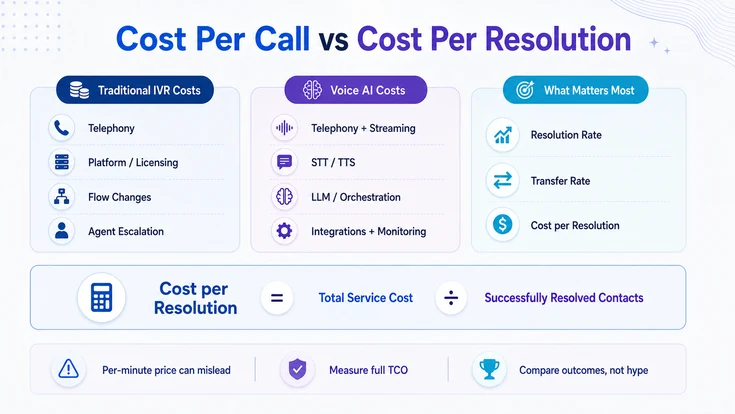
Voice AI vs IVR cost comparison showing traditional IVR costs, Voice AI costs, and cost per resolution
Compare total service economics and cost per successful resolution, not only platform or per-minute pricing.

Traditional IVR Cost Components

  • Telephony
  • IVR or contact-center licensing
  • Implementation and call-flow development
  • Recorded prompts
  • Integration work
  • Platform maintenance and flow changes
  • Support
  • Agent cost after escalation

Voice AI Cost Components

  • Telephony and streaming infrastructure
  • Speech-to-text and text-to-speech
  • Model or LLM usage
  • Orchestration software
  • API calls and knowledge retrieval
  • Integrations and observability
  • Testing, security, and monitoring
  • Human escalation

The biggest hidden expense often appears after the IVR interaction. If a caller spends two minutes navigating a menu and then requires an eight-minute agent call anyway, the organization has paid for both automation and assisted service. Quantifying that overlap accurately is normally the first task in an AI consulting engagement.

Indicative Cost Ranges You Can Plan Against

The figures below are directional planning ranges based on published list pricing for commodity telephony, speech, and model services in 2026. They exist so you have a starting point for a business case, not a quote. Assumptions: an inbound customer-service call of roughly 3–5 minutes, English-language, a single region, and no premium enterprise licensing. Replace every range with your own vendor pricing before you commit budget.

Cost LineTypical Planning RangeBasis
Inbound telephony$0.007 – $0.02 per minutePer connected minute
Streaming speech-to-text$0.015 – $0.04 per minutePer minute of audio processed
Neural text-to-speech$0.010 – $0.03 per minutePer minute of synthesized speech
Model / LLM reasoning$0.01 – $0.10 per conversationVaries with turns, context size, and model tier
Orchestration platform$0.02 – $0.15 per minutePer-minute or per-session licensing
All-in Voice AI, fully automated call$0.15 – $0.60Sum of the lines above, 3–5 minute call
Traditional IVR, contained call$0.05 – $0.25Telephony plus amortized platform and maintenance
Human-assisted call$3.00 – $8.00Loaded agent cost at 6–10 minute handle time
One-off implementation, first intent$25,000 – $120,000Design, integration, guardrails, testing

Read the table this way: Voice AI is roughly two to four times more expensive per call than a contained IVR call, and roughly five to forty times cheaper than a human-assisted call. The migration pays for itself only when the AI absorbs calls that were previously reaching an agent, not when it absorbs calls the IVR was already containing. Track the shift with the same data analytics pipeline that feeds your existing contact-centre reporting.

Cost Per Call vs Cost Per Resolution

Looking only at a per-minute or per-call price can hide the real cost. Use outcome-based formulas instead.

Primary Resolution Formula Cost per Resolution Total Service Cost ÷ Successfully Resolved Contacts
Voice AI Cost Base Voice AI TCO Inputs Telephony + AI Usage + Platform + Infrastructure + Escalation Cost
IVR Cost Base IVR TCO Inputs Telephony + IVR Platform + Maintenance + Agent Escalation Cost
3-Year TCO Implementation + Platform + Usage + Integrations + Maintenance + Human-Assisted Service

Do not build a business case around a vendor's per-minute price alone. What matters is whether the complete system reduces the cost of accomplishing the customer's goal.

Voice AI vs IVR KPIs: What Should You Measure?

A successful migration should not be measured by the number of calls “handled by AI.” A call can technically touch an AI system and still create a terrible customer experience. A stronger measurement framework focuses on outcomes.

KPIFormulaTarget Range to Aim ForWhat It Shows
Task Completion RateCompleted tasks ÷ eligible interactions × 10060% – 80% on automated intentsWhether automation actually solved the request
Containment RateFully automated interactions ÷ eligible interactions × 10030% – 50% overall; 65% – 85% on selected intentsHow much demand stayed within automation
First-Call ResolutionCalls resolved on first contact ÷ total applicable calls × 10070% – 80%Resolution effectiveness
Transfer RateTransferred calls ÷ total calls × 10020% – 40% (lower only if CSAT holds)Reliance on human agents
Abandonment RateAbandoned calls ÷ relevant inbound calls × 100Under 5% – 8%Friction before resolution
Average Handle TimeTotal handling time ÷ handled contacts1 – 3 min automated; 4 – 7 min assistedAgent/contact efficiency
Cost per ResolutionTotal cost ÷ resolved contacts40% – 70% below the assisted-call costReal economic performance
Intent AccuracyCorrectly identified intents ÷ evaluated intents × 10090%+ before wider rolloutUnderstanding quality
Escalation AccuracyCorrect escalations ÷ evaluated escalations × 10090%+Handoff quality
Repeat Contact RateCallers calling again within 7 days ÷ resolved calls × 100Under 10% – 15%Whether the resolution actually held
CSATPositive responses ÷ survey responses × 10080%+, and no worse than the IVR baselineCustomer satisfaction

How to use the target column: these are directional ranges seen across general inbound customer service, not guarantees, and they move sharply by industry: regulated financial and healthcare lines run lower containment, high-volume retail runs higher. Treat them as a sanity check on your pilot results, and replace them with your own IVR baseline as soon as you have 30 days of comparable data from your customer analytics reporting.

Do Not Optimize One KPI in Isolation

A high containment rate sounds impressive, but callers might be “contained” because they cannot escape a bad automation flow. Likewise, reducing average handle time is not useful if first-call resolution falls and customers call again.

Containment + Task Completion + Repeat Contact + CSAT + Cost per Resolution

When Should You Keep IVR or Move to Voice AI?

Moving from IVR to Voice AI should solve a real problem. The best architecture is often the simplest architecture that reliably completes the task.

Keep or Improve IVR When

  • The menu is short.
  • Most customers reach the correct destination quickly.
  • Self-service tasks are simple.
  • There is little variation in caller intent.
  • Operating costs are already low.
  • The system satisfies current experience requirements.
  • Predictable rule execution matters more than conversational flexibility.

A three-option routing menu does not necessarily need an LLM. Adding AI to a simple deterministic process can create unnecessary complexity, and the budget is often better spent on enterprise software development that fixes the systems behind the call.

Voice AI Makes More Sense When

  • Customers frequently ask for an agent.
  • Caller questions are complex or open-ended.
  • Transfer rates are high.
  • Callers often choose the wrong menu option.
  • Agents repeat the same authentication or information-gathering work.
  • Customers express several needs in one call.
  • 24/7 service is important.
  • Backend systems are already accessible through APIs.

“My flight was cancelled, I need to know whether I can get a refund, and if not I want to move my booking to tomorrow.”

How to Migrate from IVR to Voice AI

The safest IVR-to-Voice-AI migration is usually gradual. You do not need to remove working IVR infrastructure before conversational automation proves that it can perform better on selected intents.
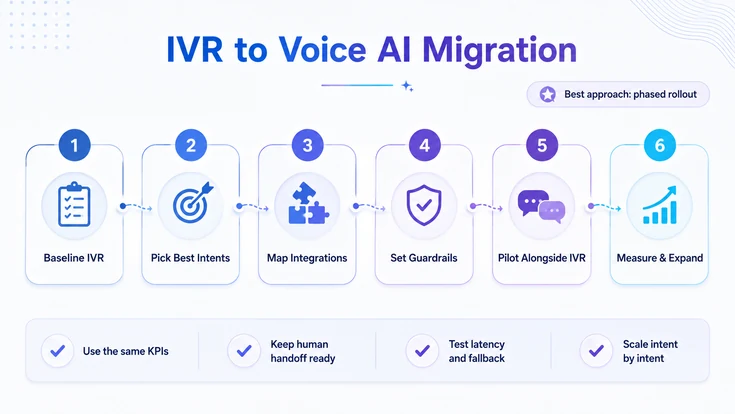
IVR to Voice AI migration roadmap showing phased steps from IVR baseline to pilot, measurement, and expansion
A phased IVR-to-Voice-AI rollout reduces migration risk by validating one measurable use case at a time.

Baseline Your Current IVR

Do not begin by asking which Voice AI vendor to buy. Begin with your existing data.

  • Call volume by intent
  • Containment
  • Transfer rate
  • Abandonment
  • Average handle time
  • First-call resolution
  • Repeat contacts
  • CSAT
  • Peak traffic
  • Cost per resolution

Why it matters: without a baseline, you will not know whether the Voice AI migration actually improved anything.

Find the Best Automation Candidates

Do not start with your most complicated call. Look for intents that are easier to measure and safer to automate.

  • High volume
  • Repetitive
  • Measurable
  • Supported by reliable data
  • Relatively low risk
  • Connected to accessible backend systems

Order status is usually easier to automate safely than a complex dispute involving several policies and account exceptions.

Map Every Required Integration

For each selected use case, identify the systems, actions, and failure paths that the voice agent must handle.

  • What data the agent needs
  • Where that data lives
  • What API is available
  • Which actions the agent can perform
  • Which actions require authentication
  • What happens when an API fails
  • When a human must take over

The conversation can only be as useful as the systems behind it. Where those systems are older platforms without usable endpoints, legacy software modernization has to come before conversational automation, not after it.

Define Guardrails Before Launch

Decide what the agent can and cannot do before production traffic reaches the new experience.

  • Authentication requirements
  • Approved data sources
  • Transaction limits
  • Prohibited actions
  • Escalation triggers
  • Fallback responses
  • Timeout behavior
  • Sensitive-data rules
  • Human handoff conditions

Run Voice AI Alongside the Existing IVR

Route a controlled portion of eligible traffic to the Voice AI system instead of replacing the full IVR on day one.

  • Keep IVR as fallback
  • Preserve escalation paths
  • Maintain recovery routes
  • Route unsupported intents safely

This creates a measurable comparison between the old and new experience.

Compare Both Systems Using the Same KPIs

Measure Voice AI against the IVR baseline and keep the definition of success consistent throughout the pilot.

MetricExisting IVRVoice AI PilotDecision
Task completionBaselinePilot resultImprove / expand
Transfer rateBaselinePilot resultImprove / expand
AHTBaselinePilot resultEvaluate
Repeat callsBaselinePilot resultEvaluate
CSATBaselinePilot resultEvaluate
Cost per resolutionBaselinePilot resultEvaluate

Expand Intent by Intent

Once one use case performs consistently, add another. A sensible progression might look like:

FAQ Order Status Scheduling Account Updates Transactions Complex Service

Each new workflow should pass testing, security review, load testing, and escalation validation before broader deployment.

How Long Each Phase Actually Takes

Timelines below assume a mid-sized contact centre, one business unit, one language, an existing cloud telephony platform, and APIs that already exist even if they need work. Add roughly 40% to 60% for regulated industries, on-premise telephony, or an integration layer that has to be built from scratch.

PhaseTypical DurationExit Condition
Baseline current IVR2 – 4 weeksEvery KPI in the table above has a recorded number
Select and design the first intent2 – 3 weeksOne intent chosen, conversation design signed off
Integration mapping and build4 – 8 weeksAll required APIs callable, failure paths handled
Guardrails, security, and test2 – 4 weeksSecurity review passed, load and escalation tests green
Parallel pilot beside the IVR4 – 6 weeksEnough call volume for a statistically usable comparison
Measure and decide1 – 2 weeksGo / no-go against the baseline, in writing
First intent live in production12 – 20 weeks totalSustained performance at or above baseline
Each additional intent wave4 – 8 weeksSame exit criteria, reusing the integration layer

The long pole is almost never the AI. In most programmes, integration mapping and security review together consume more calendar time than conversation design and model work combined. Plan the schedule around your slowest system owner, not around the voice vendor's demo timeline.

IVR to Voice AI Migration Checklist

Before increasing production traffic, confirm that architecture, integrations, security, fallback behavior, and measurement are ready.

  • Current IVR KPIs have been recorded.
  • Priority call intents have been identified.
  • Required APIs are stable and documented.
  • CRM and business-system integrations have been tested.
  • Knowledge sources are current.
  • Authentication flows are defined.
  • Sensitive information is protected.
  • Voice AI guardrails are documented.
  • Unsupported intents have a fallback.
  • Human escalation has been tested.
  • Conversation context passes correctly during handoff.
  • Latency has been tested under realistic conditions.
  • Peak concurrency has been tested.
  • Call-recording and consent requirements have been reviewed.
  • Rollback criteria are documented.
  • Production monitoring is active.
  • KPI reporting uses the same definitions as the IVR baseline.
Migration planning

Planning an IVR-to-Voice-AI Migration?

Evaluate your current call flows, telephony, integrations, automation opportunities, security requirements, and performance benchmarks before selecting a Voice AI architecture.

Talk to a Voice AI Expert

Security and Compliance in Voice AI Architecture

Security becomes especially important when Voice AI moves beyond answering questions and starts performing actions. The system may interact with customer identities, payment information, medical information, account details, or internal business records. Anchoring these controls to a neutral, publicly available framework such as the NIST AI Risk Management Framework gives the programme a reference point that is independent of any voice vendor.

Encryption & AccessProtect data in transit and at rest, and limit access to the users and services that require it.
Authentication & AuthorizationVerify callers where required and separate identity checks from permitted actions, in line with the NIST Digital Identity Guidelines.
Secrets & Tool PermissionsProtect credentials and give each agent/tool only the permissions required for approved workflows.
Retention & RedactionDefine what data is stored, for how long, and what sensitive information must be removed or masked.
Audit & ConsentMaintain audit trails and review call recording, consent, and incident-response requirements.
Guardrails & EscalationUse policy boundaries, prohibited-action rules, and human escalation when the request exceeds approved automation.
A voice agent should receive only the access needed to complete its approved tasks. Do not give an AI system broad backend permissions simply because that makes integration easier.

Voice AI vs IVR: Which One Should You Choose?

Use the business requirement, not the technology trend, to make the decision.

Business SituationBetter Starting Point
Route callers to three departmentsIVR
Collect predictable keypad informationIVR
Support open-ended customer questionsVoice AI
Automate repetitive conversational serviceVoice AI
Execute actions through backend APIsVoice AI
Existing IVR works but some branches create frictionHybrid
High-risk workflow requires strict controlDeterministic flow or tightly guardrailed hybrid
Legacy systems lack usable APIsImprove integration layer first
Need conversational service with human backupVoice AI + agent handoff
Need emergency fallback routingRetain IVR / telephony fallback
Simple rule of thumb Use IVR when the customer needs to choose. Use Voice AI when the customer needs to explain.

When the customer expects the system to understand, retrieve information, take action, and continue the conversation, Voice AI becomes much more compelling.

Voice AI vs IVR Is Often a Hybrid Decision

It is tempting to frame the market as “old IVR vs new AI.” Real contact-center architecture is usually more nuanced.

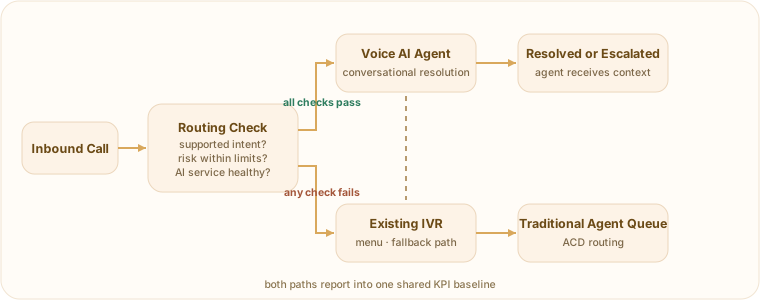
Hybrid Voice AI and IVR routing diagram. An inbound call arrives at a routing decision point that checks three conditions: whether the intent is one of the supported automated intents, whether the risk level is within approved limits, and whether the Voice AI service is healthy. If all three pass, the call goes to the Voice AI agent, which either resolves the request or escalates to a human agent with context. If any check fails, the call falls back to the existing IVR menu, which routes to the traditional agent queue. A dashed monitoring line shows both paths reporting into one shared KPI baseline.
Hybrid routing: a single decision point keeps the proven IVR as the fallback while Voice AI takes only the intents it is approved and healthy enough to handle.

Conversational Front Door

Use Voice AI for the first interaction while retaining existing telephony routing underneath.

After-Hours Automation

Deploy Voice AI during off-hours while keeping established daytime routing and agent operations.

Intent-by-Intent Rollout

Automate selected high-volume intents while regulated or highly complex calls remain with human agents.

That is why migrating from IVR to Voice AI should be treated as a service-design and systems-integration project, not simply a software replacement. For carriers and contact-centre operators it usually sits alongside broader telecom software development work.

Final Thoughts: Move From Routing Calls to Resolving Customer Needs

The most important question in the Voice AI vs IVR debate is not whether artificial intelligence is more advanced. It is whether your phone experience helps customers accomplish what they called to do.

A good IVR can still route simple calls efficiently. A well-designed Voice AI agent can go further when customers need to explain a problem, retrieve information, complete a task, or move through a conversation that does not fit neatly inside a menu tree.

Before migrating, benchmark your current IVR. Calculate the real cost per resolution. Identify the call types where conversational automation can create measurable value. Then pilot those use cases, compare KPIs, and expand only when the data supports it.

That approach turns IVR modernization from an AI experiment into a measurable contact-center strategy. Delivering it usually draws on AI development services, generative AI development services, and machine learning development in the same programme.

Build a measured migration roadmap

Move From Call Routing to Intelligent Resolution

A phased approach can help you modernize high-value interactions without disrupting the call flows that already work.

Talk to a Voice AI Expert

Frequently Asked Questions About Voice AI vs IVR

These answers cover the most common technical and buyer questions about Voice AI architecture, IVR replacement, costs, KPIs, and migration.

Is Voice AI the Same as Conversational IVR?

Not exactly. Conversational IVR usually adds speech recognition and more natural interaction to an IVR environment. Modern Voice AI can go further by combining real-time speech processing, conversational reasoning, knowledge retrieval, API integrations, workflow execution, and generated speech. The terms sometimes overlap in vendor marketing, so compare actual capabilities rather than product labels. The same distinction applies on chat channels, where AI chatbot development covers the equivalent text-based architecture.

Can Voice AI Completely Replace IVR?

It can replace many IVR flows, but complete replacement is not always necessary. Simple routing, deterministic workflows, emergency fallback, and some regulated processes may still work well with IVR. Many organizations will get better results from a hybrid architecture that introduces Voice AI where conversational automation creates measurable value.

How Much Does Voice AI Cost Compared With IVR?

As a planning range, a fully automated Voice AI call costs roughly $0.15 to $0.60, a contained IVR call roughly $0.05 to $0.25, and a human-assisted call roughly $3.00 to $8.00, with first-intent implementation commonly landing between $25,000 and $120,000. Voice AI is therefore more expensive per call than IVR and far cheaper than an agent, which means it only pays back when it absorbs calls that were previously reaching a human. Validate every figure against your own vendor pricing, and compare total cost of ownership and cost per successful resolution rather than per-minute rates.

What Are the Most Important Voice AI KPIs?

Important Voice AI KPIs include task completion rate, containment rate, first-call resolution, transfer rate, abandonment, average handle time, repeat-contact rate, intent accuracy, escalation accuracy, CSAT, and cost per resolution. As directional targets for general inbound service, aim for 60% to 80% task completion on automated intents, 30% to 50% overall containment, 70% to 80% first-call resolution, abandonment under 5% to 8%, intent and escalation accuracy above 90% before wider rollout, and CSAT at 80% or above and no worse than the IVR baseline.

How Long Does an IVR-to-Voice-AI Migration Take?

For a mid-sized contact centre with existing cloud telephony and workable APIs, expect roughly 12 to 20 weeks to get the first intent live in production: 2 to 4 weeks to baseline, 2 to 3 weeks to design, 4 to 8 weeks for integration, 2 to 4 weeks for guardrails and testing, and 4 to 6 weeks of parallel pilot. Each additional intent wave typically adds 4 to 8 weeks. Add 40% to 60% for regulated industries, on-premise telephony, or an integration layer built from scratch. Integration and security review, not the AI work, are usually the longest phases.

Can Voice AI Work With an Existing IVR?

Yes. A Voice AI system can be introduced alongside an existing contact-center and IVR environment. Calls can be routed between conversational automation, traditional flows, and human agents according to intent, risk, system availability, or business rules.

What Is the Biggest Difference Between Voice AI and IVR Architecture?

IVR primarily follows predefined paths. Voice AI adds a conversational processing layer that can interpret speech, maintain context, retrieve information, call backend systems, and generate responses. The architecture is therefore less dependent on forcing every caller through a fixed menu tree.

Is Traditional IVR Still Worth Using?

Yes. IVR is still useful for short menus, simple self-service, deterministic workflows, fallback routing, and situations where introducing conversational AI would add complexity without improving the customer's outcome. The right question is not whether IVR is old; it is whether the architecture still meets the business requirement.

ABOUT THE AUTHOR

Colin Leede

Colin is an AI expert with 10 years of experience in artificial intelligence, machine learning, and advanced analytics. He helps businesses unlock the power of AI to drive innovation, improve efficiency, and enhance decision-making, enabling companies to stay ahead in the digital era.
PLAN YOUR SOLUTION

More Insights
You Might Find Useful

Explore expert perspectives, practical strategies, and real-world solutions related to this topic.

Enterprise AI RFP dashboard showing vendor evaluation, security, data, integrations, cost, and final vendor selection.

What Should an Enterprise AI RFP Include?

An enterprise AI RFP should define what the business needs,

AI bias audit framework dashboard showing fairness metrics, disparate impact, risk level, and audit evidence for high-risk AI decisions

AI Bias Audit Framework for High-Risk Decisions

AI systems now support decisions in hiring, lending, healthcare, education,

AI supply chain security with model provenance, AI-BOMs, signed models, and third-party risk

AI Supply Chain Security: Provenance, AI-BOMs & Model Signing

  AI systems now depend on external models, datasets, APIs,

Let’s Talk About Your Product

Get expert guidance on scope, architecture, timelines, and delivery approach so you can move forward with confidence.

What happens next?