Comparing AI chatbot cost build vs license is the first budget question most teams face. The honest answer is uncomfortable, because neither option is cheaper overall.
One path costs less sooner. The other costs less later.
Licensed platforms bill you per resolution. Published 2026 rates sit between $0.50 and $2.00 for every conversation the assistant closes.
A custom build costs money once, then runs on tokens priced at roughly one to eighteen cents per chat. That single gap drives the entire argument.
Price is only half the story, though. Data residency, vendor lock in, and roadmap control all pull the decision one way or the other.
This guide walks both sides with real vendor numbers, a live break even calculator, and a framework you can run against your own ticket data this week.
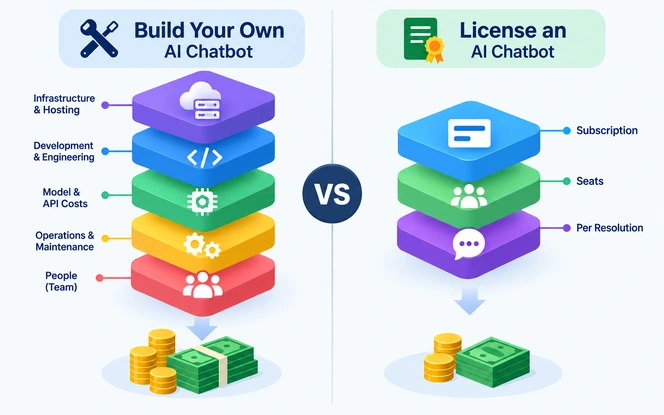
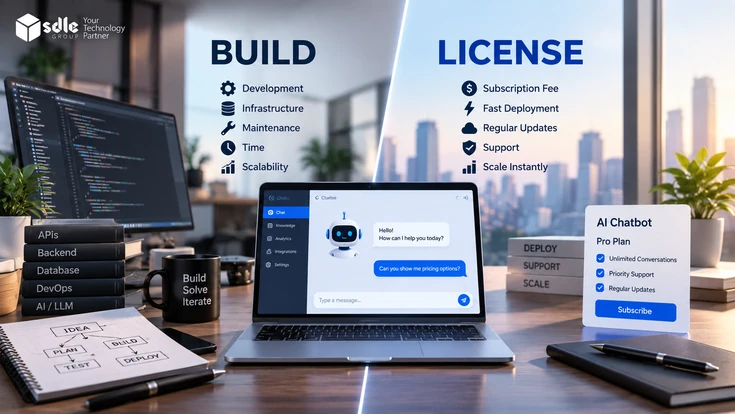
Before the detail, here is the whole trade off in a single view. One side buys speed, and the other buys ownership.
Because the numbers underneath move with traffic, the right answer changes as you grow.
Two cost structures, and two very different risk profiles. Hover either side to bring it forward.
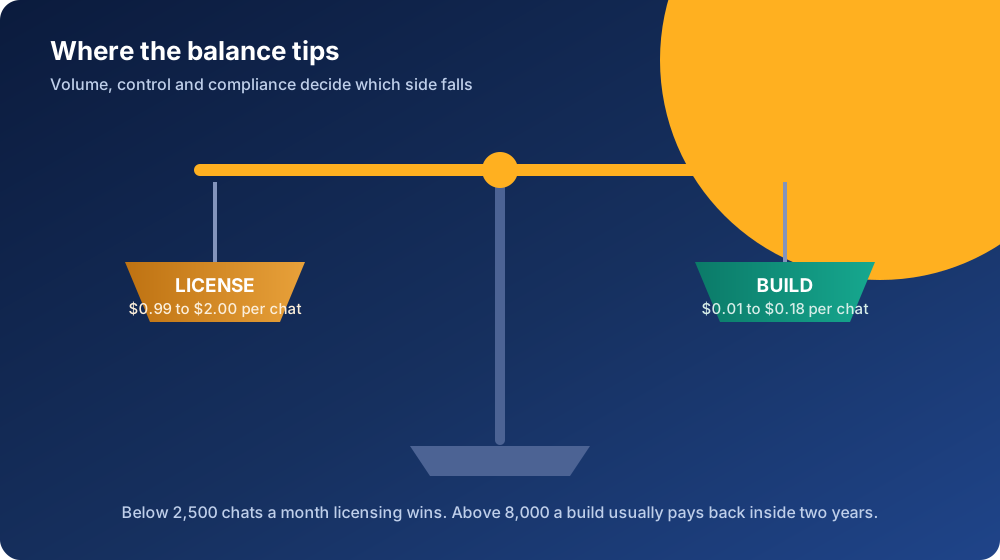
LICENSE
$0.99 to $2.00 You pay per resolution, every month, forever. Live in days, yet you fund no engineering and own nothing at the end.BUILD
$0.01 to $0.18 Model cost per chat once the system belongs to you. Launch takes eight to twenty weeks, although the asset then stays on your side.AI Chatbot Cost Build Vs License: The Short Answer
License when your use case is standard and your volume stays modest.
Build when volume is high, when regulators watch the data, or when the assistant must act inside your core systems.
The Volume Threshold That Settles Most Cases
Above all, watch the volume threshold. Below roughly 2,500 AI handled conversations a month, licensing almost always wins.
Past 8,000 a month, a build usually wins inside two years. Between those points sits a grey zone where control, rather than price, should decide.
What Building And Licensing Actually Mean
Loose definitions create bad quotes. Pin down the scope before you trust any cost model.
You Configure Someone Else's Product
The vendor hosts, secures, updates, and monitors everything. Meanwhile, you supply the knowledge base, connect your tools, set guardrails, and launch.
- Live in days to six weeks
- Billed per seat, per resolution, or both
- Roadmap controlled by the vendor
- Your transcripts live in their tenancy
You Own The System End To End
You assemble retrieval, orchestration, integrations, and evaluation around a model you choose. As a result, the system becomes an asset rather than a renewal.
- Live in eight to twenty weeks
- Capital cost once, low marginal cost after
- Full control of data location and model
- Maintenance stays with your team
Scoping warning. A retrieval assistant that answers policy questions and an agentic system that issues refunds are different products.
Vendors sell both as an "AI chatbot", yet their price tags differ by a factor of ten. Matching architecture to job protects a budget more than any negotiation will.
Want Your Own Number Instead Of A Market Average?
Send us your monthly conversation volume, your integration list, and your compliance constraints. Our architects will then model both paths and return a costed recommendation.
Get a free cost comparisonBreak Even Calculator For AI Chatbot Cost Build Vs License
Move the sliders below. The calculator compares three years of licensing spend against a build plus its running costs, then reports the month where the two totals meet.
Estimate Your Break Even Month
Planning estimates based on published 2026 vendor rates and typical delivery costs.
The model uses conservative running costs: tokens at roughly $0.07 per conversation, plus $600 a month for hosting, vector storage, monitoring, and maintenance.
Already holding a quote? Adjust the build slider to match it.
The Cost Curve That Decides It
Plot cumulative spend against months in production, and the shape becomes obvious.
Licensing starts near zero, then climbs forever in a straight line. Building starts high, flattens after launch, and rises only with usage.
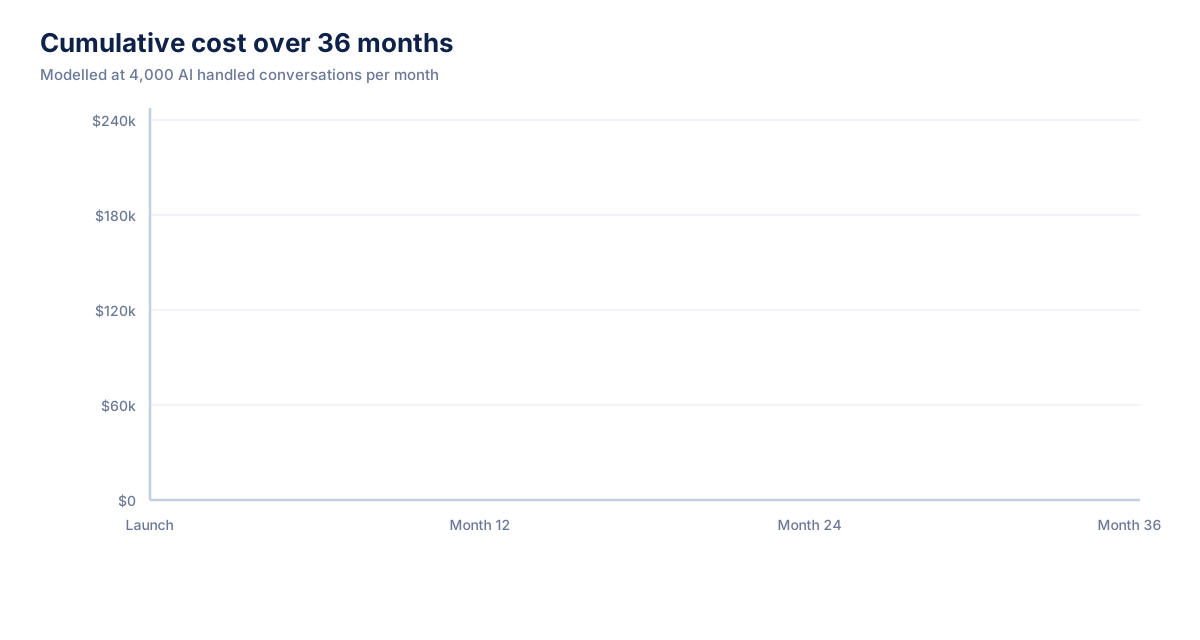
Because the crossing point moves with volume, no single answer fits every team. At 800 conversations a month it may never arrive at all.
Run 15,000 a month instead, and it can arrive before the first anniversary. An industry average is therefore close to useless for planning.
What Licensing An AI Chatbot Costs In 2026
Pricing shifted sharply through 2025 and 2026. Seat based plans gave way to outcome based billing across every major vendor.
Your bill now grows when the assistant performs well.
Published Vendor Rates
| Vendor | Rate | Billing unit | Platform cost on top |
|---|---|---|---|
| HubSpot Customer Agent | $0.50 | Resolved conversation | Hub subscription required |
| Fin (formerly Intercom) | $0.99 | Outcome, one charge per chat | $29 to $139 per seat, 50 outcome minimum |
| Gorgias | $0.90 to $1.00 | Resolution | Base plan required |
| Zendesk AI Agents | $1.20 to $2.00 | Verified resolution | $55 to $169 per seat, plus $50 Copilot add on |
| Salesforce Agentforce | $2.00 | Conversation, failures billed too | Service Cloud from $175 per user |
| Sierra, Decagon, Ada | Not published | Custom outcome contracts | $50,000 to $600,000+ per year |
Rates as of 7 September 2026, taken from each vendor's own published pricing page.
One pending change is worth flagging. Salesforce signed a definitive agreement on 15 June 2026 to acquire Fin, formerly Intercom, for approximately $3.6 billion.
That deal is expected to close during Salesforce's fiscal 2027 and has not completed, so Fin and Agentforce still price and operate separately today.
Treat the $0.99 outcome rate as stable for now, and re-check it before any multi year commitment.
Where Licensed Pricing Gets Risky
Two structural risks deserve attention.
First, the vendor defines what counts as a "resolution". Some models therefore charge you for a conversation where the customer simply gave up.
Second, you still pay for human seats on escalations. The software cost never disappears entirely.
How The Gap Scales With Volume
The scale effect is severe. At 100,000 monthly resolutions, the gap between a $0.99 rate and a $1.50 rate reaches roughly $612,000 a year.
Against a $2.00 per conversation model, that gap widens past $1.2 million annually.
Licensing also hides behind more than one number, because vendors bill subscription, seats, setup, and usage on separate clocks.
What Building A Custom AI Chatbot Costs In 2026
Build budgets follow architecture, not ambition. Four architectures dominate the market, and each one carries a very different engineering load.
Build Cost By Architecture
| Architecture | Build cost | Timeline | Best suited to |
|---|---|---|---|
| Rule based flows | $5,000 to $20,000 | 2 to 4 weeks | FAQ deflection and simple routing Entry |
| NLP assistant | $15,000 to $60,000 | 4 to 8 weeks | Intent handling and lead capture |
| RAG on your knowledge base | $30,000 to $120,000 | 8 to 14 weeks | Grounded answers from your documents Most common |
| Agentic, takes real actions | $80,000 to $250,000+ | 12 to 24 weeks | Refunds, bookings and system writes |
Where The Money Actually Goes
- Discovery and conversation design takes 10 to 15 percent. Skip it, and you reliably overspend later.
- Data preparation surprises almost every project. Because answers depend on clean sources, your team must clean, chunk, and test every document first.
- Integrations drive the largest variance. One CRM connector is routine, whereas six legacy systems form a project of their own.
- Evaluation harnesses separate a demo from production, so your team has to measure answer quality continuously.
- Running costs land near 15 to 20 percent of build cost each year, plus tokens and storage.
Running Costs After Launch
Operating spend for a mid sized RAG assistant typically sits between $1,000 and $15,000 a month.
Vector storage adds $25 to $2,000 depending on corpus size, while serverless hosting for 10,000 conversations often costs under $100.
Above roughly 50,000 conversations a month, self hosting an open weight model starts beating API pricing. Teams that switched have reported 60 to 70 percent reductions in model spend.
Our comparison of on premise AI chatbots vs cloud LLMs covers that trade off in detail.
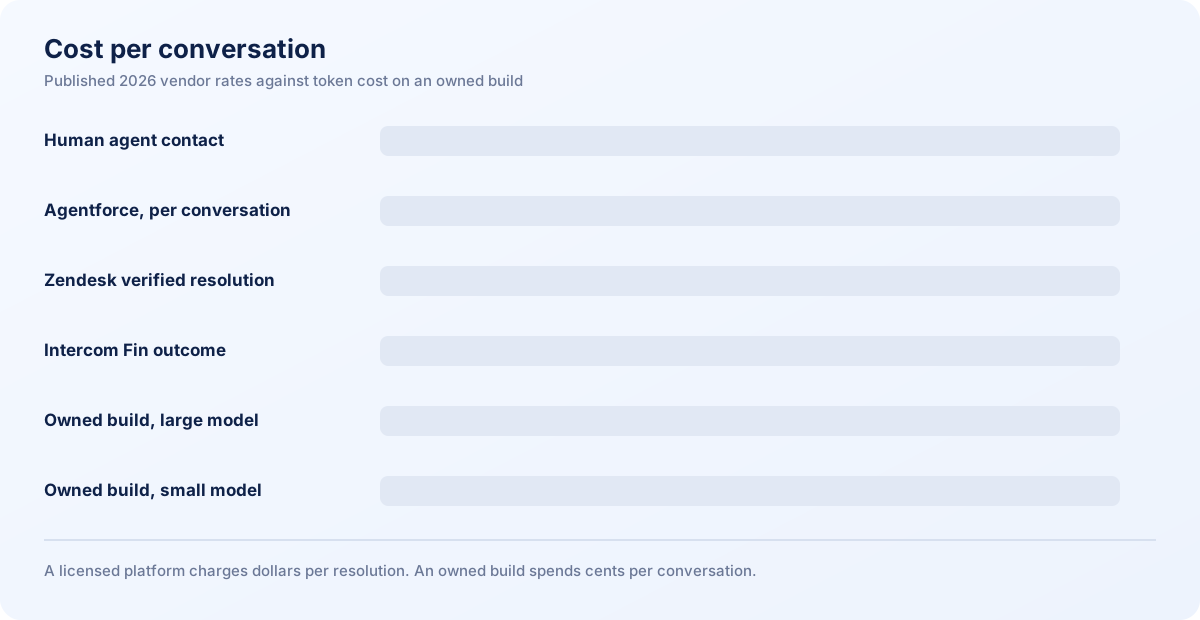
Cost Per Conversation, Side By Side
This single comparison explains the entire debate. A licensed platform charges dollars per resolution, whereas an owned build spends cents per conversation on tokens.
Nevertheless, the owned build carries fixed costs that a licence does not.
You fund engineering time, monitoring, and maintenance whether the assistant handles 500 conversations or 50,000. That fixed base is exactly what the calculator above amortises.
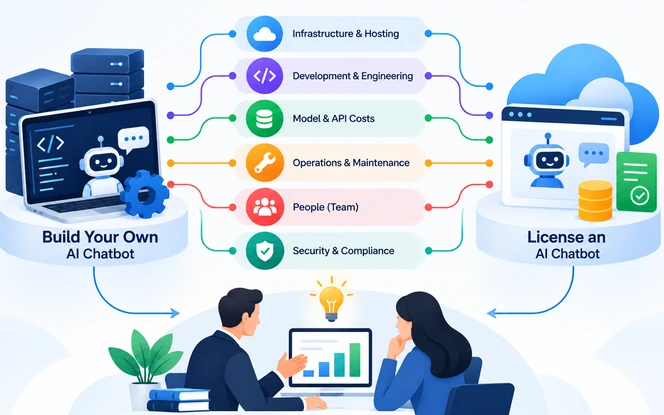
Six Hidden Costs Nobody Puts In The Quote
These items rarely appear on a pricing page. Yet they turn clean business cases into awkward conversations nine months later.

Budget for them explicitly on both paths.
Content maintenance, escalation seats, and internal staff hours turn a confident forecast into an overrun most often. None of them disappears simply because a vendor hosts the software.
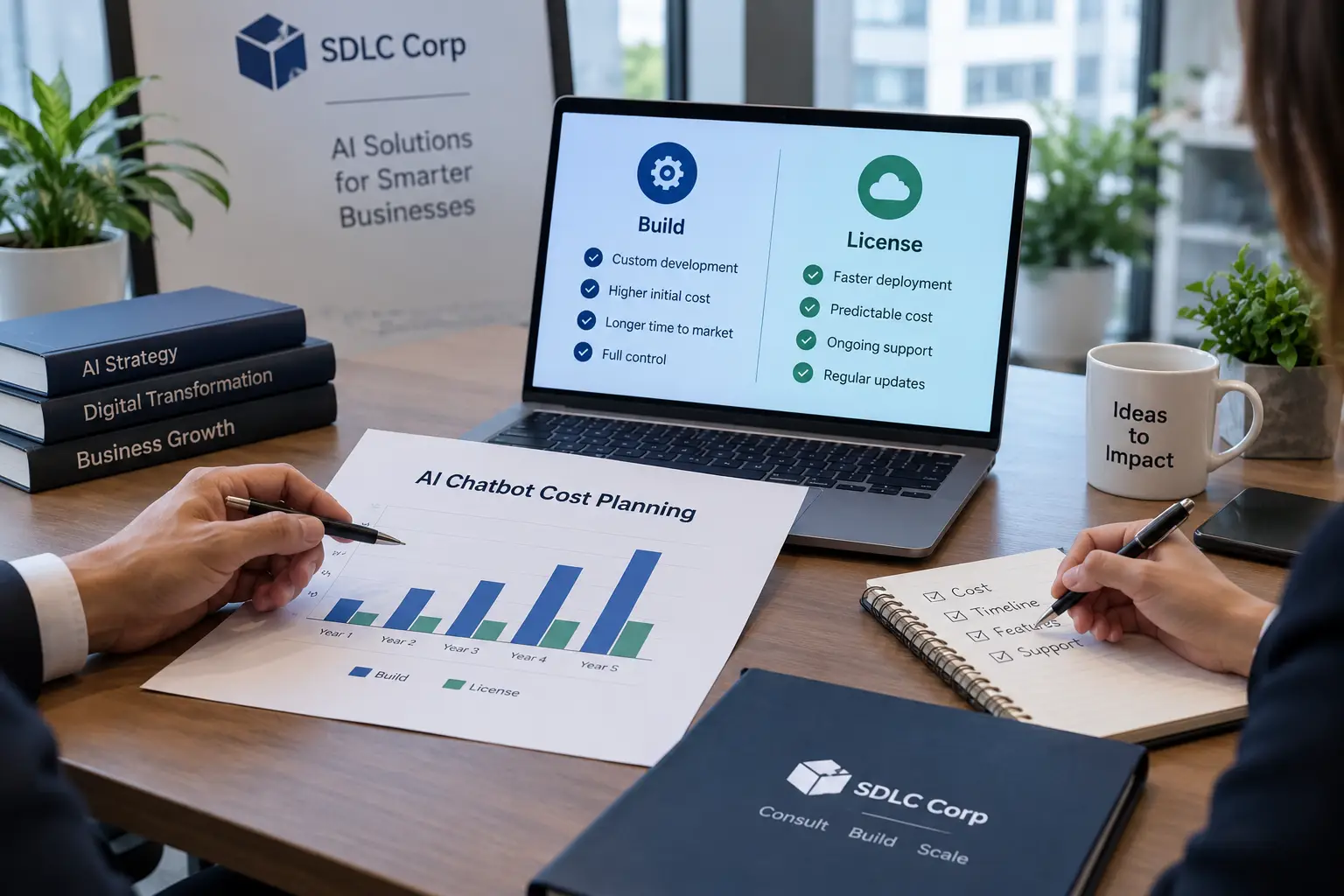
Get A Five Year Model, Not An Industry Average
We compare licensing spend, build spend, and the hybrid route side by side using your real ticket volume and integration map. Most teams find the winning line surprising.
Talk to an AI solution architectAI Chatbot Cost Build Vs License Across Five Years
The table below models four common profiles. Treat these figures as planning estimates rather than quotes.
Licensing assumes a mid market platform at $0.99 per resolution plus seats, while building assumes a RAG assistant with normal running costs.
| Profile | Chats per month | Licensing, 5 years | Building, 5 years | Verdict |
|---|---|---|---|---|
| Small support team | 600 | $42,000 to $72,000 | $95,000 to $145,000 | License |
| Growing mid market brand | 4,000 | $195,000 to $330,000 | $155,000 to $240,000 | Model it |
| Regulated enterprise | 8,000 | $380,000 to $760,000 | $260,000 to $470,000 | Build |
| High volume enterprise | 15,000 | $540,000 to $1.1M | $290,000 to $490,000 | Build |
Notice that the second row stays genuinely ambiguous. For that profile, control and data policy should decide the outcome, because the two totals overlap.
Across five years, AI chatbot total cost of ownership swings most on monthly volume.
A Decision Framework You Can Run This Week
Run your situation through four questions in order. Usually the first firm yes settles the direction, and the remaining answers shape scope instead.
When Each Option Clearly Wins
License When
- Queries are standard support and FAQ traffic
- Monthly AI volume sits below 2,500
- Your team has no spare engineering capacity in house
- You need a working assistant within six weeks
- The chatbot is a channel, not a differentiator
Build When
- Volume is high and still growing
- You handle health, finance, or government data
- The assistant must write into core systems
- The experience is part of the product you sell
- Roadmap dependence on a vendor is unacceptable
The Hybrid Path Most Teams Overlook
Teams frame build and license as opposites. In practice, the strongest programmes start on one path and then migrate on a schedule.
A licensed platform first shows you what customers actually ask. Afterwards, you build the custom system against evidence rather than assumptions.
This sequence protects against both classic failures. You avoid a six figure build nobody needed, and a runaway resolution bill on a workflow you should have owned.
Six Questions To Ask Before You Sign
Whichever direction you lean, get written answers to these. Otherwise vague replies become invoices later.
How SDLC Corp Approaches This Decision
We quote custom assistants every week. A meaningful share of those conversations end with a recommendation to license instead.
That advice is deliberate, because a build that cannot justify its own total cost of ownership serves nobody.
How We Scope It
Our scoping starts with your ticket data rather than a feature list. First, we segment volumes by intent.
Then we map integration depth against your existing stack, and we document compliance constraints before proposing any architecture.
Only then do we produce a cost model, and it covers both paths so the comparison stays honest.
Where Our Teams Fit
When a build is the right call, delivery runs through the same teams behind our AI chatbot development company practice and our wider AI development services.
Retrieval architecture, evaluation harnesses, and secure deployment sit inside our generative AI consulting services. Teams that prefer to keep engineering in house can hire generative AI developers on a dedicated basis instead.
Organisations that want the capability without owning infrastructure often start with our AI as a Service model, while strategy level engagements run through our AI consulting company team.
For a worked example of how use case specifics move a budget, our breakdown of the cost to develop an AI assistant or chatbot app in healthcare shows how the same architecture prices differently once compliance enters scope.
Bring Your Numbers, We Will Bring The Model
Share your monthly conversation volume, integration list, and compliance requirements. You will receive a side by side five year comparison covering licensing, building, and the hybrid route.
Request your cost modelFinal Word
AI chatbot cost build vs license is not a price question. It is a curve question.
Licensing buys speed, then hands you a bill that grows with traffic. Building buys control, and hands you an asset that gets cheaper per conversation over time.
So run the four questions, model both curves across thirty six months, and check where they cross.
If that point falls inside your planning horizon, a build deserves serious evaluation. Should it fall outside, licensing is the faster and cheaper call, and you can always revisit the decision once volume changes.
For wider context, independent compilations of AI customer service benchmarks and current published AI agent pricing models help confidence check any vendor quote you receive.
Frequently Asked Questions
Is it cheaper to build or license an AI chatbot?
On AI chatbot cost build vs license, licensing costs less for the first twelve to twenty four months, because you fund no upfront engineering.
Building costs less once volume climbs, usually above 2,500 to 8,000 AI handled conversations a month, since an owned system spends cents per chat rather than dollars per resolution.
How much does a custom AI chatbot cost to build in 2026?
Architecture drives the price. Rule based bots run $5,000 to $20,000, while NLP assistants run $15,000 to $60,000.
RAG assistants grounded on your knowledge base run $30,000 to $120,000, whereas agentic systems that take actions run $80,000 to $250,000 or more.
Finally, add 15 to 20 percent of build cost each year for maintenance.
What is per resolution pricing and why does it matter?
Per resolution pricing charges you each time the assistant closes a conversation. Published 2026 rates range from $0.50 to $2.00.
It matters because cost then scales with success rather than headcount. For example, at 3,000 resolutions a month on a $0.99 rate, resolution fees alone reach about $2,970 before you count a single seat licence.
Does the Salesforce acquisition of Fin change licensed pricing?
Not yet. Salesforce signed a definitive agreement on 15 June 2026 to acquire Fin, formerly Intercom, for approximately $3.6 billion, and the deal is expected to close during Salesforce's fiscal 2027.
Until it closes, Fin continues to operate and price independently at its published $0.99 outcome rate. Re-check the rate card before committing to any multi year contract.
How long does each option take to go live?
A licensed platform can launch within days to six weeks, depending on content readiness. A custom build, by comparison, normally reaches production in eight to twenty weeks.
Integration count and data quality drive that range far more than model selection does.
Can we license first and build later?
Yes, and this hybrid sequence carries the lowest risk. First, the licensed platform gathers real transcripts and volume data.
Then you scope the build against that evidence, and traffic migrates intent by intent. However, check export terms before signing, since flows and analytics history do not always transfer cleanly.
Which option suits regulated industries better?
Building usually fits better when you handle health, financial, or government data, because you then control residency, redaction, retention, and audit logging directly.
Some enterprise platforms do offer compliant deployment options, so verify vendor certifications and hosting regions in writing first.
What ongoing costs apply after launch?
Both paths carry content maintenance, escalation seats, quality monitoring, and internal staff time.
Custom builds add hosting, vector storage, and tokens, typically $1,000 to $15,000 a month at mid size, while licensed platforms add subscription growth and usage fees.
Therefore treat year one running cost as a separate budget line.
Does self hosting an open model reduce cost?
It can, above roughly 50,000 conversations a month. Teams that moved from proprietary APIs to open weight models have reported 60 to 70 percent reductions in model spend.
Below that volume, however, GPU hosting and DevOps overhead usually outweigh the token savings.