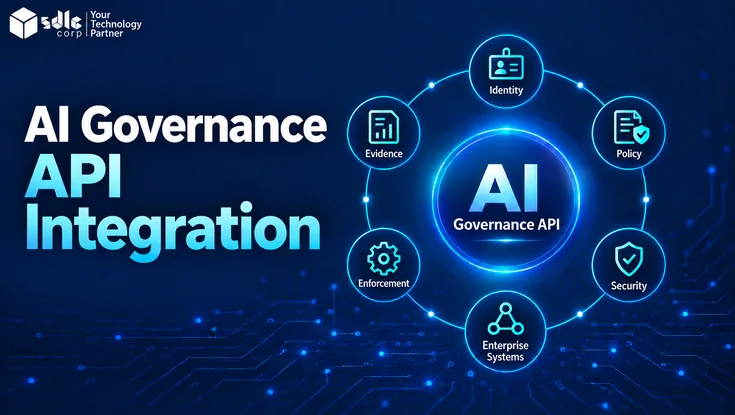
In short, AI governance API integration connects policy to the identity, security, data, and business systems where AI actually acts.
An agent may authenticate through an identity provider, retrieve a CRM record, invoke a tool, and call a model in one workflow. Therefore, each boundary needs enough context to decide what policy allows and enough evidence to show what happened.
A useful design asks five questions: Who is acting? What action and resource does it touch? Which policy applies? How will the system enforce the decision? What evidence will the system keep?
Why API-Connected Governance Matters
Of course, governance documents matter. However, production controls depend on integrations. Identity, API gateways, data classification, DLP, approval workflows, and telemetry must receive or supply the facts needed for a decision.
In IBM’s 2025 Cost of a Data Breach analysis, 97% of organizations in the study that experienced an AI-related security incident reported lacking proper AI access controls.
Moreover, 63% of the 600 researched organizations had no AI governance policy in place. Therefore, these are study findings, not population-wide rates.
Similarly, PwC’s 2025 US Responsible AI Survey reports that organizations are embedding testing, data-access controls, and telemetry into AI design and deployment. Because the surveyed group comprised 310 US business leaders, read its findings in that context.
Key Takeaways
- Connect AI applications and agents to identity, policy, security, data, and enterprise platforms at the point of action.
- Exchange the subject, action, resource, context, risk signals, request ID, and applicable policy version.
- Let a Policy Decision Point (PDP) evaluate the request and a Policy Enforcement Point (PEP) apply the result.
- Treat agent identity and tool discovery as distinct from permission to perform an action.
- Support obligations such as masking, logging, restricted fields, or human approval, then confirm that enforcement applied them.
- Design for latency, outages, policy changes, and correlated evidence before production rollout.
What Is AI Governance API Integration?
In essence, AI governance API integration is the exchange of identity, context, policy decisions, and enforcement outcomes between AI workloads and the enterprise systems that govern them.
For higher-risk actions, an application or gateway submits the relevant facts, receives a decision, and applies it before execution.
Notably, the NIST AI Risk Management Framework organizes AI risk work around GOVERN, MAP, MEASURE, and MANAGE. Likewise, ISO/IEC 42001:2023 specifies requirements for an AI management system.
However, neither prescribes a universal governance API; APIs are one way to implement an organization’s controls.
Policy decisions and enforcement
A PDP evaluates whether policy permits an action. Meanwhile, a PEP, such as an application, gateway, or tool layer, applies that decision. The OpenID AuthZEN Authorization API 1.0 standardizes communication between PDPs and PEPs for authorization.
Therefore, treat it as an authorization interface rather than a complete AI governance standard.
AI governance API integration vs. API governance
| Dimension | API governance | AI governance API integration |
|---|---|---|
| Primary object | APIs and their lifecycle | AI applications, agents, models, tools, data, and actions |
| Focus | API design, security, operation, and versioning | Identity, context, policy, enforcement, and evidence for AI activity |
| Typical controls | Authentication, authorization, schemas, rate limits | Contextual authorization, DLP, tool controls, obligations, auditability |
| Role of APIs | Governed asset | Mechanism for exchanging and enforcing decisions |
Boundary to remember: securing an API alone does not establish whether a specific AI agent should use it for a particular purpose, data class, or downstream action.
Core Architecture for AI Governance API Integration
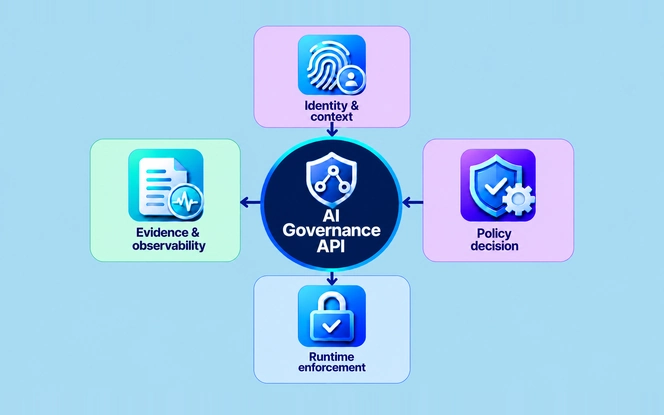
Identity
Identify the human, service, application, agent, and any delegated actor.
Context
Capture action, resource, classification, purpose, model, tool, and relevant risk signals.
Policy
Evaluate the request against an identifiable, versioned rule set.
Enforcement
Allow, restrict, block, or escalate through a system able to control the action.
Evidence
Record the decision and actual outcome for investigation and review.
The control plane holds policies, identity metadata, risk rules, approvals, and configuration. By contrast, the data plane contains live requests, model and tool calls, API activity, and enforcement. As a result, a correlation ID should link the decision and the resulting action.
Governance API Data Exchange and Contract Design
Naturally, a decision is only as useful as its input. Therefore, define a stable, versioned contract for identity, action, resource, purpose, classification, risk, policy, request ID, and timestamp.
At the same time, capture only the data needed for the decision; avoid placing raw sensitive prompts in routine authorization logs.
Illustrative request and response
{
  "request": {
    "request_id": "req-123", "subject": "user-42", "agent_id": "support-agent",
    "action": "update_order", "resource": "order-789", "tool": "crm-api",
    "data_classification": "confidential", "business_purpose": "customer_support",
    "policy_version": "v4", "timestamp": "2026-10-14T09:00:00Z"
  },
  "response": {
    "request_id": "req-123", "decision": "allow",
    "obligations": ["log_action", "restrict_fields"],
    "policy_id": "order-update", "policy_version": "v4",
    "decision_timestamp": "2026-10-14T09:00:00Z", "expires_at": "2026-10-14T09:00:30Z"
  }
}
Still, this is an example contract, not a published universal schema. In addition, specify the meaning of every decision and obligation, how a PEP acknowledges enforcement, and what happens if required fields are missing.
OpenTelemetry semantic conventions can help teams standardize traces and other telemetry alongside their own governance fields.
Identity, Delegation, and Security Boundaries
Agent identity establishes who is acting; it does not grant blanket permission. Microsoft Entra’s agent identity documentation describes dedicated identities for agents. However, the application still needs resource, tool, action, and purpose checks.
Evaluate both an individual tool call and, where the use case requires it, the wider action sequence. Consider tool scope, sensitive data, downstream effects, autonomy limits, and human approval.
When one agent invokes another, preserve the originating user, calling agent, delegated purpose, allowed scope, expiry, and correlation ID.
MCP and agent-to-agent boundaries
In particular, treat MCP tool discovery and execution as separate permissions. Before execution, validate tool parameters and side effects. Likewise, a delegated agent should receive no more authority than the explicit, time-bounded scope passed to it.
Security and architecture boundaries
Connect governance decisions with identity providers, API authorization, DLP, classification, gateways, guardrails, secrets management, and SIEM or observability systems.
For example, for sensitive data, Amazon Bedrock Guardrails documentation describes supported block and mask actions; these filters do not replace access control for enterprise resources.
In addition, protect the governance API itself with authentication, authorization, encryption, input validation, rate limits, secret handling, logging, monitoring, and documented error behaviour.
For a deeper view of sensitive-data controls across prompts, retrieval, tools, and destinations, see SDLC Corp’s AI data loss prevention guide.
Design-Time and Runtime Policy Decisions
Design time
Review schemas, policies, model changes, data flows, deployment conditions, and security requirements before release.
Runtime
Conversely, evaluate actual requests, data access, tool calls, policy decisions, obligations, and enforcement outcomes.
However, approval before deployment cannot prove that production activity stays within the approved boundary. Therefore, link release records to runtime evidence and re-evaluate when models, tools, data, or policies change.
Obligations, versioning, and provenance
Additionally, store the policy ID and version, decision time, relevant context, obligation set, expiry, and correlation ID. In addition, record whether each obligation actually succeeded; do not count an “allow with masking” response as fully enforced when masking fails.
Caching may reduce latency for suitable low-risk decisions. Therefore, set time-to-live and invalidation rules around policy, identity, risk, and resource changes. By contrast, higher-impact actions may need fresh decisions. Finally, test policy revisions like software and retain a rollback path.
For the governance lifecycle around drafting, approving, deploying, and reviewing rules, see the enterprise AI governance operating model.
AI Governance Observability and KPIs
First, measure whether controls cover real activity and whether enforcement worked. For example, useful indicators include:
- Share of AI interactions with an attributable actor and application
- Governed actions whose enforcement applied the decision
- p95 and p99 governance decision latency
- Stale-decision and policy-exception rates
- Evidence completeness and failed enforcement attempts
- Impact of policy, model, tool, and provider changes
At the same time, telemetry should let an investigator reconstruct identity, request context, policy version, decision, enforcement result, and outcome without exposing more sensitive content than necessary. SDLC Corp’s AI usage monitoring guide covers the broader visibility layer.
Integration Patterns and Enterprise Connection Points
| Pattern | Best fit | Important design point |
|---|---|---|
| Synchronous decision API | Authorization or sensitive-data access before execution | Budget latency and define unavailable-service behaviour |
| Webhooks | Violation, approval, and risk-change notifications | Authenticate delivery and make handlers idempotent |
| Events | Audit analytics, anomaly detection, reporting | Correlate events with the original request and outcome |
| API gateway or middleware | Shared enforcement across APIs and applications | Preserve end-user and agent context through every hop |
| iPaaS or connectors | Multiple enterprise protocols and systems | Document the authority of each source and destination |
Design choice: decide which controls must finish before the action and which analytics can safely run after it.
Where governance APIs connect to enterprise systems
| System | Governance role |
|---|---|
| CRM | Control access to customer records and permitted updates |
| ERP | Authorize financial and operational data use |
| HR systems | Protect employee information and consequential actions |
| Document platforms | Apply classification and source permissions |
| Identity platforms | Authenticate and attribute users, services, and agents |
| API gateways and DLP | Enforce decisions and restrict sensitive data movement |
| SIEM and observability | Correlate policy decisions with executed actions |
Therefore, the integration architecture depends on where authoritative identity, policy, data classification, enforcement, and evidence actually reside.
End-to-End Enterprise Example
For example, consider a customer-support agent asked to update an order. First, the request identifies the user, agent, application, action, order resource, data classification, purpose, tool, and request ID.
Next, the PDP checks the agent’s scope, the user’s rights, the order’s ownership, the action’s risk, and the current policy version.
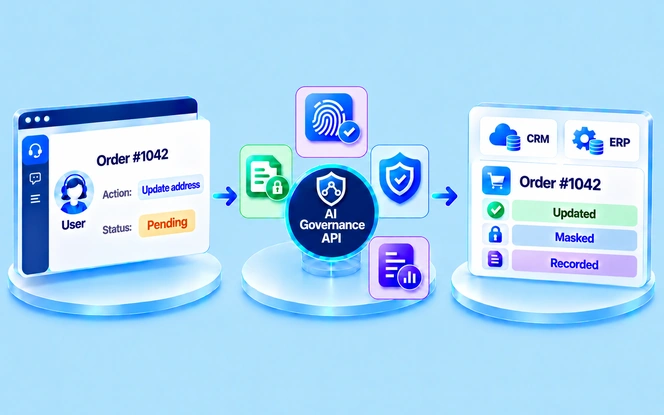
The decision allows the update only with restricted fields and logging. Then, the PEP limits the payload, invokes the approved API, and records whether the update succeeded.
Finally, the evidence record connects identity, request, policy version, obligations, enforcement, timestamp, and final outcome. If a required check fails, the action follows the predefined fallback, such as human review.
How to Implement AI Governance API Integration
- Inventory AI assets. Identify applications, agents, models, APIs, tools, data sources, and owners
- Map requirements. Tie policies and risk criteria to concrete use cases and actions
- Assign ownership. Name decision makers across AI, security, data, API, and business teams
- Locate control points. Find identity sources, classification systems, gateways, tools, and evidence stores
- Standardize metadata. Define canonical subject, action, resource, purpose, risk, and delegation fields
- Version contracts. Specify request, response, error, obligation, expiry, and correlation semantics
- Secure the interface. Apply authentication, authorization, encryption, validation, and secret protection
- Enforce and observe. Connect decisions to execution and capture failures, latency, and evidence
- Review continuously. Retest policy changes, model or provider changes, tool drift, and coverage
Integration also touches ERP, CRM, document platforms, and business workflows. The AI integration and implementation services page describes those broader system connections.
Common Challenges and Best Practices
In general, recurring problems include fragmented identity, API and tool drift, duplicated policies, excessive agent autonomy, stale cached decisions, latency, incomplete evidence, and gaps between release approval and runtime behaviour.
- Keep identity separate from authorization; pass explicit delegation context.
- Use versioned contracts and policy regression tests.
- Treat tools and sensitive data access as authorization surfaces.
- Define risk-based failure behaviour before production.
- Monitor decision latency, enforcement failures, and evidence completeness.
- Keep non-blocking analytics asynchronous and review model or provider changes.
Consequently, governance depth should match data sensitivity, agent autonomy, business impact, and applicable requirements.
Maturity, Build-or-Extend, and Production Readiness
| Level | Capability |
|---|---|
| 1. Policy | Governance is primarily documented |
| 2. Inventory and identity | AI assets and actors are identified |
| 3. API-connected decisions | Identity, context, and policy decisions are exchanged |
| 4. Runtime enforcement | Decisions are applied and monitored |
| 5. Action-level governance | Tools, data, obligations, and evidence are continuously evaluated |
Before adding a separate layer, assess existing identity platforms, API gateways, policy engines, DLP services, connectors, engineering capacity, latency, and scale.
However, a shared decision layer helps only when policies span many applications and enforcement points and the enforcement points apply and record the resulting decisions.
Production readiness checklist
| Area | Validation question | Evidence to retain |
|---|---|---|
| Identity | Can users, services, agents, and delegation be identified? | Identity and delegation record |
| Context | Are action, resource, purpose, data, and risk available? | Governance request |
| Policy | Is the exact policy version identifiable? | Decision record |
| Enforcement | Was the decision and every obligation applied? | Enforcement result |
| Failure | Is unavailable-service behaviour defined? | Failure event and outcome |
| Drift | Can API, tool, model, and policy changes be detected? | Diff and review record |
| Testing | Are high-impact rules regression tested? | Test results |
| Performance | Is governance within the p95/p99 budget? | Latency metrics |
| Evidence | Can an investigator reconstruct the action? | Correlated audit trail |
| Rollback | Can unsafe changes be reversed? | Rollback record |
How SDLC Corp Can Help
Organizations may need help designing governance decisions, identity and access boundaries, enterprise integrations, monitoring, audit evidence, and change management. SDLC Corp’s services cover AI governance and implementation; the appropriate control design depends on each organization’s existing systems.
As SDLC Corp describes it, Foresite works as a governed analytics platform with lineage, identity-based access, and auditability. In this architecture, it can serve as a governed data and analytics integration point.
However, its product documentation does not establish it as a replacement for an enterprise-wide authorization engine or API gateway.
Begin with a high-value action, its actor and data, the policy decision, the enforcement point, and the audit record. Then, use that map to identify missing integrations before expanding to more agents and systems.
Conclusion
Overall, AI governance API integration makes governance operational by connecting trusted identity, sufficient context, policy evaluation, enforcement, and evidence.
As a result, the design succeeds when each decision reaches the system that can control the action and the resulting record shows what actually happened.
Furthermore, as agents gain access to tools and enterprise systems, prioritize action-level authorization, delegation limits, obligations, versioned policies, runtime observability, and defined failure behaviour. First, validate one workflow end to end; then expand based on measured coverage.
Frequently Asked Questions
Why does policy versioning matter?
In effect, it identifies the rule set that produced a decision, making audits, investigations, regression tests, and rollback more reliable.
Should you cache governance decisions?
Caching can reduce latency for suitable low-risk decisions. Set short, risk-aware expiry and invalidate when policy, identity, risk, or resource attributes change.
What happens if the governance API is unavailable?
Define the response in advance by action risk. The system may block a sensitive or irreversible action or send it for human review; control, log, and test any fallback.
What is the difference between design-time and runtime governance?
Design-time governance reviews requirements and changes before deployment. By contrast, runtime governance evaluates and controls the AI activity that actually occurs.
How should teams govern MCP tools?
Specifically, separate tool discovery from execution permission. Check actor and delegation scope, tool parameters, data sensitivity, side effects, required approval, and policy version before invocation.
What is the difference between a PDP and a PEP?
A policy decision point evaluates whether policy permits an action. Meanwhile, a policy enforcement point, such as an application, an API gateway, or a tool layer, applies that decision. Separating the two lets one policy set serve many enforcement points.
What should a governance decision request contain?
A stable, versioned contract carrying the actor and delegation chain, the requested action, the target resource, the purpose, and a correlation ID. Then the response returns the decision, the policy version, any obligations, and an expiry.
How should teams limit delegation when one agent calls another?
Above all, preserve the originating user, the calling agent, the delegated purpose, the allowed scope, an expiry, and a correlation ID on every hop. In addition, evaluate the individual tool call and, where the use case requires it, the wider action sequence.
Which metrics show that AI governance is working?
Useful indicators include the share of AI interactions with an attributable actor and application, the share of governed actions where enforcement applied the decision, p95 and p99 decision latency, stale-decision and policy-exception rates, and evidence completeness.
Should an organization build a separate governance layer or extend existing systems?
Assess existing identity platforms, API gateways, policy engines, DLP services, connectors, engineering capacity, latency, and scale first. A shared decision layer earns its place when policies span many applications and enforcement points.