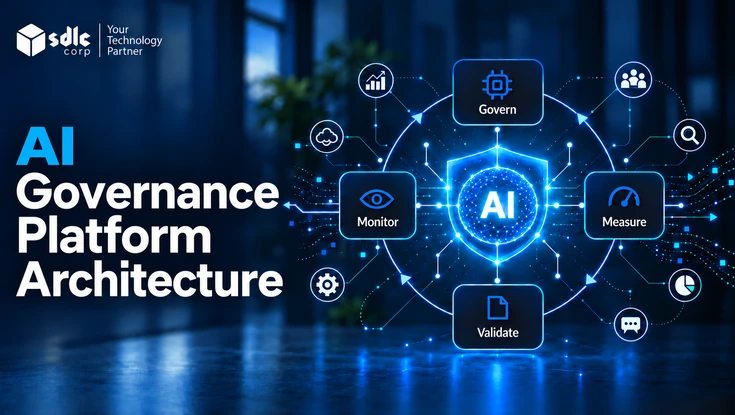
Enterprise AI governance becomes more complex when organizations move from isolated experiments to production applications, agents, retrieval systems, and automated actions. Policies and model inventories alone cannot determine whether an AI system may access sensitive data, invoke a tool, make a consequential decision, or act within defined risk boundaries.
An effective AI governance platform architecture connects requirements to technical controls across identity, authorization, policy, risk, data, runtime enforcement, human oversight, monitoring, and evidence. It also integrates with existing enterprise systems and makes important decisions and actions reconstructable.
What Is an AI Governance Platform Architecture?
An enterprise AI governance framework defines what an organization governs and why. In contrast, architecture defines where and how those requirements are implemented across technology.
The architecture covers applications, models, agents, prompts, context, APIs, tools, identities, outputs, actions, and protected resources. As a result, governance becomes an operational capability rather than a collection of disconnected policies.
Important distinction: An AI system can have substantial autonomy with tightly bounded permissions, or limited autonomy with access to sensitive resources. Therefore, governance must define its permitted action space, not assess autonomy alone.
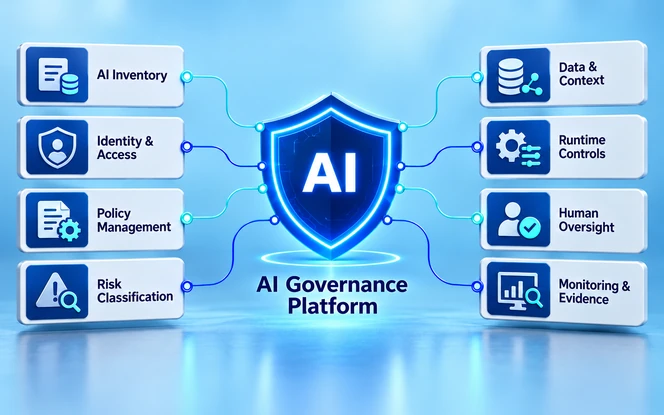
Core Components of an AI Governance Platform
| Component | Primary responsibility |
|---|---|
| AI inventory | Identify models, applications, agents, owners, and environments. |
| Identity and authorization | Determine who or what can access resources and perform actions. |
| Policy management | Define, version, evaluate, and enforce governance rules. |
| Risk classification | Apply controls according to risk, impact, and sensitivity. |
| Data and context governance | Control retrieval, context, classification, and access. |
| Runtime controls | Restrict prompts, outputs, tools, transactions, and actions. |
| Human oversight | Introduce approval, intervention, escalation, and override. |
| Monitoring and evidence | Record decisions, actions, outcomes, and control effectiveness. |
AI inventory and identity
Overall, governance starts with visibility. Specifically, maintain an inventory of AI applications, models, agents, owners, environments, connected tools, and important data dependencies. Furthermore, give agents and applications distinct identities and bounded, least-privilege permissions; do not rely on the model to decide what it is allowed to do.
Policy and risk management
Thus, a policy layer turns governance requirements into enforceable decisions. In addition, policies should be versioned, traceable, and consistently evaluated. For example, higher-risk use cases can require stronger authorization, additional validation, human approval, transaction restrictions, and more detailed evidence.
Data, context, and runtime controls
Similarly, AI applications need authorization for what they retrieve, include as context, send to models, expose through tools, and use for downstream actions. In particular, sensitive data access in retrieval-augmented and agentic systems should be checked before protected context is retrieved.
Input and output controls
Prompt-injection defenses, sensitive-information filtering, grounding, and output validation.
Action controls
Tool restrictions, transaction limits, rate controls, allowlists, denylists, and action-specific authorization.
Above all, controls that must prevent unauthorized or harmful actions belong in the runtime path.
AI Governance Data Flows
A practical sequence connects a request to the governance decision that authorizes it:
- Identity and context.
- Risk and policy evaluation.
- Runtime enforcement.
- The model or agent.
- Any tool or downstream action.
- The outcome.
- The evidence generated throughout.
While the exact order can vary, the governance decision must be correlated with the resulting action.
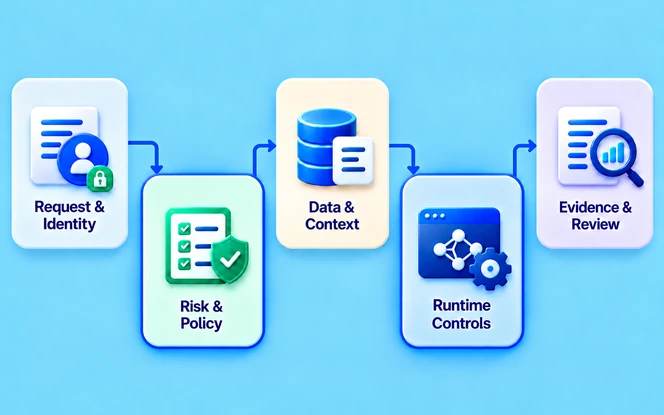
Enforcement timing: Blocking and authorization usually need synchronous checks before execution. Conversely, reporting, trend analysis, audit preparation, and control-performance analysis can run asynchronously.
Still, this flow is an illustrative architectural pattern, not a universal industry schema.
Human Oversight, Monitoring, and Governance Evidence
Generally, human oversight should reflect risk, autonomy, reversibility, and potential impact. For instance, high-impact or difficult-to-reverse actions may need explicit approval or intervention before execution. The EU AI Act sets human-oversight and record-keeping requirements for applicable high-risk AI systems.
Equally, monitoring should establish whether governance controls work, not simply whether the AI system runs.
| Evidence area | Example evidence |
|---|---|
| Identity | User, application, or agent identity. |
| Authorization | Permission and resource requested. |
| Policy | Policy ID and version. |
| Decision | Allow, deny, escalate, or approval required. |
| Action | Tool call, transaction, retrieval, or downstream action. |
| Oversight | Approval, intervention, or override. |
| Outcome | Success, failure, rejection, or exception. |
| Timing | Decision, action, and completion timestamps. |
Hence, an auditor or operator should be able to reconstruct what was requested, which policy applied, what decision was made, who or what acted, what happened afterward, and why. Still, the table is a practical recommendation, not a universal evidence schema.
Agent Governance
Moreover, agents can retrieve data, invoke tools, delegate tasks, and execute actions. An enterprise agent governance architecture therefore needs unique agent identity, bounded permissions, least-privilege access, permission-aware retrieval, delegated authority, approval requirements, tool and action restrictions, and monitoring evidence.
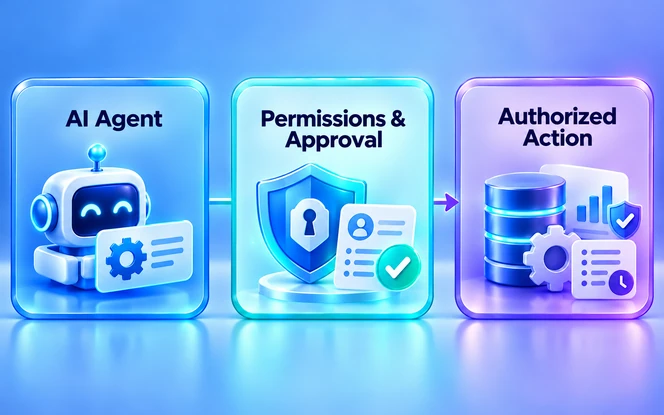
Singapore’s IMDA Model AI Governance Framework for Agentic AI and the OWASP Agentic Security Initiative provide relevant governance and security considerations.
Plan for control failure: Depending on the action and risk, the system may fail closed, block the action, use a bounded cached decision, or enter a controlled degraded mode. Define this behavior before deployment.
Governance Across the AI Lifecycle
Planning
First of all, define intended use, ownership, risks, and governance requirements.
Development and validation
Subsequently, test models, applications, prompts, data, controls, and failure conditions.
Deployment and operation
Meanwhile, enforce policies, monitor behavior, collect evidence, and manage changes.
Continuous improvement
Finally, use incidents, violations, overrides, and performance signals to improve controls.
The NIST AI RMF 1.0 organizes AI risk management around Govern, Map, Measure, and Manage; NIST notes that a revised version is in progress. ISO/IEC 42001:2023 specifies requirements for establishing, implementing, maintaining, and continually improving an AI management system.
Enterprise Integration and Governance Ownership
An AI governance platform should also integrate with existing enterprise capabilities. For example, common integration points include IAM and identity providers, DLP and data-security systems, API gateways, GRC platforms, SIEM and observability, data and context governance, and AI gateways or runtime infrastructure.
At the same time, technical enforcement needs clear ownership across security, compliance, data, engineering, product, and business teams. An AI governance operating model can specify decision rights, responsibilities, escalation paths, and accountability.
Minimum Viable Governance Architecture
In short, a minimum architecture should provide enough visibility, control, and evidence to govern production AI systems. Specifically, it should identify what exists, who owns it, what it can access, which policies apply, and what happens when it acts.
- AI inventory and ownership: Track applications, models, agents, environments, and key dependencies.
- Identity and authorization: Apply unique identities, bounded permissions, and least privilege.
- Risk classification: Classify by sensitivity, impact, and autonomy.
- Versioned policies: Tie decisions to the policy version in force.
- Runtime enforcement: Restrict unauthorized or risky actions during execution.
- Tool and action controls: Govern tool access, retrieval, transactions, and downstream actions.
- Monitoring and evidence: Record decisions, approvals, outcomes, violations, and failures.
- Failure handling: Define behavior when a governance dependency is unavailable.
- Continuous measurement: Track coverage, violations, overrides, latency, and evidence completeness.
Because coverage builds gradually, start with inventory and ownership, then add risk-based policies and runtime controls. Finally, expand toward reconstructable evidence and continuous measurement as coverage matures.
How to Implement an AI Governance Architecture
- Inventory AI applications, models, and agents.
- Identify owners and business purposes.
- Map identities, permissions, data, tools, and actions.
- Classify use cases by risk and impact.
- Define and version governance policies.
- Implement runtime authorization and guardrails.
- Establish human approval and escalation paths.
- Capture governance and operational evidence.
- Define failure and degraded-mode behavior.
- Continuously measure control effectiveness.
For instance, useful measures include policy coverage, control latency, trace completeness, approval SLA, override rate, policy violations, agent-action coverage, runtime failures, and evidence availability. An AI governance dashboard is where these measures are reported to executives, governance teams, and technical owners.
How to Evaluate an AI Governance Platform
Instead of feature count, evaluate operational capability. Specifically, ask vendors and internal teams to demonstrate an end-to-end decision and its resulting evidence.
| Evaluation area | Key question |
|---|---|
| Visibility | Can the platform identify AI systems, agents, owners, and actions? |
| Authorization | Can it enforce identity- and resource-aware permissions? |
| Runtime control | Can it restrict risky actions during execution? |
| Context and data | Can access to sensitive context be governed? |
| Evidence | Can decisions and actions be reconstructed? |
| Resilience | What happens when governance services fail? |
| Integration | Can it work with existing security infrastructure? |
| Performance | Can controls operate within acceptable latency? |
| Portability | Can governance work across models and providers? |
Implementing AI Governance Architecture with SDLC Corp
Accordingly, SDLC Corp approaches AI governance as an operational architecture that connects requirements with enforcement, monitoring, evidence, and continuous improvement. In addition, Foresite can fit alongside existing IAM, DLP, SIEM, GRC, data-governance, and runtime systems rather than replacing every enterprise control.
A practical rollout can move through four steps before expanding across the wider AI estate:
- Begin with high-impact AI applications and agents.
- Establish ownership and risk boundaries.
- Implement runtime controls.
- Build monitoring and evidence.
Sources and Editorial Scope
This guide draws on the primary references listed below. Overall, the component tables, request flow, evidence examples, and implementation sequence are practical architectural recommendations. However, they are not a universal compliance schema or a claim of certification.
- NIST AI Risk Management Framework 1.0 Core: lifecycle risk-management functions.
- ISO/IEC 42001:2023: AI management-system requirements.
- EU AI Act, Regulation (EU) 2024/1689: applicable legal requirements for high-risk systems.
- IMDA Model AI Governance Framework for Agentic AI: agent governance guidance.
- OWASP Agentic Security Initiative: agentic security considerations.
Turn AI Governance into Enforceable Controls
Map your AI systems, define risk boundaries, connect runtime controls, and build evidence your teams can use in production. So explore SDLC Corp’s AI governance consulting services to plan the next step.
Conclusion
In summary, a mature AI governance platform architecture connects governance requirements with operational controls, evidence, oversight, and continuous improvement. Specifically, organizations need clear ownership, bounded authorization, risk-proportionate controls, governed data and tool access, reconstructable evidence, and ongoing measurement.
As AI systems become more autonomous, governance must show:
- Who or what can act.
- What it can access.
- Which policy applies.
- Where that policy is enforced.
- Whether approval is required.
- What happened afterward.
- Whether the control worked.
Consequently, that turns static documentation into an architecture for managing AI throughout its operational lifecycle.
Frequently Asked Questions
What is an AI governance platform architecture?
In other words, it is the technical architecture that translates AI governance requirements into controls across identity, policy, risk, data, runtime behavior, human oversight, monitoring, and evidence.
What are the core components of an AI governance architecture?
Generally, core components include AI inventory, identity and authorization, policy management, risk classification, data and context governance, runtime controls, human oversight, monitoring, and evidence.
Which AI governance controls need to operate synchronously?
Controls that decide whether a sensitive retrieval, tool call, transaction, or consequential action is permitted generally need runtime enforcement. Meanwhile, reporting and trend analysis can operate asynchronously.
What happens if the governance platform fails?
Above all, define failure behavior in advance. Depending on the action and risk, the system may block the action, fail closed, use a bounded cached decision, or enter a controlled degraded mode.
Does an AI governance architecture guarantee compliance?
No. Architecture can provide controls, evidence, monitoring, and accountability, but compliance also depends on applicable laws, organizational processes, risk decisions, implementation quality, and ongoing oversight.