Introduction
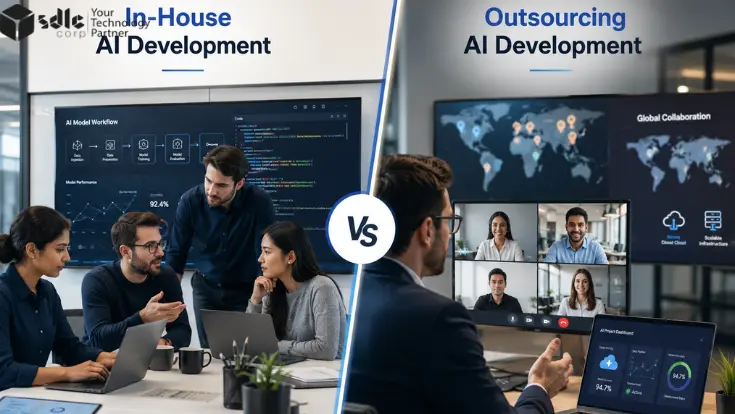
Artificial Intelligence (AI) has moved from test projects to business planning. Today, companies in finance, healthcare, e-commerce, and logistics use AI to improve decisions, reduce manual work, and support growth. However, leaders still face one key question: should they build AI in-house or outsource the work?
This guide compares both options, including their benefits, risks, and costs. It also explains AI development strategy, data security, and growth needs. As a result, businesses can choose a model that fits their goals and resources.
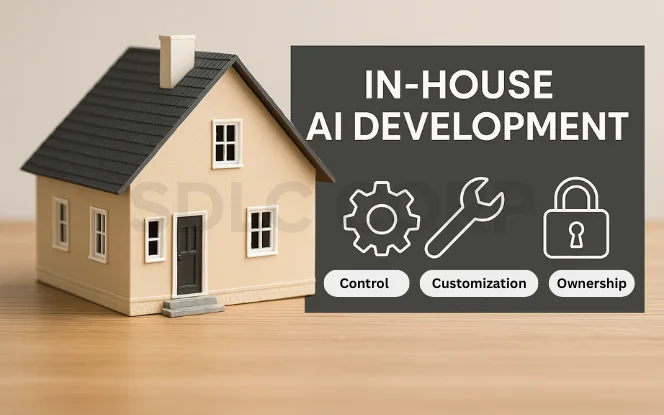
1. In-House AI Development: Control, Customization, and Ownership
Benefits of In-House AI Development
Data Security: Sensitive data stays inside company systems. Therefore, this model can suit regulated sectors such as healthcare under the HIPAA Security Rule and finance under the EU data protection framework.
Custom Solutions: Internal teams can shape AI around their own work process. For example, a bank can build an AI fraud detection engine based on its transaction data.
Business Alignment: In-house teams can connect AI with long-term company goals. In addition, they can link new tools with current systems more easily.
Challenges of In-House AI Development
Higher Starting Cost: Companies must pay for tools, cloud use, systems, and skilled AI staff. As a result, the first investment can be high.
Slower Launch: Hiring and training take time. Also, teams may need several test rounds before release.
Regular Upkeep: AI models can lose accuracy over time. Therefore, teams need fresh training data, clear release steps, and MLOps pipelines.
Staff Risk: Progress may slow when key AI team members leave. For this reason, companies need strong notes, shared knowledge, and backup staff.
2. Outsourcing AI Development: Speed and Specialized Expertise

Benefits of Outsourcing AI Development
Skills on Demand: Companies can work with trained AI experts without a long hiring process.
Faster Delivery: An outside team already has tools and staff. Therefore, an AI solution may launch in weeks instead of months.
Lower Starting Cost: Businesses avoid large early spending on staff and systems. Instead, they pay for the work or service they need.
Easy Team Growth: Resources can increase or decrease as the project changes. As a result, the company can manage demand more easily.
Challenges of Outsourcing AI Projects
Data Risk: Sharing business data with an outside team can create privacy and rule-related risks. Therefore, contracts and access rules must be clear.
Vendor Dependence: A company may rely on its partner for updates, extra resources, and ongoing model monitoring. As a result, changing vendors may take time.
Less Control: Some vendors use ready-made tools that may not fit every need. However, a clear project plan can reduce this problem.
3. Cost and Risk Comparison: In-House vs. Outsourcing
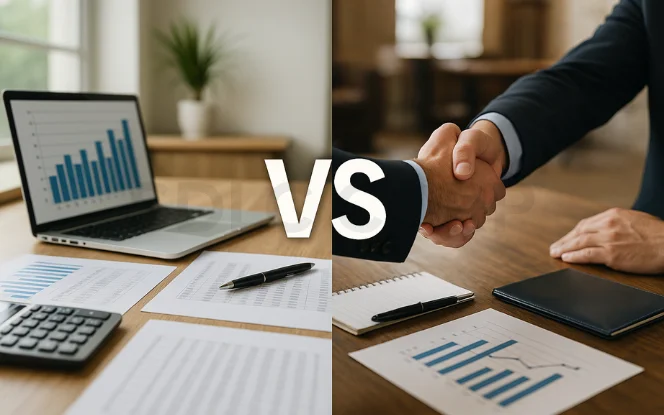
| Factor | In-House AI Development | Outsourced AI Development |
|---|---|---|
| Hard Costs | Systems, tools, salaries, benefits, and staff training | Service contracts, monthly fees, or project pricing |
| Soft Costs | Slower launch, lost time, and team management work | Vendor management, handover work, and communication gaps |
| Risk Management | More control and security, but a higher delay risk | Shares delivery risk, but adds vendor dependence |
| Scalability | Slow growth of internal skills and resources | Fast resource growth, but with less control |
4. Industry Examples
Healthcare and Finance
Large hospitals often build diagnostic AI in-house because they need strict data control. However, smaller clinics may outsource tools for booking and patient support.
Global banks may build fraud systems with internal teams. Meanwhile, fintech startups often outsource credit scoring so they can launch faster.
E-Commerce and Logistics
Large online stores often create their own recommendation tools. In contrast, smaller retailers may outsource product suggestions and customer targeting.
Large logistics firms may manage supply chain AI in-house. On the other hand, regional companies often outsource demand forecasts and route planning.
5. How to Decide: In-House vs. Outsourcing AI Development
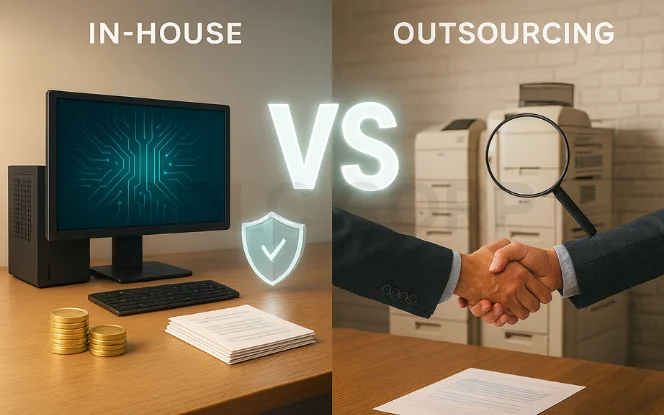
Questions to Review Before You Choose
Before choosing a model, review these four areas:
Budget and Team: First, decide whether you can pay for AI tools, cloud systems, and skilled staff.
Rules and Data: Next, check whether your industry has strict data rules, such as the EU AI Act.
Launch Speed: Also, decide how quickly the AI solution must go live.
Future Needs: Finally, consider whether the project will need regular updates, more users, or more data.
Conclusion
The right AI model depends on company size, industry rules, budget, and long-term goals.
Choose in-house AI when control, data safety, and custom work matter more than cost.
Choose outsourcing when faster delivery, expert support, and lower early cost are the main goals.
For many companies, a mixed model works well. For example, they can outsource the first version and later build an internal team for key systems.
In healthcare, finance, e-commerce, and logistics, the main goal is the same. AI should support the business plan, protect important data, and provide clear value. Therefore, companies should choose the model that best matches their needs.
FAQs
In-House vs Outsourcing AI Development: Which Should You Choose?
Choose in-house AI when you need full control, strong data security, and long-term customization. Choose outsourcing when you need faster delivery, lower initial costs, and access to experienced AI experts.
How Much Does In-House AI Development Cost vs Outsourcing?
In-house AI usually costs more because you need to hire specialists, buy tools, and manage infrastructure. Outsourcing often has a lower starting cost because you pay for the project or service you need.
Is outsourcing AI development safe for sensitive data?
It depends on the vendor. Reputable outsourcing partners follow strict data protection standards such as GDPR, HIPAA, or SOC 2. Highly regulated industries should still review the vendor’s security controls, access policies, contracts, and compliance practices before sharing sensitive data.
When should a company choose in-house AI development?
A company should choose in-house AI development when it has sufficient budget and technical resources, operates in a regulated industry, needs full control over sensitive data, or requires a proprietary and highly customized AI solution.
When is outsourcing AI development the right choice?
Outsourcing is a good choice for startups, small and medium-sized businesses, companies that need faster deployment, and organizations that want to test an AI idea before investing in a permanent internal team.
Can I Build AI Faster With an In-House Team or Outsourced Partner?
An outsourced AI partner is usually faster because the team and tools are already available. Building an in-house team can take longer due to hiring, training, and setup.
Which industries benefit most from in-house vs outsourcing AI?
Healthcare, banking, insurance, and large logistics companies often prefer in-house development for compliance and control. Smaller e-commerce businesses, fintech startups, and regional service providers often outsource AI to access expertise, reduce costs, and launch faster.
What Factors Affect the Cost of an AI Development Project?
The main cost factors are project scope, data quality, model complexity, system integrations, security requirements, cloud infrastructure, testing, and ongoing maintenance. A simple AI chatbot may cost less than a custom prediction or automation system that uses sensitive data and connects with several business platforms.
Why is data security important in AI projects?
AI systems often process confidential business, customer, financial, or healthcare data. Strong security helps prevent unauthorized access, data leaks, compliance violations, and misuse. In-house teams and external vendors should both use clear access controls, encryption, monitoring, and data governance policies.