Every outbound call opens with a question the agent has to answer before it can say anything useful.
Someone or something has picked up, and the right first sentence is completely different depending on which. The judgement has to be made in a couple of seconds, on incomplete evidence, and it will sometimes be wrong.
- It is a judgement, not a fact Nothing in the call reliably declares that a machine answered, so the decision is made from evidence and carries a confidence level.
- The errors are asymmetric Treating a person as a machine costs a live conversation. Treating a machine as a person costs a wasted message and a misleading record.
- Certainty costs time Waiting longer makes the judgement safer and makes whoever actually answered wait, which is a trade rather than a setting to maximize.
Human callers make this judgement without noticing. A recorded greeting has a shape, a rhythm and a flatness that a person does not, and we hear it instantly. Software has to reconstruct that intuition from the audio and from what the network said about the call.
What makes it worth attention is that the two possible mistakes are not equally bad, and they are not bad in the same way. One wastes a message. The other leaves a real person listening to silence.
The Question Every Outbound Call Opens With
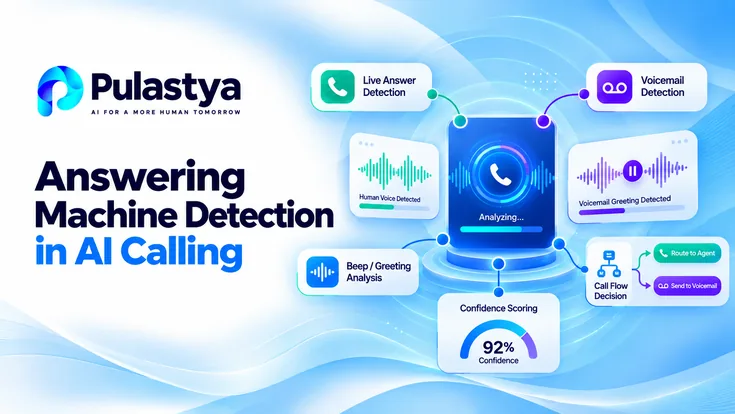
An outbound call that is answered produces audio. It does not produce an announcement of who or what is on the other end. The agent hears a greeting and has to decide what kind of greeting it was.
The difficulty is that the first second of both cases sounds identical. A person says hello. A recording says hello. What separates them arrives afterwards, in whether the greeting continues, how long it runs, and what follows when it stops.
- A person greets briefly and then stops, expecting the caller to take a turn.
- A recording keeps going, often for several sentences, and does not leave room for a reply.
- A person's greeting varies in pace and volume in a way a recorded one does not.
- A recording usually ends with a tone, and a person never does.
Each of those signals is useful and none is conclusive. Short recorded greetings exist. People answer with long distracted sentences. A mobile network may play a message before a human ever picks up, and that message is neither of the two things being distinguished.
The decision is probabilistic, so treat it as one. An agent that acts on a judgement without knowing how confident it was cannot tell later whether a bad outcome came from a bad decision or from a decision made too early.
The Evidence Available to Make the Call
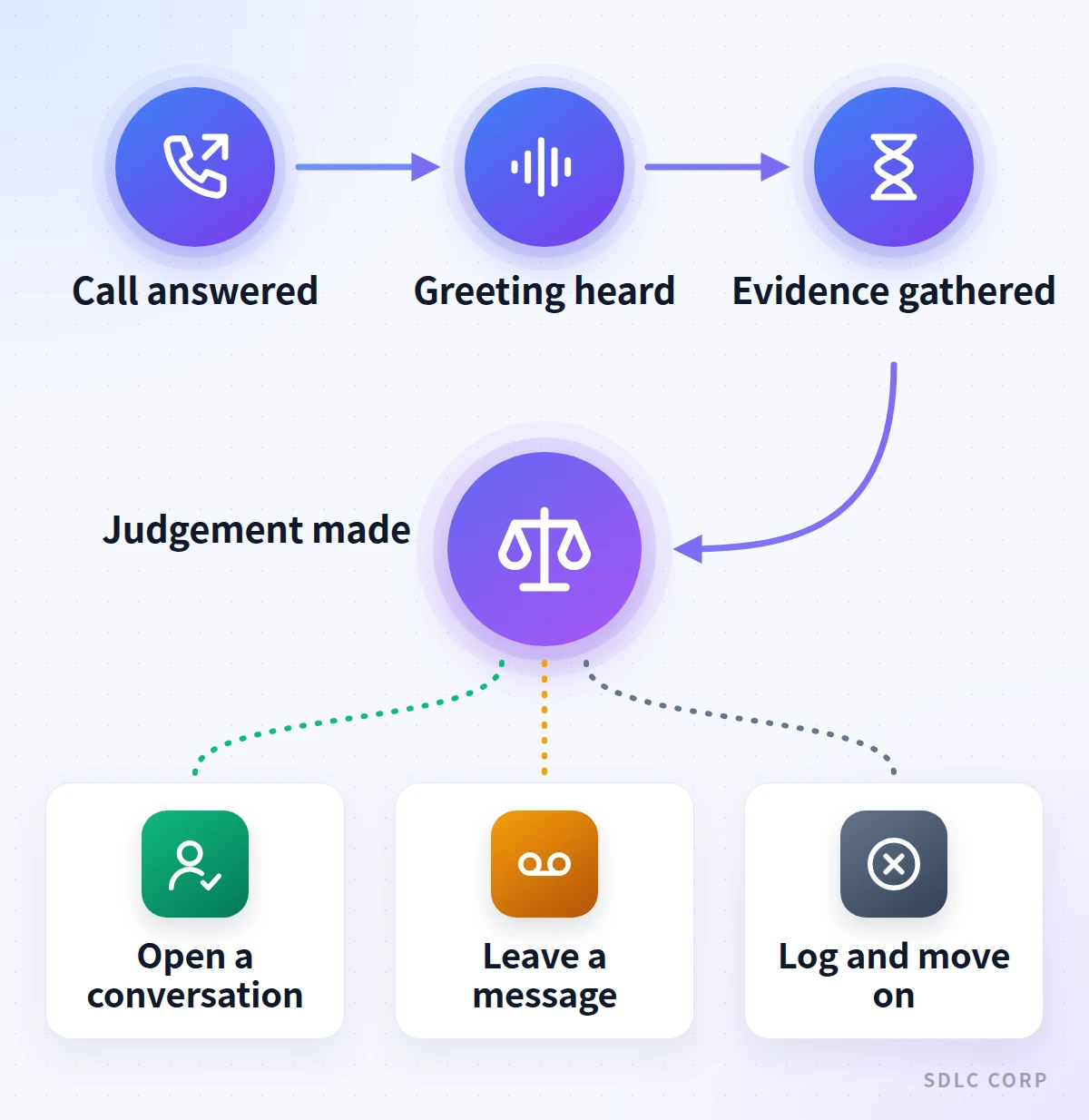
Evidence arrives in two waves. Some of it comes from the network before anyone speaks, and some of it comes from listening to whatever answered.
How long the call rang, whether it was answered by a service rather than a device, and any indication the network gives about how the call completed.
How long the greeting runs, whether it pauses for a reply, how steady the pace and volume are, and whether a tone follows it.
Recorded greetings use a small and recognizable set of phrases. Transcribing the opening words adds a strong hint the raw audio does not carry.
Network signals are cheap and early but coarse. Audio signals are far more informative and only become available by waiting, which is precisely the resource the decision is short of.
The last card is the one most often left out. A greeting that includes an instruction to leave a message is close to decisive, and it costs nothing beyond the recognition already running on the call.
None of this is stable across markets. Greeting conventions, the wording of network announcements and the prevalence of carrier voicemail all vary by country and by operator, so a detection setting proven in one market should be re-checked before it is trusted in another.
What Each Mistake Actually Costs
Both errors are usually reported as a single accuracy number, which hides the thing that matters. They are not interchangeable and they are not felt by the same people.
| The mistake | What the other end experiences | What it costs the business |
|---|---|---|
| A person judged to be a machine | Silence, then a message read at them, or a call that ends without explanation | A live conversation thrown away, and a person left with a poor impression |
| A machine judged to be a person | Nothing useful. The recording captures an agent waiting for a reply that never comes | A wasted message, and a record that says the call connected when nothing was delivered |
| Judged too slowly, either way | A long pause after answering, which people read as a nuisance call | Higher abandonment at the opening of the call, before anything has been said |
| Judged too quickly, either way | More of both errors, distributed unpredictably | Accuracy that looks acceptable in aggregate and fails on particular markets |
The first row is the expensive one, and it is the reason the sensible default leans toward assuming a person. A wasted voicemail costs a few seconds of machine time. A person greeted with silence has been given a reason to distrust the number that called them.
The third row is easy to overlook because it is not a detection error at all. Certainty is bought with time, and the person who answered is spending it. Beyond a short wait, they have concluded nobody is there.
What the Agent Should Do With Each Answer
Three outcomes need a defined behavior, not two. The ambiguous case is the one that decides how the system feels, because it is where the design either protects the caller or gambles on them.
- A person answeredOpen immediately. Say who is calling and why in the first sentence, and hand the turn over. Any delay here is read as an automated nuisance call.
- A machine answeredWait for the greeting to finish and for the tone, then deliver a short prepared message. Speaking over a greeting produces a recording that starts mid-sentence.
- It is genuinely unclearBehave as though a person answered. The opening line works for both, and a machine costs nothing by hearing it.
- Nothing answered meaningfullyA network announcement, a disconnected tone or silence is a fourth case. Record it as its own outcome rather than folding it into either of the first two.
That fourth step matters more than its size suggests. A number that has been disconnected and a number whose owner is simply not picking up look similar in a summary and call for entirely different follow-up.
What happens to each outcome afterwards, including how many further attempts are appropriate and when a record should stop being called, is set out in deciding whether a call can be attempted again.
Where the conversation with a person needs to reach a human colleague instead, the handover itself is covered in passing an outbound call to a person.
Leaving a Message Worth Leaving
A voicemail is a one-way message to someone who was not expecting it and who may delete it three seconds in. That constrains it far more than a live opening line is constrained.
- Start after the tone, not over the greeting, or the first words are lost and the message begins mid-thought.
- Identify the organization immediately. A message that does not say who is calling is deleted before it says anything else.
- Give one reason and one action. A message asking for three things gets none of them.
- Say any callback number slowly and say it twice, because the listener is writing it down on a second pass.
- Keep account detail out of it. There is no assurance about who will play the message back.
The last point is a genuine constraint rather than caution. A voicemail may be heard on a speakerphone, on a shared household line or by a colleague, so what is safe to say live is not automatically safe to record.
Whether a message may be left at all, what it must disclose and whether the call may be recorded depend on jurisdiction, call direction, sector and the basis for contacting the person. Those obligations belong with consent, suppression and calling-window controls, and the applicable rules should be established with counsel.
Measuring Detection Instead of Trusting It
Detection quality drifts quietly. Nothing breaks, no error is logged, and the first visible symptom is a decline in conversations that is easy to blame on the list or the script.
- Sample and label by handTake a set of recordings and mark what actually answered. Without a labeled set there is no way to know which direction the errors run in.
- Report both errors separatelyA single accuracy figure hides the expensive case. Count people treated as machines apart from machines treated as people.
- Measure the time to decideThe delay between answer and the agent's first word is part of the result, and it is what the person who picked up experienced.
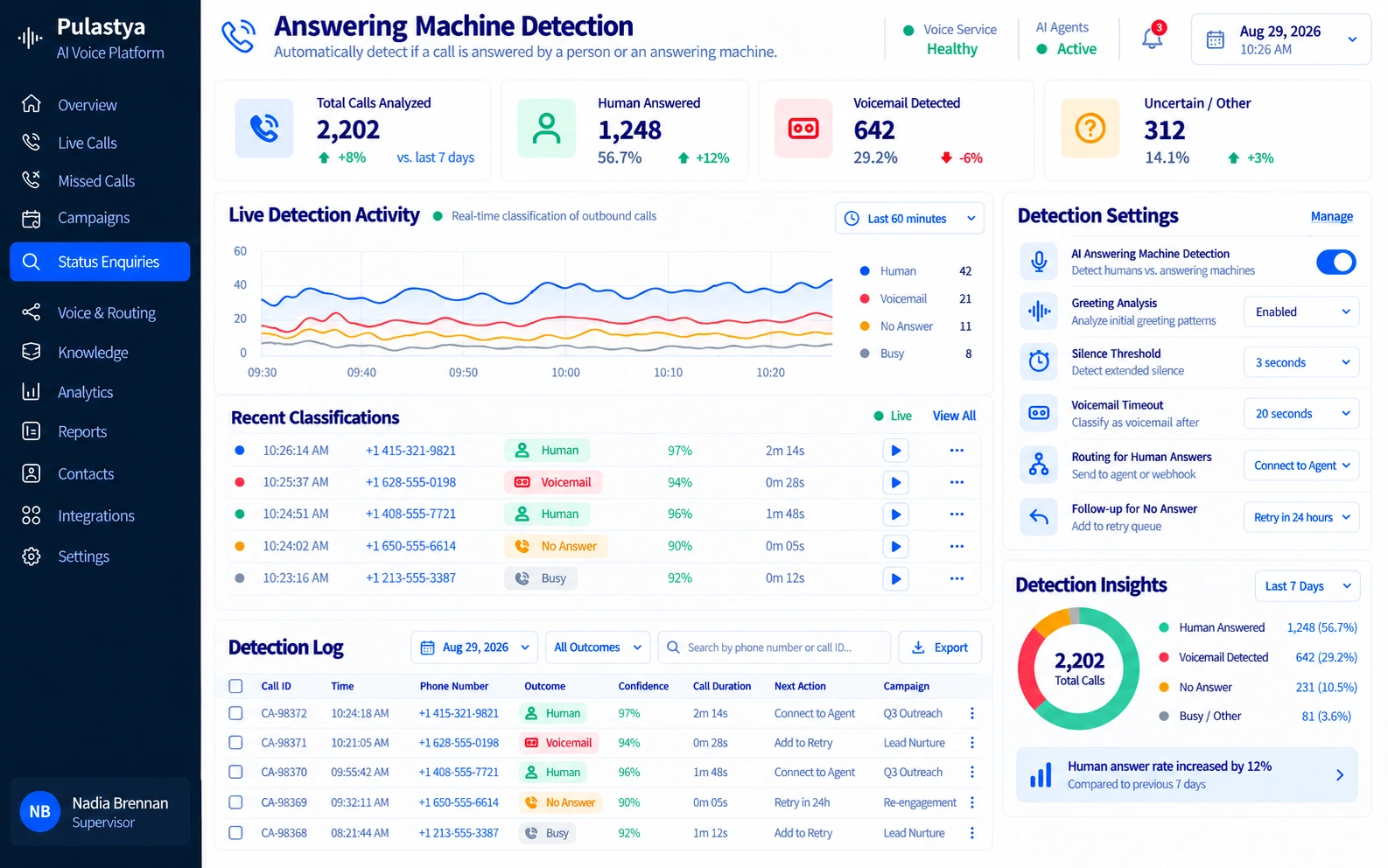
- Break results down by segmentMobile against landline, market against market, hour against hour. Aggregate accuracy hides a market where detection has stopped working.
One practical check needs no tooling. Listen to a handful of recordings where the agent left a message and a handful where it opened a conversation. The failures are obvious to an ear in a way they are not in a summary table.
Where these figures sit alongside the other numbers a campaign produces is covered in the numbers worth watching on an outbound campaign.
Conclusion
Answering machine detection helps AI outbound calling systems distinguish live conversations from voicemail, but every decision involves a trade-off between detection accuracy and response time. By evaluating greeting patterns, speech activity, voicemail signals, and uncertain outcomes, businesses can reduce unnecessary messages and improve how automated calls begin.
Effective answering machine detection requires more than selecting a detection setting. Organizations should monitor false positives and false negatives, measure response delays, test performance across carriers and markets, and apply appropriate voicemail and compliance controls. Regular evaluation helps maintain reliable call handling while protecting the experience of people who answer.
Frequently Asked Questions
It is the judgement an outbound agent makes about whether a person or a recording picked up the call. Nothing in the call declares this, so it is inferred from how long the call rang, how the greeting behaves, what the greeting says and whether a tone follows it. The result carries a confidence level rather than being a fact.
Treating a real person as a machine. They get silence or a message read at them, and a live conversation is lost along with some goodwill. Treating a machine as a person wastes a message and produces a misleading record, which is annoying but cheap. That asymmetry is why a sensible default leans toward assuming a person answered.
Because the system is still deciding what answered. Certainty is bought by listening for longer, and the person who picked up spends that time in silence. Past a short wait most people conclude nobody is there and hang up, which is why the wait is a trade rather than something to extend for accuracy.
That depends on the purpose of the call and on the rules that apply to it, which vary by jurisdiction, sector and how the contact was obtained. Where a message is appropriate, keep it short, identify the organization first, give one clear action, and leave account detail out of it, since there is no assurance about who will hear it played back.
Label a sample of recordings by hand with what actually answered, then compare that against what the system decided. Report the two error directions separately rather than as one accuracy figure, and break the results down by market and by device type, because detection that works on one segment can quietly fail on another.