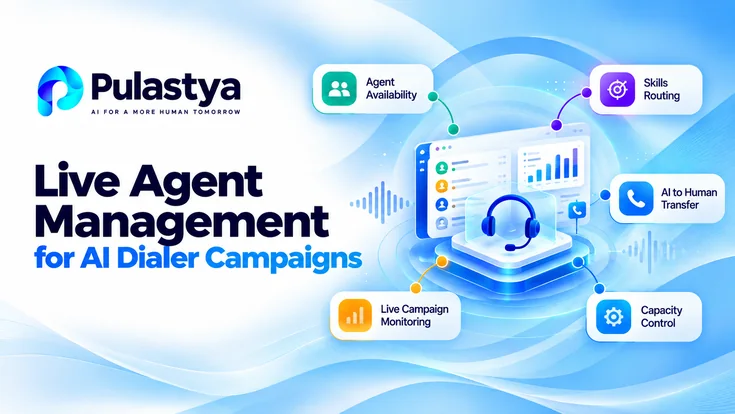
Live agent management for AI dialer campaigns coordinates real-time agent availability, skills routing, and transfer eligibility so automated outbound systems only attempt live-human handoffs when capacity and context match business rules.
Effective management reduces dropped transfers, improves contact rates, and limits regulatory risk by ensuring agents are ready for conversational handoffs.
- Clear availability states Define actionable agent states such as ready-for-transfer, busy-with-call, wrap-up, and temporarily unavailable so the dialer can make deterministic routing decisions.
- Skill- and language-aware routing Map campaign intent and transfer reasons to agent skills and languages, with explicit eligibility rules for warm and cold transfers.
- Capacity-driven campaign controls Tie dialing rate, concurrency limits, and transfer acceptance windows directly to measured live-agent capacity to prevent failed handoffs and compliance exposures.
Live-agent availability is an operational control layer between the dialer and your contact center workforce. It must represent true agent readiness, language and skill match, permissible transfer windows, and short-notice capacity changes from supervisors or workforce tools.
Implementations should treat availability signals as authoritative inputs for campaign behavior rather than advisory data. That means defining precise states, notification flows for agents, and automated campaign responses when capacity drops below thresholds to avoid high abandonment or failed handoffs.
Defining Live-Agent Availability for Outbound Campaigns
Start by standardizing a small set of agent availability states that mean something to both operations and the dialer: available-for-transfer, engaged, in-wrap, unavailable-temporary, and offline. Each state must have a clearly defined trigger and a timeout policy.
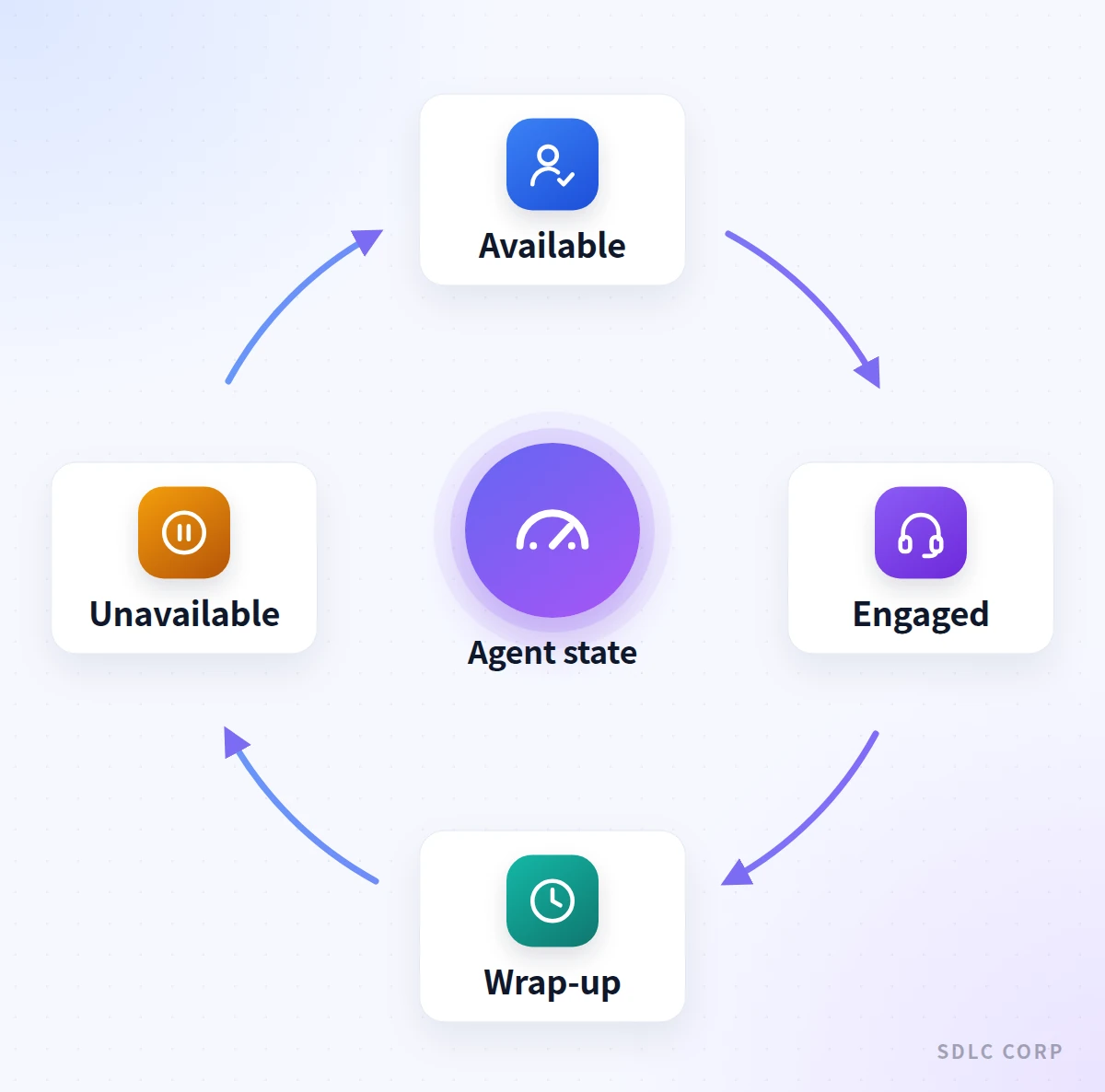
Use presence signals that reflect conversational readiness, not just phone registration. For example, require an explicit agent action to enter available-for-transfer, preventing accidental transfers when an agent is multitasking or on a backroom task.
Integrate supervisor overrides with priority rules. Overrides should change both agent state and campaign behavior immediately, with audit logging to support post-campaign analysis and compliance reviews.
Treat availability updates as high-priority events. Low-latency state propagation, ideally under one second, ensures the dialer receives accurate capacity before initiating transfers or changing dialing cadence.
- Define each state with a one-line operational meaning and the UI action or system event that sets it.
- Enforce minimal warm-up before agents become available-for-transfer to ensure microphone and headset readiness.
- Record timestamps and source of state change for auditing transfer failures and agent behavior.
- Set automated reversion rules for temporary states to avoid stale availability signals.
Availability must reflect conversational readiness, not just softphone registration.
Managing Teams, Skills, Languages and Transfer Eligibility
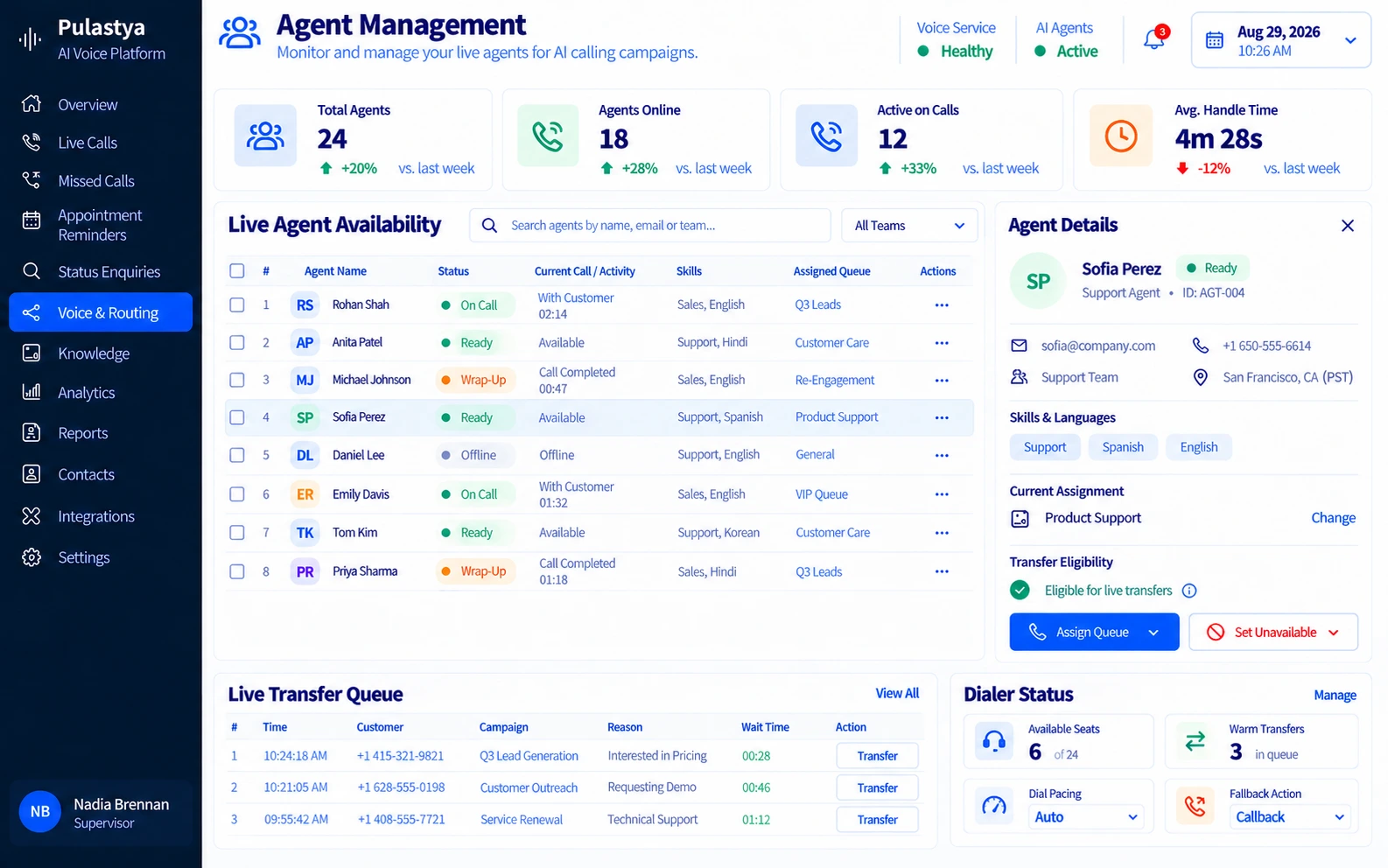
Inventory skills, certifications, and language fluency at the individual level and map them to team-level routing policies. Avoid broad, imprecise skill buckets that force manual overrides and reduce routing efficiency.
Transfer eligibility should combine business logic with agent attributes. For example, allow warm transfers for agents with required certification and language match, but restrict cold transfers to senior agents during peak hours.
Maintain explicit rules for partial matches where skills or languages are close. Rules should specify fallback behaviors such as offering an interpreter, routing to a specialized queue, or declining the transfer.
Use team definitions to enforce operational constraints like team-level concurrency caps, escalation paths, and supervisor visibility. Teams should be the primary unit for campaign assignment and capacity aggregation.
- Map each campaign transfer reason to required skills and acceptable fallback skills.
- Tag agents with proficiency levels to prioritize stronger matches when multiple agents are available.
- Define language acceptance thresholds and whether interpreter routing is permitted as fallback.
- Limit transfer eligibility changes to authorized roles with change history for compliance.
Eligibility rules must be explicit, auditable, and tied to agent attributes.
Connecting Agent Capacity to Campaign Behavior
Translate live-agent signals into concrete campaign controls: dialing pace, concurrency per agent, transfer acceptance timeout, and fallback handling. Each control needs a clear mapping to the capacity metric it protects.
Measure capacity as effective available-for-transfer seats rather than raw headcount. Effective capacity accounts for skills match, current calls, wrap time, and supervisory reserves to avoid overestimating ability to accept handoffs.
Implement automated throttles that reduce outbound cadence when transfer success falls below a threshold. Throttles should escalate in steps and provide alerts to operations for intervention before failures compound.
Design for predictable failure modes: if no eligible agents are available, route to voicemail or schedule a callback. Never let the dialer attempt handoffs repeatedly; looping transfers create regulatory and caller experience risk.
- Use a rolling window to calculate available seats, adjusting for average wrap time and predicted short-term churn.
- Link dialing rate to available seats with a simple formula: max concurrent transfers = available seats times transfer concurrency factor.
- Set transfer timeout shorter than agent ring-to-answer expectations to avoid long waits on the called party.
- Provide automatic fallback workflows such as SMS follow-up or queued callback when transfers fail.
Campaign controls must degrade gracefully when live-agent capacity diminishes.
Capacity drives the dialer
How Live-Agent Signals Should Change Campaign Behavior
| Signal | Campaign response | Why it matters |
|---|---|---|
| Available-for-transfer seats drop | Lower dialing pace and concurrent transfers to match effective seats | Dialing past real capacity produces abandoned or failed handoffs |
| Transfer success falls below threshold | Throttle in steps and alert operations before a full pause | Staged throttles let supervisors fix the cause before failures compound |
| No eligible agent for the transfer | Route to voicemail or schedule a callback | Repeated handoff attempts create regulatory and caller experience risk |
| Only a partial skill or language match | Use the defined fallback: bilingual agent, interpreter, queue or decline | Explicit fallbacks avoid ad hoc overrides and mismatched conversations |
| Supervisor override | Change agent state and campaign behavior at once, with an audit log | Logged overrides support post-campaign analysis and compliance review |
Treat agent capacity as a control input: every signal maps to a defined campaign response instead of an operator guess.
What Supervisors Should Review During Active Campaigns
Supervisors need a concise dashboard showing available seats, transfer success rate, average time-to-answer after transfer, and current skill coverage. These metrics enable quick decisions about pausing, throttling, or reassigning agents.
Monitor near-real-time indicators that predict problems: rising transfer declines, increasing wrap times, or sudden drops in skill coverage. Early detection supports targeted fixes like adding temporary staff or adjusting campaign targeting.
Use short incident playbooks for common scenarios: capacity drop, spike in declined transfers, or compliance flags. Each playbook should state immediate actions, responsible roles, and communication steps with campaign owners.
Review post-shift reports focusing on transfer failure reasons, misrouted calls, and agent feedback. Use that analysis to refine eligibility rules, refine skill tagging, and adjust dialer cadence for future runs.
- Real-time metric: available seats and predicted 5-minute capacity trend.
- Quality indicator: transfer answer rate within the configured service target and disposition accuracy.
- Operational trigger: pause or reduce dialing by 25 percent when transfer declines exceed set thresholds.
- Post-campaign action: reconcile transfer failures with call recordings and agent notes for rule improvements.
Supervisors must act on predictive signals, not only historical summaries.
Once capacity allows a handoff, live-call distribution decides which eligible agent receives each transferred call.
The rules for when an outbound AI call should reach a person, and what happens when a warm or cold transfer fails, are covered in the guide to outbound voice handoff.
Conclusion
Live agent management is a critical part of running reliable AI dialer campaigns. By coordinating agent availability, skill-based routing, language eligibility, and real-time capacity, businesses can improve the consistency of AI-to-human transfers while reducing avoidable handoff failures. Clear availability states and automated campaign controls help ensure that outbound dialing activity aligns with actual agent readiness.
A successful implementation also requires supervisor visibility, documented transfer rules, and continuous performance monitoring. Organizations should regularly evaluate agent capacity, transfer outcomes, and fallback workflows to improve operational efficiency and customer experience. With these controls in place, teams can build more predictable and accountable outbound calling operations.
Frequently Asked Questions
Availability states should be modeled as a lightweight API contract that the dialer and contact center platform both consume. Use clear state names, event-based updates, and audit fields. If a workforce management system exists, treat its data as advisory unless it can provide low-latency presence and explicit agent readiness signals.
Keep skill tags focused on operational need: campaign-specific capabilities, language fluency, and compliance certifications. Overly granular tags increase maintenance overhead; prioritize tags that directly affect transfer eligibility and customer experience decisions.
Define automated thresholds tied to transfer success and available seats. A common pattern is staged throttles when transfer answer rates drop or when available seats fall below a configurable minimum. Always include alerting so supervisors can investigate before fully pausing campaigns.
Implement explicit fallback rules: route to bilingual agents if available, offer an interpreter, or schedule a callback with an appropriate agent. Record caller language preference during the automated interaction to reduce repeat mismatches and to support post-call quality analysis.
Retain timestamps for availability state changes, source of the change, agent eligibility at transfer time, transfer outcome, and any supervisor overrides. Link these records to call recordings and dispositions for complete chain-of-event reconstruction during reviews.