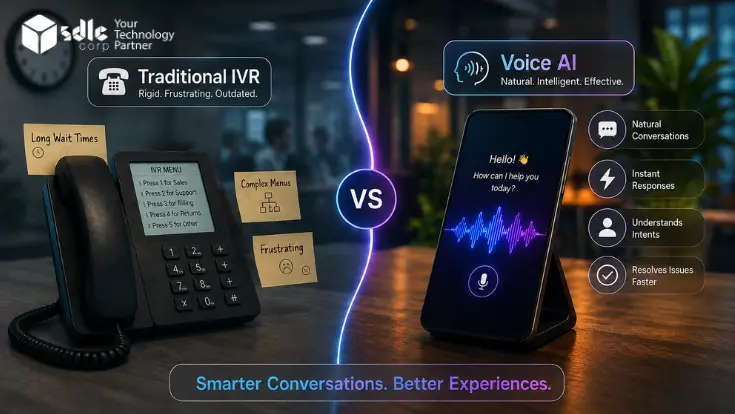
Traditional IVR works best for simple routing and predictable keypad choices. Voice AI is better when callers need natural conversation, multi-step support, or faster issue resolution. A hybrid model fits enterprises that want conversational service while keeping secure or rule-based IVR steps. Replace call journeys selectively based on customer need, system readiness, and business value.
Key Takeaways
IVR remains useful for simple and stable call flows.
Voice AI works better when customers express the same intent in many different ways.
Natural conversation creates little value if backend systems cannot complete the requested task.
Enterprises can use Voice AI and IVR together instead of forcing a full replacement.
High-volume, repeatable, API-ready workflows are usually the strongest migration candidates.
Measure successful outcomes, repeat calls, handoff quality, failures, and latency—not only AI call containment.
Scope of This Guide
This page is about the decision: whether your IVR should be replaced now, partly replaced, or improved where it stands. It assumes you already know what each technology is.
For the architecture, component-level comparison, cost ranges, KPI definitions and phased migration plan, see Voice AI vs IVR, which is the deep comparison this decision guide sits on top of.
When Should Enterprises Replace Traditional IVR With Voice AI?
A single complaint about an IVR does not justify a full migration. Look for several signals across customer experience, operations, and technology.
Customers Regularly Choose the Wrong Menu Option
Traditional menus assume every customer problem belongs neatly to one category. Real calls are often more complicated. A customer may have a billing question caused by an order issue. Another may need technical support and an account change in the same conversation. When callers routinely choose the closest available option and then get transferred, the IVR is adding steps instead of removing them. Voice AI can start with the customer's actual request rather than asking the caller to understand the company's internal department structure.
The IVR Routes Calls but Rarely Resolves Them
Routing is useful, but routing alone is not customer service. Suppose a caller navigates an order-support menu, waits in a queue, and reaches an employee who simply checks a tracking system. The IVR routed the call correctly. It did not solve the problem. Review the tasks agents perform immediately after an IVR transfer. Common Voice AI candidates include:
- Order and shipment status
- Appointment booking or rescheduling
- Application or ticket status
- Basic account updates
- Store or branch information
- Lead qualification
- Callback scheduling
- Common policy questions
- Simple troubleshooting
These workflows are stronger candidates when they follow clear rules and can connect safely to enterprise systems.
Your Call Tree Has Become Too Deep
IVR systems often grow gradually. A company adds a new product, location, language, support tier, department, or service. Each addition creates another branch. Eventually, a caller may need to remember several options before reaching the correct destination. Voice AI can reduce that navigation. The customer explains the goal, and the system determines the appropriate approved workflow behind the conversation.
Skilled Agents Repeat Predictable Tasks
The best Voice AI strategy does not begin with: “How many people can AI replace?” A better question is: “Which high-volume calls consume employee time even though the work follows a repeatable process?” Agents may repeatedly check the same systems, ask the same verification questions, update the same fields, or schedule the same services. Automating suitable routine work allows people to focus on exceptions, complaints, complex troubleshooting, negotiations, and situations that require judgment.
Customers Need Better After-Hours Service
An IVR can answer calls 24/7 without providing useful 24/7 service. A customer might hear opening hours or leave a voicemail but still be unable to change an appointment, check an order, or update a request. Voice AI becomes more valuable when connected systems allow customers to complete approved tasks outside normal support hours.
Customers Express the Same Intent in Many Ways
Consider:
- “Where is my package?”
- “Has my order shipped?”
- “My delivery hasn't arrived.”
- “Can you check my tracking?”
- “When should my order get here?”
These statements may all lead to the same business process. Traditional menus ask customers to translate their problem into the company's categories. Voice AI can identify different ways of expressing the same intent and ask for clarification when necessary.
Backend Systems Are Ready for Real Automation
This is one of the most important replacement tests. Suppose a customer says:
“Move my appointment from Tuesday morning to Friday afternoon.”
The AI still needs to:
- Identify the customer.
- Find the existing appointment.
- Check available slots.
- Apply scheduling rules.
- Confirm the new time.
- Update the system of record.
- Confirm the change.
- Record the interaction.
Natural speech alone cannot do that. Reliable APIs, clean data, permissions, business rules, clear ownership, and error handling turn conversation into useful automation. If those foundations are missing, improving the existing process may produce more value than replacing the IVR.
When Should Enterprises Keep IVR?
Voice AI does not need to replace every existing flow.
Simple Routing Works Well
If callers only need to choose between sales, billing, support, or another small set of destinations, a short menu may remain the fastest solution.
Input Is Short and Predictable
Keypad input can still work well for PINs, confirmation choices, reference numbers, and other simple entries. It can also provide more privacy when a caller is in a public place.
The Journey Has Low Volume and Low Friction
A rarely used call flow with few transfers, complaints, or failures is usually a low modernization priority. Focus first on journeys where customers and employees are losing measurable time.
Strict Control Is Required
Authentication, emergency routing, required disclosures, and some compliance-sensitive steps may need predictable behavior. These flows can remain deterministic even when Voice AI handles other parts of the conversation.
Required Systems Are Not Ready
Poor data, unstable APIs, unclear rules, or conflicting customer records will limit any automation layer. A more natural voice cannot repair a broken business process underneath it.
Voice AI and IVR Can Work Together
For many enterprises, the strongest architecture is hybrid. A customer journey might look like:
From there, the system can:
This approach reduces migration risk and lets the business use each technology where it performs best. The objective is not to remove every “press 1” prompt. It is to remove unnecessary effort.
IVR Replacement Readiness Score
Before funding a migration, score each target call journey from 0 to 2.
Why
- High repetitive volume
- Reliable APIs
- Strong automation potential
Before Migration
- Complete governance review
| Factor | 0 | 1 | 2 |
|---|---|---|---|
| Repetitive call volume | Low | Moderate | High |
| Intent variation | Mostly fixed | Some variation | Many natural-language variations |
| Backend integration | Limited | Partial | Reliable API access |
| Automation potential | Routing only | Some actions | Clear end-to-end workflow |
| Governance readiness | Not defined | In progress | Controls and ownership established |
How to Interpret the Score
Simplify menus, improve routing, fix data problems, or improve current self-service before introducing a new AI layer.
Voice AI may improve selected parts of the journey while IVR remains useful for authentication, routing, or fallback.
Move into detailed architecture, security, pilot, integration, and ROI planning. This score is not a procurement rule. It is a practical way to identify which workflows deserve deeper analysis.
An Enterprise Migration Example
Current IVR Journey
Consider a retailer whose current support journey looks like:
The agent then opens an order system and checks tracking information.
Voice AI Journey
A Voice AI journey could begin with:
“How can I help with your order today?”
A customer says the delivery is late. The system identifies the intent, verifies the customer, retrieves the order, checks the latest tracking information, and explains the current status.
If the caller disputes a charge or asks for an exception outside approved rules, the call moves to a human specialist with the relevant context.
This is an illustrative scenario, not a performance claim. Actual cost, containment, and resolution improvements should be measured through a controlled pilot using the enterprise's own call mix and systems.
What Must Be Ready Before Voice AI Goes Into Production?
A successful implementation depends on much more than the voice model.
Reliable Data
Voice AI needs trusted information. If CRM and ERP records disagree, the AI may expose the conflict rather than solve it. Define the source of truth for every customer and operational field used in the workflow.
Production-Ready Integrations
Read access helps the AI answer questions. Write access lets it complete tasks. Define which systems the AI can access, which actions it can take, what validation is required, and what happens when an integration fails.
Authentication
Match authentication to the risk of the request. A caller asking for opening hours does not need the same controls as someone changing account details or discussing financial information.
Approved Knowledge
Voice AI needs clear sources for the information it is allowed to provide. Assign owners to policies, FAQs, product data, support instructions, and other knowledge so outdated information does not remain in production.
Human Handoff
A good transfer should preserve context. The receiving agent should know:
- Why the customer called
- Whether authentication succeeded
- What information was collected
- Which systems were checked
- What actions were attempted
- Why escalation happened
Customers should not have to restart the conversation.
Monitoring
Track call outcomes, intents, integrations, transfers, failures, complaints, latency, and unexpected behaviors. Voice AI needs continuous operational review after launch.
Voice Latency Matters
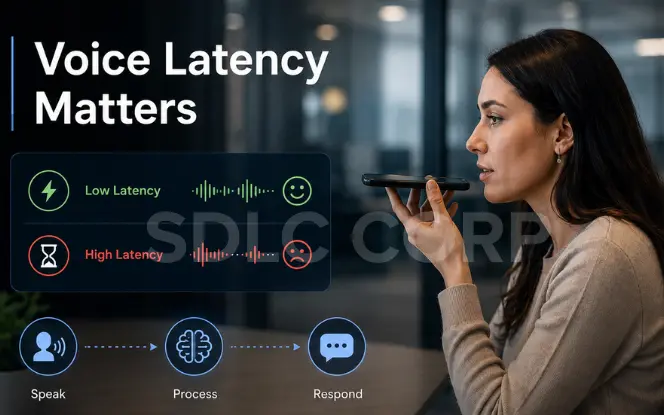
Voice conversations are less forgiving of delay than chat. A response may depend on speech recognition, AI processing, an API call, response generation, and text-to-speech output. A delay at any point can create an unnatural pause. There is no single latency number that guarantees a good experience across every enterprise system.
Measure the complete production path under realistic network, telephony, and integration conditions. Also test interruptions and overlapping speech. Customers do not always wait for an automated system to finish speaking before they respond.
How to Replace IVR With Voice AI Safely
A staged migration provides clearer evidence and a safer fallback.
Analyze Real Call Data
Review:
- Top customer intents
- Transfer-heavy journeys
- Repeat calls
- IVR abandonment
- Long handle times
- Common agent actions
- After-hours demand
- Failed self-service
Establish a baseline before introducing AI.
Choose One Valuable Workflow
Select a use case with enough call volume to measure, clear rules, reliable data, and an obvious escalation path. Order tracking or appointment management is usually a safer first pilot than a high-risk financial dispute.
Map the Complete Workflow
Document what happens before, during, and after the conversation. Include authentication, system lookups, updates, approvals, customer confirmations, logging, failures, and handoff.
Define What the AI Can and Cannot Do
Set clear boundaries. For example, the system may reschedule an appointment within available slots but escalate any request for an exception to policy. The AI should not create its own solution when the approved workflow has no valid next step.
Test Real Call Conditions
Test more than scripted conversations. Include:
- Different accents and speaking speeds
- Background noise
- Interruptions
- Silence
- Long explanations
- Changed requests
- Misheard names and numbers
- Unexpected questions
- API failures
- Authentication failures
- Requests for a human
Production problems often appear outside the ideal path.
Run a Controlled Pilot
Send a limited set of eligible calls through Voice AI while keeping existing routing available. Compare the pilot with your baseline.
Expand Only When the Pilot Meets Agreed Targets
Define success before launch. Expansion criteria might include:
- Acceptable task-completion rate
- Stable integrations
- Acceptable response latency
- Correct escalation behavior
- No unacceptable security events
- No material increase in repeat calls
- Reliable handoff context
- Customer complaints within the agreed limit
A successful demo is not enough reason for a broad rollout.
How Should Enterprises Measure Voice AI?
Avoid relying on a single metric such as “calls handled by AI.”
Task Completion Rate
Did customers actually complete the task they called about? This is more useful than simply counting automated conversations.
Repeat Contact
Did the customer call again about the same problem? A high containment rate means little if customers have to try again later.
Transfer Rate and Reason
Track how often the AI transfers calls and why. A transfer is not always a failure. Escalating a sensitive or unsupported request may be the correct result.
Handoff Quality
Measure whether agents receive the intent, authentication state, collected information, attempted actions, and useful conversation context.
Automation Failures
Group failures into categories such as:
- Intent misunderstanding
- Speech-recognition error
- Missing knowledge
This shows teams where improvements are actually needed.
Customer and Operational Outcomes
Also track:
- Customer satisfaction
- Abandonment
- Complaints
- Agent workload
The goal is not more AI-handled minutes. It is better completed customer outcomes.
Measure the full journey, not a single AI metric. Task completion, repeat contact, transfer quality, failures, and customer outcomes should be reviewed together.
How to Build the Business Case for Voice AI
Start with the current journey rather than a vendor's projected savings.
Measure Current IVR Costs
Include:
- IVR and contact-center platforms
- Telephony
- Infrastructure
- Call-flow maintenance
- Vendor support
- Agent time after IVR
- Transfers
- Repeat calls
- Peak staffing
- Failed self-service
Estimate Voice AI Costs
Include:
- Voice AI platform costs
- Telephony
- Speech processing
- Model usage
- Integration development
- Security
- Monitoring
- Testing
- Knowledge maintenance
- Ongoing optimization
Then subtract the cost of running the new workflow.
Use your own pilot data for the automation rate. Vendor case studies can help with early planning, but they should not replace data from your own contact center.
Governance, Privacy, and Compliance
Voice AI changes the risk profile of call automation because it may process audio, transcripts, customer identifiers, account information, and data from connected systems. It may also trigger actions that affect a customer. Governance belongs in the system design from the start.
Assign Ownership
Define who owns:
- Conversation design
- Approved knowledge
- Model and prompt changes
- Integrations
- Security
- Monitoring
- Incident response
- Compliance
- Human escalation
The NIST AI Risk Management Framework provides a useful structure around Govern, Map, Measure, and Manage. Organizations should check the latest NIST guidance because the framework continues to evolve.
Be Clear About AI Interaction
Organizations operating in the European Union should review the transparency requirements that apply to AI interactions under the EU AI Act. Relevant Article 50 requirements have applied since August 2, 2026. The exact requirement depends on how the system is used, so legal teams should review current European Commission guidance.
Treat Outbound Calls Separately
Inbound service calls and outbound AI-generated calls do not always create the same legal requirements. In the United States, the FCC has confirmed that AI-generated voices can fall under Telephone Consumer Protection Act rules covering artificial or prerecorded voices. Consent, identification, opt-out, and telemarketing requirements may therefore affect outbound Voice AI programs.
Protect Sensitive Data
If the voice workflow handles payment card information, assess the architecture against applicable PCI DSS requirements. Also define how audio, transcripts, summaries, and extracted customer data are stored, protected, and deleted. Retention should match the business purpose and applicable security, privacy, and legal requirements.
Where Voice AI Can Add Value
Industry matters, but workflow design matters more.
Banking and financial services
application status, appointment scheduling, branch information, and routine service questions.
Healthcare
appointment booking, reminders, referral status, and administrative requests, with clear human paths for clinical or emergency situations.
Retail and e-commerce
order tracking, delivery questions, return eligibility, store information, and product availability.
Logistics
shipment status, pickup scheduling, delivery updates, and exception intake.
Telecom
ticket status, plan information, appointment scheduling, and guided first-line troubleshooting.
Across all these industries, the strongest candidate is usually a high-volume, repeatable process with reliable data and clear rules.
What Should Enterprises Ask a Voice AI Vendor?
A polished demo does not prove production readiness. Ask:
How does the platform handle interruptions, background noise, silence, and changed intent?
How is accuracy tested against our callers, languages, accents, and use cases?
How is end-to-end latency measured?
Which systems can the platform read from and write to?
What happens when an API fails?
How are recordings, transcripts, credentials, and customer data protected?
Is enterprise data used to train shared models?
What retention controls are available?
Can the system transfer a call with full context?
Who can change prompts, tools, permissions, and knowledge?
Is there an audit trail?
Can teams monitor results by intent, failure type, transfer reason, and business outcome?
How does pricing change with minutes, calls, concurrency, models, integrations, and telephony?
What happens to data and integrations if the organization changes providers?
The answers reveal much more than a scripted demonstration.
Voice AI vs IVR Migration Checklist
Before moving a call journey to Voice AI, confirm that:
Conclusion
The Voice AI vs IVR decision should depend on the customer journey, not on which technology is newer. Traditional IVR still works well for simple routing and predictable tasks, while Voice AI is better suited to natural conversations, multi-step requests, and workflows connected to reliable business systems. Enterprises should modernize the call journeys that create the most friction, confirm that data and integrations are ready, and test Voice AI through a controlled pilot. Some IVR flows should stay, some should be replaced, and others may work best in a hybrid model that helps customers reach the right outcome with less effort.
Assess Whether Your IVR Is Ready for Voice AI
If customers still navigate long menus while agents repeatedly handle the same routine requests, identify which call journeys are actually ready for automation. Review customer intent, workflow complexity, backend integrations, security, escalation, and success metrics before choosing the replacement architecture.
Frequently Asked Questions
What Is the Main Difference Between Voice AI and IVR?
Traditional IVR usually guides callers through predefined menus or routing logic. Voice AI focuses on understanding natural speech, maintaining context, and connecting customer intent to approved business workflows. Advanced IVR systems can also support speech and natural-language features, so enterprises should compare actual capabilities rather than product names alone.
When Should a Company Replace Its IVR?
Consider replacing an IVR flow when it creates frequent transfers, deep menus, poor self-service, or repeated agent work and the target business process has reliable data, integrations, rules, and escalation paths.
When Is IVR Better Than Voice AI?
IVR remains effective for simple routing, predictable input, low-volume journeys, strict processes, secure keypad entry, and fallback paths. If a short IVR flow already works well, replacing it with AI may add cost without improving the customer journey.
Can Voice AI and IVR Work Together?
Yes. A hybrid model can use Voice AI for intent recognition and task automation while IVR handles authentication, keypad input, strict routing, or fallback. For large enterprises, this is often safer than replacing the entire call environment at once.
Is Voice AI the Same as Conversational IVR?
Not always. Conversational IVR may allow natural-language input while still relying on structured call logic. A modern AI voice agent may maintain broader context, access enterprise knowledge, perform approved actions, and manage more dynamic conversations. Vendor terminology varies, so evaluate functionality rather than labels.
Does Voice AI Reduce Contact Center Costs?
It can reduce repetitive manual work when customers successfully complete automated tasks. Actual savings depend on call mix, automation success, telephony, integrations, platform costs, support, and ongoing optimization. Use pilot data from your own environment before making an ROI commitment.
What Systems Should Voice AI Integrate With?
Common systems include CRM, ERP, contact-center platforms, ticketing systems, order management, scheduling, identity services, knowledge bases, and customer databases. Connect only the systems and actions required by the approved workflow.
What Happens When Voice AI Cannot Solve a Request?
The system should follow a defined fallback path. It may ask for clarification, move to a controlled workflow, schedule a callback, transfer to a human agent, or return to existing routing. The AI should not guess when it lacks the information or authority required to complete the task.
What Metrics Matter Most in a Voice AI Pilot?
Track task completion, repeat contact, transfer reasons, handoff quality, automation failures, API reliability, response latency, customer experience, and cost per successful outcome. Containment rate can be useful, but it does not prove that the customer's problem was solved.
How Should an Enterprise Start a Voice AI Migration?
Start with one repeatable, measurable workflow. Baseline the current IVR journey, connect the required systems, define security and escalation rules, test real conversations, launch a controlled pilot, and expand only after the workflow meets agreed business and risk targets.