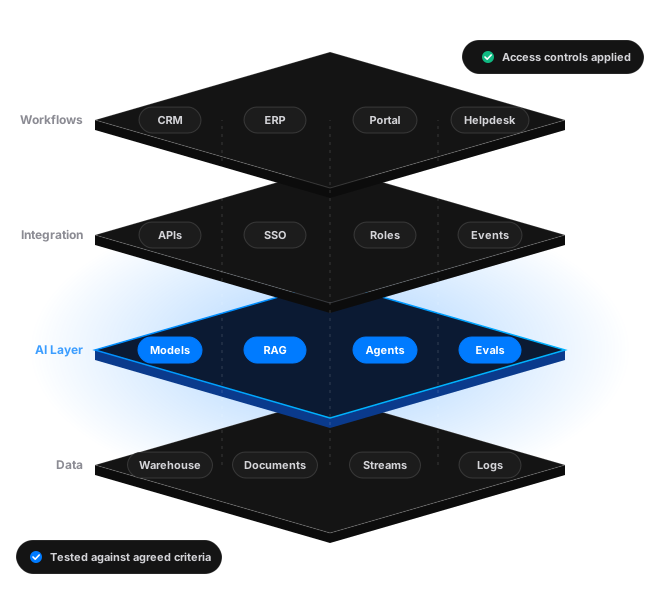
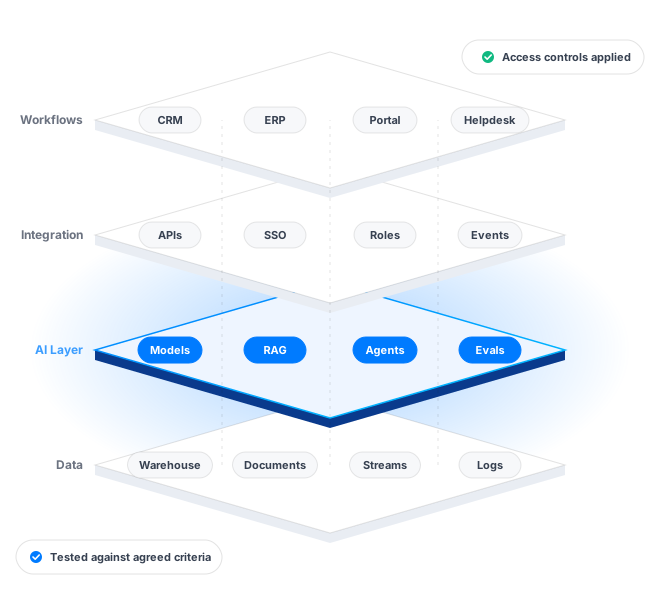
Develop. Scale. Integrate.
AI Development & Engineering
SDLC Corp provides AI development and engineering services for enterprises. We design and build AI applications, create AI capabilities that work across teams, and connect AI to the business systems you already use. This page helps you pick the right engineering path for your project.
- 125+
- AI Models Trained or Deployed
- 120+
- Enterprise AI Integrations Delivered
- 125+
- LLM Fine-Tuning Implementations Across Clients
Company-wide delivery experience across client engagements; implementations and models represent different measures of work.
Trusted by Fortune Global 500 leaders, governments & top universities across 30+ countries
Powered by leading cloud & AI platforms
Recognized by leading industry reviewers
Awards & industry recognition
Engineering Paths
Explore Our AI Engineering Services
Each path solves a different problem. Start with the one that matches what you need to build.
AI Development Services
Build a custom AI application or add AI to a specific workflow, from requirements and model selection through testing and deployment.
Enterprise AI Development
Our enterprise AI development services build shared AI capabilities that multiple teams, applications, or business units can reuse, with common access controls and evaluation.
AI Integration & Implementation
Connect AI to your existing data, applications, and business workflows, such as ERP, CRM, document repositories, and approval processes.
A project may combine all three paths. We help you scope which parts you need.
One Project, Three Paths
How AI Engineering Works in Practice
Take AI-assisted document review as an example. Each engineering path handles a different part of the same initiative.
- 01Develop

Build the Review Application
We build the application staff use to review documents, including the AI that reads each file, suggests decisions, and flags items for a person to check.
- 02Scale

Share Capabilities Across Teams
When finance, legal, and operations all handle similar documents, we turn extraction and classification into shared capabilities each team can use.
- 03Integrate
Connect to Existing Systems
We connect documents, review decisions, and approvals to your repositories, records, and workflow tools, so results land where work already happens.

Start with the part you need now. Add the others as the initiative grows.
Selected Work
3 Projects, Scroll to RevealAI Builds That Went Live
Three builds across visual inspection, fraud detection and freight operations, each running inside live business systems.
View All Case StudiesAI Defect Detection for Automotive Paint Inspection
Manual inspection caught 81% of surface defects and kept stopping the line for false alarms. SDLC Corp built an edge computer vision system that lifted detection to 96% accuracy, cut false positives by 42%, and returned each decision to the line's PLC in about 180 ms.
Read the Case Study
Graph ML Fraud Detection for a Poker Network
Rules-based controls could not keep pace with coordinated multi-account play across 62,000 hands per minute. SDLC Corp built a graph machine learning system that scores every hand in real time, lifting collusion detection from 74% to 92% and cutting false positives by 47%.
Read the Case Study
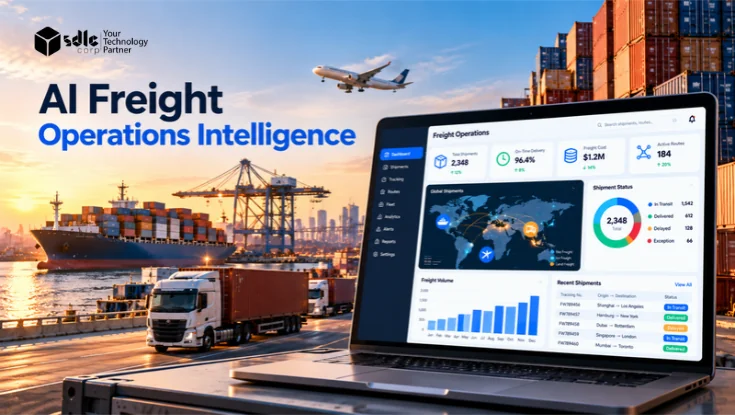
AI Freight Operations Intelligence for Oracle OTM
Invoices were matched to shipments by hand. SDLC Corp built an AI system that reads and validates each invoice. 100% of costs posted to Oracle OTM are validated and approved, and exceptions go to a reviewer with full history recorded.
Read the Case Study
How We Deliver
How We Take AI Into Production
Six stages, each with a clear output you can review before the next one starts. For a worked example of timing and effort, read AI Voice Agent Implementation: Timeline, Phases, and Effort.
- 01Goal and success measure
Define
Define the workflow, users, and measurable goal.
- 02Solution and data plan
Design
Design the application, data access, and system connections.
- 03Working, reviewed build
Build
Build the AI capability and user experience.
- 04Connected, permissioned system
Integrate
Integrate it with approved business systems.
- 05Evaluation and test report
Evaluate
Evaluate quality, security, reliability, and failure cases.
- 06Monitored production release
Deploy and Improve
Deploy and improve it using monitoring and user feedback.
Technology
Technology Behind AI Engineering
Build, scale, and integrate AI with the right models, frameworks, and cloud platforms. Technology choices follow your workflow, data requirements, security controls, and operating budget.
Your project may use a focused application stack, shared enterprise infrastructure, or integrations with existing systems. We select the components that fit the scope.
Engineering Paths
Find the Approach That Fits Your AI Goal
Three paths cover most AI engineering work. Find the row that matches your situation, then read the related guide for detail.
| Path | Best when | What you get |
|---|---|---|
| 01 AI Development Services | You need a custom AI application built around your own workflows, data and users, and a ready-made tool will not fit. | A custom AI application, designed, built, evaluated and deployed for your business objectives. Related reading Agentic AI Fundamentals |
| 02 Enterprise AI Development | Several teams or business units need the same AI capability, and you want it built once and shared. | Reusable AI capabilities, enterprise applications and shared AI services that work across teams and business systems. Related reading Enterprise DataOps Operating Model for AI |
| 03 AI Integration & Implementation | You have an AI capability ready and need it working inside the systems your teams already use. | AI connected to your ERP, CRM, APIs, data platforms and business workflows, so it can inform decisions and trigger actions. Related reading AI Voice Agent CRM, ERP, and ITSM Integrations |
Not sure which row fits? Tell us what you are building and we will point you to the right path.
What Our AI Clients Say
Client feedback on AI chatbots, business automation and healthcare platforms.
Eric Leist
CEO, Edgerton Strategies

Doug Schmidt
CEO, RoofAid USA

Reyzal Razmi
All Star Influencers
Everything worked as promised.
Discuss your AI project
Talk to our Ai Development team about your use case, data and deployment target. We will scope the model, pipeline and rollout with you.
Request a Free ConsultationBuild AI That Works With Your Business Systems
Speak with our AI engineers about your use case, data, and systems. We will help you choose the right engineering path.
Blogs and Insights
Practical Reading on AI Engineering
Practical guides to integrating AI with existing systems, running AI across teams, and building it responsibly.
How to Integrate AI Into Existing Enterprise Systems
Connect AI through APIs, events, and permissions, with human review and a staged rollout.
Read the Integration Guide →
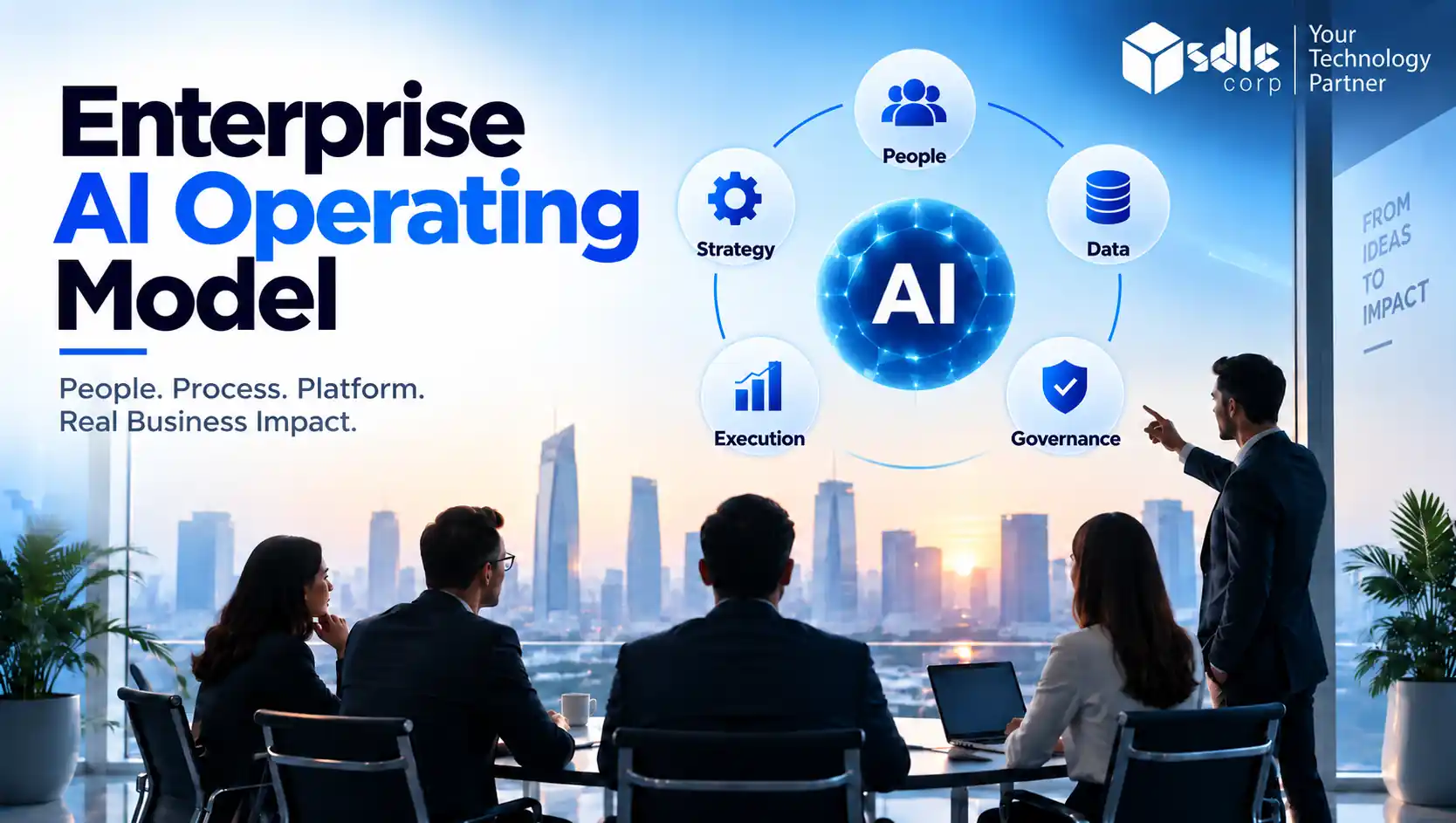
Enterprise AI Operating Model: Teams, Roles, and Delivery Responsibilities
Set clear ownership, funding, handoffs, and platform roles so shared AI capabilities deliver measurable value.
Read the Operating Model Guide →
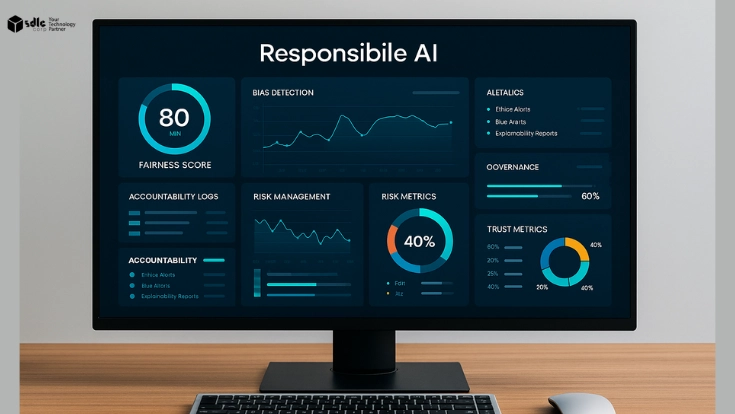
Responsible AI Development: Principles, Lifecycle and Controls
Build fairness, transparency, privacy, security, and human oversight into every stage of the AI lifecycle.
Read the Responsible AI Guide →FAQ

Frequently Asked Questions
Answers to what teams usually ask about AI development and engineering services before choosing a path.
AI engineering is the work of turning AI models into dependable business software. It covers building AI applications, sharing AI capabilities across teams, connecting AI to existing systems, and testing, deploying, and monitoring it in production.
They cover three parts: building the AI application, creating enterprise AI capabilities that teams share, and integrating AI with existing systems. Many projects need all three. A document review project, for example, may need a new application, capabilities shared across departments, and connections to existing records. We scope them together so the parts fit, then deliver them in the order that gives you value soonest. To see how the layers fit in one system, read AI Voice Agent Architecture: How Modern Voice AI Systems Work.
AI development builds the AI application itself, from requirements and model selection through evaluation and deployment. AI integration connects an AI capability to the systems your teams already use, such as ERP, CRM, and workflow tools. Enterprise AI engineering projects often need both, so we scope them together.
We integrate AI into existing enterprise systems by connecting it to ERP, CRM, document repositories, databases, APIs, and workflow tools. Each integration follows your existing permissions and approval rules, and we test it against real data flows before release.
Start with a clear business problem, the workflow you want to improve, and the result you want to measure. Then, identify the available data, required systems, and access rules. We review these inputs to define a practical project scope.
We test output quality, system connections, permissions, response times, and failure handling against agreed acceptance criteria. In addition, we check human review and approval flows where needed. A controlled pilot helps validate the workflow before wider rollout. For a structured way to think about AI risk and evaluation, see the NIST AI Risk Management Framework.
Cost depends on the scope of the application, the number of systems it connects to, the condition of your data, security and compliance requirements, and whether the capability is shared across teams. A focused pilot costs less than a shared enterprise platform. After scoping your use case, data, and systems, we provide an estimate for each phase.
Timelines depend on the same factors: scope, data readiness, the number of integrations, and testing and approval requirements. A focused use case can reach a controlled pilot sooner, while shared enterprise capabilities and multi-system integrations take longer. We agree on milestones for each phase when we define the scope.
Yes. We review the application, data flows, integrations, and production issues to identify what needs improvement. Depending on the findings, the work may include better evaluation, stronger access controls, faster responses, or more reliable deployment. For hosting options, read AI Voice Agent Deployment Models: SaaS, VPC and Self-Hosted. Cloud documentation such as the AWS Well-Architected Machine Learning Lens covers the architecture and security practices to plan for.
- Contact Us
Start Your AI Engineering Project
What happens next?
- We review your requirements
- Strategy call with experts
- Clear roadmap & estimate
- NDA Protected
- Enterprise Grade Delivery
- Global Clients