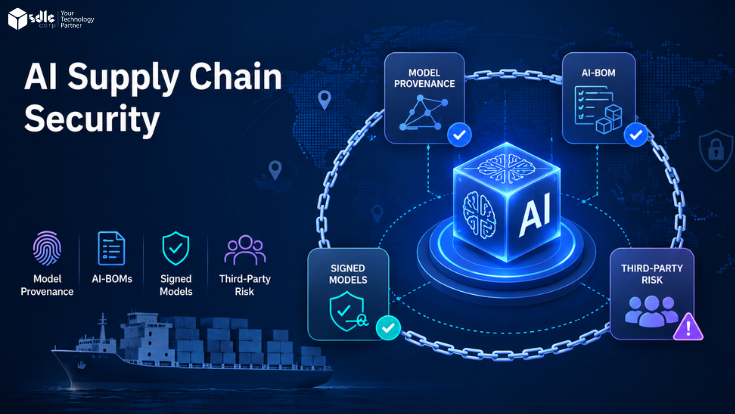
AI systems now depend on external models, datasets, APIs, and software components, and each one is a way for hidden risk to enter. Model provenance traces where a model came from, an AI-BOM shows what you depend on, and model signing confirms nothing changed after approval. This guide covers the controls, the evidence each one produces, and the EU AI Act deadlines that now depend on them.
Key Takeaways
-
AI supply chain security protects models, data, tools, and dependencies.
-
Model provenance shows where a model came from and how it was derived.
-
AI-BOMs reveal models, datasets, APIs, and dependencies.
-
Model signing verifies model integrity and authenticity.
-
Third-party risk covers external models, vendors, and hidden dependencies.
-
Continuous monitoring tracks model and dependency changes at runtime.
DefinitionWhat Is AI Supply Chain Security?
What Is AI Supply Chain Security?
AI supply chain security is the practice of protecting the models, datasets, frameworks, APIs, tools, and infrastructure used throughout the AI lifecycle.
It reduces risk from untrusted components, compromised data, and external services by keeping AI assets traceable and verifiable from development through deployment.
What Makes Up an AI Supply Chain?
Every component involved in building, training, deploying, and running an AI system, most of it sourced externally.
- AI development services
- Training and fine-tuning datasets
- ML frameworks and software libraries
- Model repositories and registries
- APIs and third-party AI services
- MLOps and CI/CD pipelines
- Cloud consulting services and infrastructure dependencies
- Agent tools and external integrations
Each can introduce security, privacy, licensing, or integrity risk, so teams need to track where assets come from, how they change, and what depends on them.
Where AI Supply Chain Risks Come From
Risks enter through models, datasets, dependencies, and external services. Some change how a model behaves. Others open a path into the infrastructure around it.
Malicious or Untrusted AI Models
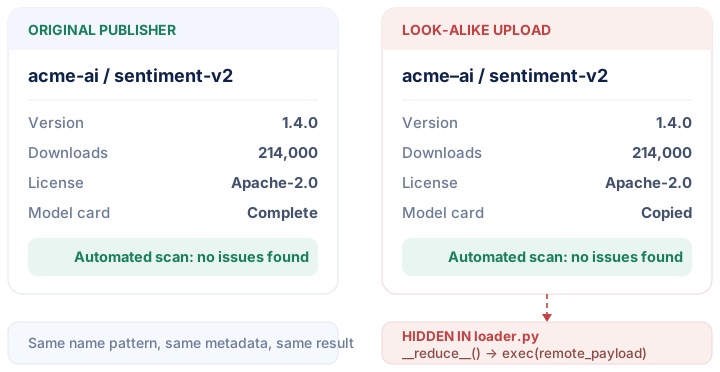
Public repositories can hide executable payloads in the artifact or its loader script, behind a listing that looks legitimate.
Data and Model Poisoning
Manipulated training data or retrieval sources make a model misbehave on cue, and scans pass clean.
Vulnerable AI Dependencies
Loaders, runtimes, and serialization libraries sit in the execution path, where unsafe formats allow code execution.
Model Tampering
An artifact can be swapped or silently updated after review, while name, version, and metadata stay identical.
Real AI Supply Chain Attacks Show the Risk Is Already Here
Four incidents from 2025 and 2026.
ReversingLabs found Hugging Face models using nullifAI to evade scanning. Open-OSS/privacy-filter copied a real model card and passed 200,000 downloads before removal.
CVE-2026-6859 in InstructLab and CVE-2026-25874 in LeRobot: unsafe model loading and Pickle deserialization enabling remote code execution.
JFrog found critical PickleScan bypasses. A clean scan does not guarantee a safe model.
Hugging Face disclosed a 2026 incident where a malicious dataset reached internal processing infrastructure.
Repository reputation, model cards, and automated scanning are all signals attackers have already learned to defeat.
What Is Model Provenance?
Model provenance is verifiable evidence of where an AI model came from, who produced it, and how it was created or modified.
It gives visibility into parent models, datasets, versions, and licenses before a model reaches production, instead of trusting publisher metadata.
Model Provenance vs. Model Lineage vs. Data Provenance
Although these terms are related, they track different parts of an AI model's history.
| Term | What It Tracks |
|---|---|
| Model provenance | Where a model came from and what it was derived from |
| Model lineage | The sequence of changes and transformations that produced the current model |
| Data provenance | Where training, fine-tuning, evaluation, or retrieval data originated |
Together they make a model traceable across its lifecycle.
What Should Model Provenance Track?
A useful record captures enough to verify a model and see how it changed:
- Source and provider
- Name and version
- Parent or base model
- Fine-tuning or other modifications
- Dataset references
- Framework and dependency versions
- Licensing information
- Cryptographic hashes for integrity checks
These records help teams identify unknown models and see what is affected when one changes.
What Is an AI-BOM?
An AI-BOM, also written as AIBOM or AI Bill of Materials, is a structured inventory of the models, datasets, frameworks, APIs, prompts, embeddings, and other assets used in an AI system.
It answers what your AI applications depend on and what breaks when one of those assets changes.
AI-BOM vs. SBOM
An SBOM covers software packages. An AI-BOM extends that to models, datasets, prompts, embeddings, and external AI services.
| Area | SBOM | AI-BOM |
|---|---|---|
| Software dependencies | Yes | Yes |
| AI models | Limited | Yes |
| Datasets | Limited | Yes |
| Prompts and embeddings | No | Yes |
| Model provenance | Limited | Core |
| External AI services | Varies | Yes |
The two work together. AI systems still run on ordinary software, and the AI-BOM adds what an SBOM cannot see.
AI-BOM Formats
CycloneDX ML-BOM and the SPDX AI Profile both provide machine-readable structure for models, datasets, versions, licenses, and provenance. The format matters less than keeping the inventory current, so review it whenever a model is fine-tuned, replaced, or repointed at a new provider.
What Is AI Model Signing?
AI model signing uses cryptographic signatures to verify who published or approved a model and whether the artifact has changed.
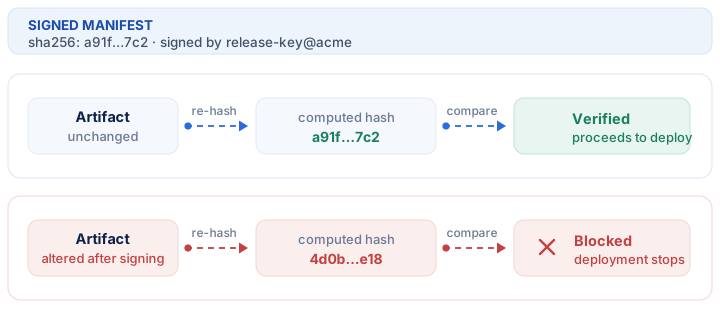
The signer hashes the model files and signs a manifest of those hashes. Anyone can re-hash and verify, so any modification breaks verification.
What Model Signing Proves
A valid signature confirms two things:
Integrity
The model has not been altered since signing.
Identity
A known key or identity signed the model.
A signed model is not automatically a safe one. Signing proves authenticity and integrity, not behaviour. A malicious publisher can sign a malicious model.
Model Scanning vs. Model Signing
Scanning checks an artifact for malicious content. Signing confirms the artifact reaching production is the one you approved. Scan first, record the hash, sign the approved artifact, verify before deploy.
Model Signing Standards: OMS, Sigstore, and Attestations
OpenSSF Model Signing (OMS) handles AI model artifacts and supports identity-based signing through Sigstore. Provenance attestations add verifiable detail about how an artifact was produced.
What Is Third-Party AI Risk?
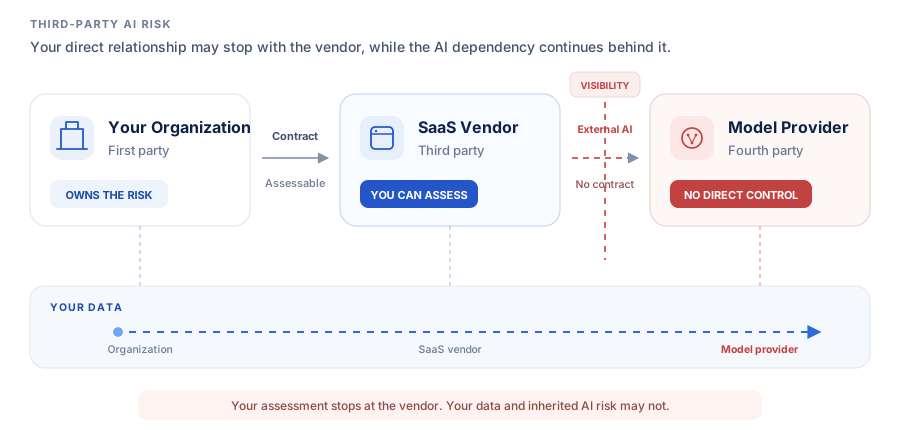
Third-party AI risk is the security, privacy, operational, or compliance exposure a business inherits from external models, APIs, datasets, tools, and service providers.
It is hardest to manage where teams cannot see how a vendor builds, updates, or secures what they supply.
Fourth-Party AI Risk
This appears when a vendor quietly depends on another AI provider, such as a SaaS platform calling a foundation model or inference API you never contracted with. You cannot assess a provider you do not know you rely on.
What Should You Ask AI Vendors?
Standard questionnaires rarely cover AI, so ask for evidence rather than assurances. Every question below maps to something reviewable.
| Ask the Vendor | Useful Evidence |
|---|---|
| Which AI models and external providers are involved? | AI-BOM or equivalent inventory |
| Where did the models and datasets come from? | Provenance and derivation records |
| What proves model integrity at deploy time? | Signature or hash verification evidence |
| Who processes customer data, and under what terms? | Data-flow documentation and contract terms |
| How are model or provider changes communicated? | Change-notification process or SLA |
| What governance controls are in place? | ISO/IEC 42001 certification or equivalent |
These surface hidden dependencies before an external service reaches production.
How Model Provenance, AI-BOMs, and Signed Models Work Together
Each control answers a different part of the same question: what you use, where it came from, and whether it still matches what you approved.
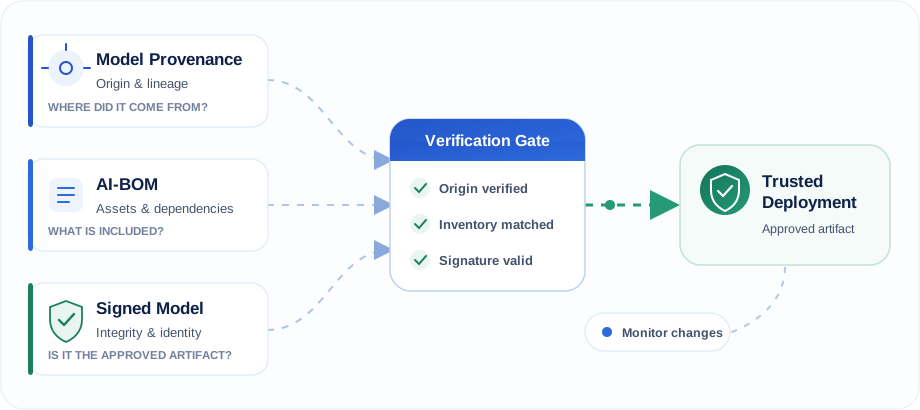
An AI-BOM answers what exists. Provenance explains where it came from. Scanning inspects the artifact. Signing binds approval to that exact artifact. Monitoring catches what changes after deployment.
Miss a step and the chain weakens. Inventory without provenance lists assets you cannot trace. Provenance without signing lets an approved artifact be swapped later. Signing without scanning proves the integrity of something nobody inspected.
How to Secure the AI Supply Chain
Seven controls across sourcing, development, deployment, and runtime.
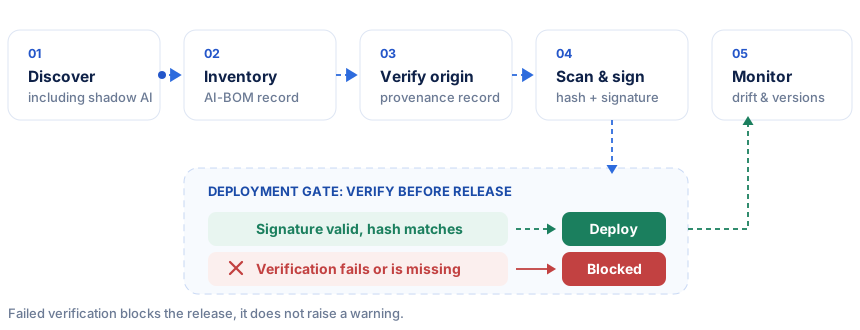
Discover Every AI Asset
Locate every model, dataset, API, and tool in use, including shadow AI adopted outside procurement.
Generate and Maintain an AI-BOM
Record every model, dataset, dependency, provider, and version, then update it on any change.
Verify Model Provenance
Confirm the origin, supplier, and derivation of any external artifact before it reaches production.
Scan and Sign Models
Scan first, sign the approved version, verify at deploy. Failed verification blocks the release, never warns.
Assess AI Vendors and Hidden Dependencies
Review third and fourth parties, and confirm how you are told when a model changes.
Pin AI Dependencies and Secure Registries
Pin dependency versions, lock down internal registries, and remove unsafe loading configurations.
Monitor AI Systems at Runtime
Track versions, provider changes, and drift, with logs tying each request to a model version.
AI Supply Chain Security and Compliance
These controls produce the records regulators ask for: models, datasets, suppliers, dependencies, and changes. They strengthen documentation and auditability, but no artifact alone proves compliance.
| Requirement or Framework | Relevant Need | Useful Supporting Evidence |
|---|---|---|
| EU AI Act Article 11 | Technical documentation for high-risk systems | AI inventory, model documentation, evaluation records |
| EU AI Act Article 53(1)(d) | GPAI training-content transparency | Model and dataset provenance records |
| CISA SBOM for AI guidance | AI and software supply chain transparency | AI-BOM or ML-BOM records |
| NIST AI RMF | Lifecycle AI risk management | Inventories, provenance, supplier controls |
| ISO/IEC 42001 | AI management and governance | Inventory, change controls, governance records |
Article 53(1)(d) ties most directly to provenance work: providers of general-purpose AI models must publish a sufficiently detailed summary of training content.
What AI Act Requirements Apply Now, and What Comes Next?
The Act lands in stages, and the AI Omnibus pushed the high-risk dates back further. Each milestone below is marked against today's date.
The 2 August 2027 date comes from Article 111(3), a transitional period for GPAI models already on the market before 2 August 2025. The later high-risk deadlines are not a reason to postpone inventory or provenance work, because those records earn their keep long before then.
AI Supply Chain Security Framework
Each lifecycle stage, its main risk, the control that reduces it, and the evidence to keep.
| Stage | Main Risk | Security Control | Useful Evidence |
|---|---|---|---|
| Source | Untrusted or unknown model | Model provenance verification | Provenance or derivation record |
| Inventory | Undocumented AI assets | AI-BOM | AI-BOM or ML-BOM record |
| Validation | Malicious artifact | Model scanning | Scan report and artifact hash |
| Integrity | Artifact altered after approval | Model signing | Verified model signature |
| Third party | Vendor or fourth-party risk | AI vendor assessment | Supplier evidence and change terms |
| Deployment | Approved version bypassed in the pipeline | Signature verification | Deployment verification record |
| Runtime | Drift or unexpected changes | Continuous monitoring | Versioned runtime and audit logs |
The evidence column is what makes this auditable. Each control leaves an artifact that both an engineer and an auditor can work from.
Start With What You Are Already Running
SDLC Corp helps enterprises build an AI asset inventory, verify model provenance, and add signing and verification to deployment pipelines.
Talk to our AI security teamFinal Thoughts
AI supply chain security comes down to three questions a team should be able to answer at any moment: what AI assets are in use, where they came from, and whether they have changed since approval. Most organizations still cannot answer all three, even as platforms adopt artifact signing and documentation rules turn inventories into a compliance concern. None of this needs solving at once, so start with discovery, because every other control depends on knowing what exists.
Frequently Asked Questions
Does the EU AI Act High-Risk Delay Mean We Can Postpone AI Inventory Work?
No. Later deadlines for some high-risk requirements do not remove the need for accurate records of models, datasets, suppliers, and dependencies.
Who Should Sign an AI Model: the Producer or the Deploying Organization?
Both, at different stages. Producers sign to establish identity and integrity; deploying teams sign an internally approved build after scanning.
Do I Need an AI-BOM If We Only Consume Vendor APIs?
Yes, a lighter one. Record the service, provider, model where known, data flows, and any providers sitting behind the vendor.
Does a Signed Model Mean the Model Is Safe?
No. Signing proves identity and integrity, not safe behaviour. Pair it with a scan report and the artifact hash it covers.