
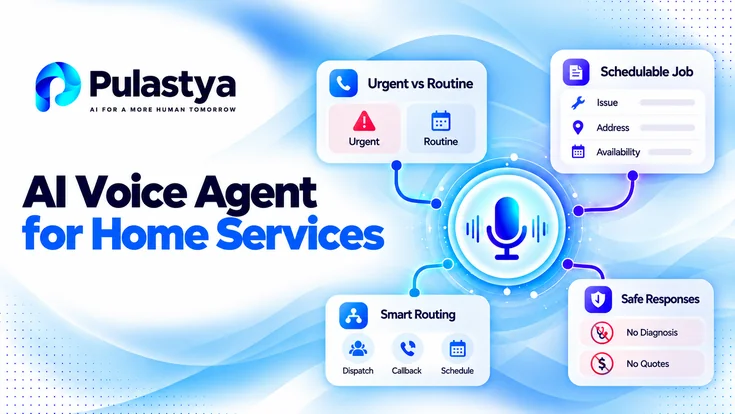
A trade business misses calls for a structural reason rather than a careless one.
The people who would answer the phone are the people doing the work, and at the moment it rings they are under a sink, on a roof or in a loft with both hands occupied. The caller does not wait, and the next number on the list is four seconds away.
- The phone rings mid-job The structural problem is not attitude or staffing levels. It is that answering and working are the same person's hands.
- Urgency comes first Active damage, a safety report and a dripping tap are three different calls, and the difference has to be established in the opening seconds.
- No diagnosis, no price Nobody has seen the work. Naming a likely fault or a figure over the phone creates an argument that happens at the customer's door.
Voicemail does not rescue this. Somebody with water coming through a ceiling will not leave a message and sit down. They hang up and dial somebody else, which is why a missed call in this trade is usually a lost job rather than a delayed one.
The work an agent can genuinely do here is narrower than it first looks. It can find out how bad this is, take down enough detail to plan a visit, and say something true about what happens next. It cannot look at the problem, and that limit shapes everything.
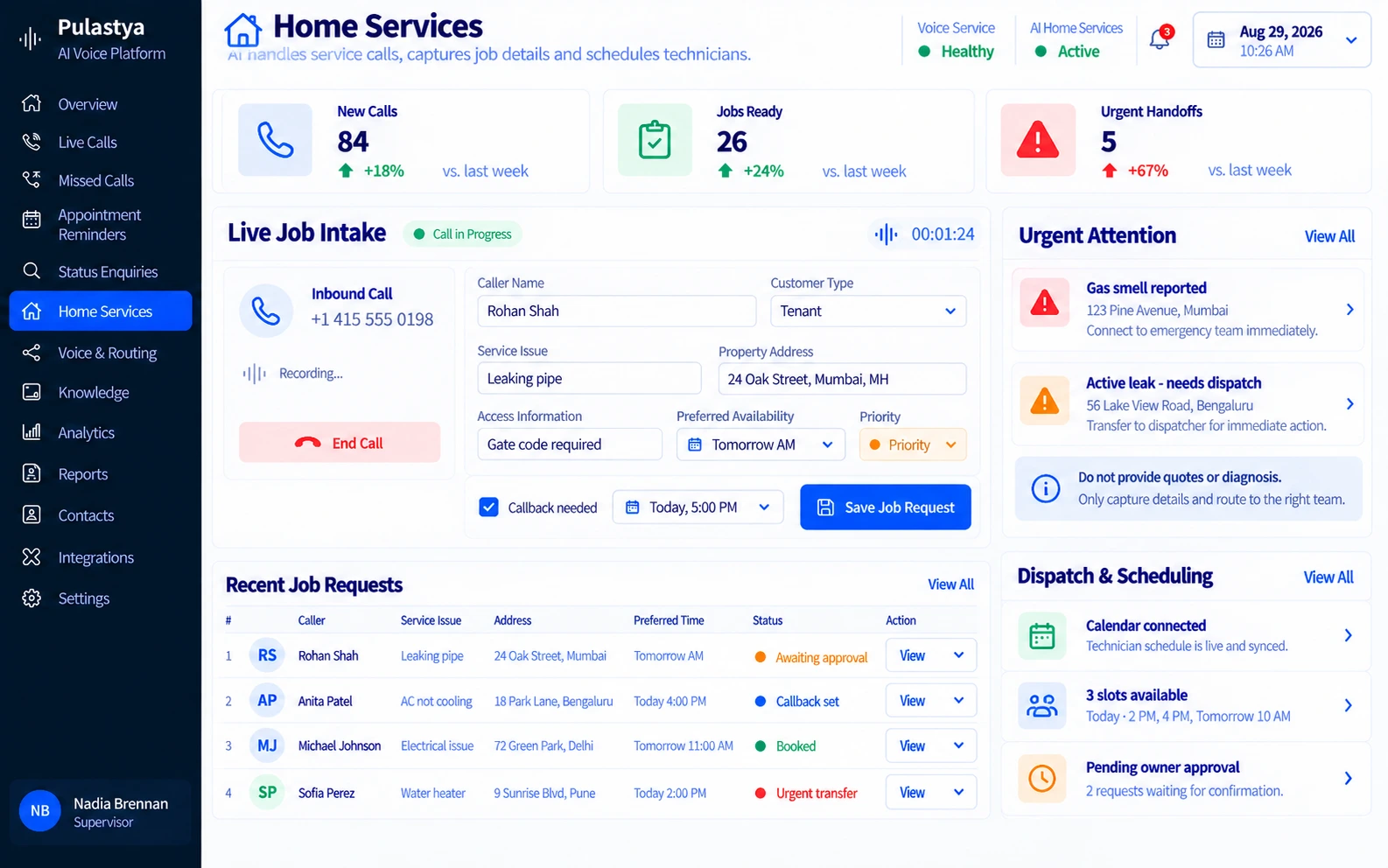
The Call That Arrives While Everyone Is on a Job
Most small trade businesses have already tried the obvious fixes. An engineer answers between jobs, a partner picks up from home, a mobile is passed around the van. Each works until two calls arrive at once, which happens on exactly the days when the work is heaviest.
The economics are stark. A single captured boiler job can be worth more than a month of whatever the phone costs to answer, and the caller who gave up at eleven is not a lead to be nurtured. They are booked with somebody else by lunchtime.
The scale of that leak and what recovering it is actually worth is set out in missed calls and the callback that recovers them.
Evenings and weekends are the other structural gap, and they need a deliberate answer rather than a hopeful one. What a call at nine on a Sunday should be told, and what should be promised, is covered in handling calls outside business hours.
Urgent, Today, or Next Week
Water coming through a ceiling is not the same call as a radiator that has been lukewarm for a fortnight. The difference has to be established in the first half-minute, because the day cannot be planned around anything else.
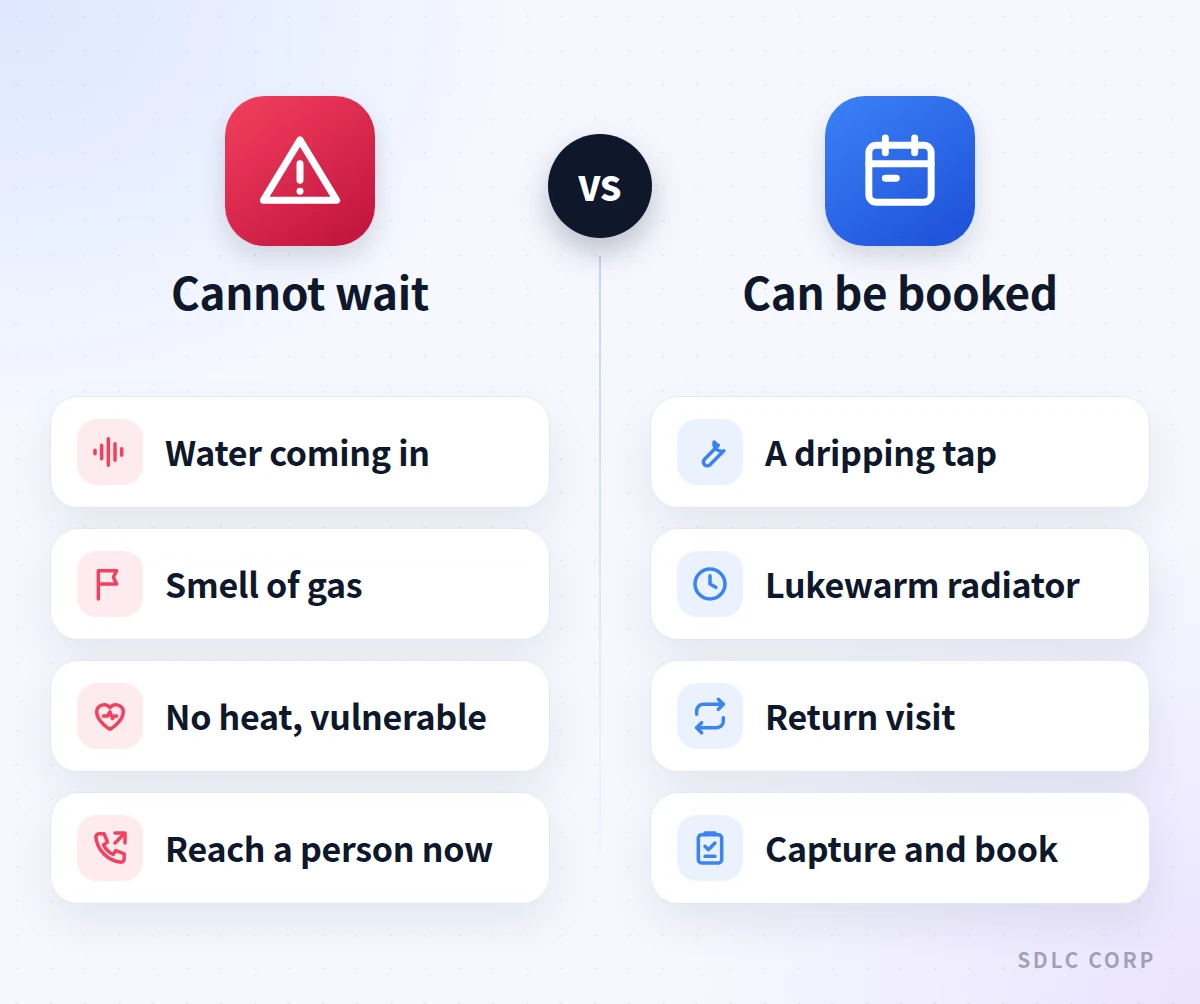
Urgency in the trades is not one scale. It is a judgment about harm, about damage that is still happening, and about whether the property is usable tonight. Callers rarely volunteer it in those terms; they describe what they can see.
| What the caller describes | What it usually means | What the agent should do |
|---|---|---|
| Water coming through a ceiling | Damage happening right now | Treat as urgent and reach a person immediately |
| A smell of gas or fumes | Possible immediate danger | Read the approved safety wording, then connect at once |
| No heating or hot water at all | Depends on the weather and the household | Flag as priority and note who lives there |
| A dripping tap | Routine, no deadline | Capture it and offer the next available slot |
| Work a previous visit did not finish | A return visit, not a new job | Link it to the existing job and route it |
The safety row is not a triage decision at all. Some reports are not jobs to be booked but situations where the only correct behavior is the wording the business has already approved, followed immediately by a person or the relevant emergency number.
Vulnerability belongs in the same conversation. No heating is an inconvenience in one household and a serious matter in another, and the agent's job is to capture what the caller says about who is in the property rather than to weigh it.
A call that starts routine and turns into one that cannot wait is a recognized pattern with its own handling, described in calls that escalate from routine to critical.
Taking a Job Description Somebody Can Schedule From
A note saying that somebody rang about a leak is not a job. It is a task for whoever reads it, and it will cost a phone call to turn into anything useful. A schedulable job is a different object, and the difference is four or five specific fields.
- The address, including the detail that decides the van: parking, access, a gate code, a flat above a shop.
- What is wrong, in the caller's own words, plus the one or two facts that decide the trade and the slot length.
- Whether the property is occupied and who will be there to let somebody in.
- When the caller is actually available, as a range rather than a single hopeful time.
- How to reach them, and whether that number is answered during a working day.
Access is the field most often missing and the one that wastes most time. A visit that arrives to find nobody home, a locked side gate or a parking restriction has burned a slot that was already promised to somebody else.
Some of the detail is trade-specific. A heating job needs the appliance type, its approximate age and where in the property it sits. Ask two or three of those, not fifteen. Whoever attends will ask the rest.
Getting an address, a postal code or a reference number right over a phone line is a problem of its own, and the confirmation techniques are covered in capturing spoken addresses and references reliably.
The Two Answers a Trade Agent Must Never Give
Two questions arrive on nearly every call, and both have to be declined in a way that still sounds helpful. What is wrong with it, and how much will it cost.
Diagnosis over the phone is guesswork even for an experienced engineer. An agent repeating a plausible cause creates an expectation the visit then has to argue with, and the customer remembers the first answer. What they gave you is a symptom, not a fault.
A price is worse, because it becomes a number the customer has written down. Work nobody has seen cannot be quoted, and a figure offered on a first call turns into a dispute at the door when the job is not what it sounded like on the phone.
- Do not name a likely cause, however obvious the description seems to make it.
- Do not give a price, a range, or a figure prefaced with the word usually.
- Do state a published call-out charge or standard hourly rate if the business publishes one, exactly as written.
- Do say plainly that the work and the cost will be confirmed before anything starts.
Customers accept that a price needs somebody to look at the job. What they do not accept is being given a number on the phone that changes once the engineer arrives. The refusal is not the awkward part of the call; the invented figure is.
This is also where grounded answering earns its place. Pulastya answers from the documents the business provides and says when it lacks the context to answer, offering a transfer instead of guessing, which on a trade line is the difference between a captured job and a complaint.
Who Is Calling Changes What the Job Is
Home services calls come from more than homeowners, and the caller's relationship to the property changes what has to be captured and, crucially, who is going to pay.
Decides, pays and is usually on site. The simplest case, and the one most call flows are quietly designed around.
Reports the fault but rarely authorizes the work. The landlord or managing agent needs to be on the record before a visit is promised.
May be calling about a property they have never stood in, so access arrangements and the tenant's number matter more than the description does.
Has agreed response times and an account. The job needs the site, the contract reference and the name of whoever reported it.
Brings a claim or authorization number that has to be captured exactly, because the work cannot be invoiced without it.
Getting this wrong is expensive in one specific way: somebody attends, completes the work properly, and the business then discovers that nobody with authority ever agreed to pay for it.
Getting the Job to the Person Who Will Do It
Capturing a job well is only half the work. It has to arrive on a board, a diary or a dispatcher's screen in a form nobody needs to retype, and the caller has to be told something true about what happens next.
What the agent must not do is commit to a slot it cannot see. Promising an engineer this afternoon when the afternoon is already full converts a captured job into a complaint, and it does so before anyone has left the yard.
The honest version is a choice between two behaviors. Either the agent can see a diary and book within its rules, or it captures the job and commits to a callback within a stated time. Doing neither is what loses the caller.
Where a booking is genuinely available to take on the call, the mechanics are described in booking an appointment during a call. How a day's visits are then sequenced, and how engineers are dispatched against them, is a separate discipline set out in coordinating field work and engineer dispatch.
Pulastya passes this handover as a warm transfer with the conversation context and call summary attached, and produces a transcript and summary for every call, which is what lets whoever attends read what the customer actually said rather than a paraphrase of it.
Scoping a First Deployment for a Trade Business
Start where the loss can be measured. For most trade businesses that is the call arriving between jobs and the call arriving after six, and both can be proved or disproved within a month.
- Count what you are missingPull a month of call records and separate the calls that rang out from the ones that were answered. That gap is the business case.
- Write the urgency rules downAgree which described situations are emergencies, which are priority and which are routine, before anything is configured.
- Agree the refusalsNo diagnosis and no price. Then add the published charges the agent is allowed to state, word for word.
- Decide what can be promisedEither the agent books against a visible diary, or it captures and commits to a callback within a stated time. Pick one.
- Rehearse the hard callsThe panicked leak, the tenant who cannot authorize anything, and the caller ringing from a noisy kitchen with a bad line.
A trade business can generally keep the number already printed on its vans by pointing that number's webhook at the platform, and a browser test call before launch lets the owner hear the urgency rules working before any customer does.
The same shape appears wherever the people who could answer the phone are the people doing the work, and the wider map of voice AI use cases by industry sets out where else it turns up.
Conclusion
An AI voice agent for home services can help trade businesses respond when engineers cannot answer the phone. By recording the caller’s problem, checking urgency against agreed rules and collecting access and availability details, the agent can turn an unanswered inquiry into a job that a team can actually schedule.
Reliable handling means knowing the limits: safety-related calls need approved emergency instructions and prompt escalation, while diagnosis and unverified price quotes stay with qualified professionals. A booking should only be confirmed when the agent can check real availability; otherwise it should set a clear callback expectation.
With those safeguards in place, Pulastya can support consistent intake, routing and handover so the team spends less time chasing missing details and more time serving customers.
Frequently Asked Questions
It can sort a call against rules the business has written down, matching what the caller describes to a defined urgency level. What it should not do is invent that judgment. Agree in advance which situations count as emergencies, which are priority and which are routine, and treat safety reports as an immediate handover.
No. Nobody has seen the work, and a figure given on the phone becomes the number the customer expects at the door. The agent can state a published call-out charge or standard rate word for word if the business publishes one, and should say plainly that the work and cost are confirmed before anything begins.
The address with its access detail, the problem in the caller's own words, whether the property is occupied and who can let somebody in, a realistic availability range, and a number that will be answered. Access is the field most often missed and the one that wastes the most engineer time.
Only where it can see a diary and apply the booking rules. Without that, it should capture the job and commit to a callback within a stated time. Promising an afternoon visit that the schedule cannot support turns a captured job into a complaint before anyone has left.
The agent establishes the relationship early and captures what that relationship requires. A tenant reports the fault but rarely authorizes the work, so the landlord or managing agent needs to be on the record before a visit is promised. Otherwise the work gets done and nobody with authority agreed to pay.