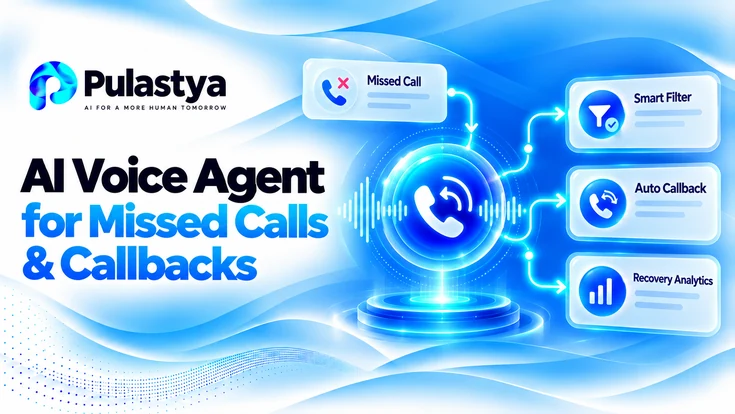
A missed call is the least expensive lead a business will ever get and the one it most reliably loses.
Someone wanted something badly enough to dial, and then nothing happened. Recovering that call is less about dialing back quickly than about knowing which misses are worth returning and calling in a way the person recognizes as an answer.
- A miss is not one event Ringing out, abandoning a queue and hanging up mid-conversation are different signals and deserve different treatment.
- Wanting a callback is a judgement Some misses are already resolved, some were never for you, and returning them all costs goodwill rather than earning it.
- Recognition decides the outcome A callback from an unfamiliar number, opening with an unfamiliar question, is answered as an unwanted call.
The failure is rarely intent. Most teams agree that missed calls should be returned. What defeats them is that an unanswered call leaves almost no record, so nobody can see the queue, and a queue nobody can see never gets worked.
Automating the return call makes the queue visible and workable. It also introduces a new way to fail: dialing back people who did not want to be dialed back, from a number they do not recognize, about a call they have already forgotten.
What Actually Counts as a Missed Call
Treating every unfinished call as one category is where callback programmes go wrong. The circumstances of the miss say a great deal about whether the person still wants to hear from you.
| Type of miss | What it usually signals | Callback case |
|---|---|---|
| Rang out with no answer | Nothing was heard and nothing learned | Strong, since the caller got nothing |
| Abandoned while waiting | Willing to talk, unwilling to wait | Strong, and time-sensitive |
| Hung up during a menu | The options did not match the reason | Moderate, and the reason is unknown |
| Ended mid-conversation | Either satisfied or cut off | Depends entirely on where it ended |
| Busy or rejected | Possibly not a real attempt at all | Weak until something else supports it |
The last row deserves care. A call rejected within a second is often a misdial or a pocket, and returning those teaches people to treat your number as an annoyance.
A call that ended mid-conversation is the most interesting case, because a transcript exists. What the person had already said is usually enough to decide whether they were finished or interrupted.
Where the miss is noticed decides how much of this you can tell apart. A disconnect event on the telephony side knows the number and the duration and very little else, while a call that reached the agent leaves an account of what the person was trying to do.
Both are worth capturing into the same place, with the thinner record marked as thin. A recovery queue built only from calls that reached the agent silently omits exactly the calls that got the least.
Deciding Which Misses Want a Callback
The instinct is to return everything, on the grounds that a wasted return costs almost nothing. It costs the person receiving it, and it costs a number that starts getting flagged.
- Already answered another way: the same person emailed, used the web form, or simply called again and got through.
- Already handled: a colleague picked it up on a second line, or the case it relates to is closed.
- Not for you: a wrong number, a misdial, or an automated dialer that hung up on your greeting.
- Explicitly finished: the caller reached the agent, got what they needed and ended the call themselves.
- Asked not to be called: any standing preference on the record outranks the miss entirely.
Deduplication matters more than any other rule here. One person who dialed four times in ten minutes is one callback, not four, and the callback should reference the whole run rather than the last attempt.
Withheld numbers end the decision early. If there is no number, there is no callback, and the only useful response is to make the next inbound attempt land better.
Write the suppression rules before the dialing rules. A callback list without them is a list of people about to be interrupted on their own terms.
How Quickly the Callback Has to Happen
The value of a returned call decays, and it decays against the caller's memory rather than any internal service target. They remember dialing you for a while, and then they do not.
Within minutes, the callback lands as a continuation. The person is still holding the reason in their head, still near whatever prompted the call, and still waiting on the conversation they started.
Within hours, it lands as a response. It is welcome, but they have to reload the context, and some of them have solved the problem elsewhere in the meantime.
The next day it lands as an unfamiliar call. This is the point at which a callback starts costing more than it returns, and it is worth deciding in advance whether the attempt is still made or the miss is simply logged.
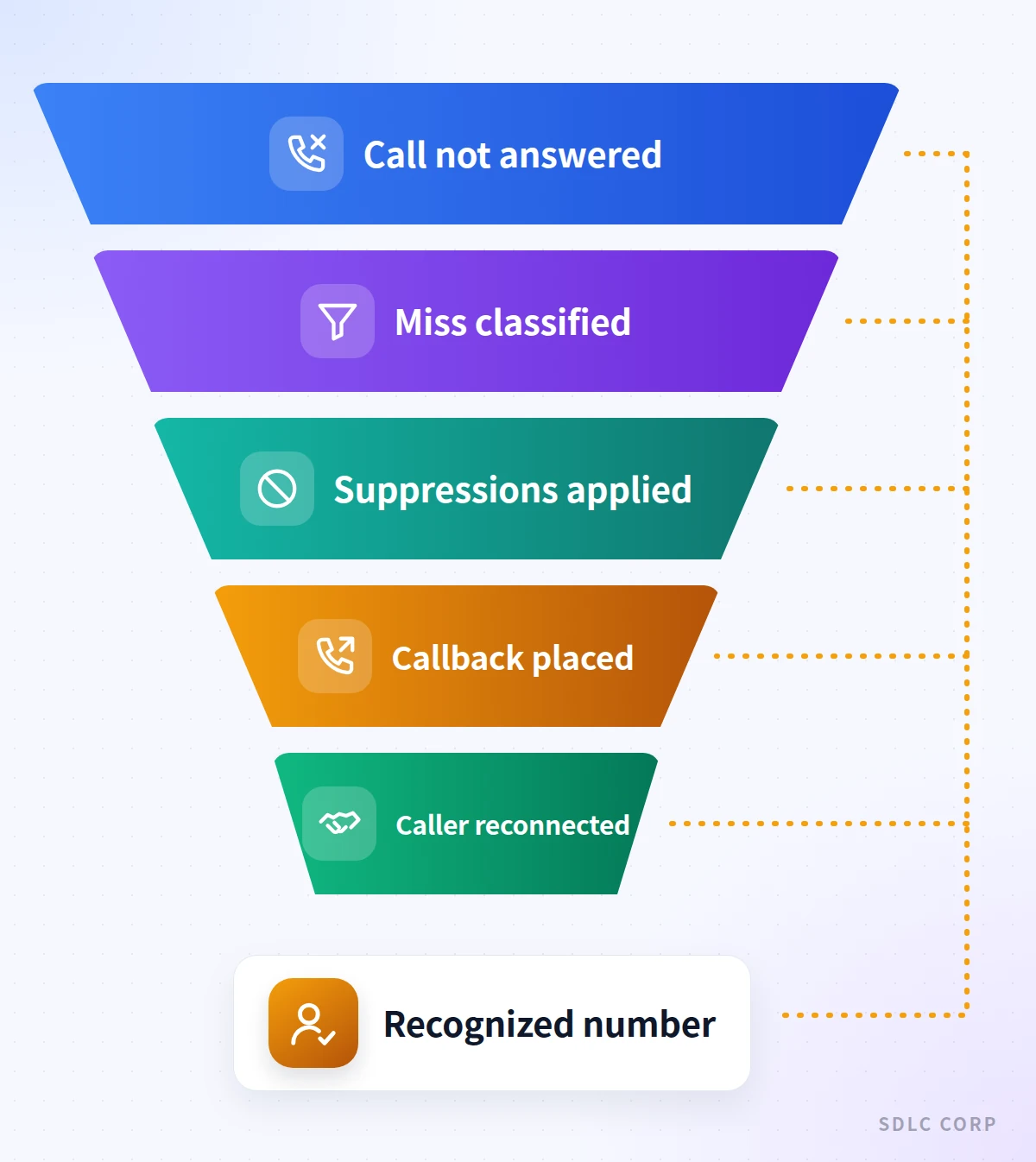
One structural point cuts across all of this. Speed is only available if the miss is detected as it happens rather than found in a report later, which makes the detection path, not the dialing path, the thing worth engineering first.
Placing a Callback the Person Recognizes
Most callback failures are recognition failures. The call is placed correctly, to the right person, at a reasonable time, and it is declined because nothing about it looks like the call they made.
- Present the number they dialedA callback from the published number is recognizable. A callback from an unfamiliar outbound number is a cold call.
- Name the business in the first breathBefore any question, before any menu, so the person can place the call before deciding whether to keep listening.
- Reference their call, not your queueSay when they called and, where it is known and appropriate to state, what it was about.
- Offer the exit immediatelyMake it easy to say this is a bad time or to decline further attempts, and honor both.
Not making them start again is the part that is felt. If the original call reached an agent before it dropped, the callback should carry what was already established rather than asking for a name that was given four minutes ago.
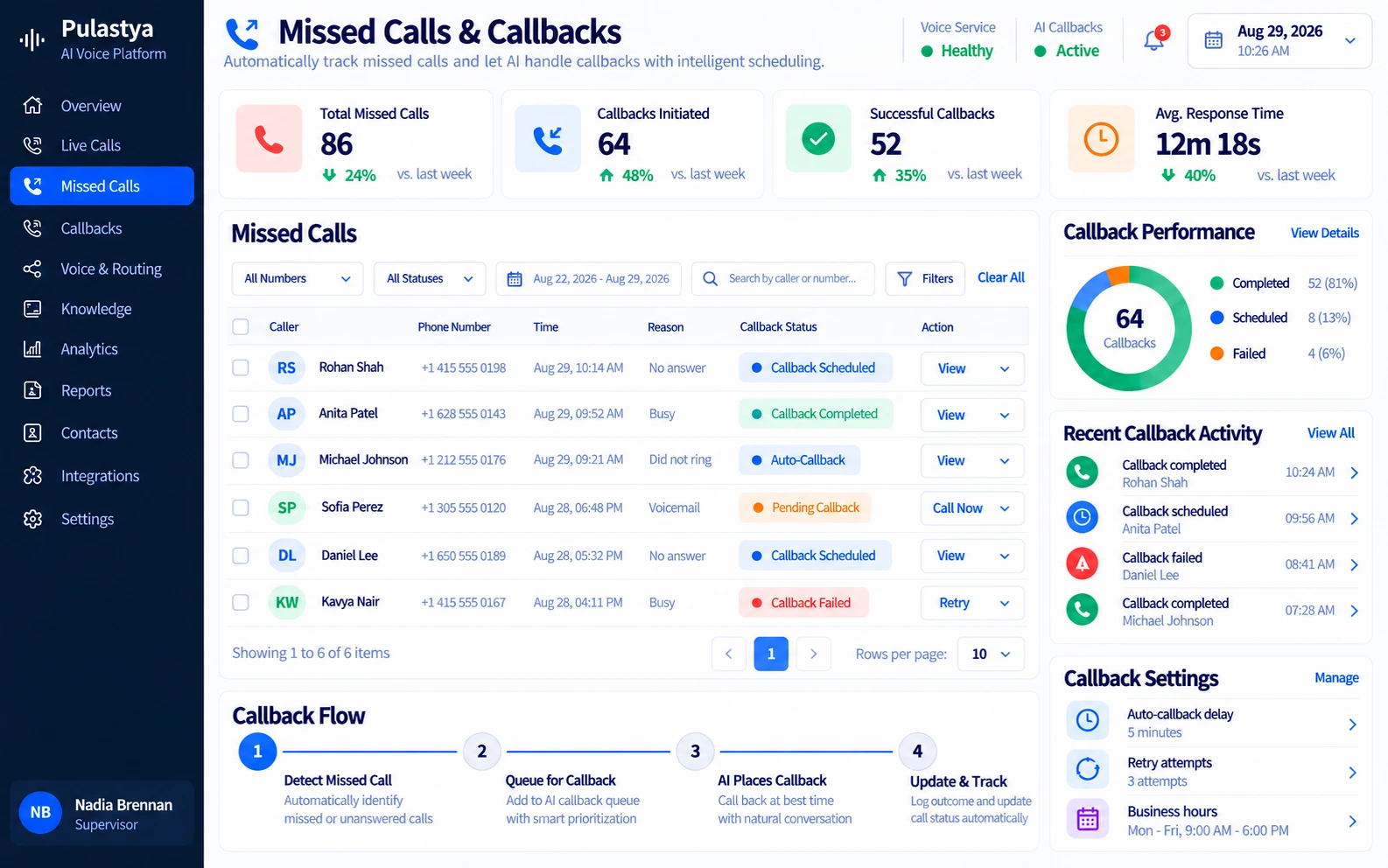
Pulastya handles inbound and outbound business calls on the same platform, which is what makes that continuity practical: the inbound call leaves a transcript and a summary, and the outbound callback can be transferred to a person with that context attached rather than handing them a blank line.
Where a caller should reach a person rather than the agent on the return leg, the handover mechanics are set out in passing an outbound call to a teammate.
When the Callback Is Missed in Turn
Callbacks get missed at least as often as the original calls, and the second miss is where a recovery programme either stops cleanly or turns into pestering.
Who or what responds changes the correct behavior entirely, and the agent must settle that before it says anything useful. That decision is its own subject, covered in working out who or what answered.
A recorded note left on a callback should be shorter than one left on any other outbound call. The person already knows why you might be calling, so it needs the business name, the fact that this is a return call and one route back to you.
Attempt limits belong here too, and they are not a missed-call question. Once a callback is a scheduled outbound attempt it inherits the same rules as any other, which are set out in attempt limits, delays and stop states.
The cleanest stop rule is that a callback gets fewer attempts than an outreach call, not more. The person made the first move, and if two returns do not connect, the useful action is to reach them another way or wait for them to try again.
Knowing Whether the Recovery Worked
The number most teams report is callbacks placed, which measures activity rather than recovery. It rises when the programme is working and also when it is dialing people who did not want to hear from you.
- Misses detected against misses returned, which exposes the queue nobody could see before.
- Time from the miss to the connected callback, reported at the slow end rather than as an average.
- How many returned callers had already solved it, which is the direct measure of returning it too late.
- Declines and opt-outs on the callback leg, which is the direct measure of returning too many.
Those last two pull in opposite directions, and that is what makes them useful together. Tightening the filter raises the first and lowers the second, and the right balance is a business judgement rather than a setting.
Where these figures sit alongside the rest of a voice operation is covered in the measures worth tracking for a voice agent. Coverage outside staffed hours is a separate design question, handled in handling calls that arrive when nobody is there.
Conclusion
AI voice agents can make missed-call recovery more manageable by identifying unanswered calls, prioritizing callbacks, and preserving conversation context when it is available. The objective is not to return every missed call, but to reconnect with callers who still need assistance while respecting their preferences.
An effective callback process combines timely detection, suppression rules, recognizable caller identification, controlled retries, and measurable outcomes. Businesses can use these practices to improve response consistency and evaluate whether automated callbacks are creating useful conversations rather than unnecessary interruptions.
Frequently Asked Questions
No. Returning everything means calling wrong numbers, misdials, people who already got through another way and people who finished their business before hanging up. Build the suppression rules first, deduplicate repeat attempts from the same person into one callback, and drop any number with a standing preference not to be contacted.
As close to the miss as the rules allow, because the value decays against the caller's memory. Minutes later it reads as a continuation of the call they made. Hours later it reads as a response. The next day it reads as an unfamiliar call, and at that point it is worth deciding whether to place it at all.
The number the person dialed, wherever that is possible. Recognition is the single biggest factor in whether a callback is answered, and an unfamiliar outbound number turns a return call into a cold call. If a different number has to be used, name the business before anything else is said.
It can when the original call reached an agent and left a record. Carrying that forward is what stops the person repeating a name and a reason they already gave, and it is the difference callers remark on. If the call rang out and nothing was captured, the callback has to start from the number alone.
Leave a short note that names the business, says this is a return call and gives one route back, then apply a stop rule. A callback deserves fewer attempts than an outreach call, since the person already made the first move. After that, try another channel or wait for them to call again.