Introduction
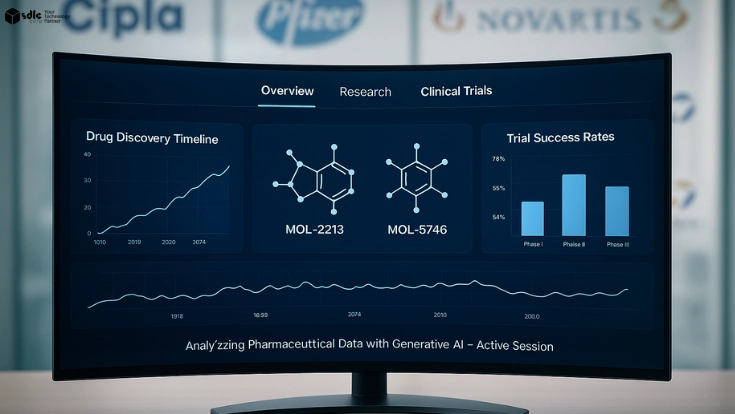
Generative AI in drug discovery is transforming how the pharmaceutical industry develops new treatments. Traditional methods take years, cost billions, and often lead to high failure rates in clinical trials. At the same time, patients continue to wait for effective therapies. With the integration of generative artificial intelligence, the entire pharmaceutical pipeline from molecule design to clinical testing is becoming faster, more accurate, and more cost-efficient.
This technology is not just an experiment. It is already applied in pharmaceutical research where precision and safety matter most. By generating novel molecular structures, predicting trial outcomes, and analyzing massive datasets, generative AI offers a way to reduce uncertainty and speed up innovation. Moreover, it supports the shift toward personalized medicine, giving patients treatments designed specifically for their needs.
For a broader perspective on AI in healthcare, check out our guide on AI in Healthcare Transformation.
The Role of Generative AI in Drug Discovery
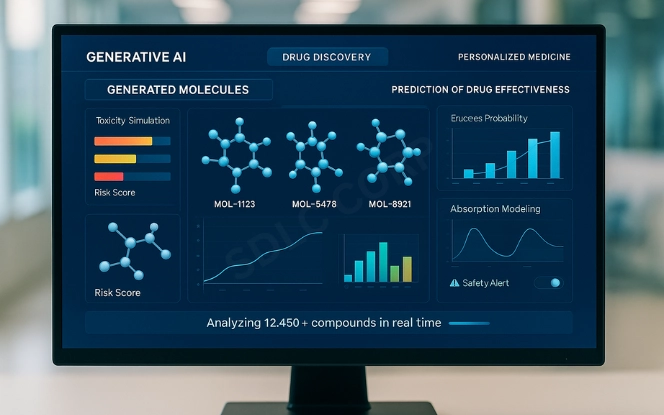
Generative models are increasingly applied to molecular structure generation, compound optimization, and target identification. These systems explore chemical spaces efficiently while incorporating biological constraints. Teams developing such solutions often rely on Generative AI development services to ensure models are trained on high-quality, domain-specific datasets.
Key ways AI contributes include:
- Molecule Generation → AI proposes novel chemical structures.
- Predictive Modeling → Tools estimate toxicity, absorption, and side effects.
- Decision Acceleration → Teams move faster from digital simulations to wet-lab validation.
As a result, researchers spend less time screening blindly and more time focusing on viable solutions.
To see how similar approaches are used in other sectors, you may explore our article on Generative AI for Healthcare
Applications of Generative AI in the Pharmaceutical Industry
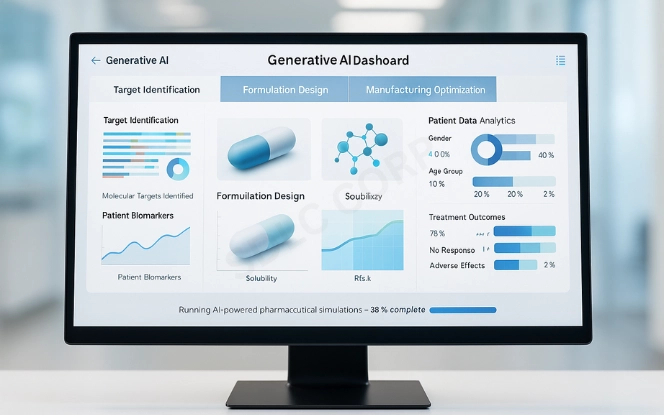
The range of generative AI pharmaceutical industry applications continues to grow. Each stage of the value chain in research, development, manufacturing, and marketing benefits in unique ways.
First, AI systems analyze genomic data to find new therapeutic targets. As a result, the earliest stage of R&D becomes faster and more accurate. Second, generative models help optimize how drugs are delivered to the body, such as in oral tablets or injectable forms. In addition, they enable researchers to test delivery mechanisms digitally before moving into expensive clinical work.
Third, AI algorithms simulate manufacturing steps to reduce waste, improve yield, and ensure consistent quality. Moreover, companies can identify potential issues in scaling production before they occur. Finally, AI analyzes patient data and clinical results to predict which populations benefit most from a treatment. This creates opportunities for precision marketing and patient-focused solutions.
Taken together, these applications give pharmaceutical companies the tools to shorten development cycles, reduce costs, and improve outcomes for patients.
Improving Clinical Trials with Generative AI

Clinical trials are one of the most expensive steps in drug development. A single failed Phase III trial can cost billions. How generative AI improves clinical trials is not just theoretical, it is already visible in modern studies.
For instance, AI models can predict which patients will likely respond positively to a new treatment. This allows smaller, more precise trials instead of broad, expensive recruitment campaigns.
Generative AI strengthens trials by:
- Smarter Recruitment → Patient records analyzed to identify exact matches.
- Synthetic Data → Simulated outcomes reduce dependence on scarce real-world data.
- Real-Time Monitoring → Algorithms detect side effects or dropouts earlier than human teams.
By combining predictive insights with continuous monitoring, AI makes trials faster, safer, and more reliable.
For insights on digital innovations in medical research, visit our blog on generative AI in healthcare and healthtech.
Personalized Medicine and Generative AI
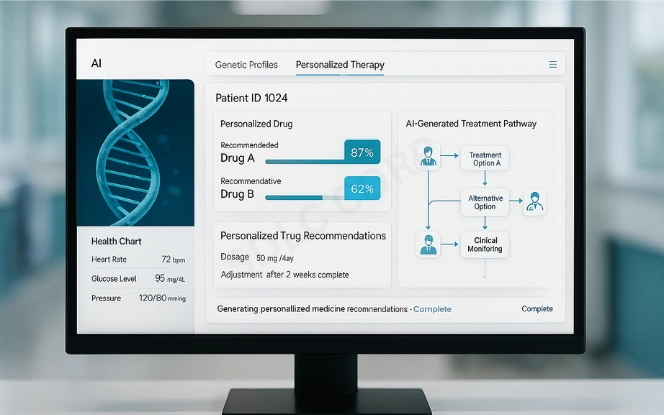
A major promise of modern healthcare is personalized medicine treatments designed for individual patients rather than broad populations. Generative AI for personalized medicine in pharma is moving that promise closer to reality.
By combining genetic profiles, medical history, and treatment outcomes, generative AI creates models that suggest tailored therapies. As a result, cancer patients with specific mutations can receive drugs optimized for their genetic makeup. Similarly, individuals with rare diseases benefit from therapies modeled on their unique conditions.
Moreover, generative AI does not replace human expertise. Instead, it acts as an assistant, generating treatment pathways for doctors to evaluate. This approach gives physicians more evidence to make informed decisions. In addition, it reduces the trial-and-error process often associated with treatment planning.
The outcome is a more informed decision-making process that improves both safety and effectiveness for patients.
Regulatory Challenges of Generative AI in Pharma

With innovation comes regulation. Agencies such as the FDA and EMA must balance speed of drug approval with patient safety. Regulatory challenges of generative AI in pharma highlight this tension.
Consider three main issues regulators face:
- Transparency → Black-box algorithms make approval difficult.
- Data Integrity → Poor-quality datasets risk inaccurate predictions.
- Intellectual Property → Who owns AI-generated molecules? The developer or the algorithm?
Therefore, pharma companies must adopt hybrid strategies: using AI to accelerate discovery while ensuring models remain explainable and validated under strict compliance frameworks.
To understand compliance better, read our analysis of Responsible AI Development.
Ethical Considerations in Pharmaceutical AI

Beyond regulation, there are ethical dimensions to generative AI adoption. Patient data privacy is a top concern. Synthetic data helps reduce risks, but companies must ensure anonymization techniques are robust.
On the other hand, accessibility presents another issue. If only large pharmaceutical firms can afford advanced AI, smaller players may be excluded, reducing competition. Patients may also face unequal access to AI-enabled therapies depending on geography or socioeconomic status.
Moreover, transparency in communication is vital. Patients must understand how AI contributes to their treatment. Building trust requires openness about what AI can and cannot do. For this reason, organizations must communicate AI’s role responsibly.
Therefore, balancing innovation with fairness and privacy will define whether generative AI is seen as a trusted tool or as an opaque system that patients resist.
The Future of Generative AI in Pharmaceuticals
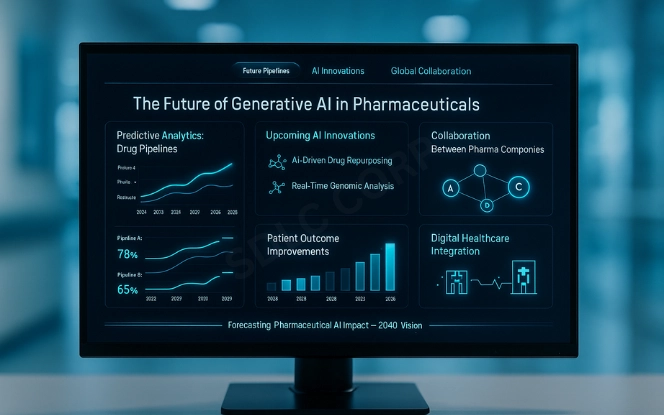
The future of generative AI in pharmaceuticals will likely involve even tighter integration with lab research and healthcare delivery. Advances in computing power and model training will allow AI systems to process larger and more complex datasets.
Looking ahead, we can expect faster discovery of new molecules, more efficient trials, and wider adoption of personalized therapies. At the same time, addressing regulation and ethics will remain central.
In addition, collaboration between pharmaceutical companies, biotech startups, and regulators will become essential. As a result, innovation can proceed while maintaining compliance and patient safety.
Furthermore, AI-enabled platforms may become part of everyday healthcare decision-making, guiding doctors toward better treatment options.
Generative Models in Drug Discovery
In discovery, generative models are used to propose candidates rather than to confirm them. Molecular generation models suggest structures against a target profile, protein structure prediction narrows which targets are worth pursuing, and retrosynthesis models propose routes a chemist evaluates for feasibility and cost.
Three things decide whether this is useful in a given programme:
- Data quality and coverage. Proprietary assay data usually matters more than model choice, and negative results are as valuable as positive ones.
- Validation loop. Generated candidates are hypotheses. The value comes from the speed of the design, make, test, analyse cycle around them, not from the generation step alone.
- Chemists in the loop. Synthesisability, toxicity signals, intellectual property position and developability are judgement calls that a model ranks but does not settle.
Knowledge, Literature and Scientific Workflows
Outside the molecule itself, most of the practical value is in knowledge work.
- Literature and patent triage. Screening large corpora against a research question, with citations back to the source so a scientist can verify each claim.
- Internal knowledge assistants. Retrieval over study reports, SOPs, batch records and prior submissions, which is often the first place a research organisation feels the time saving.
- Scientific summarisation. Draft summaries of experiments, study data and safety signals for expert review.
- Protocol and method drafting. First drafts built from templates and prior studies, edited by the responsible scientist.
Regulatory Documentation and Controls
Regulatory writing is repetitive, highly structured and heavily reviewed, which makes it a reasonable candidate for drafting support and a poor candidate for automation.
- Drafting support for clinical study reports, summaries and responses to questions, always from validated source data.
- Consistency checks across documents, where a model flags contradictions for a human to resolve.
- Traceability. Every generated passage needs a path back to the underlying data, because a submission has to be defensible line by line.
Controls that apply across all of the above: validated systems and change control where the output supports a regulated decision, data integrity expectations such as attributable, legible, contemporaneous, original and accurate records, documented human review, and confirmation that no patient-identifiable or commercially sensitive data leaves an approved environment. None of this is regulatory advice; classification and validation requirements belong with your quality and regulatory functions.
Conclusion
Generative AI is no longer an experimental technology. It is already transforming how the pharmaceutical industry discovers drugs, runs trials, and develops personalized treatments. By improving accuracy, reducing timelines, and generating synthetic data, AI is opening new possibilities for patient care.
However, adoption comes with challenges. Regulatory bodies must ensure that algorithms are transparent, fair, and safe. Ethical issues such as privacy, access, and accountability must also be addressed. In summary, generative AI’s role in pharmaceuticals is both promising and complex.
The journey ahead requires collaboration between researchers, regulators, and AI specialists. Therefore, if managed responsibly, generative AI can accelerate breakthroughs that save lives and improve healthcare worldwide.
Contact us SDLC Corp to learn how our expertise supports innovation in healthcare and life sciences. Hire AI Development Services to integrate advanced AI solutions into your pharmaceutical projects.
FAQs
What Is The Role Of Generative AI In Drug Discovery?
Generative AI in drug discovery helps scientists create and test new molecules digitally before they move to lab experiments. This reduces time and costs while improving the chances of finding effective treatments
How Does Generative AI Improve Clinical Trials?
How generative AI improves clinical trials can be seen in faster recruitment, better trial design, and real-time monitoring of patient data. AI also creates synthetic patient data that strengthens testing while protecting privacy.
What Are The Main Generative AI Pharmaceutical Industry Applications?
The regulatory challenges of generative AI in pharma involve data quality, model transparency, and compliance with FDA or EMA guidelines. These challenges must be addressed to ensure safe and ethical use of AI in drug development.
What Are The Regulatory Challenges Of Generative AI In Pharma?
The regulatory challenges of generative AI in pharma involve data quality, model transparency, and compliance with FDA or EMA guidelines. These challenges must be addressed to ensure safe and ethical use of AI in drug development.
How Is Generative AI Used For Personalized Medicine In Pharma?
Generative AI for personalized medicine in pharma supports custom treatments by analyzing genetic data, medical history, and patient outcomes. This leads to therapies designed for individual needs rather than broad populations.