
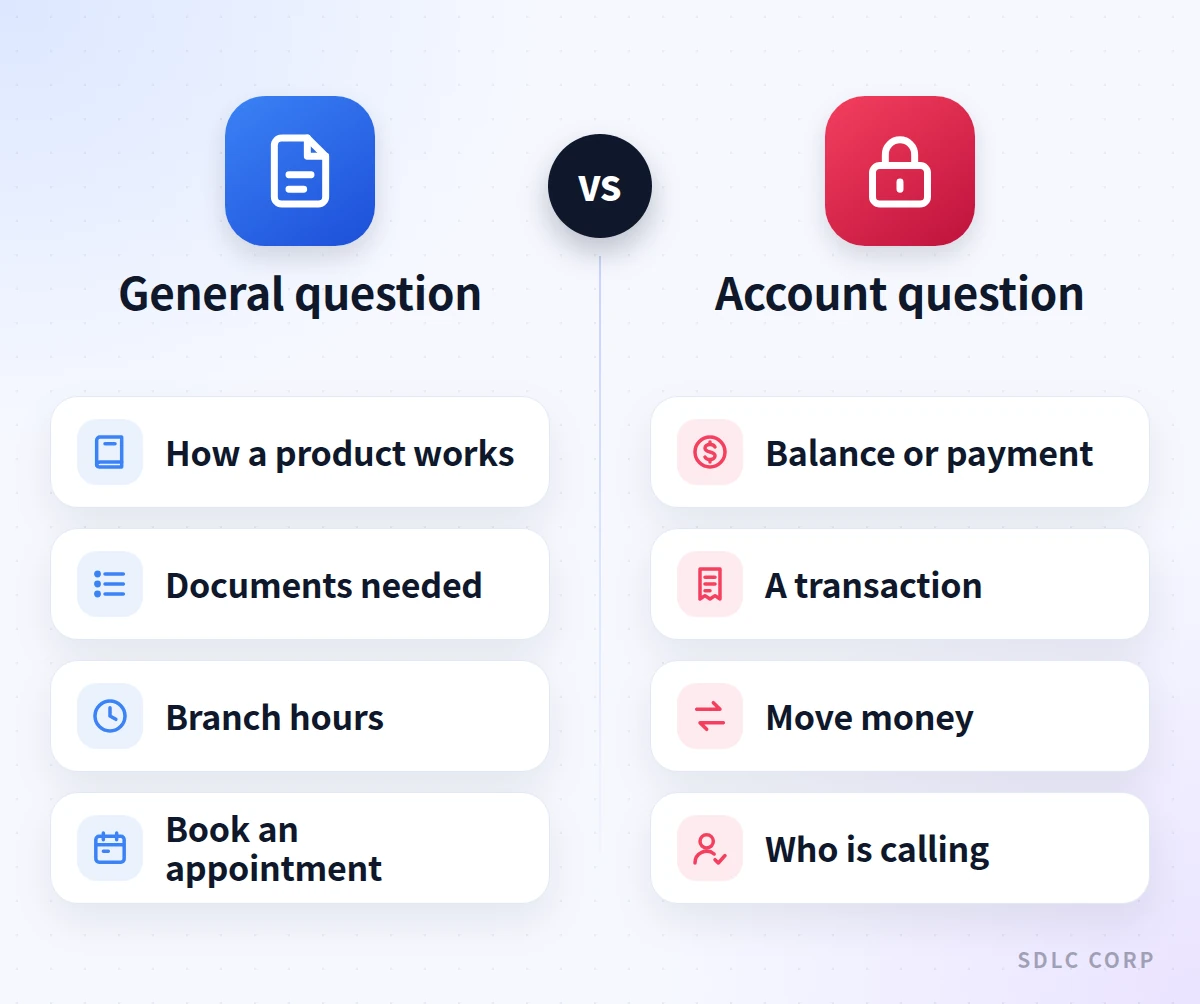
A bank's phone line carries two kinds of call that sound identical to the caller and are nothing alike underneath. One asks how something works. The other asks what is happening on a specific account. An agent can take the first kind at volume, and the second kind is where it has to stop.
- Two kinds of question General product and process questions have one answer for everyone. Account questions have an answer for one person, and only once the bank knows who is calling.
- The account is the boundary No balance, no transaction detail and no instruction that moves money, however confident or insistent the caller sounds.
- Identity is not improvised Whether a caller is who they claim to be is settled by the bank's own approved process, never by questions the agent invents mid-call.
That split is not a nicety. Someone asking which documents a mortgage application needs is asking a question with one answer that does not change between callers. Someone asking why a payment left their account yesterday is asking about a record, and about whether the voice on the line is entitled to hear it.
Most of the volume on a retail banking line sits in the first group. Most of the risk sits in the second. The design work is drawing that line clearly enough that the agent never drifts across it while a caller pushes.
Which Banking Calls an Agent Can Take
Sort the line by what each answer depends on rather than by how hard the question sounds. If the answer is identical for everyone who asks it, an agent can give it. If it depends on a record held about one person, the agent would be reading out somebody's financial position, which carries different obligations.
| What the caller asks | What the agent does | What stays with the bank |
|---|---|---|
| How an overdraft works | Explain the product from approved content | Whether this caller has one |
| Documents for a mortgage application | List the current requirements | Whether an application will succeed |
| Branch hours and services | Answer from the bank's own published detail | Nothing |
| Why a debit left the account | Capture the request and route it | The record and the explanation |
| Move money between accounts | Decline and transfer | Every instruction that moves funds |
| A card has been lost | Recognize it and connect immediately | The block and the replacement |
That table is the whole design. Everything else is detail about how the agent stays on the left of it.
Where a lender also sells or administers cover, those calls run on a separate boundary of their own, described in policy and claims call handling.
Product and Process Questions Carry Most of the Volume
These are the calls that consume staffed time without needing a person: how a product works, what a process requires, what a term means, and where to go next. They repeat constantly, their answers are stable, and the bank has usually written them down already.
- How an overdraft is charged, how interest is applied, and what a named fee is for.
- Which documents a loan or mortgage application asks for, and in what order.
- How long a process usually takes, stated as the published service standard rather than a promise about this caller.
- Which branch or desk handles a request, when it opens, and what a caller should bring.
Two properties make this safe. The answers come from documents the bank has approved rather than from whatever a model happens to know about banking in general. And when those documents do not cover the question, the agent says so and offers a transfer instead of producing something plausible.
Pulastya works this way: answers are grounded in documents the organization provides, and it states when it lacks the context to answer and offers a transfer rather than guessing. On a banking line the second behavior matters more than the first, because a confident wrong answer about a fee becomes a complaint.
Approved content here needs a scope label and a named owner, because product terms vary by product, by market and by the date a customer signed. An unlabeled document is how an agent ends up quoting a superseded fee, which is the subject of building the knowledge base a voice agent answers from.
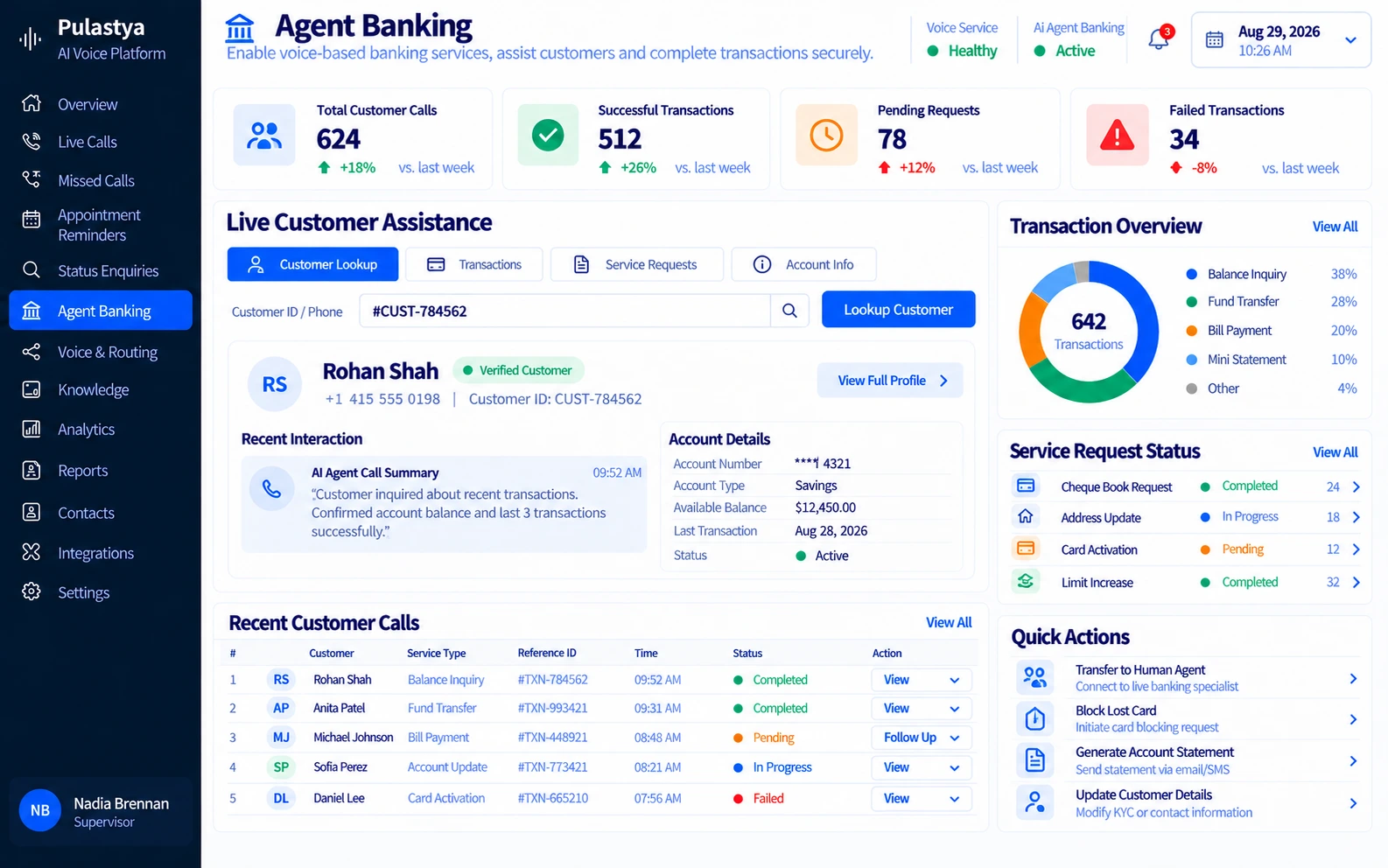
The Hard Boundary: Anything That Touches an Account
The boundary is not a list of forbidden words. It is one rule: the agent does not read out, confirm, interpret or act on the state of a specific account. Three behaviors follow, and each needs writing down as a refusal rather than a caution.
- It does not confirm a balance, a limit, a due amount or whether a debit has cleared, even when the caller states the figure first and asks only for a yes.
- It does not discuss a specific transaction, including whether one exists, where it went, or why it was declined.
- It does not take an instruction that moves money, opens or closes anything, or changes a limit, a payee or an address.
The confirmation case is the one that slips. A caller who states a number and asks the agent to agree is requesting account information in a form that feels like small talk, and an agent tuned to be helpful will oblige unless the rule is explicit.
A yes or no about an account is still account information, and so is a correction. The only safe behavior is to move the request to a channel that already knows who is calling.
Money movement deserves its own sentence, because it is not a disclosure problem but an authority problem. An instruction taken on a call the bank cannot later attribute to the account holder is a dispute the bank will lose, whoever was actually on the line.
Identity Belongs to the Bank's Own Process
Everything above turns on one question: does the bank know who is calling? That question already has an owner, and the owner is not the voice agent.
Banks establish identity through controls they have chosen, tested and can evidence: an authenticated app session, a one-time code sent to a channel tied to the customer, a callback to a number on file, or a staffed process. An agent improvising its own questions builds a parallel control nobody approved.
- Do not invent knowledge-based questions, and do not accept a near-enough answer as a pass.
- Do not treat a caller's ability to recite a number as proof, since it may be printed on a statement anyone can pick up.
- Do not retry a failed check until it passes. Stop, and offer a route that can establish identity properly.
The design question for a banking deployment is therefore narrow: how much useful work exists on the unverified side of that boundary? The answer turns out to be most of the volume. Verification policy itself is set out in designing calls that carry identity and sensitivity risk.
Appointments, Callbacks and Reaching the Right Desk
Between answering and refusing sits a third thing an agent can finish end to end: capturing what the caller needs so that a person picks it up with everything already in hand.
- Name the requestClassify what the caller actually wants, using the bank's own call types rather than a generic menu of departments.
- Take what a person will needA name, a callback number, and the product or process in question, without asking for account detail.
- Set the expectation honestlyState the published response time for that queue rather than predicting when a specific person will call back.
- Hand it on completeAttach the conversation and a summary of it, so the caller is not asked to start again from the beginning.
An appointment is the cleanest version of this, because it finishes on the call and needs nothing account-specific to complete: a person or specialism, a branch, a time and a reason. The scheduling mechanics are set out in booking appointments on a business call.
Pulastya performs this handover as a warm transfer, with the conversation context and call summary attached for the person taking over, and a failover to a human line when it cannot continue at all.
On a banking line that handover is most of what a caller remembers, and its mechanics are covered in handing a live call to a person.
Calls That Must Reach a Person Without Delay
Some calls are not automation candidates at any confidence level, and the agent's only job on them is to recognize them quickly and get out of the way.
- A lost or stolen card, a device the caller no longer controls, or anything the caller frames as urgent about access.
- Suspected fraud or a scam in progress, including a caller who says somebody has instructed them to send funds.
- Bereavement, or a caller acting for someone who has died or lost capacity.
- Financial hardship, distress, or a caller who says plainly that they cannot cope.
- A complaint, from the moment the caller names it as one.
Fraud in progress rewards a low threshold. A caller being coached by somebody else may be part-way through an instruction the bank would want to stop, and clarifying questions are seconds the agent should not spend.
Arrears is a related but separate conversation with its own constraints, set out in calls about money owed.
Regulatory Ground and Scoping a First Deployment
Financial services calls sit inside rules that vary by jurisdiction, call direction, product and whether the conversation counts as regulated advice. Nothing written in general terms can tell you which apply to your line.
- Whether the automated nature of the call must be disclosed, and in what words.
- Whether the call may be recorded, who must be told, and how long recordings and transcripts may be kept.
- Which statements count as regulated advice or a financial promotion, and who is permitted to make them.
- What must be retained and produced if a caller later disputes what they were told.
Establish each of those with your own counsel and compliance function before launch, then write the answers into the agent's boundary list instead of leaving them as background knowledge. The general shape of these controls appears in compliance considerations for voice agents.
- Start with one product linePick a product whose process questions repeat constantly and whose approved content already exists in a maintained form.
- Write the refusal list firstThe questions the agent must decline are the specification. Have compliance sign that list before anything is configured.
- Rehearse the insistent callerTest the caller who states a balance, insists it is their own money, and asks the agent to confirm just this once.
- Place the calls yourselfA test call against your own content and refusal cases shows what a scripted demonstration never will.
Other regulated sectors evaluate the same platform capabilities and draw their line somewhere else entirely, which the wider map of voice AI use cases by industry lays out sector by sector.
Conclusion
An AI voice agent for banking can make routine customer calls easier to handle by answering approved product and process questions, capturing appointment and callback requests, and directing callers to the right team.
The limits matter just as much as the benefits. Account-specific requests, transactions, identity checks, suspected fraud, and sensitive circumstances must follow the bank's approved security, authentication, and escalation processes rather than an improvised AI decision.
A practical first deployment starts with carefully scoped enquiries, maintained knowledge sources, clear refusal and transfer rules, and testing with realistic banking scenarios. This approach can improve service consistency while protecting customer trust.
Frequently Asked Questions
It should not. A balance is information about one person's account, and giving it out depends on the bank having established who is calling through a control it owns. Confirming a figure the caller states first is the same disclosure in a different shape. The safe behavior is to route the request to a channel that has already authenticated the customer.
The repetitive ones whose answer is the same for every caller: how a product or fee works, which documents an application needs, published timescales, and where to go next. Add appointment booking and callback capture, which finish on the call without touching an account.
Identity should be established by the bank's own approved process rather than by questions the agent invents. That process might be an authenticated app session, a one-time code, a callback to a number on file, or a staffed check. An agent that improvises its own version creates a control nobody tested.
No. Moving money is an authority question rather than an information one, and an instruction the bank cannot later attribute to the account holder is a dispute waiting to happen. Card and bank details should stay out of the conversation entirely. The agent recognizes the request and moves the caller to the channel the bank has approved for it.
It depends on where you operate, the direction and purpose of the call, and the sector rules you fall under. Disclosure, recording notice and retention duties all vary, and none can be assumed from general practice. Establish what applies with your own counsel, then write the agreed wording into the agent's opening.