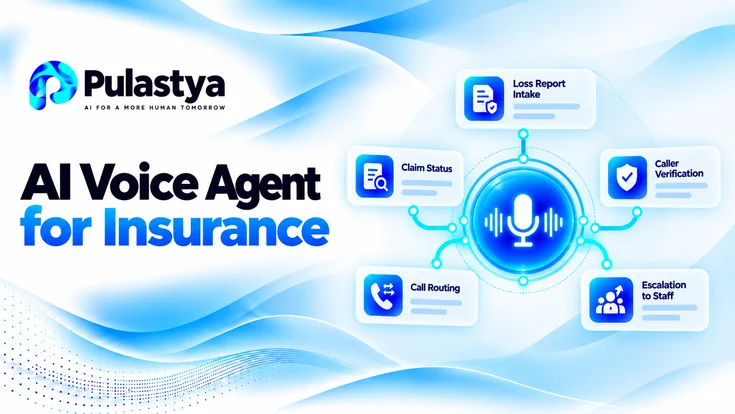
An AI voice agent for insurance is software that answers policyholder and claimant phone calls, explains general policy and claims processes from approved content, captures first notice of loss details, and routes calls to claims, billing or licensed staff.
It is for insurers, agencies, brokers and claims administrators handling large volumes of repetitive service calls.
- Process, not decisions The agent explains processes and captures information, while coverage, underwriting and claim decisions stay with authorized staff.
- Verify before specifics Policy-specific and claim-specific details require caller verification and an integration with the relevant core system.
- Structured intake Loss report calls produce consistent, reviewable records that the claims team can act on.
The practical outcome is faster first response and cleaner intake. Callers get process answers immediately, and claims and service teams receive structured details instead of voicemails, while every decision stays with people.
Insurance calls carry more risk than most. Callers ask whether something is covered, share personal and sometimes medical details, and may be calling minutes after an accident. An AI voice agent in this setting must never make underwriting, coverage or claim decisions, and it must not give legal or insurance advice.
Which Insurance Calls an AI Voice Agent Can Handle
An AI voice agent can handle insurance calls that follow a defined process: general policy and claims questions, first notice of loss intake, claim-status requests where integrated, and routing to the right team. It should not handle any part of a call that requires a coverage, underwriting, liability or payment decision.
| Call type | AI voice agent role | Stays with people |
|---|---|---|
| How to file a claim or make a payment | Explain the process from approved content | Exceptions and account problems |
| New claim or loss report | Capture structured intake details | Coverage, liability and settlement decisions |
| Claim status | Share approved status after verification, if integrated | Explaining decisions and handling disputes |
| Policy changes, cancellations or quotes | Identify the request and route it | Advice, underwriting and binding coverage |
| Is this covered? | Explain that a qualified person must review it | All coverage determinations |
General service automation patterns are covered in the guide to AI voice agents for customer support. Insurance raises the stakes on three points: policy-specific disclosures, who may hear claim details, and sensitive personal data.
Where General Policy Information Ends
An AI voice agent may explain general information the insurer has approved, but it must stop at anything that depends on a specific policy's terms or the facts of a specific loss. Explaining what a deductible is sits on one side of that line. Saying whether a deductible applies to this caller's loss sits on the other.
- General, so answer from approved content: how to report a claim, documents usually requested, payment methods, office hours and how to reach an adjuster.
- Policy-specific, so route to staff: whether a loss is covered, how exclusions or endorsements apply, and what a claim may pay.
- Advice, so always route: which coverage to buy, whether to file a claim, or whether to accept a settlement.
Approved content has to reflect how insurance products vary. Process guides and glossaries often differ by product line, jurisdiction or policy form, so each document needs a clear scope label and an owner. The guide to RAG for AI voice agents explains how retrieval keeps answers tied to the right source.
A voice agent answering insurance process questions has to be grounded in the insurer's own approved content rather than model recall. A plausible-sounding but unapproved description of how a claim is filed is still a misstatement made to a policyholder, and grounding is what gives the answer a traceable source when compliance reviews the transcript later.
Equally important is the behavior when the approved content does not cover the question: the agent should say it does not have enough information and offer a transfer rather than fill the gap. Financial and legal advice sit outside the boundary entirely, whatever the source documents happen to contain.
An AI voice agent must never tell a caller whether a loss is covered, what a claim will pay, or whether a policy will be issued or renewed. Those decisions belong to authorized people. Which conversations require a licensed professional varies by jurisdiction, so confirm the rules with your compliance team.
First Notice of Loss Intake Without Claim Decisions
First notice of loss (FNOL) intake is the structured capture of a new loss report so the claims team can open and assign a claim. An AI voice agent can collect these details consistently at any hour, but it records facts. It does not assess fault, coverage or value.
- Check safety firstAsk whether anyone is injured or in danger, and follow the emergency policy before any intake questions.
- Identify the policyholder and policyCapture the caller's name, policy number if known and contact details, reading identifiers back.
- Record the lossDate, time and location, type of loss, what happened in the caller's words, and any other parties involved.
- Capture supporting referencesPolice or incident report numbers, and whether photos or documents exist.
- Confirm and set expectationsRead the summary back and explain the next step in approved wording, without predicting the outcome.
The value of voice intake is consistency: every report arrives with the same fields, whatever time it was made. The article on turning spoken requests into structured data explains how free-form speech becomes validated fields.
Whether a claim record is created automatically depends on an integration with the claims system. Without one, the report goes to an intake queue for staff to review.
Example scenario
Thank you for calling the claims line. How can I help?
Someone backed into my car in a parking lot about an hour ago. I need to report it.
I'm sorry that happened. Before anything else, is anyone hurt or in danger right now?
No, everyone is fine. Is this going to be covered? I don't want my premium to go up.
I can't advise on coverage or premiums, but a claims specialist will review that with you. I can record the details now so they have everything. Where did this happen?
The Oak Street Market lot, around 2:15 this afternoon. The other driver gave me their details.
Thank you. I have a parking lot collision at Oak Street Market around 2:15 p.m. today, no injuries, and you have the other driver's information. Would you like to be connected to the claims team now, or receive a callback?
The agent checked for injuries first, declined the coverage and premium questions without guessing, and captured facts rather than opinions about fault. The claims specialist receives a structured report and the transcript.
Claim-Status Enquiries and Caller Verification
An AI voice agent can give claim-status updates only when two conditions are met: it has an integration with the claims system, and the caller has passed a verification step the insurer approves. Without both, the right behavior is to capture the request and route it to the claims team.
Verification in insurance is complicated by who calls. The policyholder, a third-party claimant, a repair shop, a public adjuster or an attorney may all ask about the same claim, and each may be entitled to different information. Disclosure rules should be defined by caller role, not only by whether the caller knows a claim number.
- Share only approved status descriptions, such as received, assigned or awaiting documents, never internal notes.
- Do not discuss reserves or investigation details, or predict timelines and outcomes beyond approved wording.
- After a failed verification, stop and offer a callback or transfer instead of retrying indefinitely.
System lookups during a call, including slow or unavailable claims systems, are covered in how AI voice agents use real-time APIs. Start with read-only access to claims data.
Identity proofing is the point where insurance voice deployments most often overreach. Establishing that a caller is the policyholder, or is entitled to hear another party's claim details, is a control the insurer owns, and it normally sits with a licensed representative or an already authenticated channel such as the policyholder portal.
A voice agent improvising that check is a compliance exposure rather than a shortcut.
Keep verification-dependent policy and claim enquiries with staff or a dedicated verification process, and let the agent do the work that needs no proof of identity: process questions, intake and routing.
Routing Calls to Claims, Billing, Service and Agents
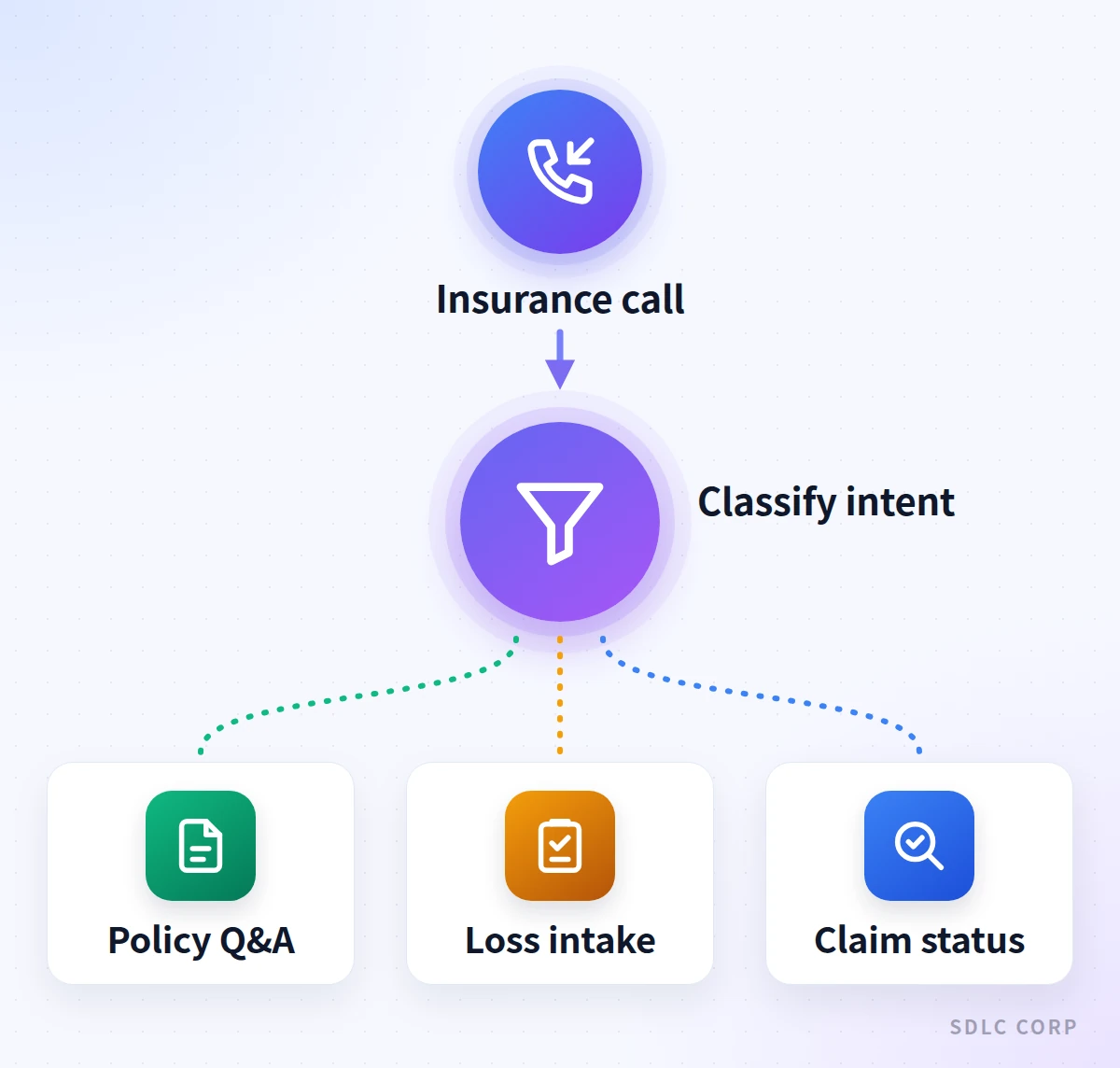
An AI voice agent routes insurance calls by classifying the caller's intent into defined call types and applying fixed routing rules to each. Deterministic rules matter here, because a misrouted loss report or complaint can delay a time-sensitive process.
- New claims and loss reports: FNOL intake, then the claims intake team.
- Existing claims: the assigned adjuster or claims unit, with the claim reference captured.
- Billing and payments: the billing team, beyond general payment information.
- Policy changes, cancellations and quotes: licensed service staff or the servicing agent.
- Complaints: customer relations or the designated complaints process.
After a storm or other large event, call volume can far exceed staffed capacity. Routing rules should send callers reporting injuries or unsafe homes to people first, while the agent captures routine loss reports.
Pulastya uses intent classification mapped to defined call types, deterministic routing rules and structured capture of request details, as the AI call intake and routing case study describes. That case covers a service business, not an insurer, so it shows the routing pattern rather than an insurance deployment.
Map your own insurance call types before comparing platforms. The overview of inbound AI voice agents shows how intake, routing and service requests fit together.
Human Escalation on Sensitive Insurance Calls
An AI voice agent should escalate to a person whenever a call involves distress, a dispute, a request for advice or a decision, or signs that the caller is vulnerable. Many insurance calls follow an accident, a fire or a death, and a scripted exchange can make a hard day worse.
- Injury, bereavement or clear distress, including life and health-related claims.
- Disputes about a decision, a delay or a settlement offer, or mentions of an attorney or regulator complaint.
- Questions about coverage, advice or anything requiring a licensed person.
- Fraud or identity theft reported by the caller.
- Low confidence, repeated misunderstanding or a request for a person.
Detecting these signals reliably takes more than keyword lists, and the guide on how AI voice agents detect human escalation needs explains the approaches. For conversation design around distressing topics, see handling sensitive calls with AI voice agents.
A transfer should carry the conversation with it. When a voice agent hands a call to a person, the receiving adjuster or service representative needs the conversation context and a call summary already in front of them, so the caller is not asked to start the account again.
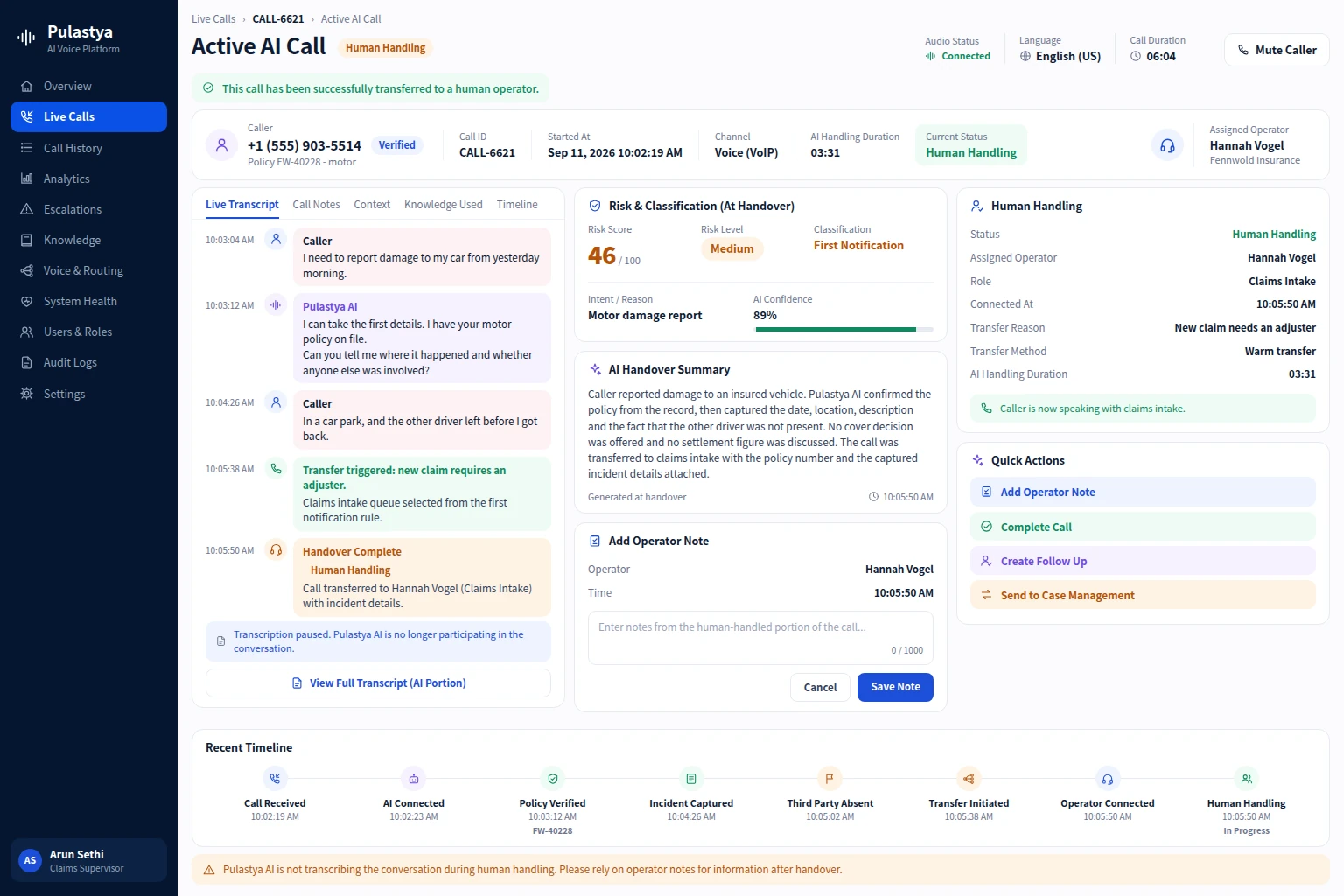
For someone who has just described a collision, a fire or a bereavement, retelling it to a second listener is the part of the experience that gets remembered, and it is avoidable.
The same principle applies to failure rather than escalation: if the agent cannot continue at all, the call should fall through to a staffed line instead of ending on the caller.
Handling Sensitive Data on Insurance Calls
An AI voice agent on insurance calls should collect only the personal data each workflow needs, and keep payment details and highly sensitive information out of the conversation unless a secure process exists. Transcripts and summaries inherit that sensitivity.
- Minimize: capture identifiers and loss facts, not full medical histories or unrelated personal details.
- Keep payment card and bank details out of the AI conversation and use the insurer's secure payment channel.
- Avoid reading back full identifiers such as dates of birth or account numbers.
- Restrict transcript access to the roles that need it, and set retention and recording consent rules with your compliance team.
Your business remains responsible for call consent and local recording requirements. Confirm security and regulatory requirements, including any certifications you need, directly with each vendor. The guide to AI voice agent security and privacy covers the controls to review.
Decision guide
Insurance Call Boundaries
| Caller asks | Agent action | Decision owner |
|---|---|---|
| How do I file a claim? | Explain process from approved content | No decision required |
| I need to report a loss | Capture structured FNOL details | Claims team |
| What is my claim status? | Share approved status if verified and integrated | Claims team for follow-up questions |
| Is this loss covered? | Do not answer; transfer | Authorized claims staff |
| Which policy should I buy? | Do not advise; route | Licensed agent |
| I want to dispute a decision | Transfer with call summary | Claims or complaints team |
Writing down the agent's action and the decision owner for each request keeps coverage, advice and disputes with authorized people.
How to Scope an Insurance Voice Agent Pilot
Start narrow: one line of business, process questions and FNOL intake, with every decision and verification-dependent request routed to people. Expand into claim status or billing only after verification, integration and escalation rules are reviewed with claims, compliance and security owners.
- Choose one line of businessPick a product line with repetitive, process-driven calls and a claims team ready to review intake records.
- Write the boundary listDocument which questions the agent answers, captures or routes, and have compliance approve it.
- Prepare scoped contentBuild approved process guides labeled by product line and jurisdiction, each with a named owner.
- Define verification ownershipDecide whether staff or a dedicated system verifies callers before any policy-specific detail is shared.
- Test hard scenariosInclude injured callers, coverage questions, third-party callers, attorneys and surge conditions.
For insurance teams, the capabilities worth evaluating in any voice platform are general rather than industry-specific: answers grounded in the content you approve, intent classification mapped to your own call types, structured intake, transfers that arrive with context attached, and transcripts and call summaries you can audit afterwards.
None of that is unique to insurance; what is specific to insurance is the boundary list you hold each capability against.
Other regulated sectors write that list differently while evaluating the same capabilities, and the wider industry map of voice AI use cases shows where each one draws its line.
Insist on placing a test call yourself before launch, using your own content and your own refusal cases, because a scripted vendor demonstration will never show you how a system behaves on the questions you have decided it must decline.
Bring the boundary list to every vendor conversation, since it defines what a pilot must prove.
Pulastya, built and supported by SDLC Corp, is one implementation of this pattern for inbound and outbound business calls; the capabilities above are set out on the AI voice agent platform page, and a live voice agent demo shows the call flow end to end.
Conclusion
An AI voice agent for insurance can support policyholders and claims teams by answering approved process questions, collecting first notice of loss details, and routing calls to the right people. Claim-status updates require appropriate caller verification, authorization and access to reliable claims data.
The strongest implementations keep insurance advice, coverage decisions, liability assessments and settlement decisions with authorized staff. They also protect sensitive caller information and provide clear escalation when a situation involves distress, uncertainty or a dispute.
Start with a focused pilot for routine enquiries and structured loss intake, test the transfer and verification safeguards, and expand only when compliance, security and claims teams have reviewed actual outcomes.
Frequently Asked Questions
No. An AI voice agent should not make coverage, underwriting, liability or claim payment decisions, and it should not give insurance or legal advice. Its role is to explain approved processes, capture structured information and route calls, while authorized staff make every decision.
Yes, as structured intake. The agent checks for injuries or danger first, then records the policyholder, loss date, location, description and other parties, then routes it to the claims team. It records facts and does not assess fault, coverage or value.
Only with an integration to the claims system, a verification step the insurer approves and approved status descriptions. Because third parties, repair shops and attorneys also call, disclosure rules should depend on the caller's role. Otherwise, the agent captures the request and routes it to the claims team.
Collect only what each workflow needs, keep payment details out of the AI conversation, avoid reading back full identifiers, and restrict access to transcripts and summaries. Recording consent and retention rules vary by jurisdiction, so set them with your compliance team and confirm vendor security controls directly.