A call about money owed is not an ordinary outbound call with a different script. It is a call where saying the wrong sentence to the wrong person can create a problem the payment itself never would have, and where the agent's most important behavior is knowing what it must not say.
- The rules are not one set of rules What applies turns on jurisdiction, on the type of debt, on who is calling and on the sector, so it has to be established with counsel.
- Say nothing before you know who answered No amount, no account status, no statement that anything is owed, until the right person is on the line.
- Inform and route, never negotiate The agent states what it is allowed to state and hands anything beyond that to a person or a defined process.
The hazard is concentrated at the start. Before anyone has established who picked up the phone, almost everything interesting about the call is something the agent should not be stating aloud.
The second hazard is at the other end, when the conversation turns into something the automation is not equipped to hold: a dispute, a hardship, a request to stop. Knowing where to stop is a design decision made before launch, not a judgement made on the call.
Why This Call Type Sits Apart
Calls about money owed attract more specific regulation than almost any other outbound category, and the rules are not uniform. What applies to one programme may not apply to a programme that looks very similar from the outside.
- Jurisdiction, at national and often sub-national level, which can differ for the caller and the called party.
- Whether the money is owed by a consumer or by a business, which frequently sits in different regimes.
- Who is calling: the original creditor, a purchaser of the account, or a third party acting on behalf of one.
- The sector the debt arose in, since some carry additional duties of their own.
- How the contact is made, since automated and recorded calls are sometimes treated differently from live ones.
Change any one of those and the answer can change. That is why a control inherited from another programme, another country or another vendor's template is not evidence that it applies to yours.
Treat every statement in this area as conditional. The obligations that govern a specific collections or payment reminder programme should be established with qualified counsel before any number is dialed, and reviewed when the programme, the portfolio or the territory changes. A lighter case sits alongside it, since reminder calls that only confirm an appointment carry far fewer obligations than a payment request.
The general obligations that sit under any outbound programme, such as consent, suppression and permitted contact times, are covered in consent, suppression and calling-window controls. They are a floor here, not a ceiling.
What the Agent May Say Before It Knows Who Answered
A ringing number is not a person. Shared handsets, family members, colleagues and reassigned numbers all mean the voice that answers is regularly not the one the call is about.
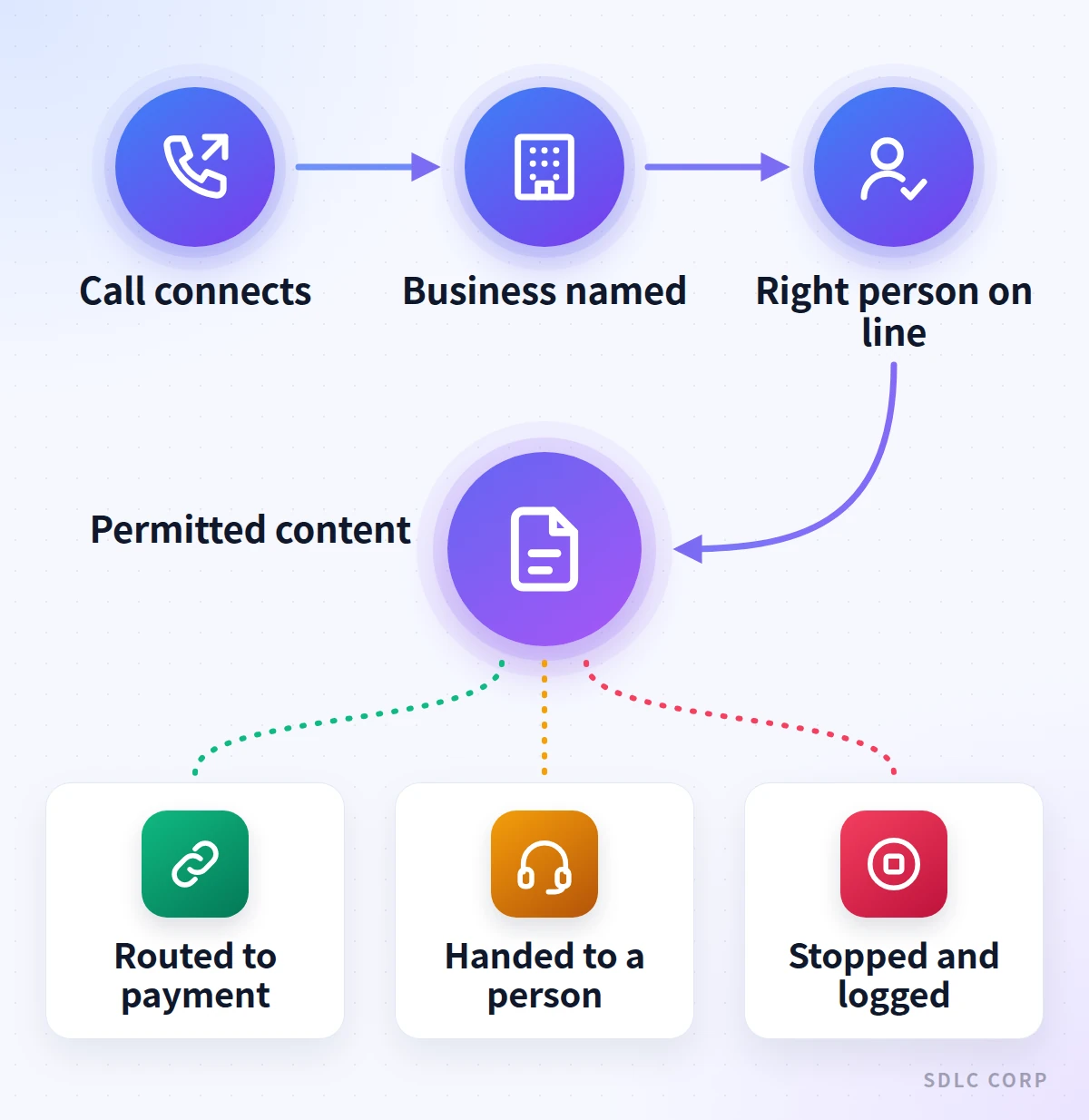
So the opening has to be informative enough to be answered honestly and empty enough to reveal nothing. In practice that means naming the business, asking for the person by name, and stopping there.
| Before identity is established | Position |
|---|---|
| Name the business placing the call | Normally stated, subject to the programme's own rules |
| Ask for the named person | Normally stated |
| State that money is owed | Not stated |
| State an amount or a due date | Not stated |
| Describe the account or its status | Not stated |
| Explain the reason to a third party | Not stated |
If somebody else answers, the only safe responses are to ask when the person is available, to leave a request that they call back, or to end the call. Explaining why you are calling is the specific failure this whole sequence exists to prevent.
The same restraint applies to a recording. A message that names the business and asks for a return call discloses nothing; a message that mentions an account, a balance or a payment may be heard by anyone. Whether a message may be left at all is one of the things to settle with counsel rather than by default.
How the person is then identified, and to what standard, is policy rather than script, and it is set out in handling calls that carry sensitive information.
The Line the Conversation Must Not Cross
Once the right person is on the line, the agent has a narrow job: state what it is permitted to state and find out what the person wants to do. Everything past that is out of scope, and saying so plainly is what keeps the call defensible.
No settlement figure, no arrangement, no altered terms and no waiving of anything. Those are decisions a person makes.
No statement about consequences, escalation, legal action, credit effects or what happens if nothing is paid.
No legal descriptions of the account or the person's position. Restating the record is not the same as interpreting it.
Anything outside the approved content becomes a transfer or a callback, never a best guess about policy.
The failure mode is not usually a dramatic sentence. It is a helpful-sounding one: an agent trying to reassure somebody by predicting what the business will do, or by suggesting an amount that might be acceptable.
Building the agent so it says when it does not have the context, and offers a person instead of guessing, is what makes that boundary hold under pressure from a caller who wants an answer now.
Where the Call Has to Stop
Some things a person says should end the automated part of the call immediately, regardless of how well the conversation was going. These are defined in advance and are not left to a confidence score.
- Any dispute about whether the money is owed, or about the amount.
- Any indication of hardship, illness, bereavement or vulnerability.
- Any request to stop being contacted, or to be contacted only in another way.
- Any mention of representation, insolvency proceedings or a third party acting for the person.
- Any request to speak to a person, stated in any form.
Stopping cleanly matters as much as stopping. The agent should acknowledge briefly, say what happens next, and either connect somebody or record the request and end the call without a final attempt to continue.
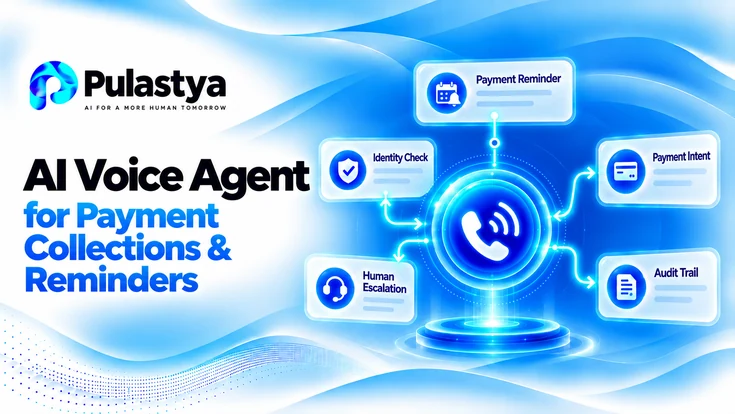
Pulastya transfers a call to a person with the conversation context and a call summary attached, and can fail over to a human line, which is the shape this needs: the person picking up already knows what was said, and an outage leaves a ringing phone rather than a dead one.
Which signals should pull a live person into a call, and how they are detected, is covered in recognizing when a caller needs a person.
Handing on a Payment Intent Without Taking a Payment
The productive result of one of these calls is an intention, not a transaction. Somebody says they will pay, or wants to arrange something, and the job is to get that to the process the business already runs.
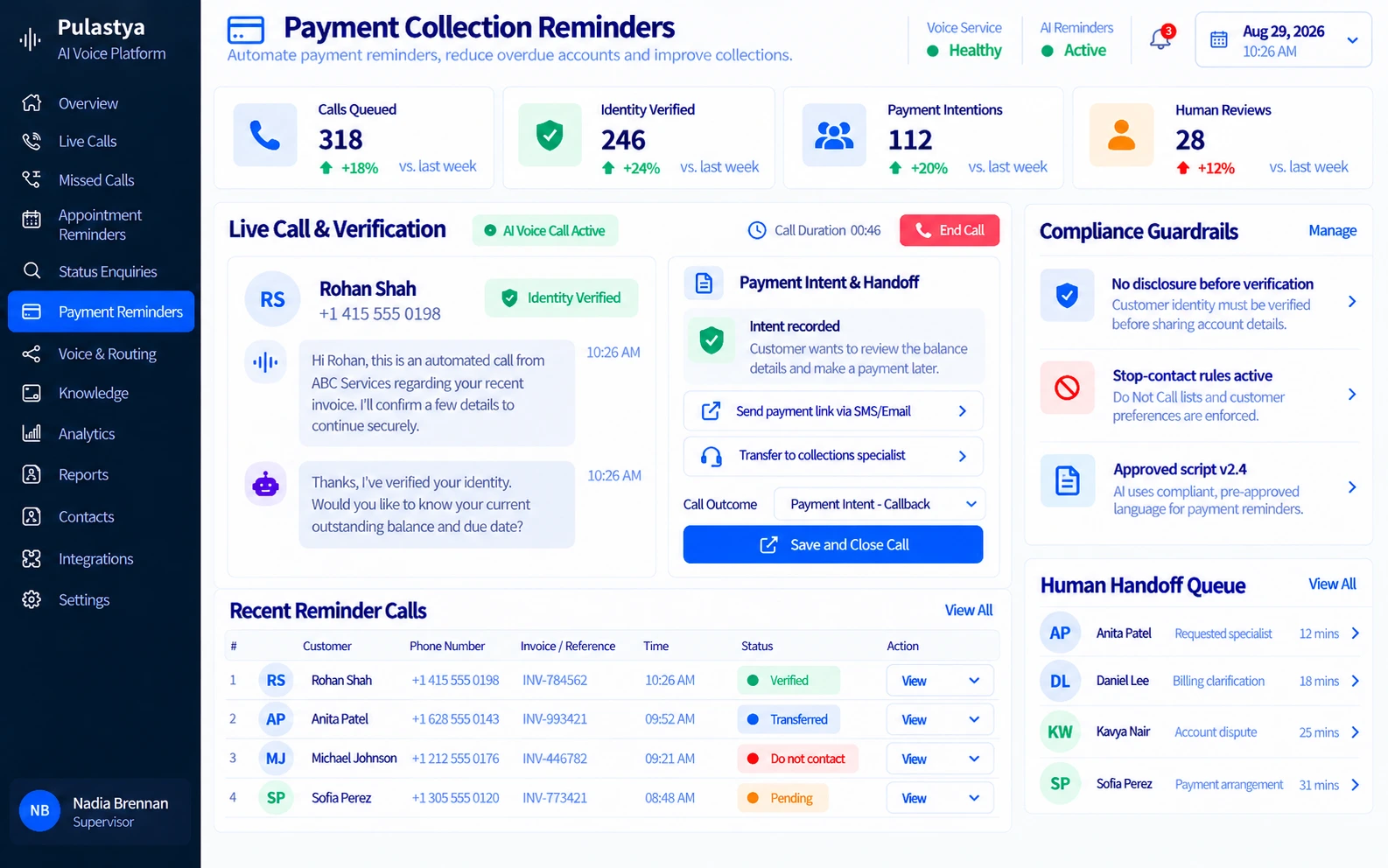
Card details do not belong in this conversation. Digits spoken on a call become audio, become a transcript and become a record, which is a burden nobody wants to have created for a payment that could have been taken elsewhere.
- Record the intent, not the instrumentWhat the person said they intend to do and by when. No card numbers, no bank details, no security codes.
- Offer the existing routeThe channel the business already uses for payments, described plainly enough for the person to reach it unaided.
- Transfer where a person is neededAnything requiring a decision goes to a colleague with the conversation already established, not restarted.
- Close the loop in the recordWrite the outcome and the promised date so the next contact knows what was already said.
The thinner the handoff, the more the receiving person has to re-ask, and re-asking on this call type is exactly what irritates somebody who has already explained themselves once. What a handoff should carry is set out in the information a handoff should carry.
One promise the agent should never make is that a payment has been received or applied. It can state that an intention has been recorded, which is a different sentence and a true one.
Making the Call Reviewable Afterwards
On most call types, records exist so work can continue. Here they exist so the call can be examined, because the question asked afterwards is usually what exactly was said.
That raises the value of knowing which version of the approved content was running. A programme that changes its wording without recording when it changed cannot reconstruct what a specific call was permitted to say.
- The conversation itself, in the form that can show what was actually stated.
- The version of the script and the approved content that was in force at the time.
- Where the call stopped, and which signal stopped it.
- What was recorded as the outcome, and whether it matches the conversation.
Sampling matters more here than elsewhere. Reviewing a handful of calls a week against the boundaries above catches drift long before a complaint does, and it is the only way to know whether the stop rules are firing when they should.
Where these obligations sit in a wider accountability picture is covered in governance for enterprise voice deployments.
Conclusion
AI voice agents can help businesses manage payment reminders and collections more consistently, but these conversations require stricter controls than ordinary outbound calls. Protecting customer information starts with identifying who answered and limiting any disclosure to what the applicable rules and approved policy permit.
A responsible programme defines the boundaries before calls begin: what the agent may say, when it must stop for a dispute or hardship, and how it records a payment intention without collecting sensitive payment credentials. Human escalation, secure payment routes and reviewable call records make those boundaries practical.
Before deployment, establish the applicable consent, disclosure, contact and recordkeeping requirements with qualified counsel and test the agent against them. The goal is efficient follow-up without compromising privacy, customer trust or accountability.
Frequently Asked Questions
That depends on factors that vary sharply: the jurisdictions involved, whether the debt is consumer or commercial, whether the caller is the original creditor or a third party, the sector, and how automated calls are treated locally. No general answer covers a specific programme. Establish the position that applies to yours with qualified counsel before dialing.
As little as possible. Naming the business and asking for the person is normally the limit, subject to the rules the programme operates under. It should not say that money is owed, state an amount, describe the account or explain why it is calling. If the person is unavailable, ask when to call back or end the call.
No. Spoken card details become audio and then a transcript, creating a record nobody benefits from. Record what the person intends to do and route them to the payment process the business already runs, or transfer them to a colleague. The agent can confirm that an intention was logged, never that a payment was received.
Stop the automated conversation. A dispute is not something to answer from approved content, and attempting to resolve it is where these calls go wrong. Acknowledge briefly, say what happens next, and connect a person or record the dispute and end the call. The same applies to hardship, bereavement and any request to stop contact.
It should not. Negotiating terms, proposing settlements, waiving charges and predicting what the business will accept are decisions for a person with the authority to make them. The agent's role is to state what it is permitted to state and pass anything beyond that on, with the conversation so far already established.