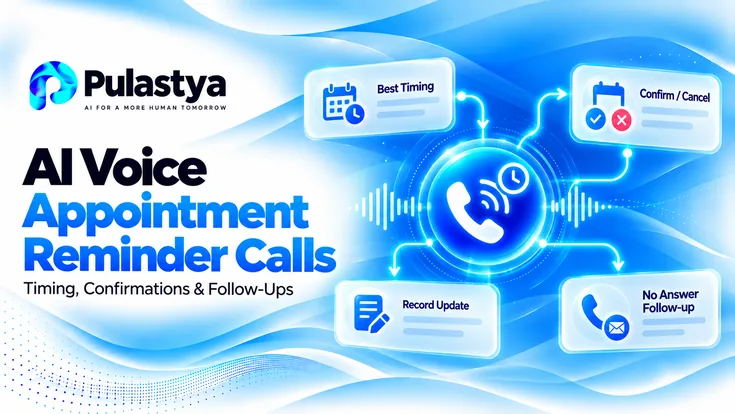
A reminder call has one job and a very short window in which to do it. Something is already in the diary, someone agreed to it, and the only open question is whether they will turn up. Everything about the call, including how long it lasts and when it is made, follows from that narrow purpose.
- Lead time is the main lever How far ahead the call is made decides whether the business can still use the news it receives.
- One question, asked plainly The call exists to collect an intention, so anything that delays that question is working against it.
- Silence is not a yes A reminder that got no answer must land in the record as unknown, not as a confirmation no one gave.
Most reminder calls drift because they forget this. The call grows a greeting, a short menu, an offer and a survey, and by the time it reaches its actual question the person has stopped listening or ended the call.
The other common drift is timing. A reminder timed at the wrong distance from the appointment is not a weaker reminder, it is a different thing: either a message no one recalls by the day itself, or a warning that arrives too late for anyone to act on.
What a Reminder Call Is Actually For
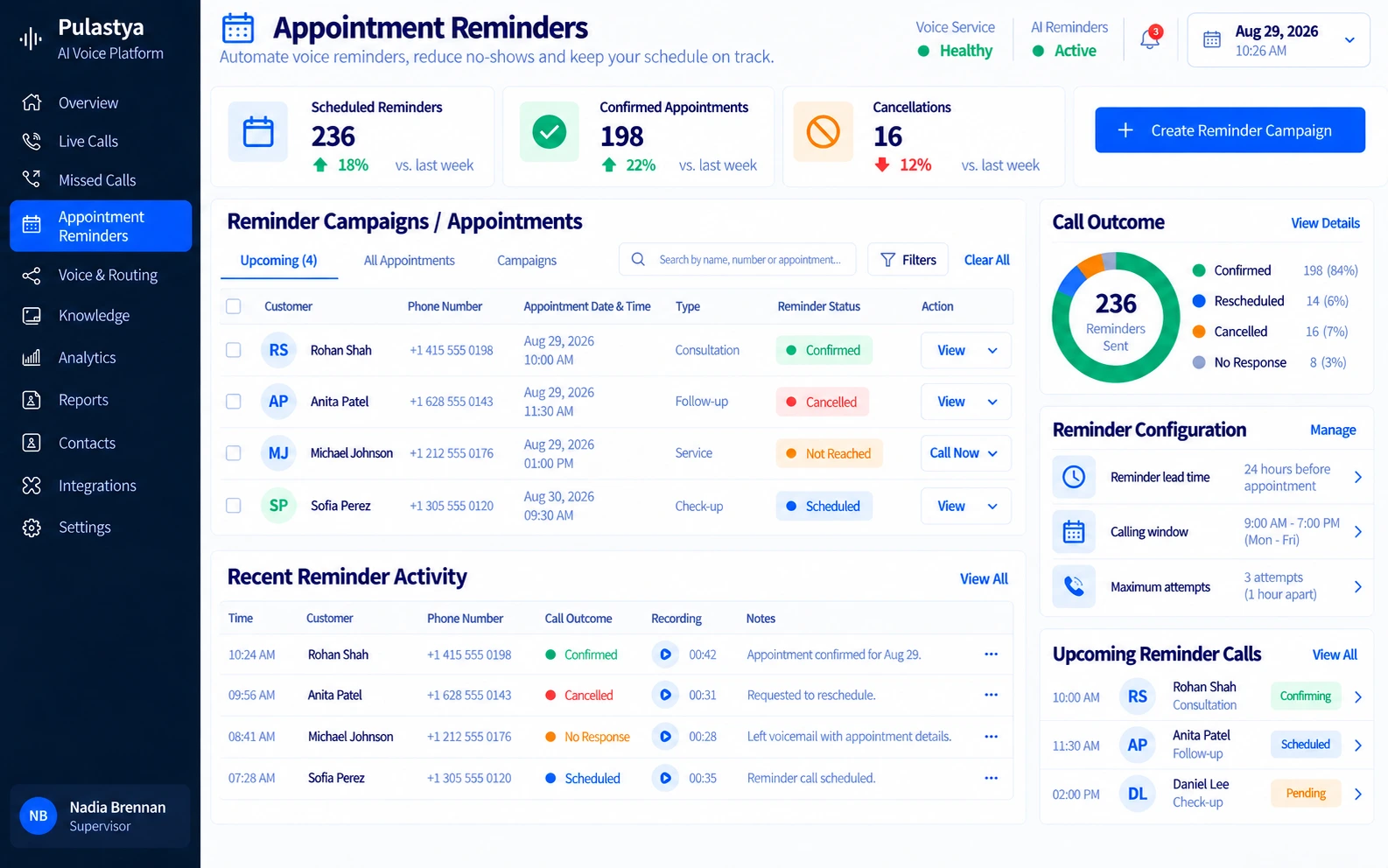
The commitment already exists. Nothing is being arranged, nothing is being negotiated, and the agent is not there to find a time. It is there to find out whether the person still intends to attend.
That gives the call three legitimate results and no others. The person confirms, the person says they cannot make it, or nothing is learned at all.
A fourth outcome, where the reminder turns into a rearrangement, belongs on a different call with different rules, and the mechanics of that conversation are set out in taking and changing bookings on inbound calls.
Keeping the reminder narrow is not a limitation, it is what makes it work. A short call with one question gets answered by people who would not stay on the line for a longer one.
A cancellation collected on a reminder call is a success, not a failure. The business now has notice it would otherwise have discovered as an empty chair.
Choosing the Lead Time
The right distance between the call and the appointment is set by one practical question: how much notice does the business need in order to do something useful with a cancellation.
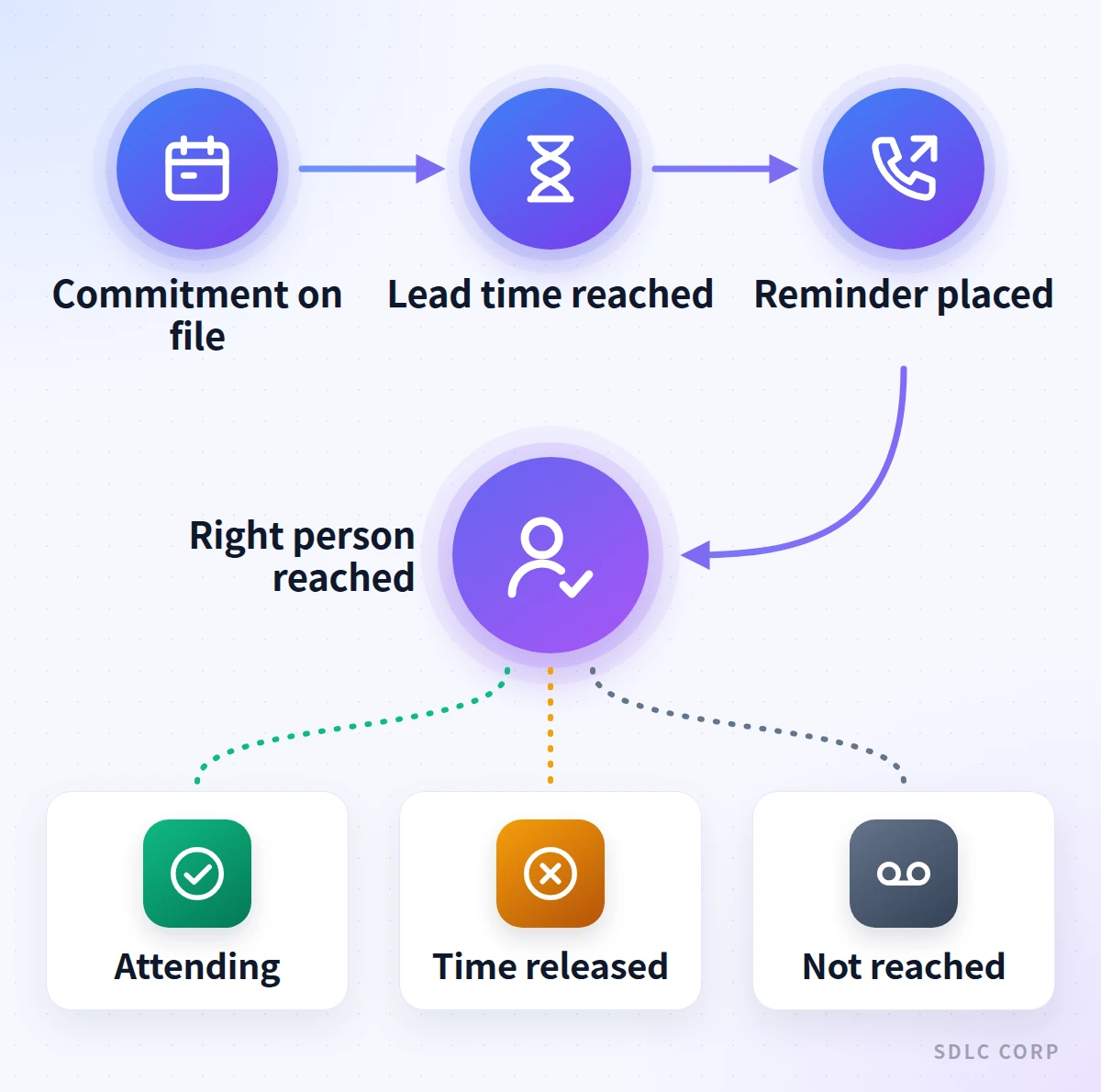
If refilling a vacated time takes a day of calling round, a reminder made the evening before collects news arriving too late to act on. If the time cannot be refilled at all, the lead time only has to serve the person's memory.
Memory pulls the other way. A call made a week ahead is out of mind by the day itself, which is why a single reminder rarely does both jobs well and many teams settle on two touches at different distances.
| Lead time | What it is good at | What it gives up |
|---|---|---|
| Several days ahead | Leaves room to refill or reassign the time | Is out of mind by the day itself |
| The day before | Sits close enough to be acted on personally | Gives the business little room to respond |
| Hours before | Catches people who forgot on the day | Collects news no one can use operationally |
| Two touches | Serves notice and memory separately | Doubles contact, which some people resent |
Two touches need a rule the first one sets up. If the person confirms on the earlier call, the later one should either not happen or should acknowledge the confirmation rather than asking the same question again as though nothing was said.
What the Call Should Ask, and in What Order
Order matters more here than wording, because the agent does not know who answered. Household and shared numbers mean the first voice heard is frequently not the person the reminder is about.
- Name the businessFirst words, before anything about the appointment, so the person can place the call and decide to keep listening.
- Ask for the personBy name, and wait. Nothing specific about the reason is stated until the right person is on the line.
- State the commitment onceDay, date and time in one sentence, with the location only if it is genuinely variable.
- Ask one closed questionWhether they still intend to attend. Not how they are, not whether anything has changed.
Closed beats open on this call. An open question invites an explanation the agent has no use for and no authority to act on, and it lengthens a call whose whole advantage is being short.
How much detail the reminder may state before the right person answers depends on what the appointment reveals. Where the subject of an appointment is itself sensitive, the constraint is tighter, and that boundary is handled in calls that carry sensitive information.
Anyone who asks a question the reminder cannot answer should reach a person or a stated next step immediately. An agent that tries to improvise around a reminder script is the fastest way to turn a thirty-second call into a complaint.
Getting the Answer Back Into the Record
A reminder that collects an answer no one writes down has achieved nothing beyond reminding. The value of the whole exercise is almost entirely in the writeback.
- Confirmed: the person said yes, and the record should show who said it and when.
- Cancelled: the person said no, which needs to reach whoever can release or reuse the time.
- Unclear: someone answered but the intention was never stated, which is its own status.
- Not reached: no one answered at all, which must never be written as either a yes or a no.
Those last two are where most systems cheat. Collapsing unclear and not reached into confirmed makes the report look better and makes the day worse, because staff plan around attendance that no one actually promised.
Provenance is worth carrying with the status. Knowing that a confirmation came from a reminder call at a particular time, with a transcript behind it, is what lets a colleague settle a disagreement about whether notice was given.
Pulastya places outbound business calls and leaves a transcript and a call summary against each one, which is the practical form that evidence takes: a status in the diary and the conversation that produced it sitting behind it.
Races are real on this leg. A customer can cancel by text while the call is being made, so the status the call writes should never overwrite a more recent action taken elsewhere.
The same freshness problem runs the other way, and it is the one people notice. A reminder about something that was cancelled two days ago tells the person their cancellation was never registered, which costs more trust than the reminder was ever going to earn.
So the list is built as late as it can be rather than assembled the night before and used unchanged. Anything already settled, by any route, comes out of it before the first number is tried.
When Nobody Answers
Reminder calls have a deadline nothing else on an outbound line has. The appointment itself ends the useful life of the attempt, which means the attempt budget is set by the calendar rather than by policy.
A reminder delivered after the appointment has passed is worse than no reminder. It tells the person you were not paying attention, and it arrives when the only remaining action is an apology.
That constraint should be encoded rather than assumed. Attempts stop at a fixed distance from the appointment, and any attempt that would land inside that boundary is simply not made.
Whether a message can be left at all depends on what the appointment discloses and who else might hear it. A message naming only the business reveals nothing; one that states the reason for the visit may reveal far more.
Distinguishing a live listener from a recording is its own problem, set out in separating a live answer from a recorded one.
Spacing and counting those tries turns the reminder into an ordinary outbound sequence, and it follows the rules described in how many tries an outbound number gets.
What Reminders Change and What They Do Not
Reminders work on forgetfulness. They do very little about unwillingness, and being honest about that distinction is what keeps expectations reasonable when results are reviewed.
A person who forgot will attend once reminded. A person who no longer wants to attend will either say so, which is useful, or say yes to end the call and then not turn up, which is not.
That second behavior is why confirmation rates flatter a reminder run. A confirmation is a statement of intent collected under mild social pressure, and it predicts attendance imperfectly.
The figure worth watching is the one that is hard to argue with: how many appointments were vacated with enough notice for the business to do something about them. Where that sits among the wider measures is covered in choosing what to measure on a voice line.
Conclusion
AI voice appointment reminder calls are most useful when they are timed around the business's need for notice and the customer's need for a timely prompt. A brief call that clearly asks for confirmation or cancellation can help teams identify available appointment slots earlier, while keeping the interaction simple for the person answering.
Reliable follow-through matters just as much as the call itself. Confirmations, cancellations, unclear responses and unanswered attempts should each be recorded accurately, with safeguards against outdated updates and unnecessary repeat calls. With suitable integrations and human escalation where needed, an outbound reminder process can support better scheduling decisions without treating silence as agreement.
Frequently Asked Questions
Work backwards from how much notice the business needs to use a cancellation. If a vacated time takes a day to fill, a reminder the evening before arrives too late to act on. If memory is the only concern, closer is better. Many teams settle on two touches because one call rarely serves both needs.
One closed question about whether the person still intends to attend, asked after the business has been named and the right person has come to the phone. Open questions invite explanations the agent cannot act on and lengthen a call whose main advantage is being short enough that people stay on it.
Record it as not reached, which is a status in its own right and must never be written as a confirmation. Further attempts stop at a fixed distance from the appointment itself, since a reminder that lands after the time has passed is worse than none at all.
Yes, and it should. A cancellation collected on a reminder is the most valuable result the call can produce, because it turns an empty chair into notice. What the agent should not do is drift into arranging a replacement time, which is a different conversation with different rules.
It depends on what the appointment itself reveals and who else may hear the message. A message that names only the business and asks for a return call discloses nothing. One that states the reason for the visit may disclose far more, so the safer default is to say less rather than more.