Most savings cases for a voice agent fail the same review. They multiply a count of automated calls by the cost of a human call, and a finance team rejects the result because neither figure survives a question about what would have happened otherwise.
- Name the counterfactual A saving only exists relative to what would otherwise have happened, so the baseline has to be chosen and written down before anything is counted.
- Handled is not resolved A call the agent takes is not automatically a call finished, and a call finished is not automatically work a person would have done.
- Give a range, not a figure A case that states its assumptions and shows a low and a high outcome survives review far better than a single confident number.
A defensible case is built the other way around. It starts with the baseline it is measuring against, admits which effects can be counted and which can only be argued, and states every assumption as a line someone else is free to change.
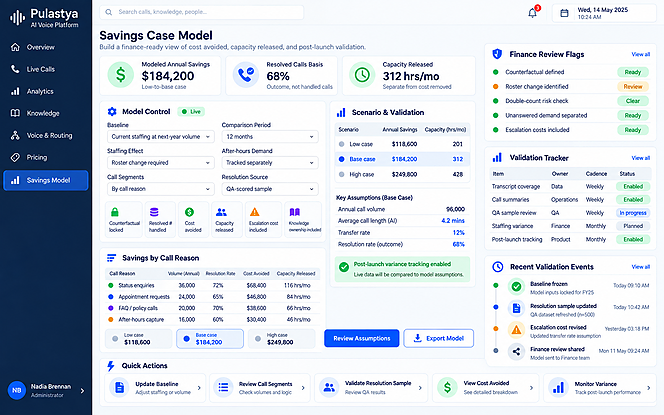
The method below gives you the structure and the variables. The figures have to come from your own traffic and your own cost base, because a number borrowed from someone else's deployment is exactly what a reviewer will strike out first.
Decide What the Investment Is Being Measured Against
Return is a comparison, and the thing being compared against is a choice. Different baselines produce different answers from identical data, so the baseline belongs at the top of the model rather than buried inside it.
Current cost and current volume, assumed flat. Simple to agree, and usually the least realistic if demand is growing.
What the current arrangement would cost at next year's expected volume, including the hiring or overtime it would need.
The next best option actually available, such as changed hours, a different routing rule or an outsourced line.
Accepting the unanswered calls and the delay, which has a cost even when nobody is currently paying it.
The fourth option is the one teams skip and reviewers reach for. If calls currently go unanswered after hours, nobody is spending money on them today, so automating them does not reduce a cost. It changes an outcome instead, and that has to be argued differently.
Pick one baseline, write it in a sentence, and hold it constant for the whole model. A case that quietly switches baseline between sections is the fastest way to lose a reviewer.
Where the Saving Is Usually Overstated
Four assumptions do most of the damage, and all four are easy to make without noticing. Each one inflates the top line of the model while leaving it looking arithmetically correct.
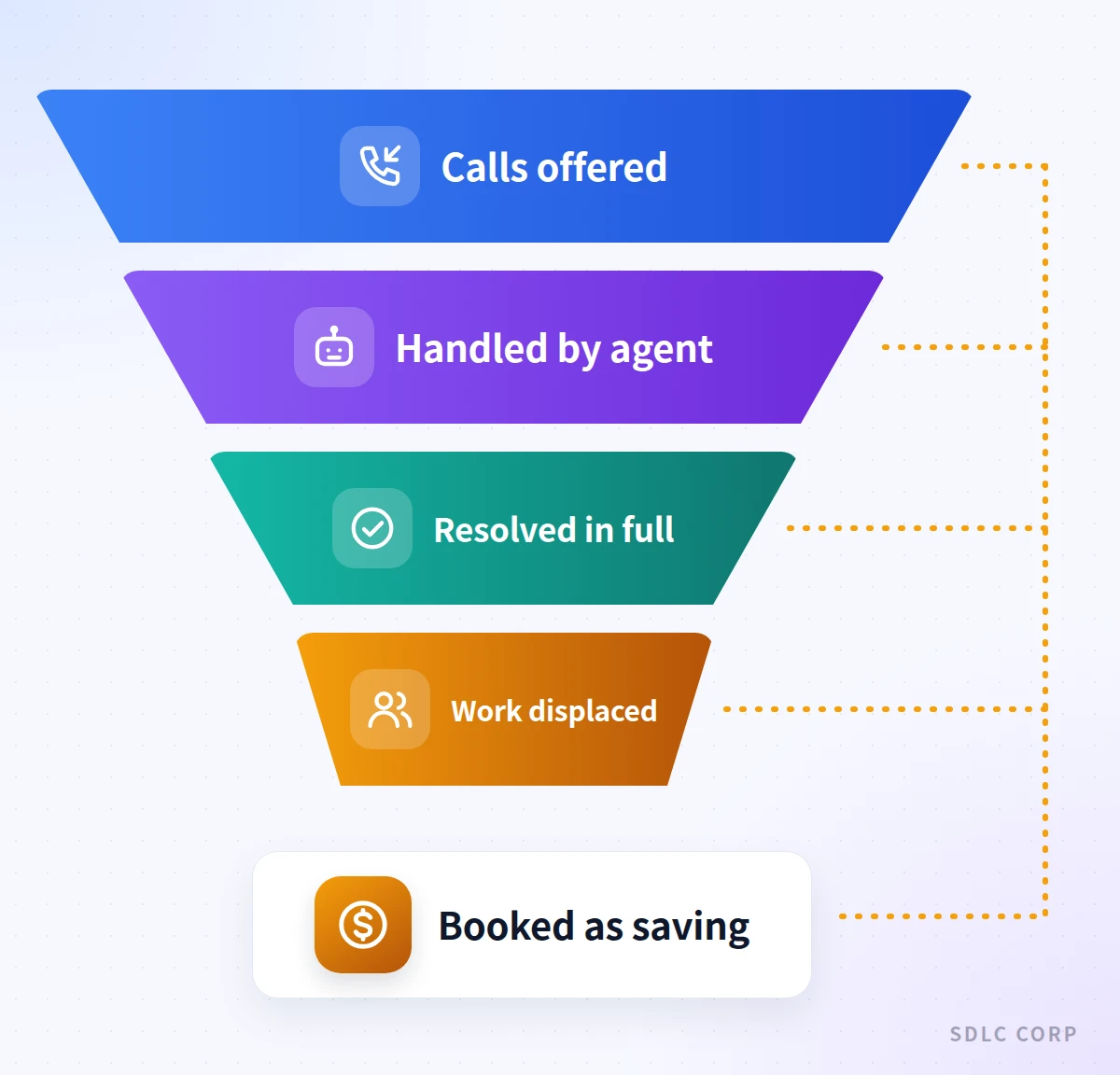
- Treating every handled call as a resolved one. An agent that takes a call, cannot answer and transfers it has added a step, not removed one.
- Treating every resolved call as displaced work. Calls that nobody was answering before were never costing staff time.
- Assuming staff cost falls with volume. Most teams are staffed in whole people on a roster, so a reduction in minutes only becomes money at the point a shift or a role changes.
- Counting the same request twice. A caller who rings back because the first attempt failed produces two handled calls and one piece of work.
The first two collapse into one discipline: count outcomes, not connections. A voice agent that flags a knowledge gap and offers a transfer rather than guessing, as Pulastya AI does, is behaving correctly, but those calls belong in the transferred column of the model and not the saved one.
The third is worth stating plainly to a reviewer before they raise it. Express the staffing effect as the specific roster change it would allow, and if no roster change follows, the saving is capacity released rather than cost removed. Both are real; only one appears on a budget line.
Write two totals: cost avoided, which shows up in a budget, and capacity released, which shows up in what the team can now take on. Never add them together.
Effects You Can Measure and Effects You Can Only Assert
Splitting the effects into two lists early keeps the argument honest, and it stops a reviewer from discounting the whole case because one soft claim sat next to a hard one.
| Effect | Can it be counted | What the count needs |
|---|---|---|
| Calls completed without a person | Yes | An outcome recorded per call, not just a connection |
| Calls answered outside staffed hours | Yes | Volume and outcomes for the unstaffed window |
| Time a person spends per transferred call | Yes | Handling time measured after the transfer, not before it |
| Data captured correctly on first attempt | Yes | A sample scored by a person against the record created |
| Caller satisfaction and reputation | Partly | A survey or scored sample, with a pre-launch comparison |
| Revenue from calls that were previously missed | Partly | Attribution rules agreed with finance before launch |
The right column is the real requirement. Most of these figures are only available if the instrumentation exists before launch, which is why the measurement plan has to be agreed while the system is being configured rather than after.
Transcripts, call summaries and a call dashboard of the kind Pulastya AI records give you the raw material for the countable rows. Turning that raw material into the operational view a team runs on is a separate exercise, set out in the measurements worth tracking for a voice agent.
The Cost Side of the Same Model
A savings case is judged on whether the cost side looks complete. An incomplete cost side invites the reviewer to invent the missing items, usually generously.
- Running cost for the call volume in the model, built from your own call profile rather than a headline rate.
- The work to get live: connecting systems, preparing the documents the agent answers from, and testing.
- Ongoing ownership: keeping knowledge current, reviewing transcripts and adjusting behavior as the business changes.
- The human side of escalation, since transferred calls still consume staff time and sometimes more of it.
- The cost of being wrong: corrections, repeat contacts and the occasional call that has to be recovered by a person.
Two of those five are usually missing. Knowledge maintenance is continuous work that nobody owns until it is named, and escalation handling can be slower per call than the calls it replaced, because the easy requests are the ones that stopped arriving.
Build the run-cost line from a decomposed figure rather than a quoted rate, using the approach in what actually makes up a per-minute figure. Whether the ownership line is yours or a supplier's depends on the choice examined in building a voice agent against adopting a platform.
Assembling a Model a Finance Team Will Accept
The structure matters more than the sophistication. A short model whose assumptions are all visible beats a detailed one whose inputs cannot be traced.
- State the baselineOne sentence naming what the investment is being compared against, and the period over which the comparison runs.
- Segment by call reasonModel each call reason separately. They differ in length, in resolution rate and in what a person would have done instead.
- Apply a resolution rate, not a handled rateFor each call reason, carry only the share that finishes without a person through into the saving.
- Convert to money onceApply the labor cost at the point a roster or contract genuinely changes, and label anything else as released capacity.
- Subtract the full cost sideRun cost, setup, ownership and escalation, taken from the same volume assumptions as the saving.
- Show a low and a high caseVary resolution rate, call volume and call length. The spread tells the reviewer which assumption the decision actually rests on.
The last step does more work than the rest combined. When the low case is still acceptable, the discussion moves off the arithmetic and onto the decision, which is where you want it.
Checking the Case After Launch
A model written before launch is a forecast. It becomes evidence only if someone goes back and compares it against what happened, using the definitions agreed at the start.
- Freeze the baseline figures before the agent takes its first call, including current volumes, handling times and staffing.
- Roll out by call reason rather than all at once, so each segment has a period where it can be compared against the rest.
- Re-score resolution by hand on a sample of calls, because a system-recorded outcome and a genuinely finished request are not always the same thing.
- Report the variance against each original assumption, not only the headline result.
Sampling by hand is the step with the highest return. It is the only way to catch calls that were recorded as complete and were not, and those calls are precisely the ones the original model counted most generously.
Where the variance comes from a call reason the agent should not have been given, the answer is usually scope rather than tuning, and the criteria for that are set out in deciding which calls should go to a person. Configuration choices that shape call length and resolution are made on the AI voice agent platform.
Conclusion
A reliable AI voice agent savings case starts with a clearly defined baseline and counts only work the agent genuinely removes. Measure completed requests rather than handled calls, include setup, running, maintenance and escalation costs, and keep actual budget savings separate from staff capacity released. Calls that were previously unanswered can improve service or capture demand, but they should not be presented as avoided labor costs.
Use your own call data to build low and high scenarios, then test the forecast after launch. Review a sample of call outcomes, check transfers and repeat contacts, and compare actual results with the assumptions finance approved. A transparent model that can be updated with evidence offers a stronger basis for an investment decision than a single headline ROI figure.
Frequently Asked Questions
Deflection counts calls the agent took. Resolution counts calls where the caller's request was actually finished without a person. Only the second belongs in a saving, because a deflected call that ends in a transfer has consumed agent time and staff time for one piece of work. Score a sample by hand to find the gap between the two.
It is safer to use it as a sanity check than as an input. Resolution rates depend on your call mix, your documents and how narrowly the agent has been scoped, and those differ enough between businesses that a borrowed figure will be the first thing a reviewer challenges. Derive the figure from a trial on your own calls instead.
Not as a cost saving, because nobody was paying to answer them. Treat them as a separate line for captured demand or improved service, with its own argument and its own attribution rule agreed with finance beforehand. Mixing them into the labor saving is one of the fastest ways to have the whole case discounted.
At the point a roster, a contract or a headcount plan changes. Minutes saved across a shift do not leave the budget on their own. State the specific change the saving would permit, and if no change is planned, report the effect as released capacity so the reviewer can weigh it as what it is.
There is no figure that transfers between deployments, because it depends on call volume, call length, resolution rate, your labor cost and how much integration work is needed. Build the period from your own inputs and present it as a range driven by the resolution assumption, which is almost always the variable the answer is most sensitive to.