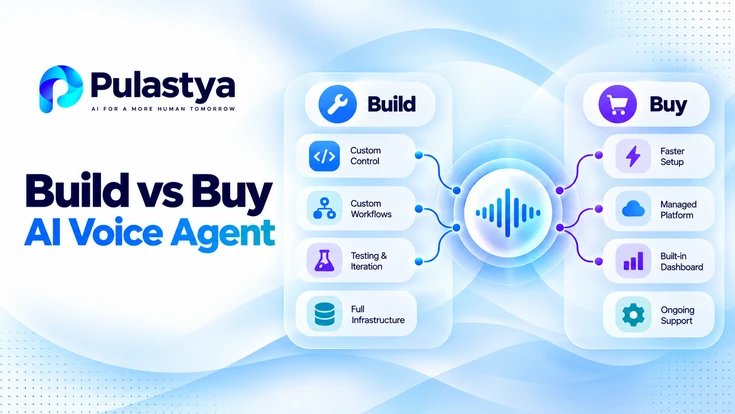
A working voice agent can be assembled by a competent engineer in a couple of weeks. That fact is what makes this decision hard, because those two weeks are not the part that costs anything, and the demo they produce answers almost none of the questions the decision actually turns on.
- The demo is not the system Getting a call answered is a small fraction of the work. Handling the calls that go wrong is most of it.
- Ownership is a standing cost A built agent needs someone on call for it, and that obligation does not end when the project does.
- Both paths have an exit cost Buying creates dependence on a supplier. Building creates dependence on the few people who understand the assembly.
The honest framing is not build against buy. It is which parts of the system your organization wants to own permanently, and what it is willing to pay in attention rather than in fees to keep owning them.
That reframing matters because the two paths fail differently. A bought platform disappoints you at the point it cannot do something. A built one disappoints you later, quietly, when the person who understood it has moved on and a provider has changed something underneath it.
What Building Actually Means Once the Demo Works
The parts that get a call answered are well documented and quick to wire together. The parts that keep a call sensible when something unexpected happens are neither, and they are the bulk of the build.
- Turn taking: deciding the caller has finished, and stopping cleanly when they talk over the agent.
- Recovery: what happens on a mishearing, a silence, a wrong number pressed or a caller who changes the subject halfway through.
- State: keeping what has been established across a long call, and not losing it when a component times out.
- Grounding: making sure answers come from approved documents rather than from the model's general knowledge.
- Handover: reaching a person, passing what has already been said, and deciding what happens when nobody picks up.
- Operations: a record of every call that someone outside engineering can read, search and act on.
None of those items is difficult in isolation. The cost is that they interact, so a change to one of them regularly breaks another, and there is no way to know that has happened except by running calls again.
The shape these components take is set out in how the layers of a voice agent fit together, which is the map of what a build has to cover.
The Ownership Cost No First Estimate Contains
First estimates price the construction. The recurring obligations that follow are what decide whether building was cheaper, and they are rarely written down at the point the decision is made.
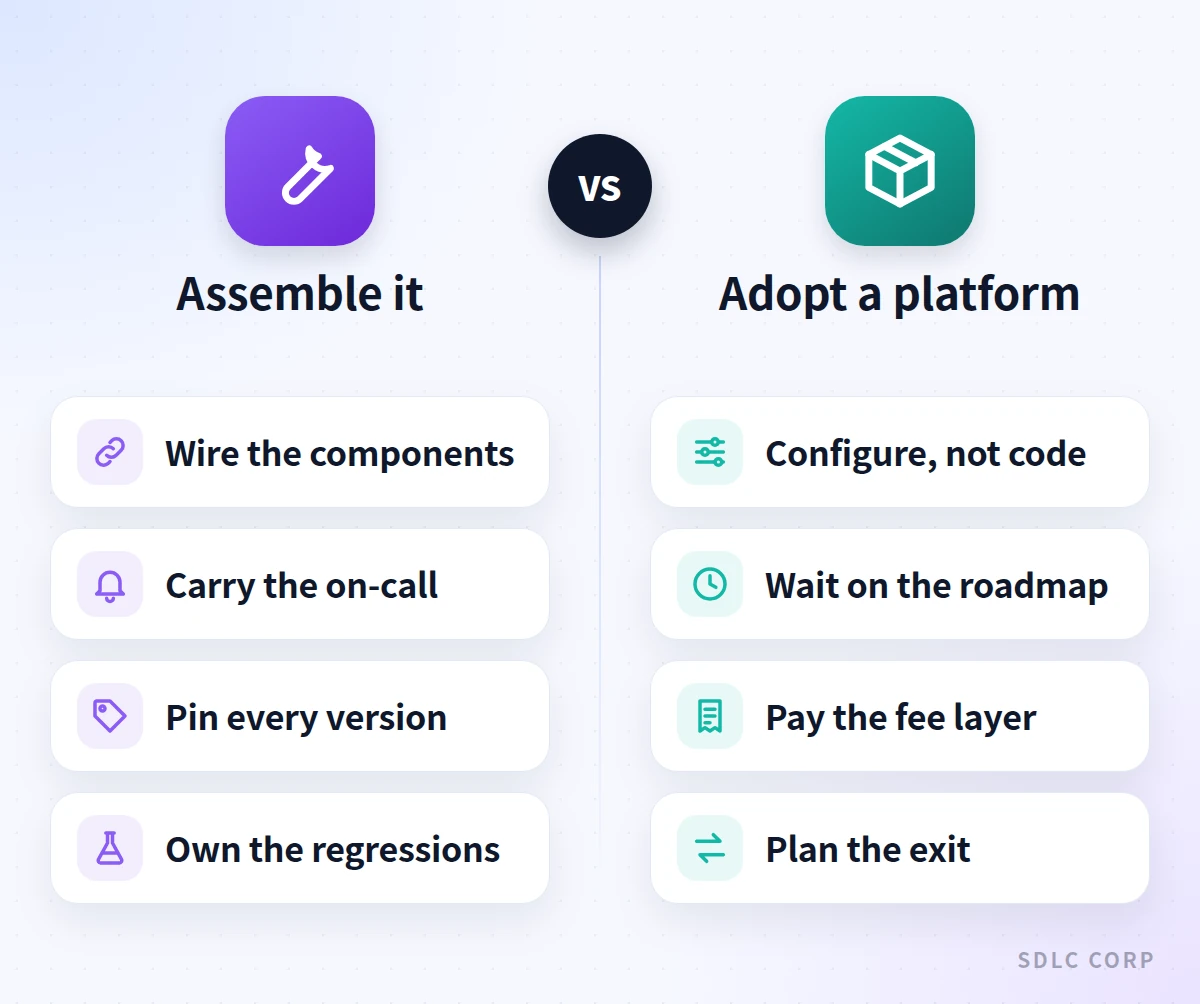
A phone line that answers customers needs a person responsible when it stops behaving, including outside office hours.
Model versions, voices and telephony interfaces change on their suppliers' schedules, not yours, and pinned versions eventually retire.
There is no cheap way to confirm a prompt edit did not break a different call reason, so a regression suite becomes a permanent asset to maintain.
If changing a greeting or a policy line requires a deployment, the business team stops asking and the agent drifts out of date.
The last card is the one that quietly decides the outcome. A built agent that only engineers can change accumulates a queue of small corrections nobody has time for, and the gap between what the agent says and what the business currently does widens month by month.
That drift is most visible in the answers themselves, which is why keeping the source material current is a named job rather than a task, as described in keeping the answers a voice agent gives accurate over time.
What Breaks in Year Two
Year one problems are visible and get fixed. Year two problems are the ones that arrive after the project has been declared finished and the attention has moved elsewhere.
- The engineer who built it changes team, and the assembly turns out to have been documented mostly in their head.
- A provider deprecates the model or voice the agent was tuned against, and the replacement behaves differently on exactly the calls that mattered.
- The prompt has been edited thirty times by different hands and nobody can say which instruction is load bearing.
- Call volume grows past what the original concurrency arrangement assumed, and the failure shows up as a busy line rather than an alert.
- A new call reason is added by copying an existing one, and the copy inherits a workaround that no longer applies.
These are ordinary software ageing problems. What makes them heavier here is that the symptoms reach customers directly and in real time, so the feedback arrives as complaints about a phone line rather than as a ticket in a queue.
A bought platform does not remove this class of problem. It moves the responsibility for the component layer to the supplier and leaves you owning the configuration, the documents and the call design, which is a smaller surface but not an empty one.
What Buying Costs You Instead
Adopting a platform is not the cost-free branch, and a decision paper that presents it that way will be right back in front of you within a year.
Capabilities you need arrive when the supplier builds them, and capabilities you rely on can change when the supplier decides.
Anything outside what the platform exposes is either unavailable or has to be worked around, often awkwardly.
Whatever the platform charges for orchestration sits on top of the usage you were already going to pay the providers.
Call flows, prompts and integrations written into one platform rarely transfer, so leaving is a second project.
Exit cost is the one worth testing early. Ask what leaves with you: the documents, the transcripts, the call records, the phone numbers. Where those can be exported and the numbers can be pointed elsewhere, the dependence is real but bounded.
Which capabilities a given platform exposes, and how suppliers differ on them, is a separate exercise covered in a structured comparison of voice agent platforms.
Which Organizations Genuinely Need to Build
Building is the right answer for a minority, and the minority is identifiable in advance. The conditions are specific rather than a matter of ambition.
- The voice interface is the productIf what you sell is the conversation itself, its behavior is your differentiator and cannot sit behind someone else's configuration screen.
- A hard constraint no platform meetsA requirement about where audio may travel, which network it must cross or which systems it may touch that no supplier can satisfy.
- You already run platformsAn existing team that owns telephony or machine learning infrastructure in production, with on-call, release process and monitoring already in place.
- Scale changes the arithmeticAt sufficient volume a per-minute fee layer exceeds the cost of the team that would replace it, and the volume is durable rather than seasonal.
Two or more of these usually have to hold together. One on its own tends to be a preference rather than a constraint, and preferences are cheaper to satisfy through configuration than through a permanent engineering commitment.
Where a hard constraint is the deciding factor, write it into the requirements document as something a supplier must evidence rather than assert, using the approach in a requirements document built around evidence.
The Middle Path Most Teams Land On
The decision is rarely all or nothing in practice. Most of the value in building comes from controlling a few specific choices, and several of those choices can be kept without owning the assembly.
- Keep the model choice, so a change of provider or tier is a configuration decision rather than a rebuild.
- Keep the provider accounts in your own name, so usage, limits and keys stay visible to you.
- Keep the phone numbers, so leaving does not mean telling customers a new number.
- Keep the documents the agent answers from, since they are the part that encodes how your business actually works.
- Let the supplier own turn taking, recovery, transport and the call record, which are generic and expensive to maintain.
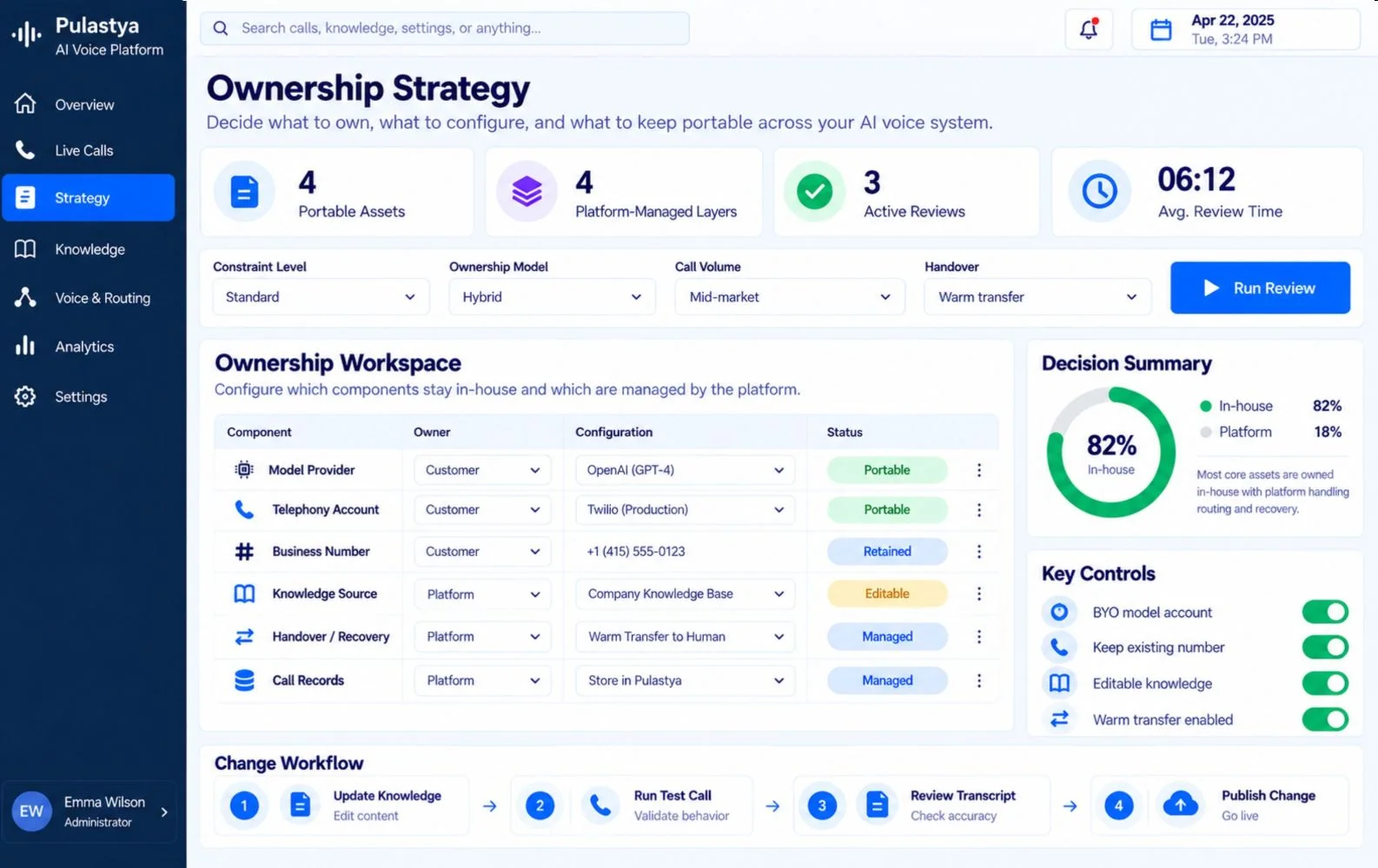
Platforms differ in how much of that list they allow. Pulastya AI is built around most of it: the model layer is configurable across OpenAI and open-source models, customers connect their own telephony and model accounts with those providers billing usage directly, and an existing business number can be kept by pointing its webhook at the platform.
The other half of the middle path is who does the changing. A four-step setup aimed at business teams rather than developers, which is how Pulastya AI is configured, is what stops the agent drifting out of date while a ticket waits in an engineering queue.
Whichever path is chosen, the cost side of the comparison should be built on the same volumes and the same call profile, using the method in a savings case built on measurable effects. Configuration and provider choices are made on the AI voice agent platform.
Conclusion
Choosing whether to build or buy an AI voice agent comes down to the responsibilities your team can sustain after launch. Building offers deeper control when the conversation is your product, technical constraints demand it, or steady call volume justifies an operating team. Buying reduces the infrastructure you maintain, but introduces platform fees, configuration limits and supplier dependence.
For many organizations, the practical answer is to keep ownership of the assets that matter—phone numbers, source documents, provider accounts and usable call records—while a platform handles real-time call orchestration and recovery. Before committing, compare both options using the same call volumes, include testing and on-call costs, and verify what you can export if your needs change.
Frequently Asked Questions
A demo that answers a call is quick. A system that handles interruptions, recovers from mishearings, grounds its answers in approved documents, hands over cleanly and leaves a readable record is a different order of work. Estimate the second, not the first, and include the regression testing that every later change will require.
It can be, because a per-minute fee layer scales with volume while a team does not. The comparison has to include the standing team cost, on-call coverage and the re-testing burden, not only the fee it removes. Run the arithmetic at your durable volume rather than a peak, and re-run it at a lower volume to see how quickly it reverses.
Usually the requirement that every change be re-tested against calls. Without a regression suite, small edits become risky and stop being made; with one, the suite itself becomes an asset that has to be maintained as the business changes. Either way it is continuing work that rarely appears in the original estimate.
Not necessarily. Platforms differ on this, and some let you connect your own model and telephony accounts and keep your existing numbers. Treat those as specific requirements to confirm rather than assumptions, because they are the choices that most affect how easily you could change direction later.
That is a common and reasonable sequence, and it is easier when the portable assets stay yours. Keeping the phone numbers, the source documents, the transcripts and the provider accounts in your own name means a later build starts from material you already hold rather than from nothing.