
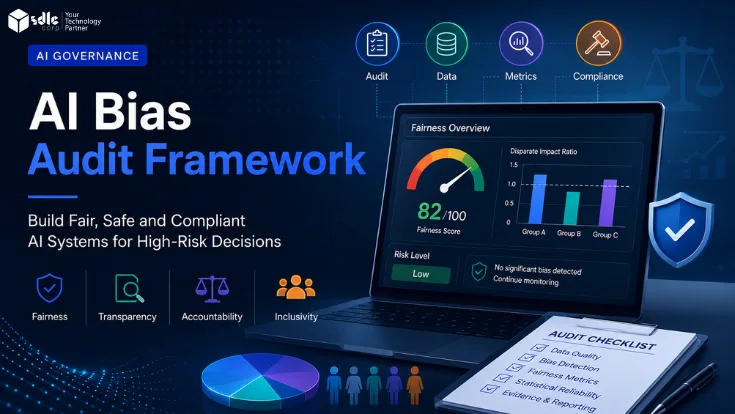
AI systems now support decisions in hiring, lending, healthcare, education, and other high-risk areas. An AI bias audit framework helps teams find unfair outcomes and understand when action is needed.
A strong audit combines fairness metrics, statistical testing, evidence, mitigation, and AI deployment and MLOps monitoring. It shows what was tested, what the results mean, and when the system should be reviewed again.
Key Takeaways
Start with harm: Define the decision and who could be negatively affected.
Choose metrics by risk: Different harms require different fairness measures.
Test intersections: Broad demographic results can hide subgroup disparities.
Set evidence rules first: Define minimum sample requirements before testing.
Treat thresholds carefully: Toolkit defaults are not universal fairness standards.
Retest and monitor: Re-evaluate fairness after mitigation and material changes.
DefinitionWhat Is an AI Bias Audit?
An AI bias audit, also called an algorithmic bias audit or AI fairness audit, evaluates whether an automated decision system produces meaningful differences in outcomes or error rates across relevant groups.
Aggregate accuracy is not enough. A system can perform strongly overall while producing materially different outcomes for a smaller demographic or intersectional group.
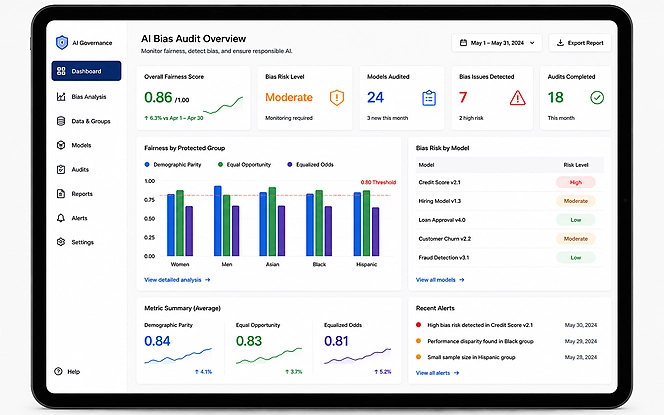
What Should the Audit Review?
- Data quality and representation
- Protected attributes and proxy variables
- Selection or approval rates
- False-positive and false-negative rates
- AI fairness metrics
- Statistical uncertainty
- Decision thresholds
- Human review and mitigation
- Audit evidence
- Production monitoring
Which Decisions Need Auditing?
Bias auditing matters most when AI-assisted decisions materially affect rights, opportunities, finances, employment, safety, or access to important services.
Employment
Hiring, candidate screening, promotion, evaluation, and workforce decisions.
Finance & Insurance
Credit scoring, lending, insurance eligibility, pricing, and fraud actions.
Health & Public Services
Healthcare prioritization, benefits eligibility, and access to essential services.
Education & Housing
Admissions, assessment, housing, tenant screening, and other consequential decisions.
EU AI Act Timing: What Was Deferred and What Was Not?
Much published guidance still refers to 2 August 2026 as the main deadline for high-risk AI systems. The 2026 Digital Omnibus changed that timeline, but it did not postpone the entire AI Act.
| Requirement | Current Timing |
|---|---|
| Prohibited AI practices | Since February 2025 |
| AI literacy obligation | Since February 2025 |
| Article 50 transparency obligations | From 2 August 2026 |
| Legacy synthetic-content marking under Article 50(2) | Transition until 2 December 2026 |
| Annex III high-risk requirements | 2 December 2027 |
| Annex I product-related high-risk requirements | 2 August 2028 |
The Deferral Is European Only
New York City's Local Law 144 requires covered automated employment decision tools to undergo an independent bias audit within one year before use, along with publication and notice requirements. California's employment regulations concerning automated-decision systems have applied since October 1, 2025 and clarify how existing anti-discrimination requirements apply when employers use these systems.
Do not treat the EU delay as a reason to pause responsible AI development, documentation, testing, or monitoring. Obligations outside the EU were not moved.
The AI Bias Audit Framework
Scope → Harm → Data → Groups → Metrics → Statistical Testing → Evidence → Mitigation → Monitoring
| Stage | Main Question |
|---|---|
| Scope | What decision does the AI influence? |
| Harm | Who could be affected and how? |
| Data | Is the evaluation data suitable? |
| Groups | Which groups require testing? |
| Metrics | Which measures correspond to the harm? |
| Statistics | Is the observed difference reliable? |
| Evidence | Can another reviewer reproduce the assessment? |
| Mitigation | What happens when a test fails? |
| Monitoring | When must the system be evaluated again? |
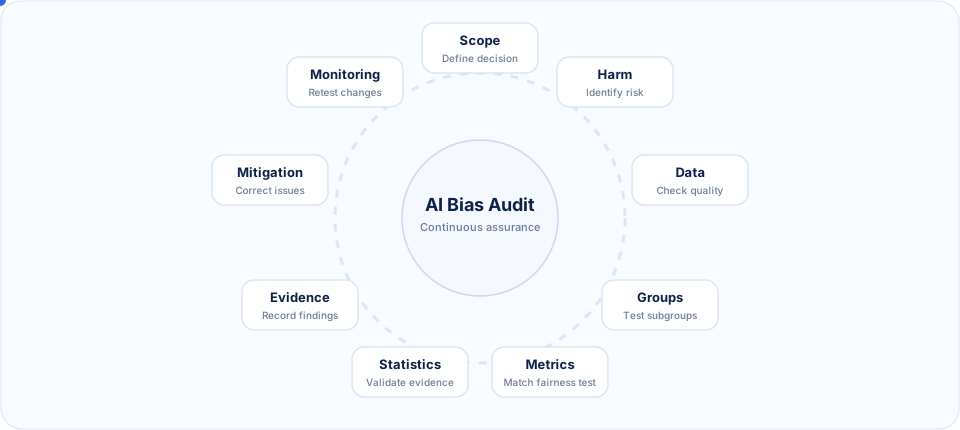
The audit is a lifecycle: monitoring can send a system back into investigation, mitigation, and retesting whenever evidence changes.
Define the Decision and Potential Harm
Do not begin by choosing demographic parity or equalized odds. First define what the system actually does and how an incorrect decision can affect people.
- The decision or recommendation
- Population affected
- Positive and negative outcomes
- human-in-the-loop approval controls
- Potential harm
- Relevant demographic groups
- Severity of an incorrect decision
- How AI output changes the final action
If an AI hiring system rejects qualified applicants from one group more often, overall selection rates may not capture the main harm. False-negative rates or true-positive rates may provide more meaningful evidence. If the main concern is unequal access to an opportunity, selection-rate comparisons may fit better.
The metric should follow the harm. Start with the decision risk, then choose the metric that measures it.
Audit the Data Before the Model
Fairness results depend on the enterprise AI data readiness. Historical records may contain human bias, inconsistent labels, missing values, underrepresentation, or measurement differences.
- Group representation
- Missing values
- Label quality
- Outcome distribution
- Historical decision patterns
- Data collection differences
- Time-period relevance
- Proxy variables
Removing a protected attribute does not automatically remove its influence. Location, education, occupation, employment history, or purchasing behavior can correlate with sensitive characteristics. Meaningful protected attribute analysis therefore considers both direct attributes and features capable of acting as proxies.
The target label also needs scrutiny. A hiring model trained on previous hiring decisions can reproduce patterns present in those decisions. Healthcare data can likewise reflect differences in access to treatment rather than differences in medical need.
Test Protected and Intersectional Groups
Aggregate performance can hide localized disparities. Depending on the use case, testing may include gender, race or ethnicity, age, disability-related groups, and other legally or operationally relevant characteristics.
Single-Group Testing
Compare relevant protected or sensitive groups individually to identify broad disparities.
Intersectional Testing
Test meaningful combinations such as race × gender where sufficient evidence exists.
A model may show acceptable results when gender and race are evaluated separately while producing worse outcomes for a specific race × gender subgroup. However, intersectional testing often produces smaller cells, which makes sample-size rules essential.
Set a Minimum Cell-Size Rule Before Testing
Do not wait until an unfavorable result appears to decide that a subgroup is too small. Define minimum evidence requirements before calculations begin.
Practical internal starting point: routine fairness pass/fail decisions require at least 30 observations in each subgroup-outcome cell used in the comparison.
If a cell falls below that threshold:
- Do not issue a standard pass/fail conclusion
- Mark it as insufficient evidence
- Extend the evaluation period where appropriate
- Add comparable data only when justified
- Use exact statistical methods where suitable
- Escalate high-consequence cases for specialist review
The 30-observation rule is an operational guardrail, not a statutory threshold. Organizations should adapt it to the statistical method, decision risk, outcome prevalence, and regulatory environment.
New York City's AEDT rules take a different approach: certain categories representing less than 2% of the audit data may be excluded from required impact-ratio calculations, although disclosure requirements still apply.
Choose the Right AI Fairness Metrics
No single AI fairness metric proves a model is fair. Match the metric to the harm being tested.
| Fairness Concern | Useful Metric |
|---|---|
| Positive decisions differ | Demographic parity |
| Qualified people are missed | Equal opportunity |
| Error patterns differ | Equalized odds |
| Scores have different meanings | Calibration |
| Employment selection differs | Impact ratio |
| Combined populations differ | Intersectional subgroup metrics |
Demographic Parity
Compares the rates at which groups receive positive outcomes. Useful when access to the opportunity itself is central to the harm.
Equal Opportunity
Compares true-positive rates: do qualified people from different groups have comparable chances of a positive decision?
Equalized Odds
Evaluates true-positive and false-positive behavior to reveal unequal error patterns between groups.
Calibration
Tests whether the same score represents a similar real-world probability across different groups.
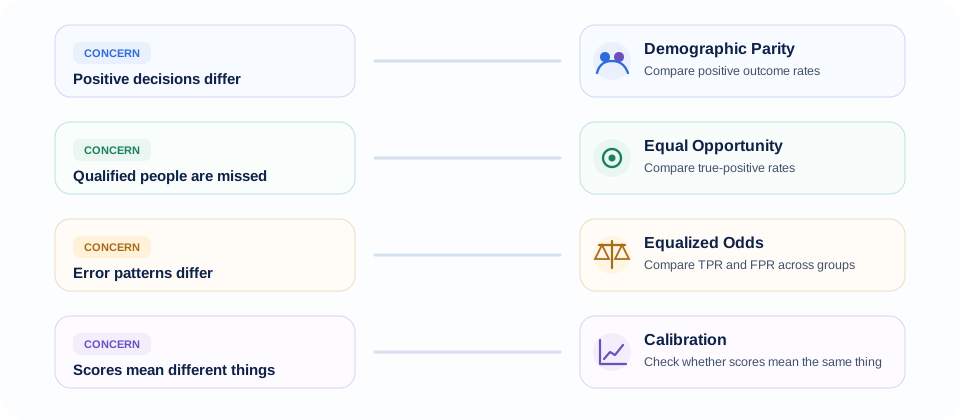
Different fairness questions require different measures. Choose the metric after defining the decision risk and the harm you need to detect.
Fairlearn's guidance makes the key point: a fairness measure being widely used does not automatically make it appropriate for a particular application.
Use the Four-Fifths Rule Carefully
Employment audits often compare selection rates through an impact ratio. If Group A is selected at 50% and Group B at 35%, the impact ratio is 35 ÷ 50 = 0.70.
Under the Uniform Guidelines on Employee Selection Procedures, a selection rate below four-fifths of the highest group's rate can indicate potential adverse impact during initial screening. However, the EEOC describes the four-fifths test as a rule of thumb, not a universal legal definition.
Why Toolkit Defaults Can Be Misleading
Aequitas uses a 0.8–1.25 fairness band and can classify disparity measures inside that range as fair. Its documentation applies the same threshold framework across disparity measures, including false-positive-rate disparities. Watkins, McKenna, and Chen criticize this portability beyond the employment-selection context. They contrast Aequitas with Fairlearn, which deliberately avoids supplying default fairness thresholds.
A default parameter can quietly become policy. A dashboard threshold is not automatically a regulatory threshold, and a software default is not automatically your risk tolerance.
- Passing 0.80 does not establish overall fairness
- Failing 0.80 does not establish unlawful discrimination
- Error-rate bands are not automatically legal standards
- Document the purpose of every threshold
Test Statistical Reliability
Fairness metrics need statistical context. A point estimate can look alarming while the available evidence is too weak to support a decision.
| Group | Impact Ratio | Cell Size | 95% CI | Audit Treatment |
|---|---|---|---|---|
| A | 0.94 | 2,400 | 0.91–0.97 | Normal review |
| B | 0.82 | 1,150 | 0.79–0.85 | Investigate |
| C | 0.74 | 18 | 0.49–0.97 | Insufficient evidence |
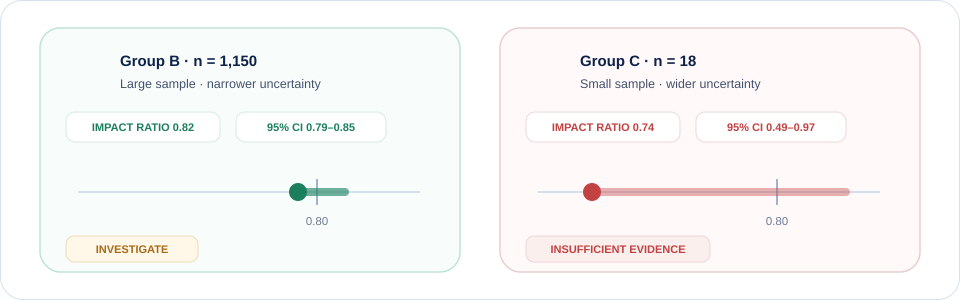
A low point estimate is not automatically decision-grade evidence. The width of the interval and the underlying cell size determine how confidently the audit can act.
Group C should not be treated as a confirmed fairness failure. Its sample falls below the predeclared minimum and its confidence interval is wide. The proper action is to collect more evidence rather than change the model based on an unstable result.
- Cell and subgroup sample size
- Confidence intervals
- Effect size
- Statistical significance where appropriate
- Practical significance
- Stability across evaluation periods
- Threshold sensitivity
- Number of comparisons performed
Account for Multiple Comparisons
Testing many groups and metrics creates a multiple-comparisons problem. With enough independent tests, some apparent disparities will occur by chance.
A defensible audit can manage this by:
- Pre-specifying confirmatory groups and metrics
- Separating exploratory and formal findings
- Applying family-wise error controls
- Using false-discovery-rate procedures
- Using simultaneous confidence intervals
- Confirming newly discovered subgroup issues
Research by Cherian and Candès treats fairness auditing as a multiple-hypothesis-testing problem and develops simultaneous statistical bounds for evaluating many subgroups while controlling false findings.
The more groups you search, the more clearly you should distinguish discovery from confirmation.
Preserve AI Bias Audit Evidence
Strong AI bias audit evidence should let another reviewer understand and reproduce the assessment.
System Evidence
System purpose, model identifier and version, decision threshold, and deployment environment.
Data Evidence
Dataset version, provenance, evaluation period, population, subgroup counts, exclusions, and limitations.
Testing Evidence
Metric definitions, thresholds, sample rules, statistical methods, confidence intervals, code version, and results.
Decision Evidence
Severity, root cause, mitigation, alternatives, retest result, residual risk, reviewer, approval, and monitoring trigger.
Decision evidence is especially important. Recording what the team found without recording what it decided makes it difficult to distinguish an accepted trade-off from an overlooked problem.
Mapping Bias-Audit Evidence to EU AI Act Annex IV
For high-risk systems, these artifacts can also support Annex IV technical documentation.
| Bias-Audit Evidence | Annex IV |
|---|---|
| Intended purpose and system version | 1(a) |
| Software and version dependencies | 1(b)–1(c) |
| Development methods and model choices | 2(a)–2(c) |
| Dataset provenance, selection, labelling | 2(d) |
| Human oversight measures | 2(e) |
| Predetermined model changes | 2(f) |
| Validation data, metrics and discriminatory-impact testing | 2(g) |
| Test logs and signed test reports | 2(g) |
| Group-specific limitations and discrimination risks | 3 |
| Why chosen performance metrics are appropriate | 4 |
| Risk-management documentation | 5 |
| Lifecycle changes | 6 |
| Post-market monitoring plan | 9 |
What Happens When a Bias Test Fails?
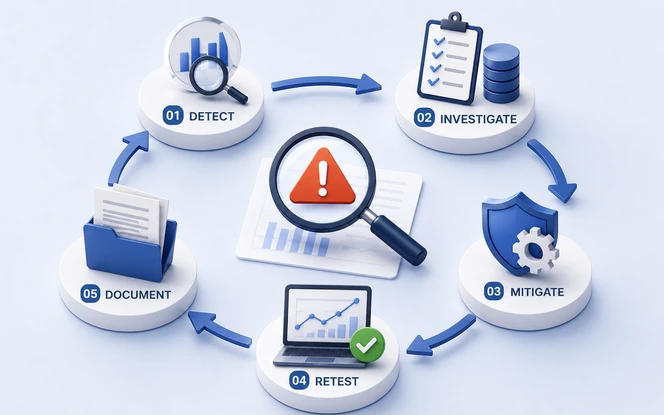
A failed test should trigger investigation before teams change the model.
Detect
Identify the disparity and preserve the test evidence.
Investigate
Check data representation, labels, proxies, thresholds, architecture, and human review behavior.
Mitigate
Apply data, model, threshold, workflow, or human-review changes appropriate to the root cause.
Retest
Re-evaluate fairness and operational performance because improving one metric can worsen another.
Document
Record the action, alternatives considered, residual risk, approval, and monitoring trigger.
A finding should remain open until mitigation has been tested again.
Continuous Bias Testing After Deployment
A model that passes its initial audit may not remain within the same fairness profile. Populations change, data shifts, thresholds move, models are retrained, and reviewers change how they use recommendations.
Trigger a New Assessment When
- A model version changes
- Retraining or fine-tuning occurs
- Training data changes materially
- A decision threshold changes
- Population drift crosses a limit
- Subgroup representation changes
- A new market is introduced
- A fairness metric crosses a warning level
- Human override patterns change
- A vendor updates a third-party model
- A bias complaint or incident occurs
- Business rules affecting decisions change
AI vendor risk assessments deserve particular attention. AI RFP requirements should include material-change notifications, and organizations should maintain enough monitoring to detect important changes if notification fails.
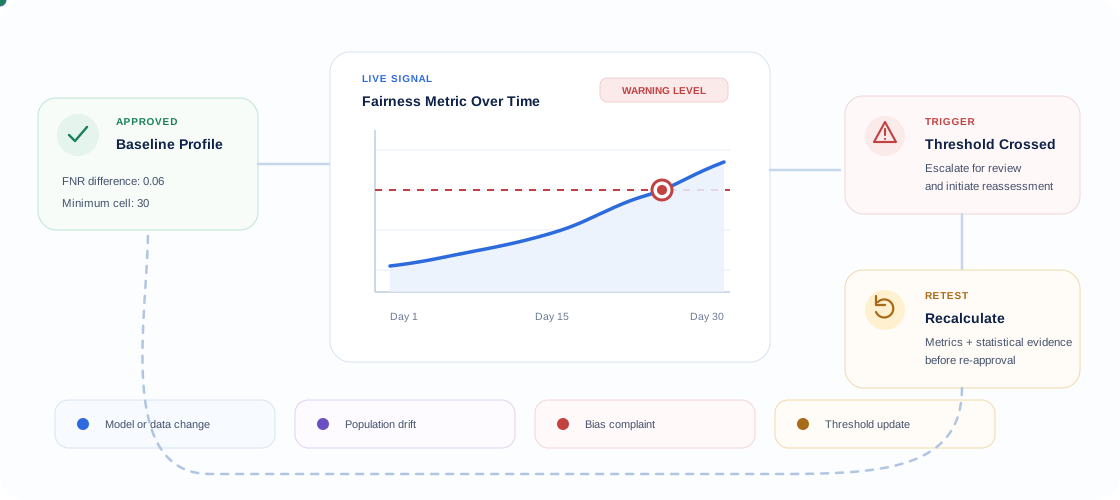
Scheduled reviews provide a baseline cadence, while model, data, threshold, population, vendor, or incident changes should trigger additional testing.
Recommended Audit Cadence
| Tier | Example Systems | Monitoring | Formal Review |
|---|---|---|---|
| Tier 1: Critical | Hiring, credit, healthcare eligibility | Continuous/weekly signals + monthly review | Quarterly |
| Tier 2: Material | Employee scoring, insurance recommendations, fraud actions | Monthly | Every 6 months |
| Tier 3: Lower Materiality | Advisory systems with limited direct impact | Quarterly | Annually |
These are Shadow AI governance recommendations, not statutory deadlines. Where a law establishes a required audit interval, that requirement takes priority. Material model, data, threshold, or population changes should also trigger testing regardless of schedule.
Monitoring Configuration
| Field | Example |
|---|---|
| Metric | False-negative-rate difference |
| Groups | Group A vs Group B |
| Baseline | Approved audit result |
| Warning level | Internal tolerance |
| Critical level | Escalation threshold |
| Window | Rolling 30 days |
| Minimum cell | 30 per outcome cell |
| Owner | AI Risk Team |
| Action | Review, restrict, or escalate |
Continuous fairness monitoring should answer two questions: has fairness changed, and is there enough evidence to interpret the change? If the sample falls below the minimum, display insufficient evidence, not “pass.”
Independent Review
The team that built a model should not always be the only team evaluating whether its fairness evidence is acceptable.
- Audit scope
- Metric selection
- Group coverage
- Data quality
- Threshold rationale
- Statistical methods
- Mitigation choices
- Residual risk
For high-consequence systems, reviewers may include model-risk specialists, compliance teams, legal teams, domain experts, independent auditors, or other relevant stakeholders. Some jurisdictions require independence directly; New York City's Local Law 144 guidance is one example.
AI Bias Audit Checklist
- Decision and affected population are defined
- Potential harms are documented
- Evaluation data reflects deployment context
- Relevant protected groups are tested
- Intersectional groups are considered
- Minimum cell-size rules are set in advance
- Metrics correspond to identified harms
- Statistical uncertainty is evaluated
- Multiple comparisons are addressed
- Model and dataset versions are traceable
- Thresholds are documented
- Failed tests trigger investigation
- Mitigation is retested
- Residual risk is recorded
- Monitoring limits are defined
- A cadence tier is assigned
- Statutory audit requirements are identified
- Event-triggered testing conditions are documented
- Another reviewer can reproduce the findings
Common AI Bias Audit Mistakes
Using One Metric as Proof
A system can pass demographic parity while producing unequal false-positive or false-negative rates.
Ignoring Intersectional Groups
Broad demographic categories can hide meaningful disparities affecting smaller populations.
Changing Sample Rules Late
Evidence requirements should be established before testing, not after an unfavorable result appears.
Treating 0.80 as Universal
The four-fifths rule is an employment-selection rule of thumb, not a universal definition of AI fairness.
Using Toolkit Defaults as Policy
Software calculates metrics; it cannot decide which threshold is legally or operationally appropriate for your use case.
Ignoring Multiple Comparisons
Running many subgroup tests without controls increases the likelihood of false findings.
Testing Only Before Deployment
Fairness evidence can become stale when models, populations, data, or workflows change.
Failing to Preserve Evidence
Without versions, datasets, methods, and decisions, teams may be unable to reproduce their own audit.
Build a Defensible AI Bias Audit Process
Connect decision risk, fairness metrics, statistical evidence, audit records, mitigation, and continuous monitoring into one repeatable governance workflow.
Talk to our AI teamFinal Thoughts
An effective AI bias audit framework should answer five questions: who could be harmed, which metric measures that harm, whether the evidence is strong enough to support the conclusion, what documentation proves what was tested and decided, and what will trigger the next test.
Start with the decision rather than the metric. Test relevant and intersectional groups, define minimum evidence rules in advance, and select AI fairness metrics that correspond to the identified harm. Then preserve reproducible AI bias audit evidence, validate mitigation, and connect the assessment to continuous fairness monitoring.
For high-risk AI, fairness is not a one-time score. It is an ongoing assurance process that should evolve with the system, its data, its operating environment, and the people affected by its decisions.
Frequently Asked Questions
What Metrics Are Used in an AI Bias Audit?
Common metrics include demographic parity, equal opportunity, equalized odds, calibration, impact ratios, false-positive rates, and false-negative rates.
What Minimum Sample Size Should an AI Bias Audit Use?
There is no universal legal minimum. A practical internal starting point may be 30 observations per subgroup-outcome cell, with smaller cells classified as insufficient evidence rather than pass or fail.
Is the Four-Fifths Rule a Fairness Threshold?
No. The EEOC describes it as a rule of thumb for adverse-impact analysis in employment selection. Sample size, statistical significance, practical significance, and other evidence can affect interpretation.
Did the EU AI Act Delay Remove the Need to Audit?
No. Annex III high-risk requirements moved to 2 December 2027 and Annex I product-related requirements to 2 August 2028, but other AI Act obligations have already started applying. Requirements outside the EU were not affected.
How Often Should AI Bias Audits Be Performed?
Use risk-based review intervals rather than one cadence for every system. Critical systems may require quarterly formal reviews with more frequent monitoring, while lower-materiality systems may use annual reviews. Material changes should trigger additional testing regardless of schedule.
Why Do Multiple Comparisons Matter?
When many groups and metrics are tested, some apparent disparities can occur by chance. Audits should distinguish exploratory analysis from confirmatory findings and use appropriate statistical controls.
How Does Bias-Audit Evidence Support EU AI Act Documentation?
Annex IV requires information about system versions, data provenance, validation, discriminatory-impact testing, metrics, test logs, group-specific performance, risk management, lifecycle changes, and post-market monitoring. Structured bias-audit evidence can support many of these documentation requirements.