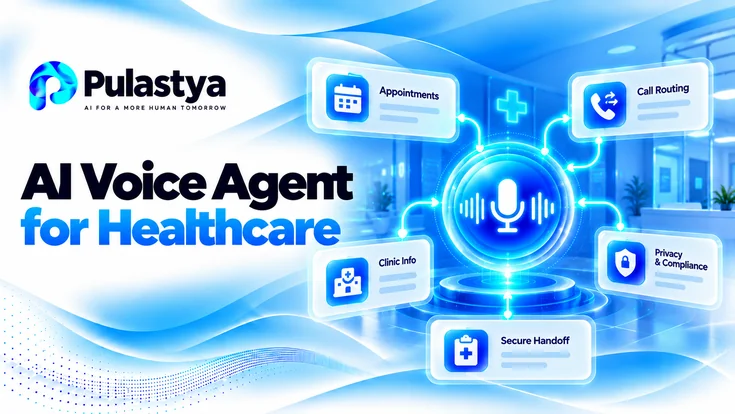
An AI voice agent for healthcare is software that answers routine calls to clinics and medical practices, handles appointment enquiries, office information and call routing, and transfers clinical or urgent calls to staff.
It is for practice managers and operations leaders whose front desks are tied up by repeat, non-clinical phone requests.
- Administrative calls only Appointments, hours, directions and approved practice information form the core scope of the agent.
- Emergencies follow policy Urgent or clinical calls follow the organization's emergency and clinical policies, never the AI's own judgment.
- Context at handoff Staff receive the caller's reason for calling and captured details, so patients do not repeat themselves.
The practical outcome is that patients get routine answers and appointment requests handled without waiting on hold, while front-desk staff spend their phone time on calls that need a person. The design goal is that calls about symptoms, medication or urgent concerns always go to people qualified to respond.
A healthcare deployment is defined as much by what the agent refuses to do as by what it automates. Set those boundaries first, because appointment, information and routing workflows, handoff context, reminders and data decisions all depend on them.
Which Healthcare Calls an AI Voice Agent Can Handle
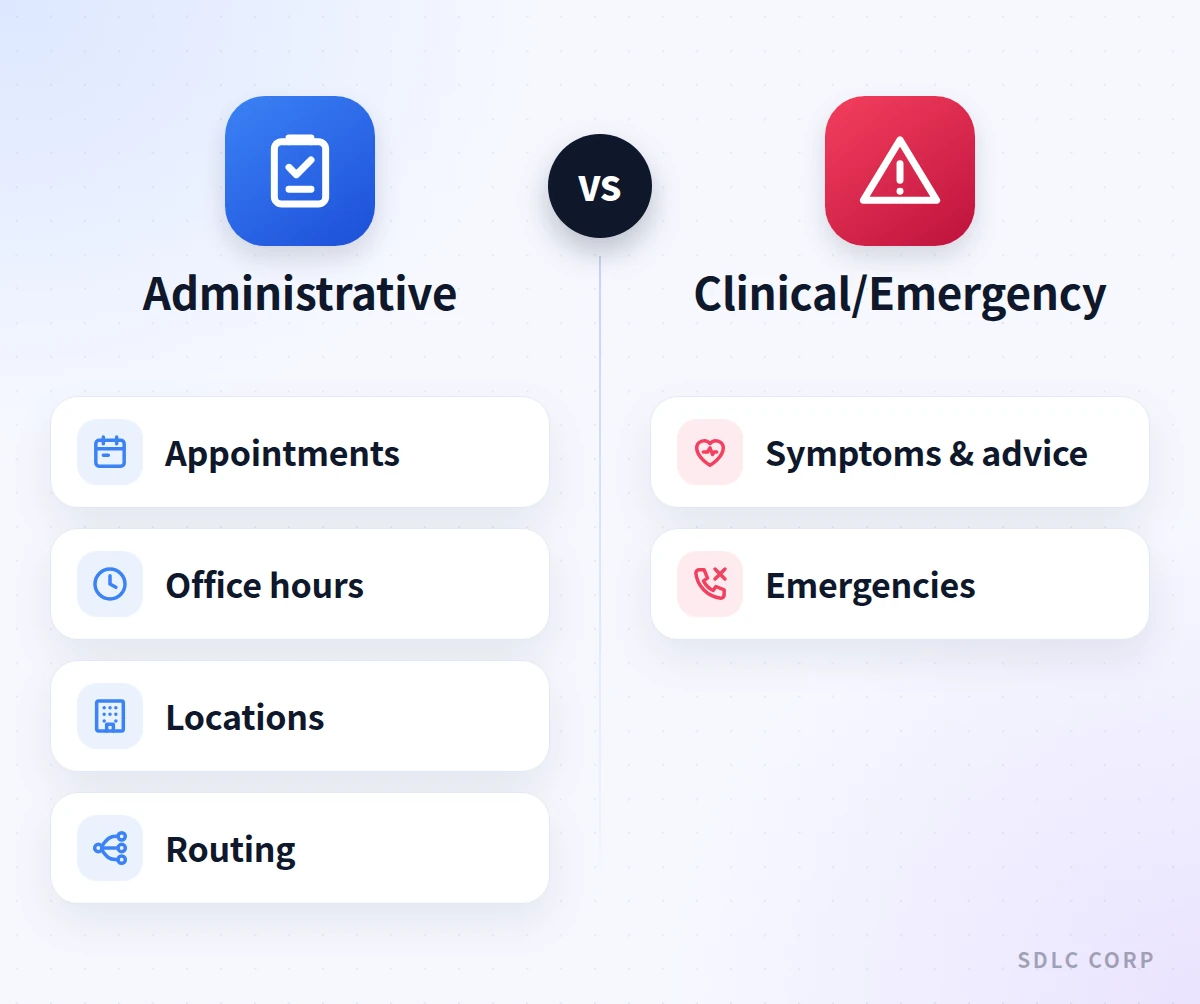
An AI voice agent can handle the administrative calls a practice receives every day: appointment requests, changes and cancellations, opening hours, locations, parking, what to bring and which team handles a request. It should not assess symptoms, give medical advice or decide whether a situation is urgent.
Much of this work matches the front-desk role described in the guide to the AI receptionist for business calls. Healthcare adds two requirements: a stricter boundary around clinical content, and more care about what information is captured and who can see it.
That pattern is not unique to medicine: how the same call patterns appear in other industries shows the same administrative core with a different boundary drawn around it in each one.
The scope that works in practice is narrow and stated in advance: appointment requests and changes, opening times, locations and access details, the published insurance list and general practice policies. What makes those answers safe is not the model, it is the source.
Answers should be grounded in the practice's own approved content rather than general model recall, so a caller hears what the practice actually publishes and a manager can point to the document behind any answer.
Everything outside that scope has two honest endings, capture for staff to action or transfer to a person, and both should leave a transcript and a call summary behind so the practice can audit what the agent said.
| Call type | Example request | Default action |
|---|---|---|
| New appointment | I need a follow-up visit next week | Capture the request, or book if integrated |
| Reschedule or cancel | I cannot make my Thursday appointment | Capture the change, or update if integrated |
| Practice information | Are you open Saturday, and where do I park? | Answer from approved content |
| Billing and insurance | Do you accept my insurance plan? | Share the published plan list, route specifics to billing |
| Prescriptions and results | Are my test results back yet? | Capture and route to clinical staff |
| Symptoms or urgent concerns | I have had chest pain since this morning | Follow the emergency and clinical policy |
How it works
How a Healthcare Call Is Handled
- Patient callPractice number connects the caller
- Greeting with emergency noticeTells callers what to do first
- Identify requestAppointment, information, billing or clinical
- Apply practice rulesApproved content and clinical triggers
Possible outcomes
- AnswerHours, locations and published policies
- Capture requestAppointment details for staff follow-up
- Transfer to staffClinical or urgent, per policy
Emergency instructions come first and clinical topics always route to people, so the AI only resolves administrative requests.
Emergency and Clinical Boundaries to Set First
An AI voice agent must not handle medical emergencies or make clinical decisions. When a caller describes a possible emergency, the agent should follow the organization's written emergency policy without trying to assess the situation. That policy usually means directing the caller to local emergency services or connecting them to staff immediately.
AI voice agents must not replace emergency response, triage or clinical decision processes. Diagnosis and emergency support sit outside what any voice agent should be asked to do, and a vendor whose own documentation does not state that limit plainly is a vendor to question before it answers a patient line.
Intent detection will not catch every urgent call, because callers describe problems in unpredictable ways and often mention them late in the conversation. Practices should therefore layer several safeguards instead of relying on detection alone.
- An approved greeting that tells callers what to do in an emergency before the conversation starts.
- Conservative escalation triggers, so mentions of symptoms, pain, injury, medication reactions or distress go to people or emergency instructions.
- No symptom questions, advice or reassurance from the AI, even when the caller asks directly.
- A staffed destination, or clear emergency instructions, whenever a transfer cannot connect.
- Clinical review of escalation wording and triggers before launch and after every change.
Escalation design for high-stakes conversations is covered in more depth in handling sensitive calls with AI voice agents. In healthcare, clinical leadership should own these rules, with the operations team responsible for implementing and testing them.
Appointment Enquiries, Scheduling and Changes
An AI voice agent handles appointment calls by identifying whether the caller wants a new appointment, a change or a cancellation, collecting the details scheduling staff need, and confirming what happens next. These calls are a natural starting point because they follow a predictable pattern.
Whether the agent can confirm a time depends on access to the practice's scheduling system. With an integration, it can offer times within the rules the practice sets. Without one, it captures preferred times and contact details for staff to confirm. The guide to AI appointment scheduling for business calls explains both patterns.
- Caller name and callback number, read back to confirm accuracy.
- Whether the caller is a new or existing patient, and any preferred clinician or location.
- The type of visit in the caller's own words, without asking for clinical detail.
- Preferred days and times, plus accessibility or interpreter needs.
- For changes and cancellations, which existing appointment the caller means.
Where no scheduling integration exists, capture is the honest default rather than a shortfall. The agent collects the details above, tells the caller exactly who will confirm and roughly when, and passes the request to the scheduling desk with the conversation context attached so nobody has to call the patient back for basics.
A practice that wants times confirmed live on the call should treat calendar access as a separate procurement question, ask any vendor which scheduling systems it writes to and under what booking rules, and get the answer in writing before designing a script around a confirmation the agent may not be able to give.
Office Hours, Locations and Approved Practice Information
An AI voice agent answers general practice questions from content the practice has approved, such as hours, holiday closures, locations, parking and new patient instructions. It should not answer from general internet knowledge, and it should tell the caller when a question is not covered.
- Hours by location, including holiday closures and after-hours instructions.
- Directions, parking and accessibility information for each site.
- New patient paperwork and what to bring to a first visit.
- The published list of accepted insurance plans and billing contact options.
- Practice policies, such as late arrival and cancellation rules.
Insurance questions need a clear line. The agent can repeat the practice's published list of accepted plans, but coverage for a specific treatment, expected costs and claim questions belong with billing staff who can check the details.
Two behaviors make this safe. Answers must come from the practice's own approved documents rather than model recall, which is what keeps a policy or insurance answer defensible when a patient repeats it back at the front desk.
The agent must be willing to say it does not have enough context and offer a transfer, because a confident wrong answer about a holiday closure or an accepted plan costs far more than an admitted gap.
Treat that approved content as a living set of documents with a named owner per item and a refresh step in the change process, so a new closing time reaches the phone line on the same day it reaches the website.
Billing and account calls often follow general support patterns rather than clinical ones. The guide to AI voice agents for customer support covers knowledge retrieval, service requests and escalation for those calls.
Routing Calls to the Right Desk or Clinical Team
An AI voice agent routes healthcare calls by matching the caller's request to destinations the practice defines, such as scheduling, billing, records, referrals or clinical staff. Routing for clinical topics should be fixed by rule: anything about symptoms, medication or results goes where the clinical policy says.
- Scheduling desk: appointment requests and changes that cannot be completed on the call.
- Billing: statements, payment questions and insurance specifics.
- Records and referrals: record requests, referral status and forms.
- Clinical staff: prescription refill requests, test result questions and symptom concerns, as the clinical policy defines.
- Failover: a staffed line that receives calls directly if the AI service is unavailable.
Two settings do most of the work in any implementation. The first is a human transfer destination that supports a warm handoff, such as a hunt group rather than a single extension, so a clinical transfer does not depend on one person being at their desk.
The second is a failover line that receives calls directly when the agent cannot continue.
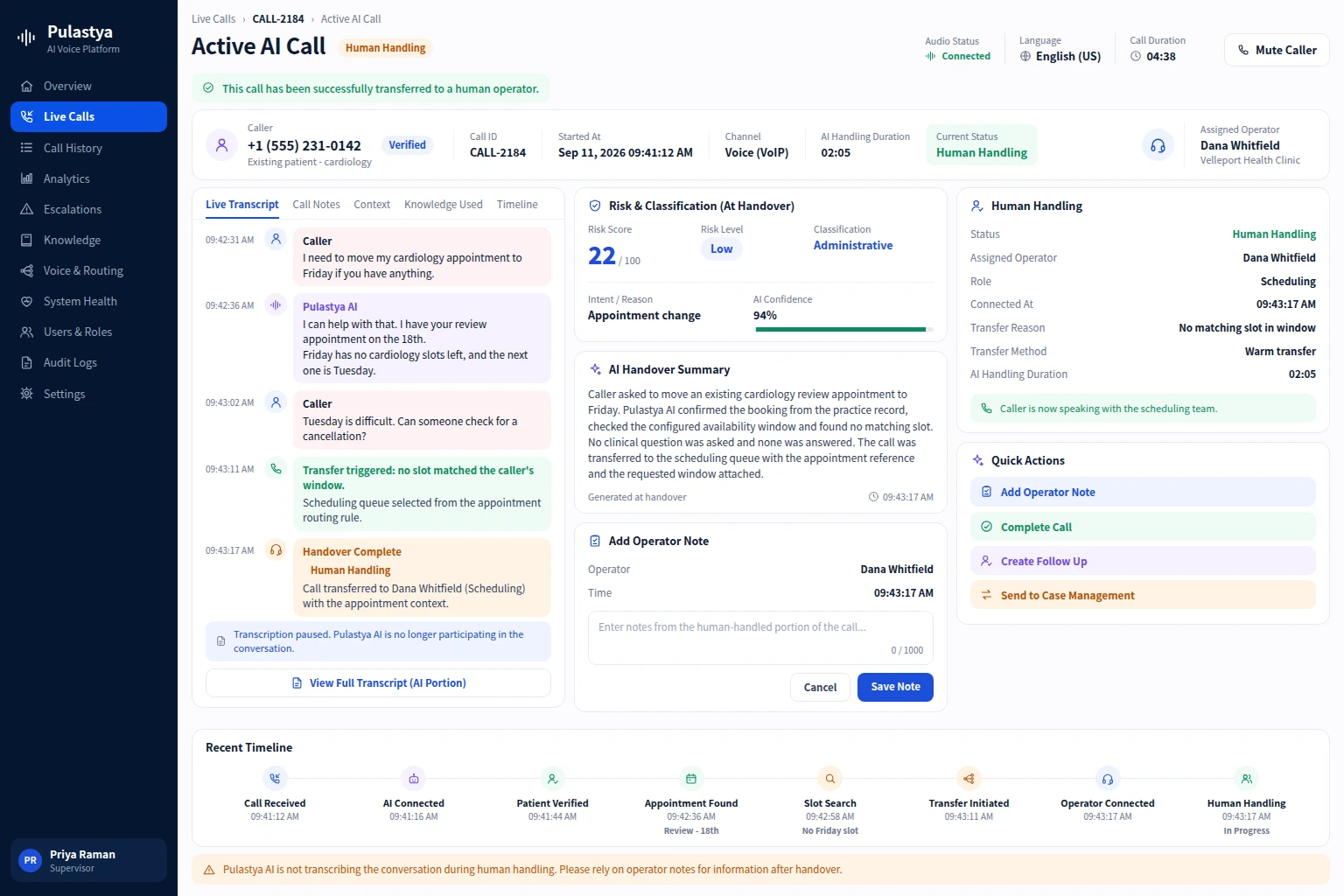
In Pulastya, both sit on the voice and routing screen shown above, alongside the intent classification that maps a caller to a defined call type before the routing rules decide where that type goes. Whichever tool a practice uses, the failover destination should be a line someone genuinely answers, tested by calling it.
Caller Context and Handoff to Staff
A good handoff passes the caller's reason for calling and the details already collected, so staff continue the conversation instead of restarting it. In healthcare, the context should be limited to what the receiving person needs to act, because transcripts and summaries may contain sensitive information.
- Caller name and callback number, as confirmed on the call.
- Request type and a short, neutral summary.
- The transfer reason, such as a clinical topic, a request for a person or low confidence.
- Anything the agent already told the caller, including emergency instructions.
Example scenario
Thank you for calling the family clinic. If this is a medical emergency, please hang up and call your local emergency number. How can I help today?
I need to move my appointment on Thursday. Something came up at work.
I can take that request. Can I have your full name and the best number to reach you?
Dana Ruiz, and this number is fine. Also, I have been feeling dizzy since yesterday. Should I be worried?
I am not able to advise on symptoms, so I want you to speak with someone who can. If this could be an emergency, hang up and call your local emergency number now. Otherwise, I can connect you to our nursing staff now.
Please connect me.
Connecting you now. I will pass on your reschedule request and what you told me, so you do not need to repeat it.
The agent captured the routine request, declined to assess the symptom, repeated the emergency instruction and transferred with context. The practice's clinical policy, not the AI, decides where that transfer goes and who takes it.
A voice agent should hand off with the conversation context and a call summary attached, so the patient is not asked to repeat to a person what they already said to a machine.
In healthcare that summary should be neutral and minimal: enough for the receiving member of staff to act, and no more clinical detail than the caller volunteered unprompted. For the wider rules on when a transfer should happen at all, see when AI voice agents should transfer calls.
Appointment Reminders and Other Outbound Patterns
AI voice agents can also place outbound healthcare calls, such as appointment reminders, confirmations or recall notices. Placing the call is the easy part; the constraints around it are not.
Consent, calling hours and message content rules all govern what a reminder may say and when it may be dialed, and in healthcare the content rule is the strict one, because the bare fact of an appointment at a named practice can itself disclose something about the patient.
Reminder work is also where voice products differ most from one another. How a patient list is loaded and protected, which calling windows can be enforced, how many retries are allowed and how an opt-out is recorded are all worth confirming in writing with any vendor during evaluation, rather than assuming a feature exists because the product places outbound calls.
- Confirm the patient agreed to receive automated calls, and honor opt-out requests immediately.
- Keep messages minimal: practice name, appointment time and a callback number, without the reason for the visit.
- Assume a voicemail box or another household member may hear the message.
- Send replies that raise clinical questions to staff rather than handling them inside the reminder flow.
The controls behind outbound calling, including calling windows, retry limits and opt-out handling, are summarized in the overview of outbound AI calling controls. Healthcare reminder campaigns should apply those controls with the practice's privacy rules layered on top.
Privacy, Call Data and Questions to Ask Vendors
Healthcare organizations are responsible for determining which privacy and health data regulations apply to their phone workflows, and for confirming that any AI voice vendor meets those requirements. Treat vendor security statements as items to verify in documentation and contracts, not as assumptions.
- Where call recordings, transcripts and summaries are stored, and for how long.
- Who can access call records, and whether that access is logged.
- Which third-party telephony and AI providers process call audio and text.
- Whether the vendor will sign the agreements your compliance team requires.
- How callers are told about recording, and how consent is captured.
Remember that a voice agent is rarely one vendor. Telephony, speech recognition, the language model and the transcript store may each sit with a different provider, so a review has to follow the call audio and the text it becomes across every party that touches them rather than stopping at the name on the contract.
Where patient information is involved, the usual expectation is a written agreement with each processor, a defined retention period, access that is restricted and logged, and a current list of subprocessors.
Which regulation applies to a given workflow, and whether a given vendor satisfies it, is a determination for the practice's compliance and legal advisors, not something to infer from marketing copy. The practice remains responsible for call consent and local recording requirements whatever the stack underneath looks like. Wider controls are covered in AI voice agent security and privacy.
Decision guide
Healthcare Voice Agent Launch Decisions
| Area | Decision to make | Typical owner |
|---|---|---|
| Emergency handling | Greeting wording and escalation triggers | Clinical leadership |
| Clinical topics | Which topics always transfer, and where | Clinical leadership |
| Scheduling | Capture requests or book through an integration | Practice operations |
| Practice information | Approved documents and who updates them | Front-desk manager |
| Call data | Retention, access and provider agreements | Compliance and IT |
Assigning each boundary decision to a named owner before launch keeps clinical and privacy choices with the people accountable for them.
How to Launch an AI Voice Agent in a Practice
Launch with a narrow administrative scope, clinical sign-off on the boundaries and a review routine that catches problems early. Expanding scope later is far easier than rebuilding patient trust after a poorly handled call.
- Map call reasonsUse front-desk logs to list the most common call types and mark which ones are clinical.
- Write the boundariesAgree emergency wording, clinical transfer triggers and the failover line with clinical leadership.
- Prepare approved contentUpload hours, locations, policies and published insurance information, each with a named owner.
- Test difficult callsInclude symptom mentions, distressed callers, interruptions and requests to speak with a person.
- Review transcriptsCheck escalations, missed intents and unanswered questions, then adjust rules and content.
Rehearse the difficult calls before any patient hears the agent. A browser-based test call is the cheapest way to hear the emergency wording out loud and catch a script that reads well on paper but sounds wrong at the start of a worried call.
Pulastya, the voice agent platform built and supported by SDLC Corp, includes that browser test call, and its document-grounded answers, routing and transfer settings can be reviewed on the AI voice agent platform page or walked through in a live call demonstration.
Conclusion
An AI voice agent for healthcare can help medical practices manage routine calls, appointment requests, office information and routing while freeing front-desk teams to focus on patients who need personal assistance.
The most effective deployments begin with a clearly defined administrative scope, approved practice information, reliable scheduling and human handoffs, and safeguards for patient privacy. Clinical questions and emergencies must always follow the practice's established policies rather than the AI's own judgment.
Start with a small set of common call types, test difficult conversations and review outcomes regularly. With appropriate oversight, healthcare voice agents can improve access to routine services without replacing clinical expertise or human care.
Frequently Asked Questions
No. An AI voice agent should not assess or manage emergencies. It should follow the organization's emergency policy, which typically means telling the caller to contact local emergency services or connecting them to staff immediately. Emergency instructions in the greeting add a safeguard, because detection will not catch every urgent call.
It can book directly only when it has access to the practice's scheduling system and rules. Without that integration, it should capture the patient's details, visit type and preferred times, then tell the caller how staff will confirm. Integration options vary, so confirm them with any vendor before planning around direct booking.
It should not. A healthcare AI voice agent should decline symptom, medication and treatment questions and route them to clinical staff according to the practice's policy. It can answer administrative questions, such as hours, locations and published policies, from content the practice has approved.
Ask where recordings, transcripts and summaries are stored and for how long, who can access them, which telephony and AI providers process call data, and whether the vendor will sign the agreements your compliance team requires. Which regulations apply is a decision for your compliance and legal advisors.